

Straight answers on marine gear: what to fit, why, and where to get it.

Boat batteries and chargers, explained

Navigation lights and horns, explained
EPIRBs and PLBs, explained
Boat fire extinguishers, explained

Flares and distress signals, explained

Marine binoculars, explained

Boat compasses, explained

Marine toilets, explained
Bilge and freshwater pumps, explained
Life jackets (PFDs), explained
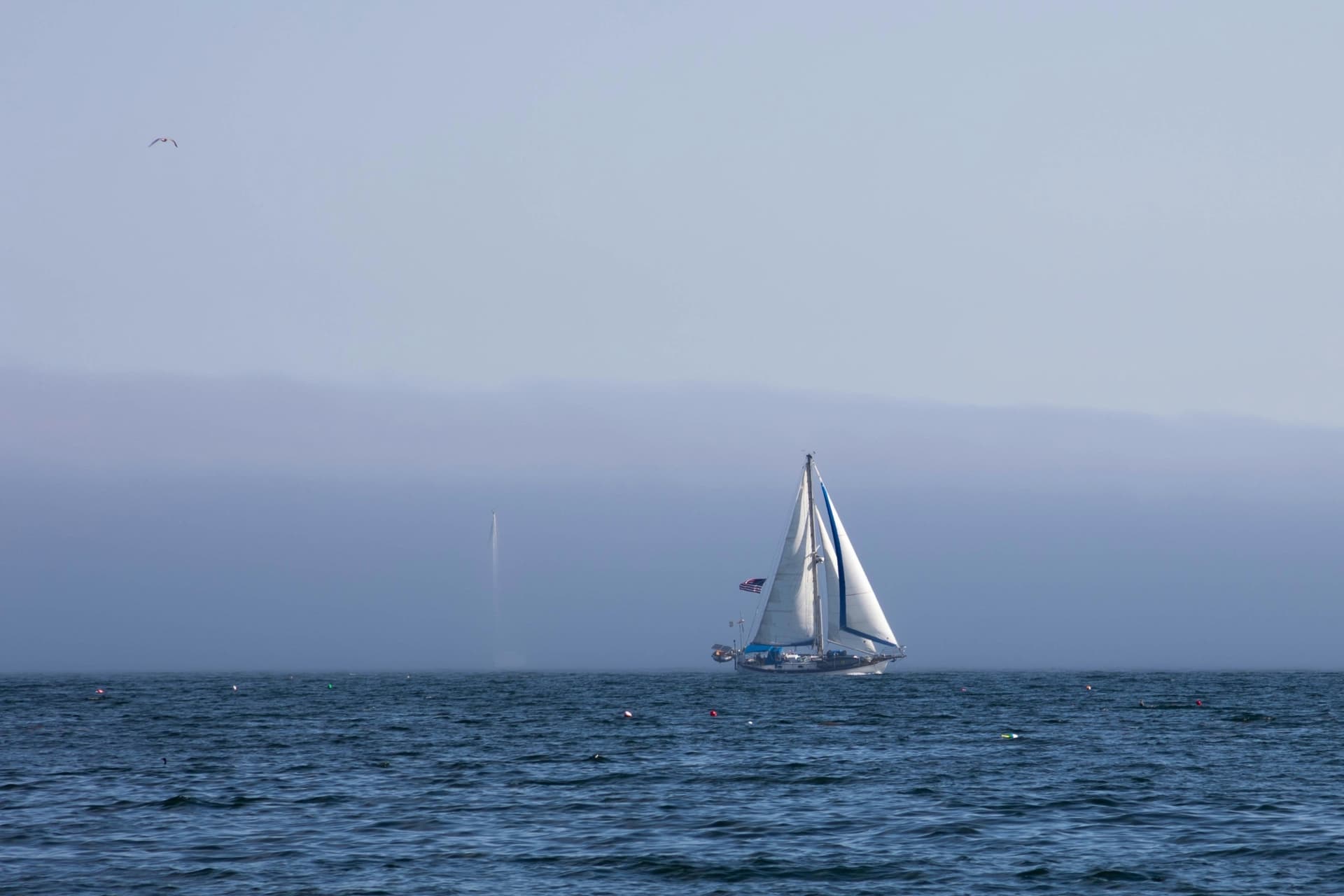
Boat autopilots, explained
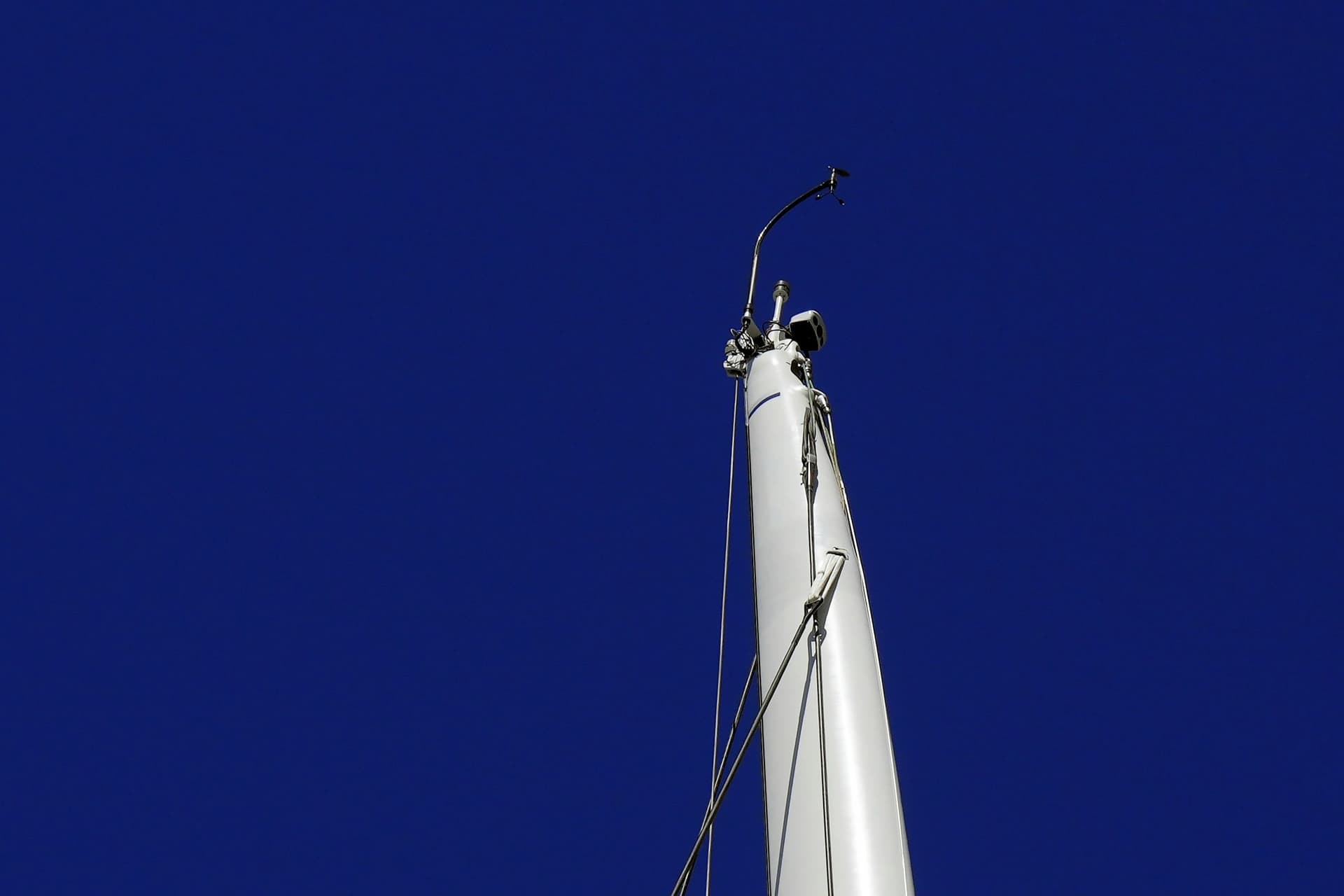
Wind, depth and speed sensors, explained
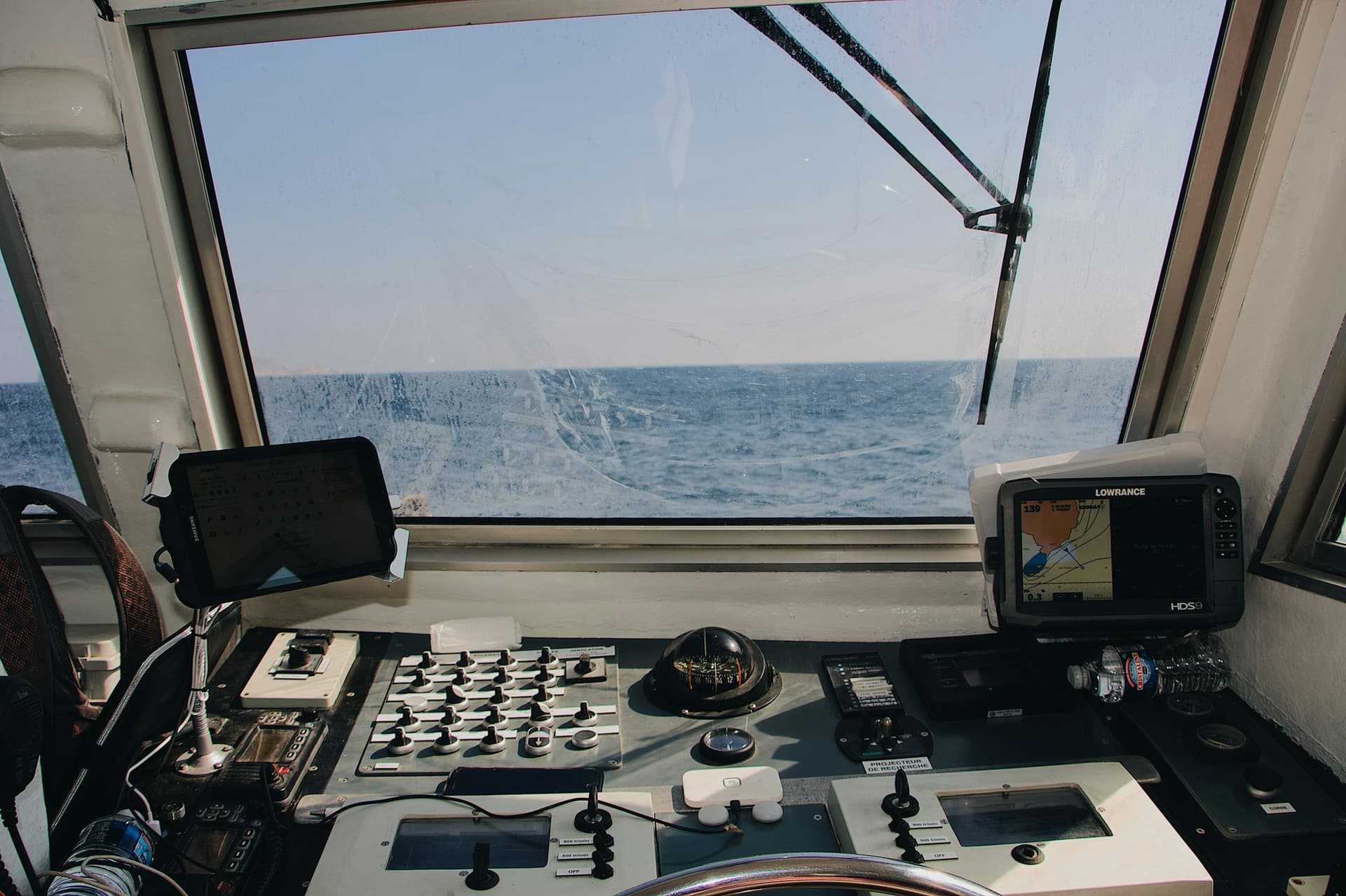
Chartplotters and instrument displays, explained

Diesel cabin heaters for boats, explained

Handheld VHF radios, explained
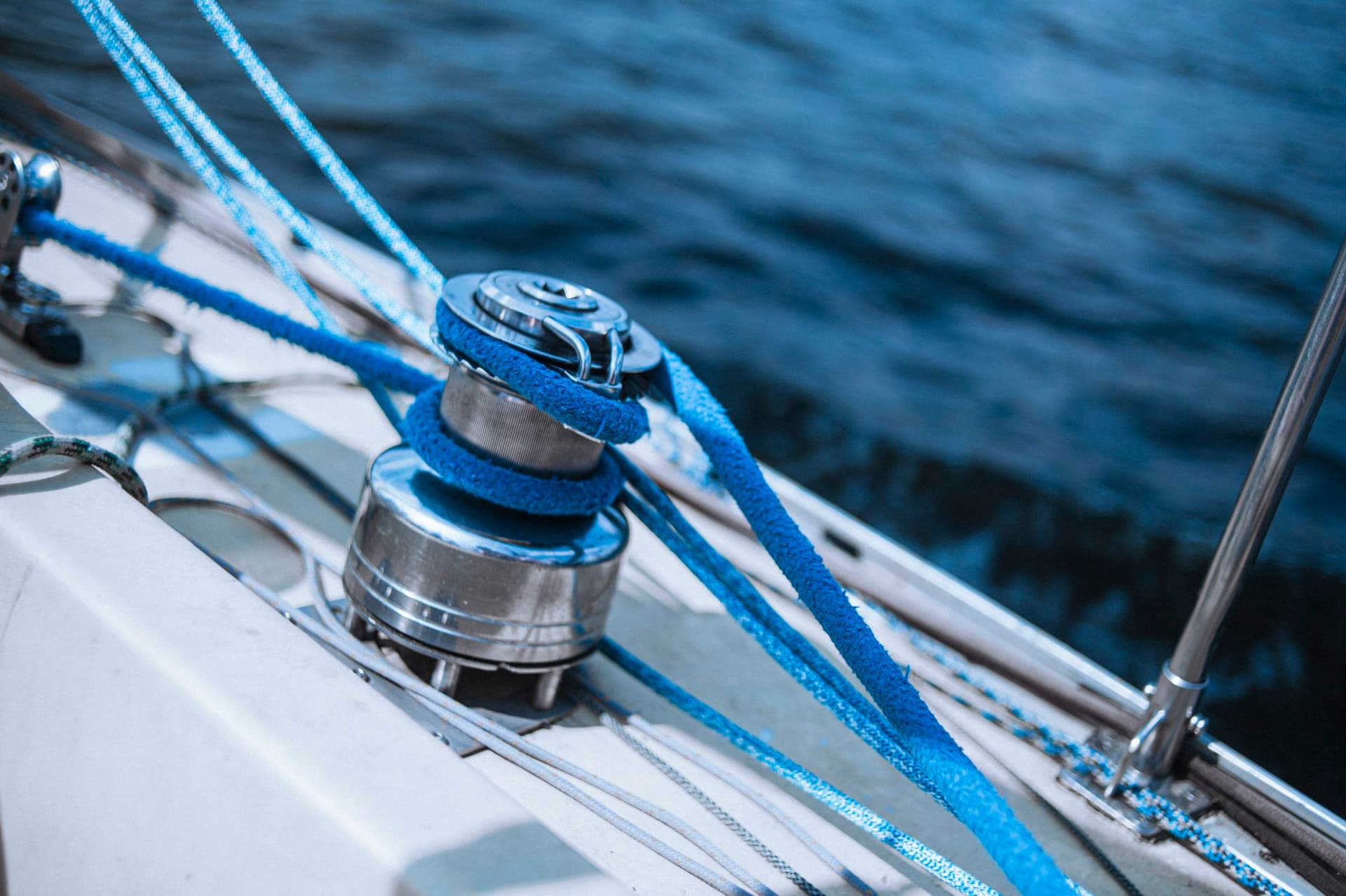
Sailboat winches, explained
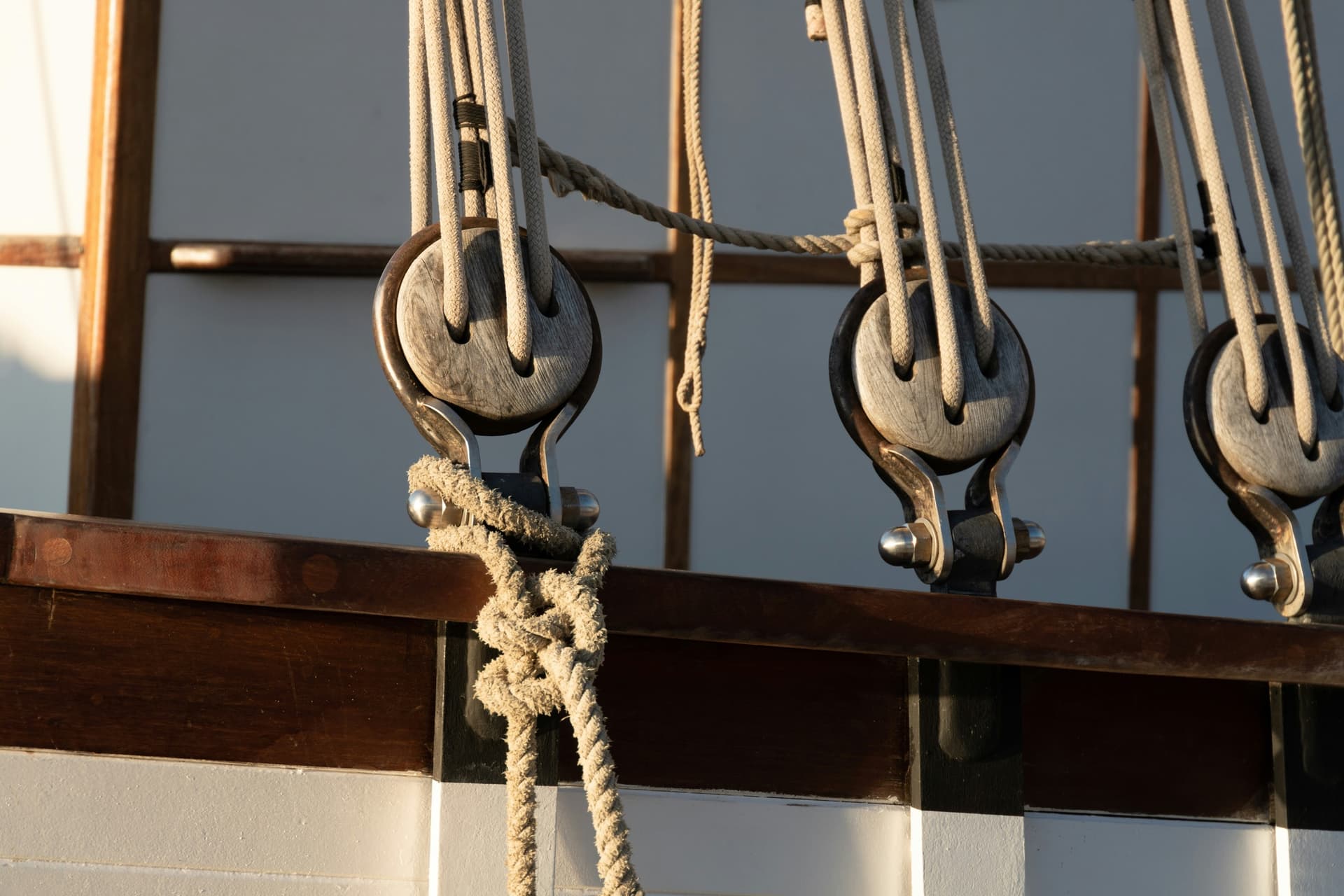
Sailboat block types, explained
Skipper’s Locker has changed. We’ve retired the peer-to-peer marketplace — no more listings, escrow or shipping. We now help you find the right marine part and send you straight to the retailer who stocks it. A full catalogue of thousands of products is on the way; below is a hand-picked start.
A short list to start with. Prices and stock live on Amazon, where you finish the purchase.
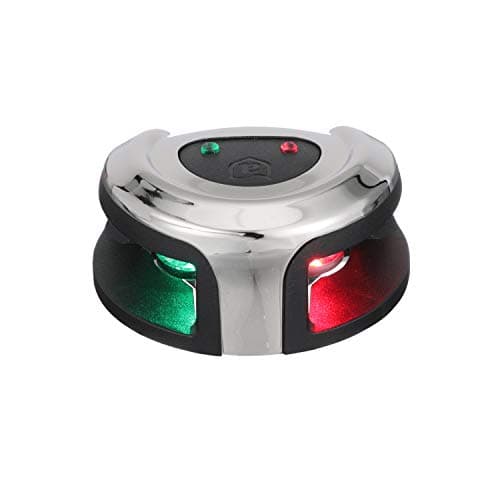
Attwood's round stainless bi-color deck-mount light (NV2002SS-7, the aftermarket version of NV2002SS-1), which its 2025 catalog lists as a 2-NM light for boats up to 65.6 ft (20 m). Inland Rule 21(b) lets a vessel under 20 m combine its sidelights in one lantern on the centerline (as nearly as practicable under 12 m). On a power-driven vessel under 12 m it pairs with the Rule 23(d) all-round white light, which Inland Annex I puts at least one meter higher than the sidelights.
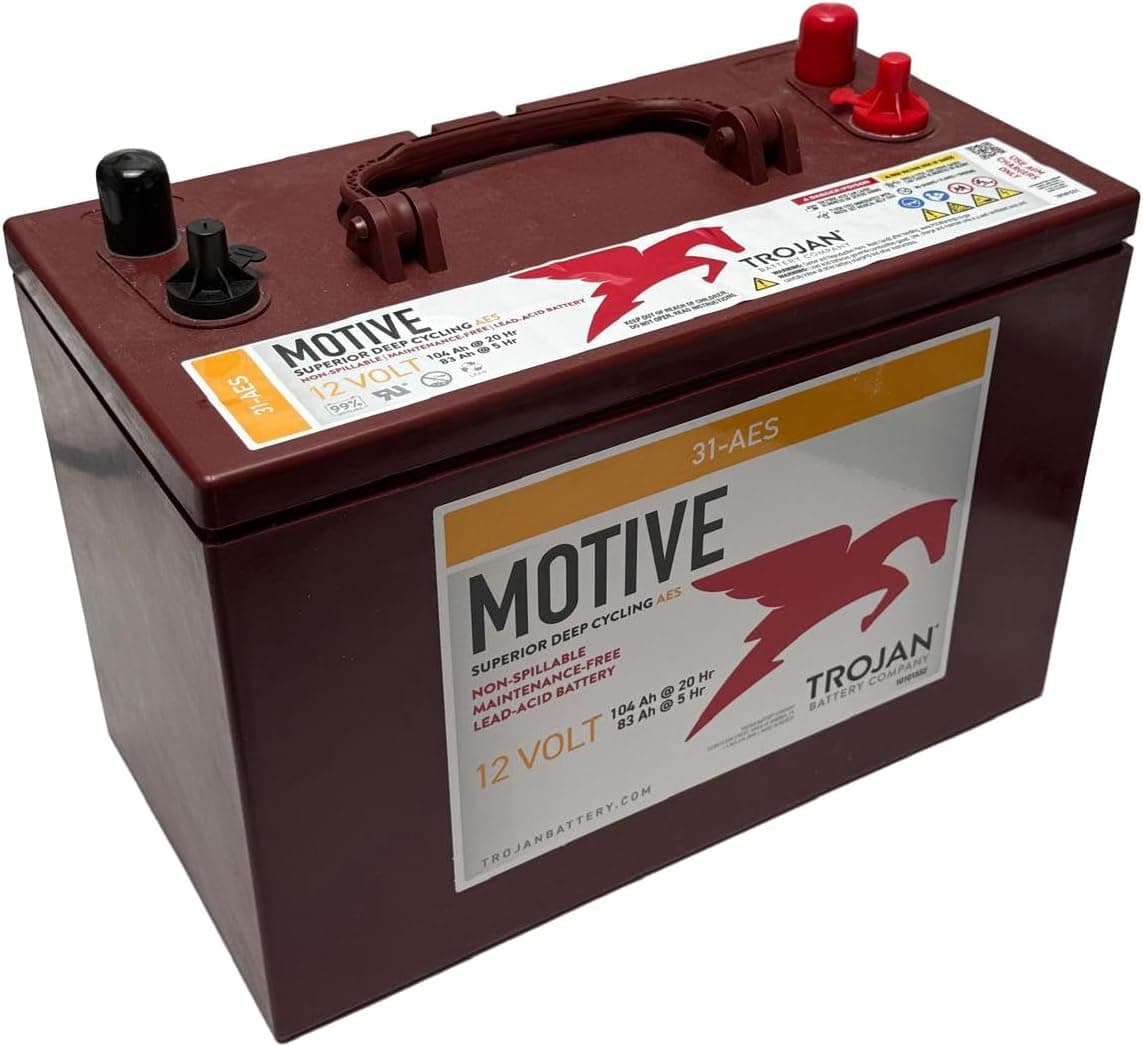
A valve-regulated AGM battery that Trojan makes in Groups 29 and 31; the listing's dimensions match the Group 31, which Trojan gives as 12.80 x 6.81 in and 69 lb, 9.37 in high in its group table and 9.43 in on its data sheet. Trojan's data sheet gives 104 Ah at the 20-hour rate (83 Ah at 5 hours), 540 CCA at 0°F and 178 minutes of reserve capacity, and charger settings at 77°F of 14.40 V absorption and 13.50 V float. Trojan says it can be installed horizontally or vertically and that no watering is required, and backs it with a 3-year warranty.
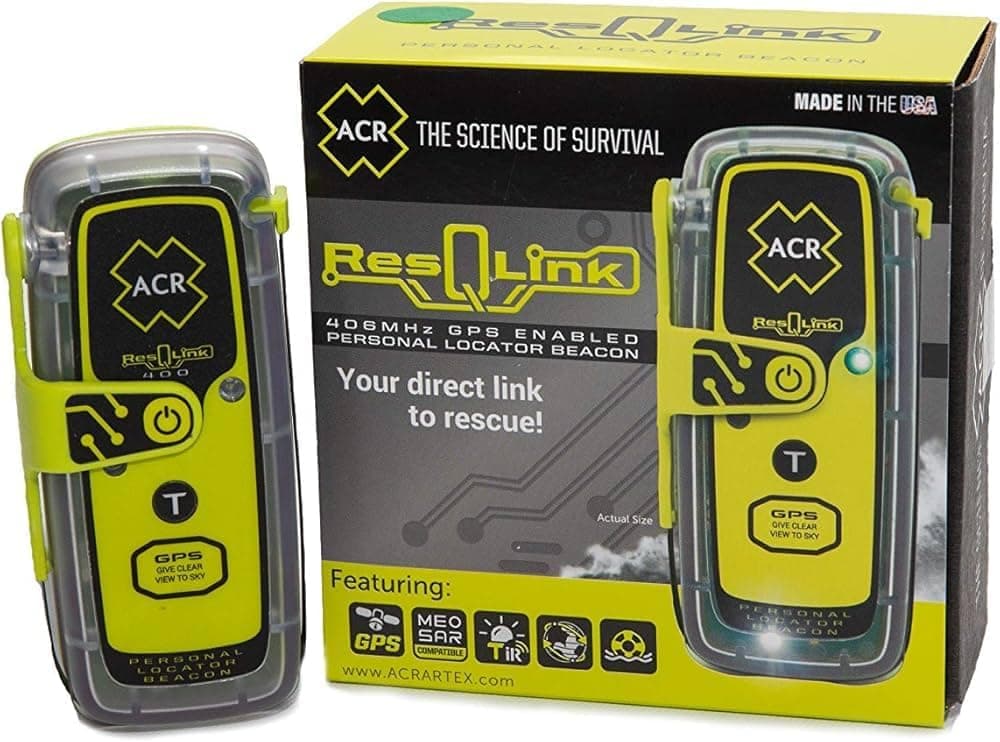
ACR's ResQLink 400 PLB (model PLB-400, US part 2921), with GPS and Galileo, a 121.5 MHz homer and visible and infrared strobes, and no Return Link Service or AIS. ACR calls it buoyant, so it can be retrieved, but says it will not work submerged: hold it above the water with the antenna up. The battery is replaced after 5 years or emergency use, through ACR's authorized centers. Register it with NOAA.
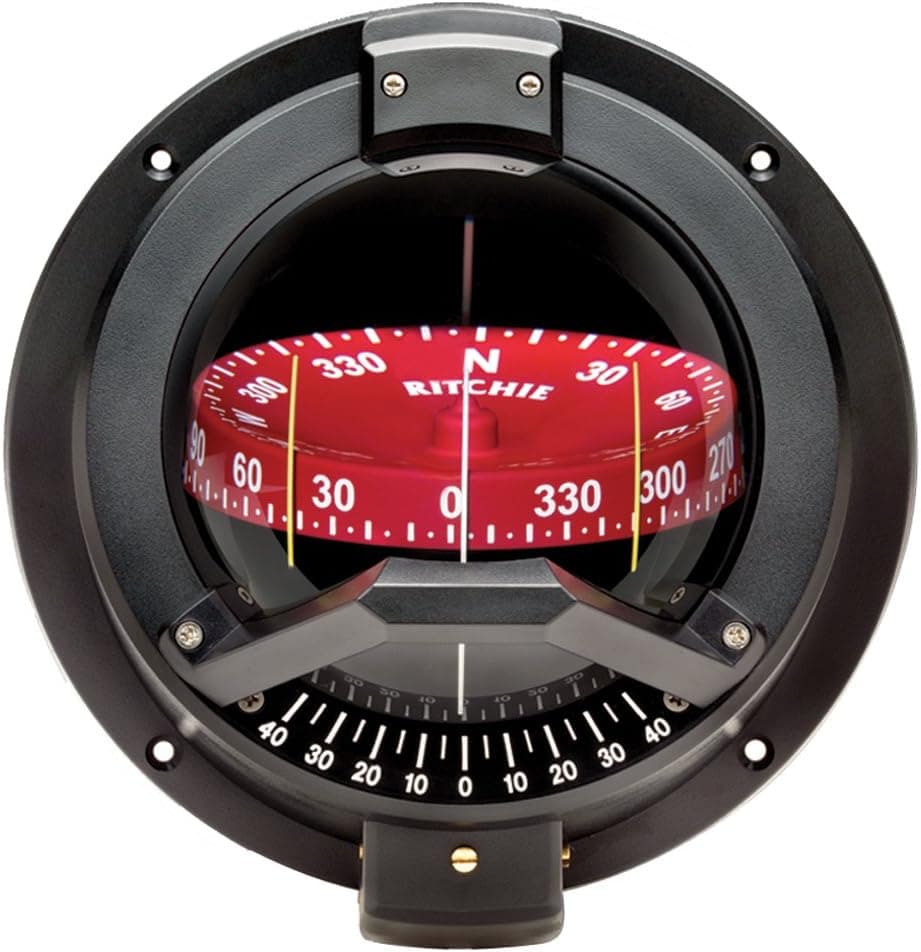
Ritchie's sailboat bulkhead compass (BN-202), with a 4-1/2 in (115 mm) CombiDial that reads from above or in front, a built-in inclinometer, internal gimbals and built-in compensators, for a 5.75 in (146 mm) hole. Its lighting is amber LED at 12 V; for boats with 24 V or 32 V systems, Ritchie says dropping resistors are available.
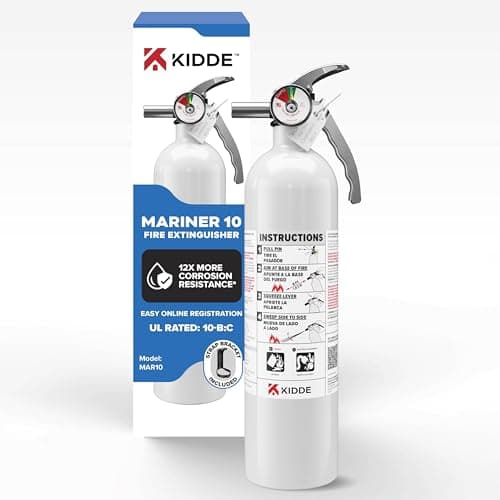
Kidde's single-use marine extinguisher (MAR10), UL rated 10-B:C, which Kidde says is USCG approved with its UL-approved strap bracket (322057), included. A 10-B holds more agent than a 5-B but, the Coast Guard says, still counts as only one 5-B; one 20-B may be substituted for two. Disposable, so the Coast Guard's 12-year limit from the date of manufacture applies.
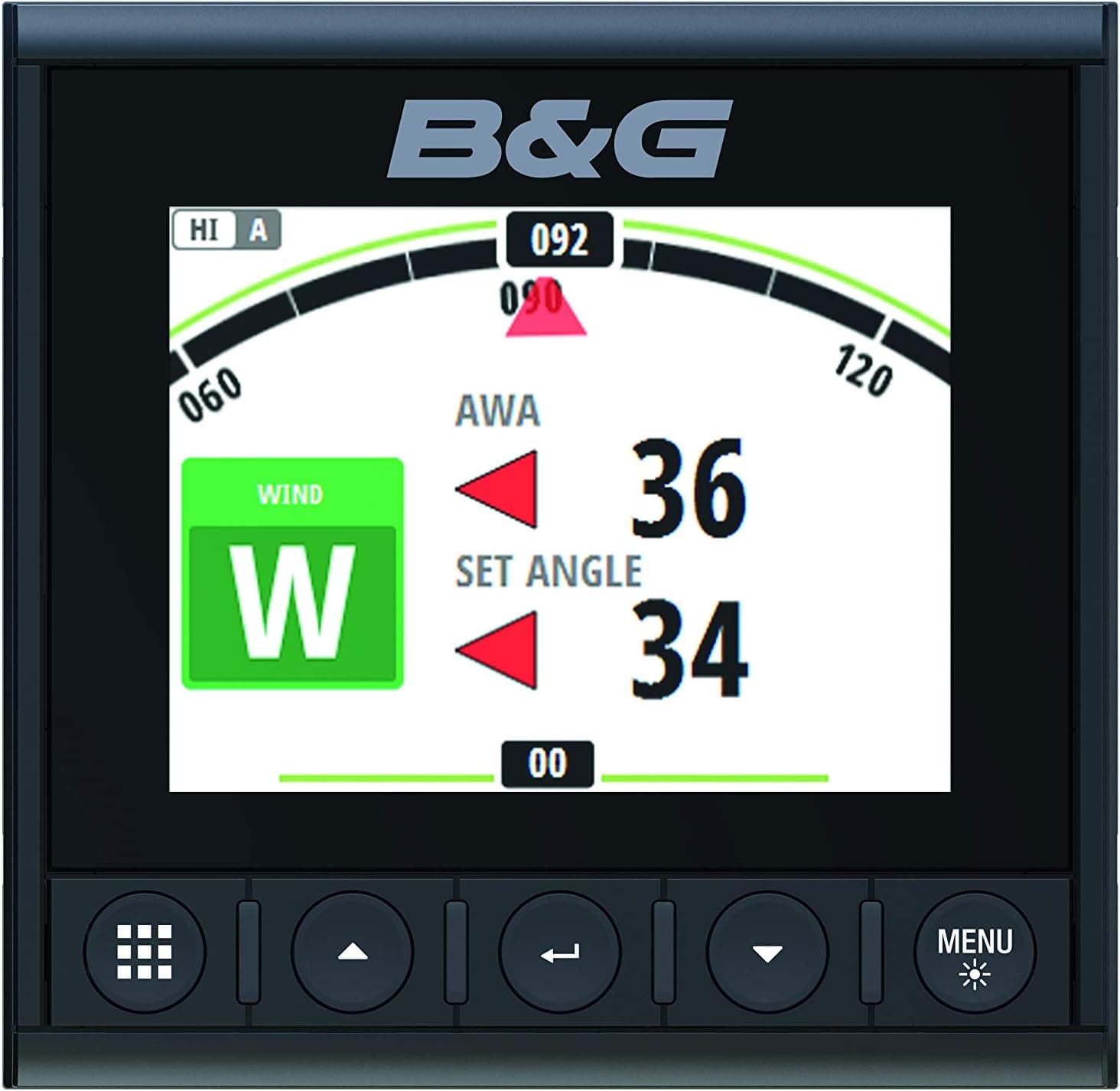
A 4.1-inch instrument display that B&G says can go at the helm, on a bulkhead or over the hatch. It joins an existing NMEA 2000 backbone through one connection and shows what the sensors on it supply, plus some values it calculates itself. With a compatible autopilot computer on the network it shows autopilot status; steering from it also needs the Triton2 Pilot keypad and a drive.
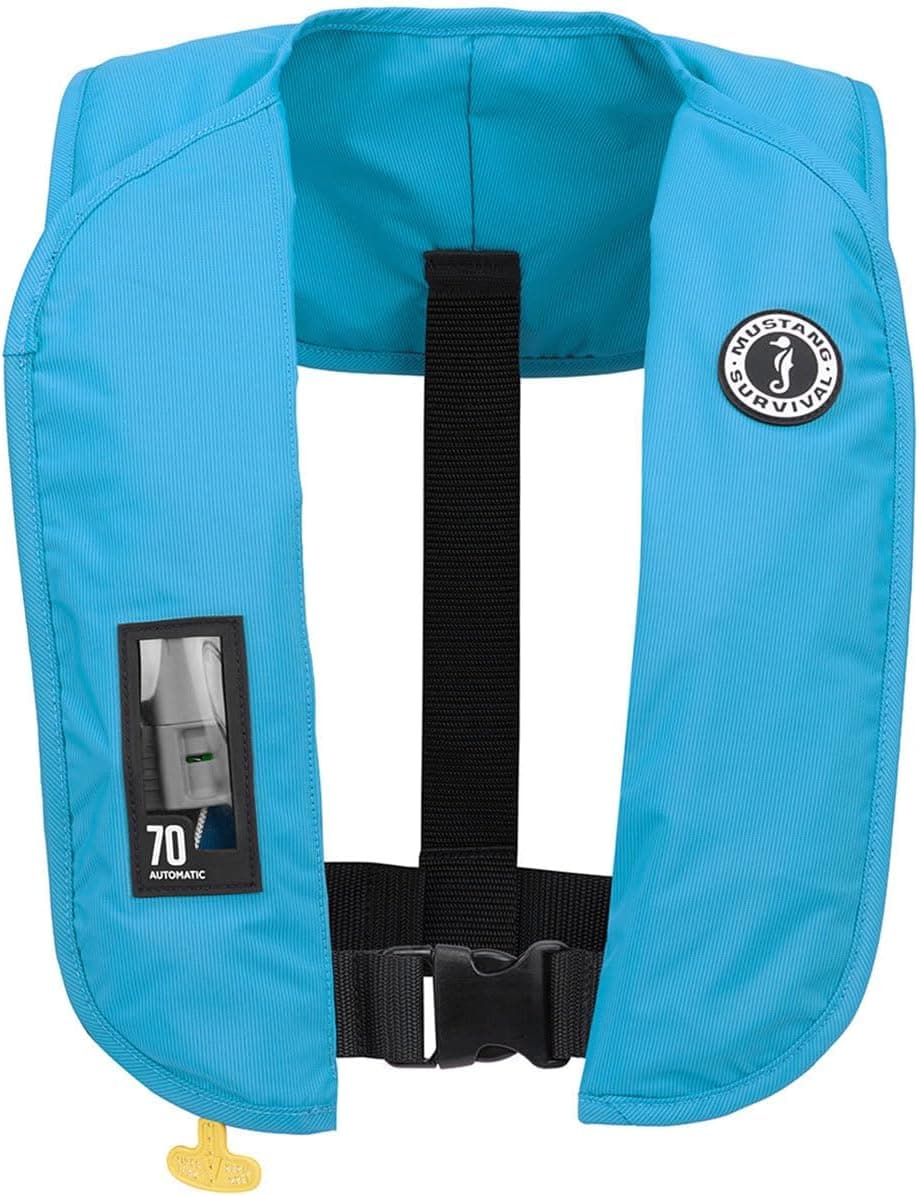
Mustang's slim automatic inflatable (model MD4042), approved as Harmonized Level 70 by the USCG and Transport Canada, with at least 70 N (15.7 lb) of buoyancy from a 17 g cylinder. Its bobbin fires within 10 seconds of immersion, and Mustang warns it can fire early in heavy splashing, high humidity, heavy fog or heavy rain. Mustang says users must be at least 16, that it is designed for wearers over 88 lb (40 kg), and that it is not approved for white water, water skiing or other high-impact, high-speed activities. Rearm it with Mustang's Kit K (MA4041) after every inflation.
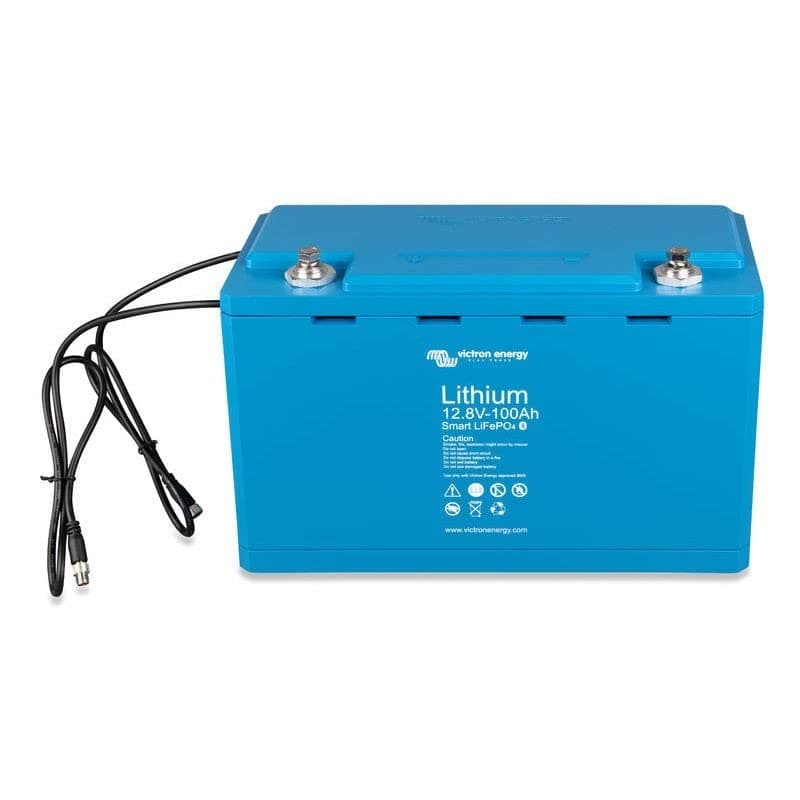
Victron's 12.8 V, 100 Ah lithium iron phosphate battery. It needs one of Victron's external BMS units, and Victron says an external safety relay is mandatory. Victron recommends charging at 14.2 V with a 13.5 V float, only between 5°C and 50°C, and continuous discharge of 100 A or less (200 A maximum). Victron recommends a charger with a LiFePO4 profile or a custom profile adjustable to the battery, and says to disable temperature compensation. For alternator charging, Victron's manual lists four measures, among them a DC-DC charger and a BMS with a current-limited alternator port.
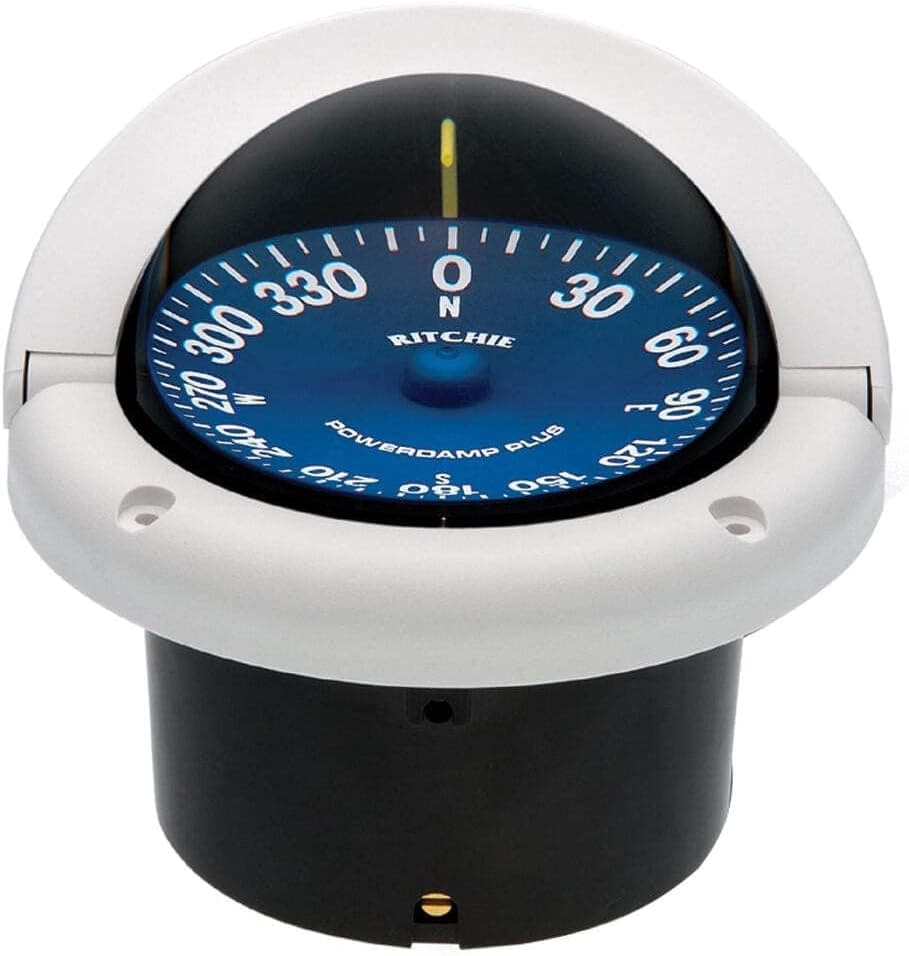
Ritchie's flush-mount compass (SS-1002) for a 4 in hole, with a 3-3/4 in (96 mm) PowerDamp Plus open-face dial, built-in compensators, and 12 V green LED lighting in a movable sun shield; 24 V and 32 V lighting are options, and Ritchie lists a red replacement kit and adapter rings for a 6 in hole.
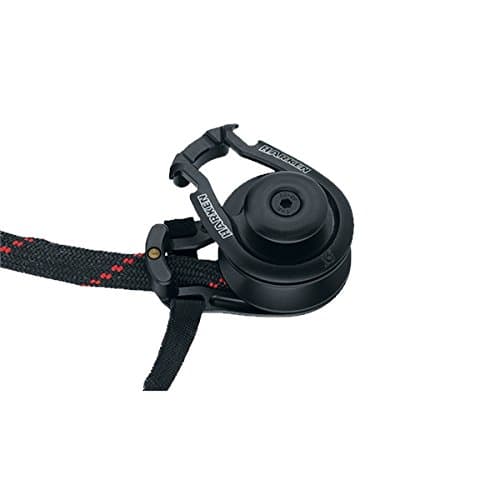
The side plate opens, so it goes onto a line that is already rigged without feeding the line through from one end. Harken and Ronstan both name the same jobs: temporary leads and line deflection.
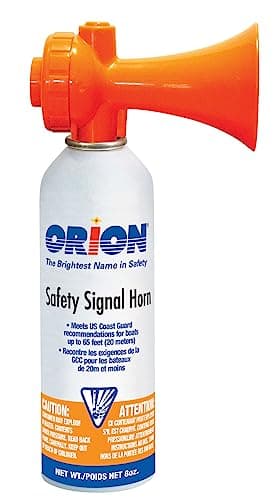
Orion's 8 oz. air horn (item 509): up to 106 blasts per can and a 120 dB blast measured at 10 feet, where Annex III measures at 1 meter. Orion says it meets USCG requirements for boats up to 65 feet (20 m). Refill cans are a separate item (510).

The larger of Raymarine's self-contained tiller pilots, rated for boats up to 4,500 kg (10,000 lb) maximum displacement, which Raymarine says to read against the fully laden weight, often 20% above the designed displacement. Its 2006 handbook gives 77 kg of thrust and 4.5 seconds lock to lock, against 57 kg and 8 seconds for the ST1000+, and two critical mounting dimensions: 589 mm (23.2 in) from socket to tiller pin, and 460 mm (18 in) from the rudder-stock centerline to the pin. Raymarine says it is for coastal cruising, not offshore passage making.
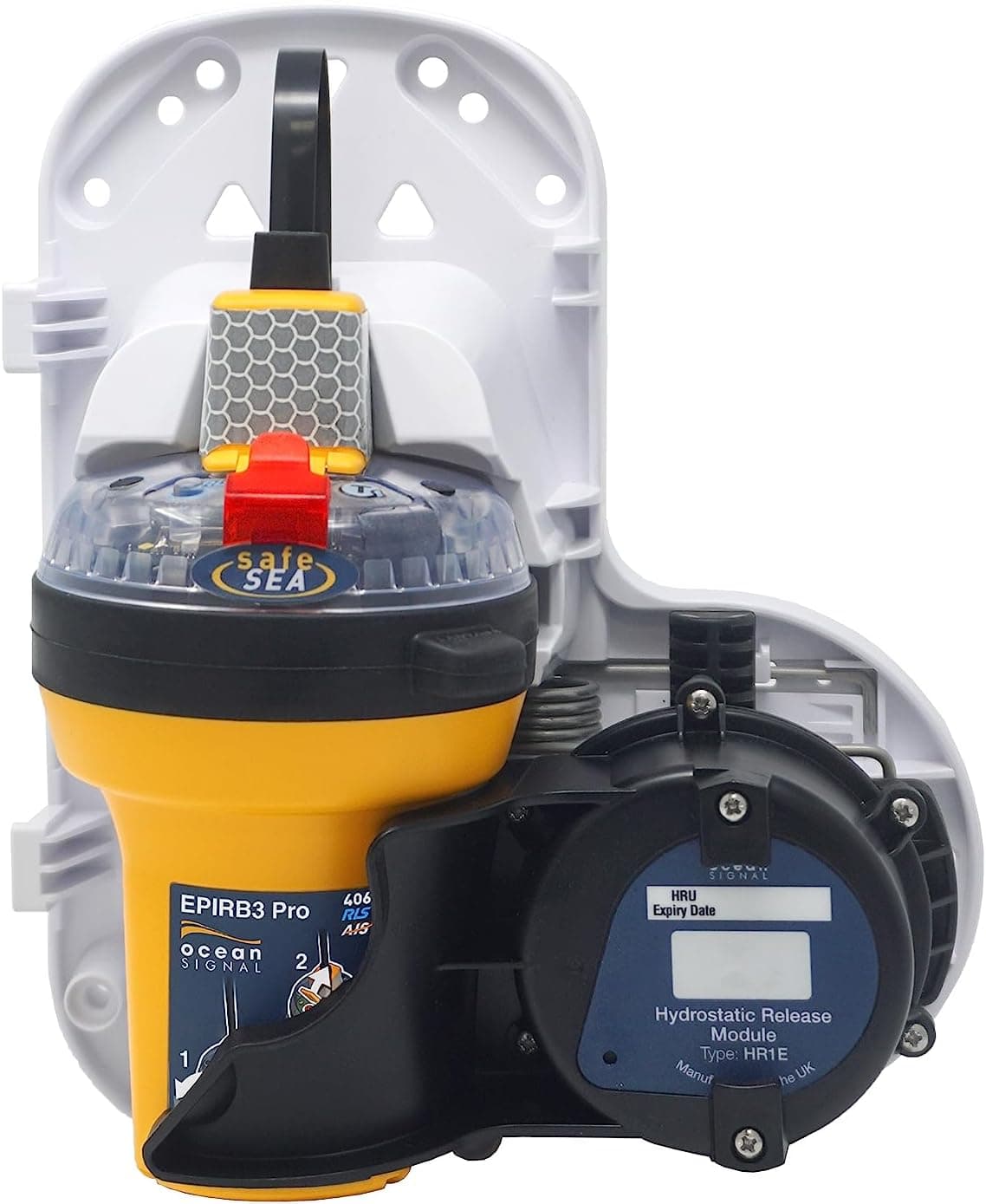
Ocean Signal's Category I EPIRB with an AIS alert (SKU 702S-03933), in an auto-release housing with an HR1E hydrostatic release, plus Return Link Service, a 72-channel multi-GNSS receiver and a 121.5 MHz homer. Ocean Signal gives a 10-year battery replacement period and over 48 hours at -20°C, and says to replace the HR1E (701S-00608) two years after installation, with an expiry label no more than three years from its date of manufacture. When registering, NOAA says to enter the beacon's own AIS MMSI. Check it is coded for the US.
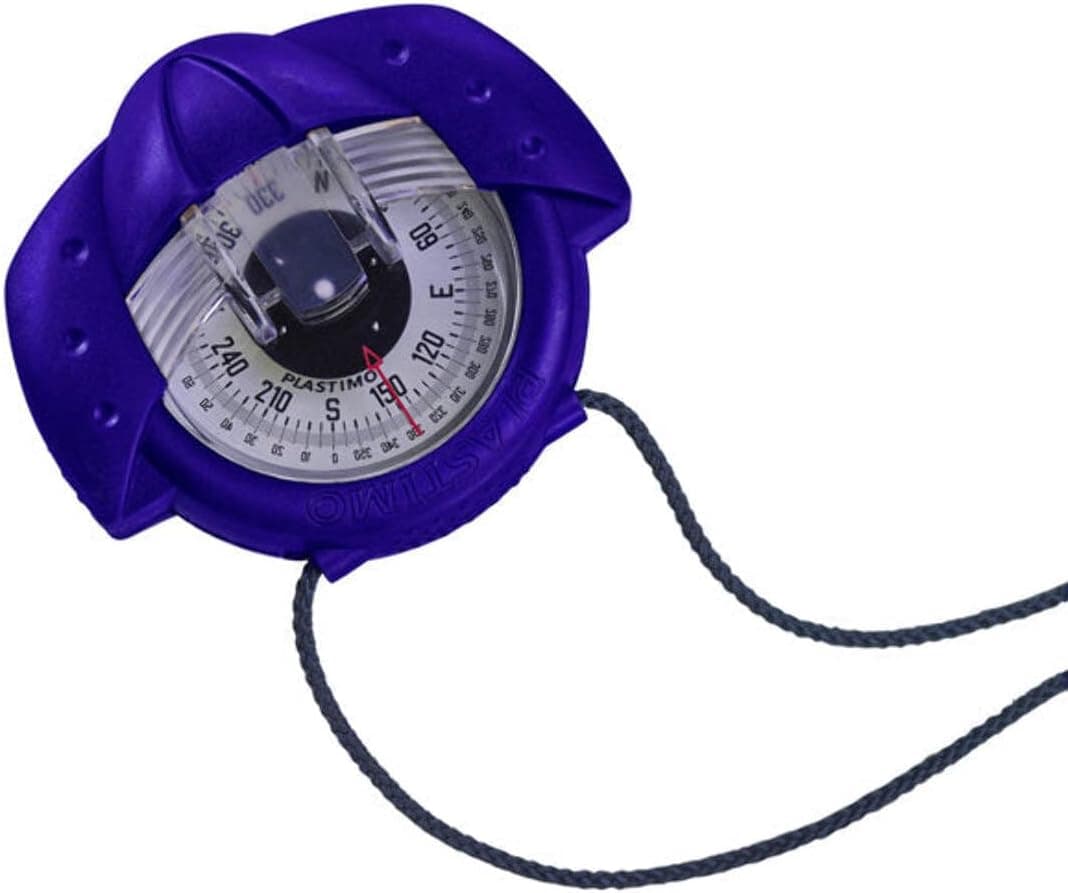
A small handbearing compass that Plastimo's 2022 catalog lists with 1-degree graduations, a 20-degree field of view, a weight of 105 g and photoluminescent lighting that needs no batteries. The same catalog sells it in zone versions (blue 63870 for Zones A and B, 21809 for Zone C), and some retailers list the blue as 21807, so check the part number and zone before you buy.

Orion's orange distress flag (item 925): 3 ft x 3 ft heavy-duty vinyl with four 12 in nylon ties, which Orion lists as USCG approved as a daytime signal. The federal minimum is 36 x 36 in with a black square and a black disc. A flag counts for day only, so it needs a night signal beside it; the Coast Guard says it is most visible waved on a paddle or boat hook, or flown from a mast.
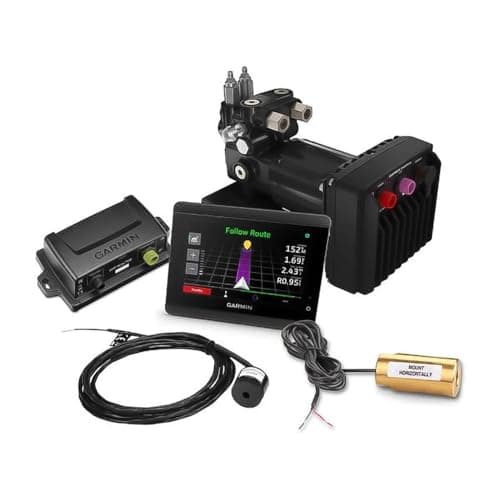
Garmin's Reactor 40 for hydraulic steering, with its SmartPump v2 and GHC 50 control head, as part 010-02794-01. Garmin rates SmartPump v2 for steering cylinders of 4 to 24 cu in, and its Shadow Drive sensor suspends autopilot control when someone turns the helm by hand. Hydraulic hoses and fittings are not in the box, and Garmin says a qualified marine installer should fit it, followed by its Dockside and Sea Trial wizards, the second in calm water.
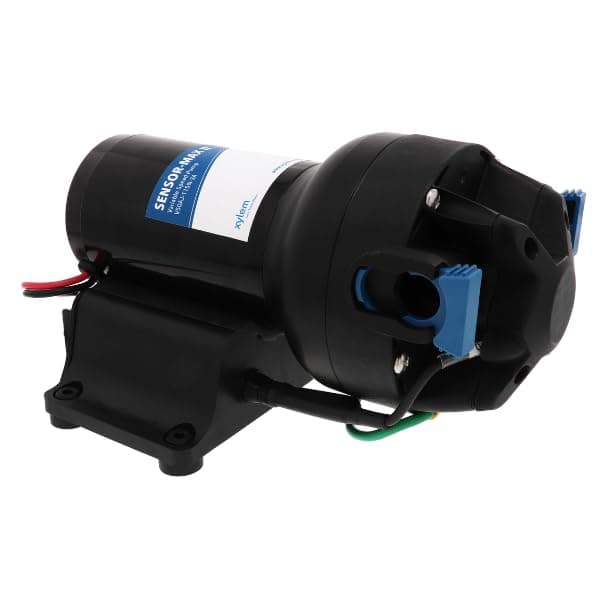
Jabsco's variable-speed freshwater pump (V50AJ-115N-3A): a pressure sensor sets the motor speed instead of a pressure switch cycling it on and off, and Jabsco rates it at 5 GPM open flow at 12 V and says it supplies up to five outlets. It draws up to 12 A at 40 psi and needs a 15 A fuse, not included. Jabsco says it eliminates the need for an accumulator, and that its accumulators must not be used with variable-speed pumps.
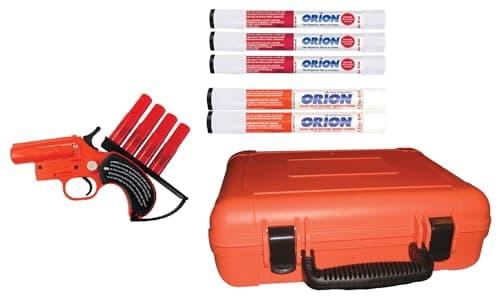
Orion's 12-gauge kit in a hard, floating case (item 244, which replaces item 544): a 12-gauge safety launcher with a hammer safety lock, four aerial flares, three hand-held red flares and two hand-held orange smoke signals, per Orion's page; the Amazon listing says one smoke signal, so count what arrives. Orion gives the aerials up to 500 ft, 16,000 candela and 7 seconds each, the hand-helds up to 950 candela and 3 minutes, and the smoke up to 1 minute. Red flares count for day and night, smoke for day only, and each pyrotechnic expires no more than 42 months after it was made, so read the date. Orion says its launchers are for Orion signals only.
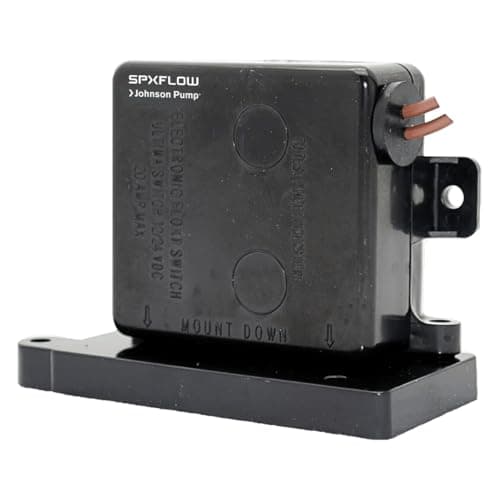
A solid-state electronic bilge switch (Johnson 36303) that senses water through sealed field-effect cells, with no moving parts. Johnson says it turns on at 2 in, after a three-second delay that stops sloshing water starting the pump, and off at 3/4 in; it switches pumps drawing up to 20 A at 12 V, draws under 20 microamps on standby, and must never be mounted below the pump base. Water inside its electronics can make the pump run constantly, Johnson says, and the switch must then be replaced.
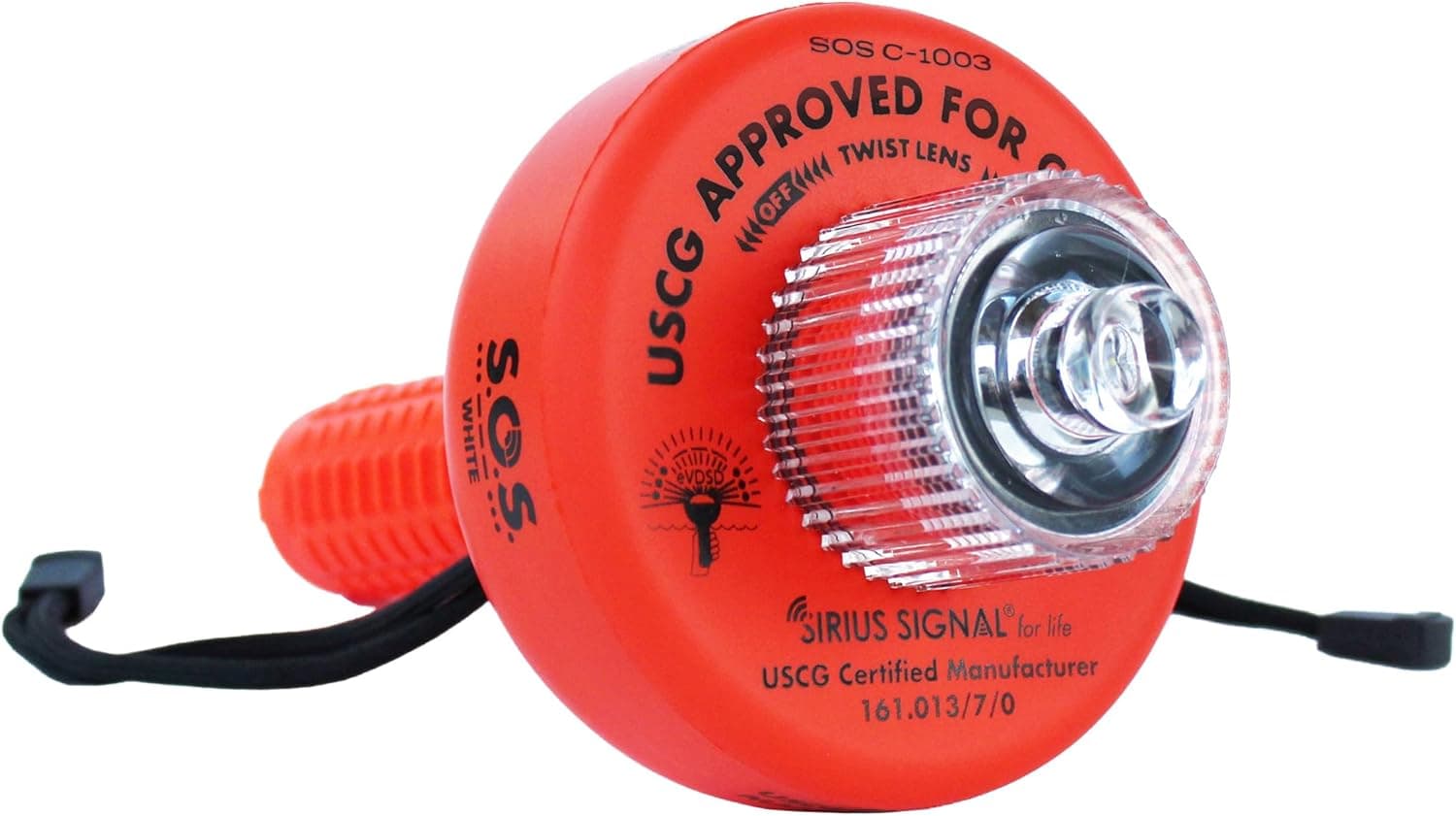
Sirius's electronic distress light (C-1003), with an orange daytime distress flag and a whistle. Sirius says the light is built to comply with 46 CFR 161.013, flashes S-O-S for up to 60 hours, lists the LED at 75 candelas, and comes with three C alkaline batteries; it recommends checking and replacing them at the start of each season. An electric distress light counts for night only. Sirius's page does not give the flag's size or a 160.072 marking, so check the flag's label.
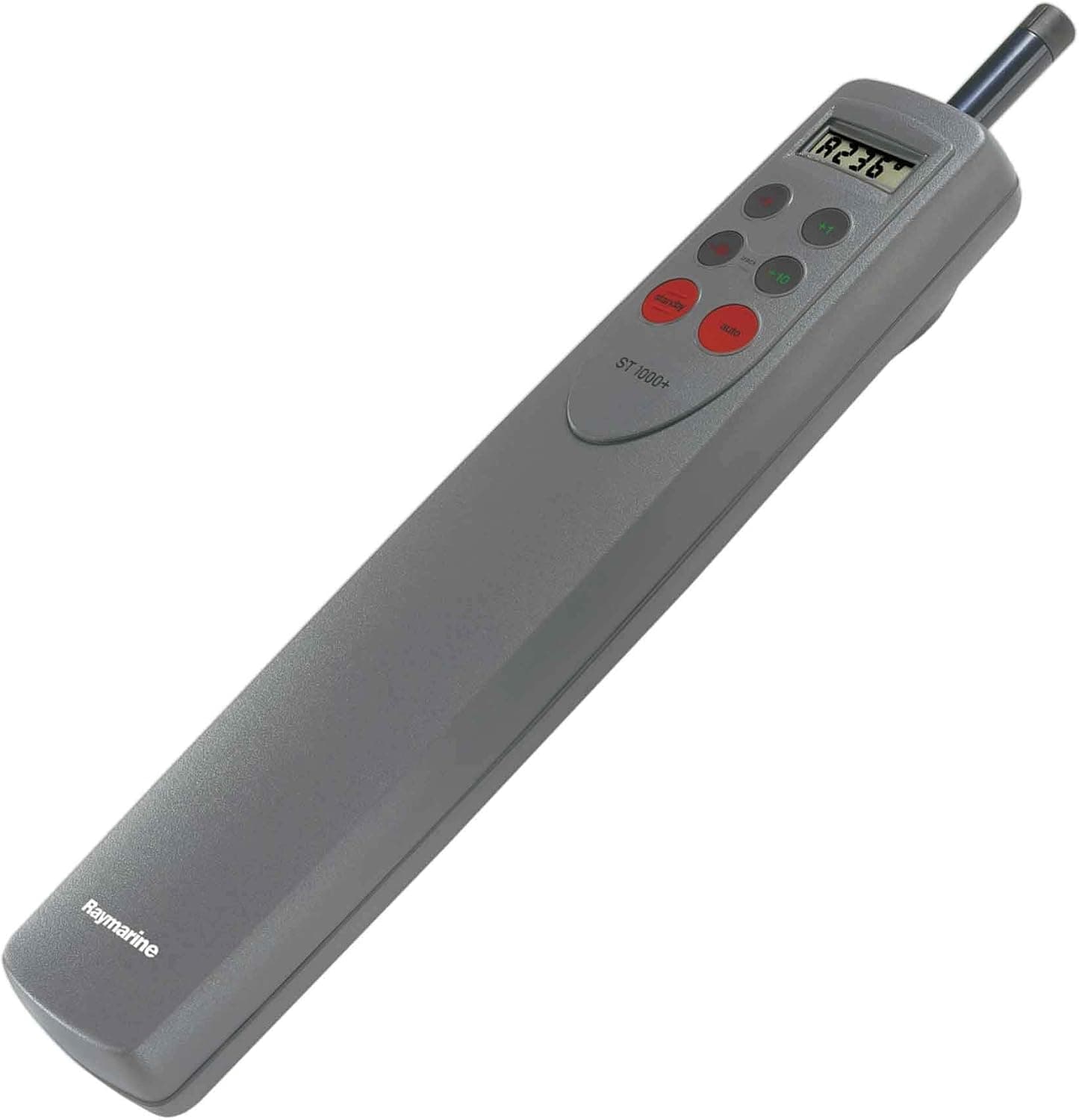
Raymarine's smaller self-contained tiller pilot: an electric linear drive, a fluxgate compass and the control panel in one housing. Raymarine rates it for boats up to 3,000 kg (6,600 lb) maximum displacement, and says to size on the fully laden weight, often 20% above the designed displacement. It is for coastal cruising, not offshore passage making, and its handbook says someone must be at the helm at all times.
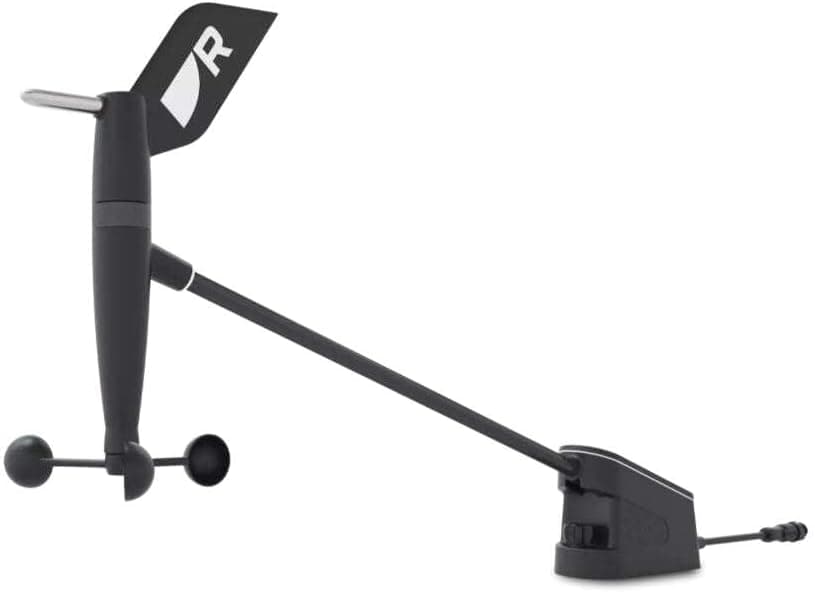
A wired masthead wind sensor: a vane and anemometer with a built-in gyro, accelerometer and magnetometer. Raymarine says these correct for pitch and roll and improve true wind accuracy, but gives no figure. This is the short-arm version with a 30 m mast cable, and the box includes Raymarine's own gateway and a SeaTalkng-to-DeviceNet adaptor. Raymarine's i70 installation instructions say the display also needs speed through water from a speed transducer and heading from a heading sensor to show true wind.
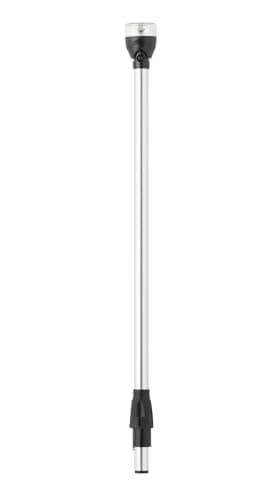
Attwood's LED all-round articulating light on a 24 in. pole (5530-24A7), which Attwood rates for 2-mile, 360-degree visibility on boats up to 39.4 ft (12 m) and says carries USCG certification. Used as the Rule 23(d) all-round white light on a power-driven vessel under 12 m, Inland Annex I puts it at least one meter above the sidelights and, on boats built after July 31, 1983, requires it to be screened to prevent direct illumination of the vessel forward of the operator's position; masts and structures may not obscure it over sectors of more than 6 degrees.
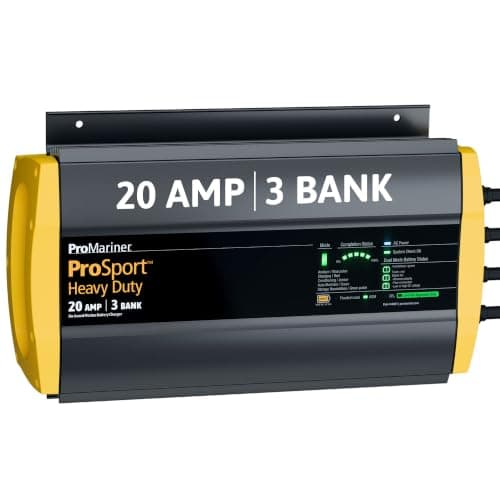
A 20 A, three-bank, IP67 waterproof onboard charger for three 12 V batteries, which ProMariner says gives a full charge in 8 to 10 hours. Its AGM profile charges to 14.7 V and maintains at 13.6 V, so compare that with your battery maker's settings; its LiFePO4 profile is for ProMariner-approved lithium batteries only. ProMariner says waterproof chargers are for batteries not in use while charging and recommends a charger of about 10 percent of the bank's total amp-hours, and its manual asks for a GFCI-protected outlet.
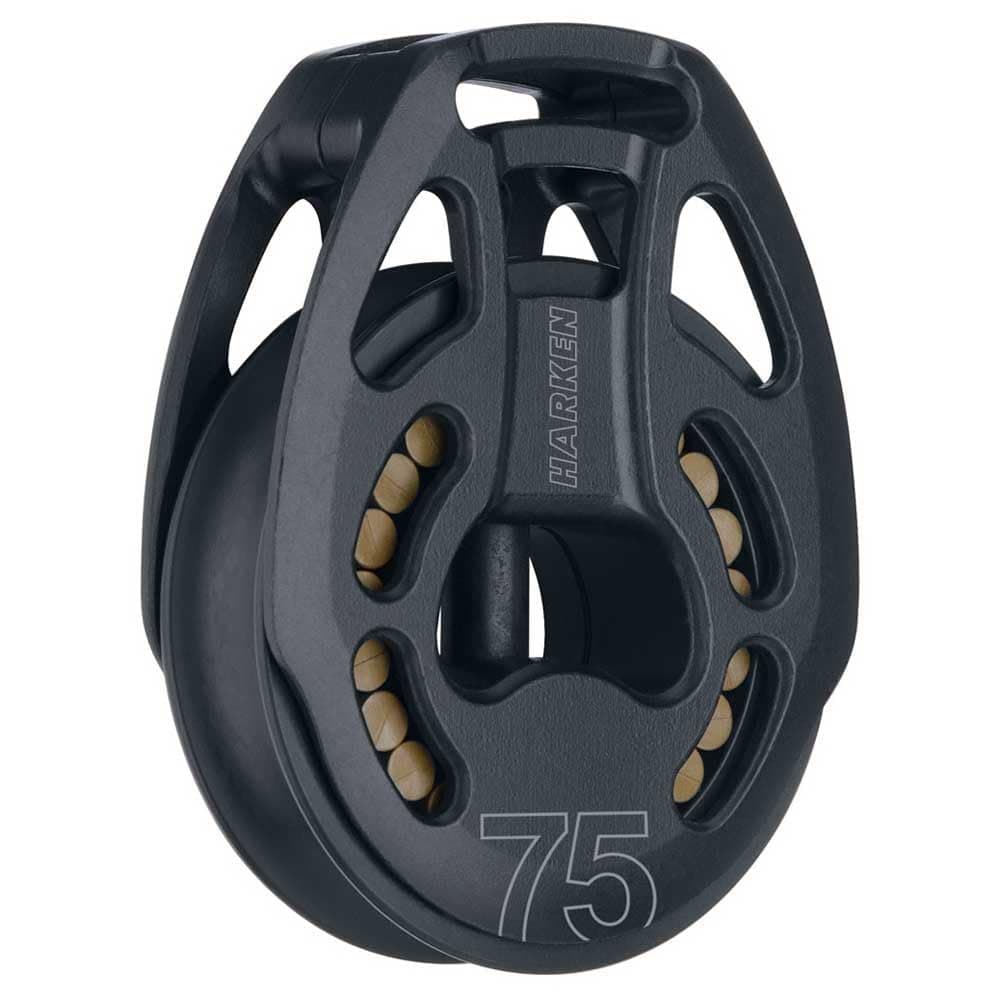
Harken builds these for big-boat sail controls that work hard — their own list is mainsheet, runner, halyard and spinnaker systems. They are made to be serviced: few parts, no loose balls or rollers to lose, and they come apart with a single hex wrench instead of being riveted.
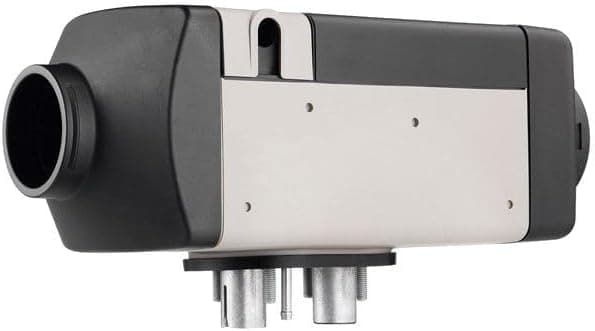
Webasto's 2 kW air heater, also sold as a marine version: 0.9–2.0 kW. Webasto says it can suit a smaller boat with one main cabin, or a larger one with several cabins through several outlets, depending on where you cruise and how much heat you need. Webasto publishes marine installation instructions and says installers need Webasto training, so check a yard near you has a trained technician before you buy.
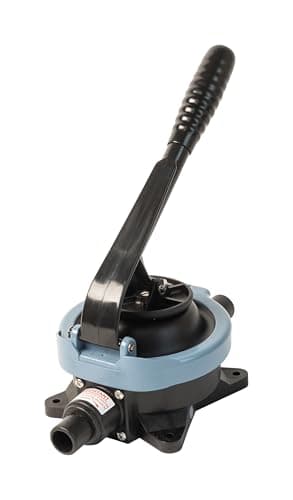
Whale's manual bilge pump (BP9005, with an on-deck fixed handle), rated at up to 55 L (14.5 US gal) a minute and, under ISO 15083, as a primary bilge pump on boats up to 12 m (40 ft) with 1 in hose or 12 m and over with 1-1/2 in hose. At 1 m lift, 0.5 m head and 60 strokes a minute, Whale's own table shows the larger hose giving about 36% more flow. Whale's installation guide says it is designed for normal bilge water and that its capacity may not be sufficient to cope with a rapid influx of water. Its warranty is five years, but one year on rubber parts.
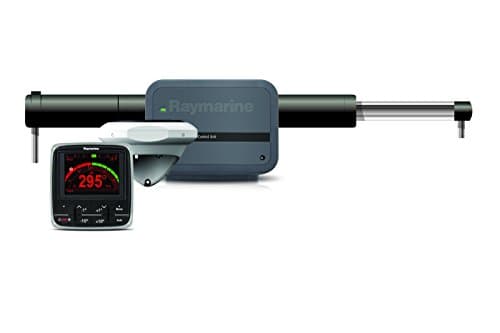
A tiller drive run by Raymarine's Evolution electronics, rated for tiller-steered sailboats up to 6,000 kg displacement, read against the fully laden weight. Raymarine says its Evolution tiller drive is suitable for local coastal sailing only; for offshore use it advises considering a larger drive with ample spare capability and making sure a backup system is in place. The electronics are the EV-1 sensor core, both heading sensor and course computer, and the ACU-100. Raymarine's T70153 pack lists the p70s control head, but this listing's title names the older p70, so check the box. Raymarine's EV-1 manual lists an ACU power cable as essential and not supplied, calls its M81105 rudder reference (sold separately) highly recommended, and strongly recommends installation by an authorized Raymarine service representative, tying full warranty benefits to it.
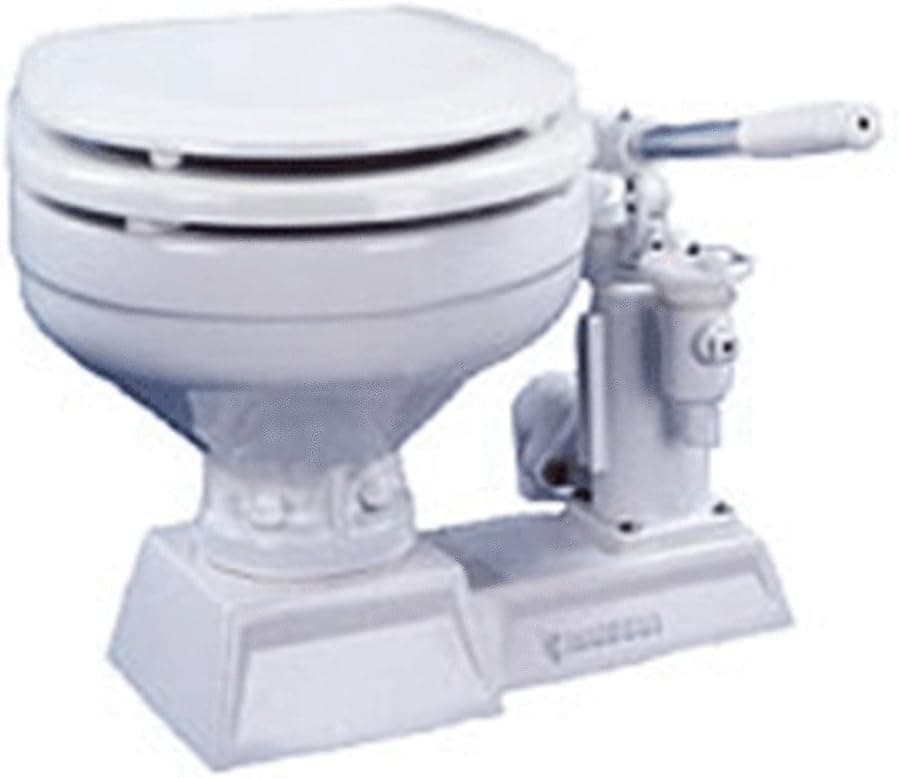
Raritan's manually operated, double-action piston toilet with the household-size bowl (PHHBII), which Raritan says is still in production. If it sits at or below the waterline at greatest heel, Raritan requires vented loops in the discharge line and between the intake pump and the bowl, with every hose connection double-clamped. Its PHII manual names the PHRKIIU overhaul kit (its FAQ gives PHRKIIC for units from June 1992 on), and says to lubricate the piston rod every spring and fall, or more often with frequent use.
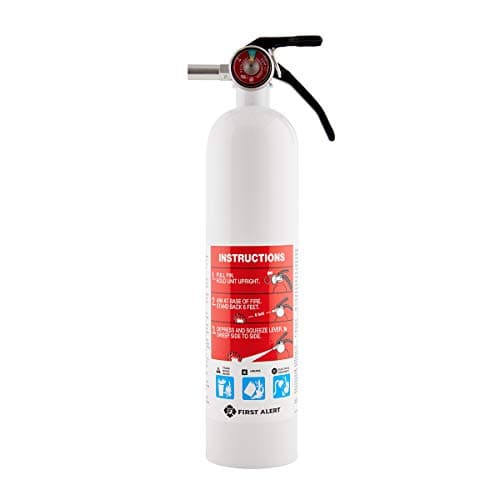
First Alert's rechargeable marine extinguisher (model FE1A10GR), rated 1-A:10-B:C, with a mount, bracket and strap. First Alert says it can be recharged by a certified professional after use, and its manual says a certified dealer should service it once a year. First Alert's own page makes no Coast Guard statement, so check the label for 'Marine Type USCG Approved'. A rechargeable is not removed at 12 years; the Coast Guard's FAQ says it must be maintained annually by a technician, though the regulation sets no annual-service duty.
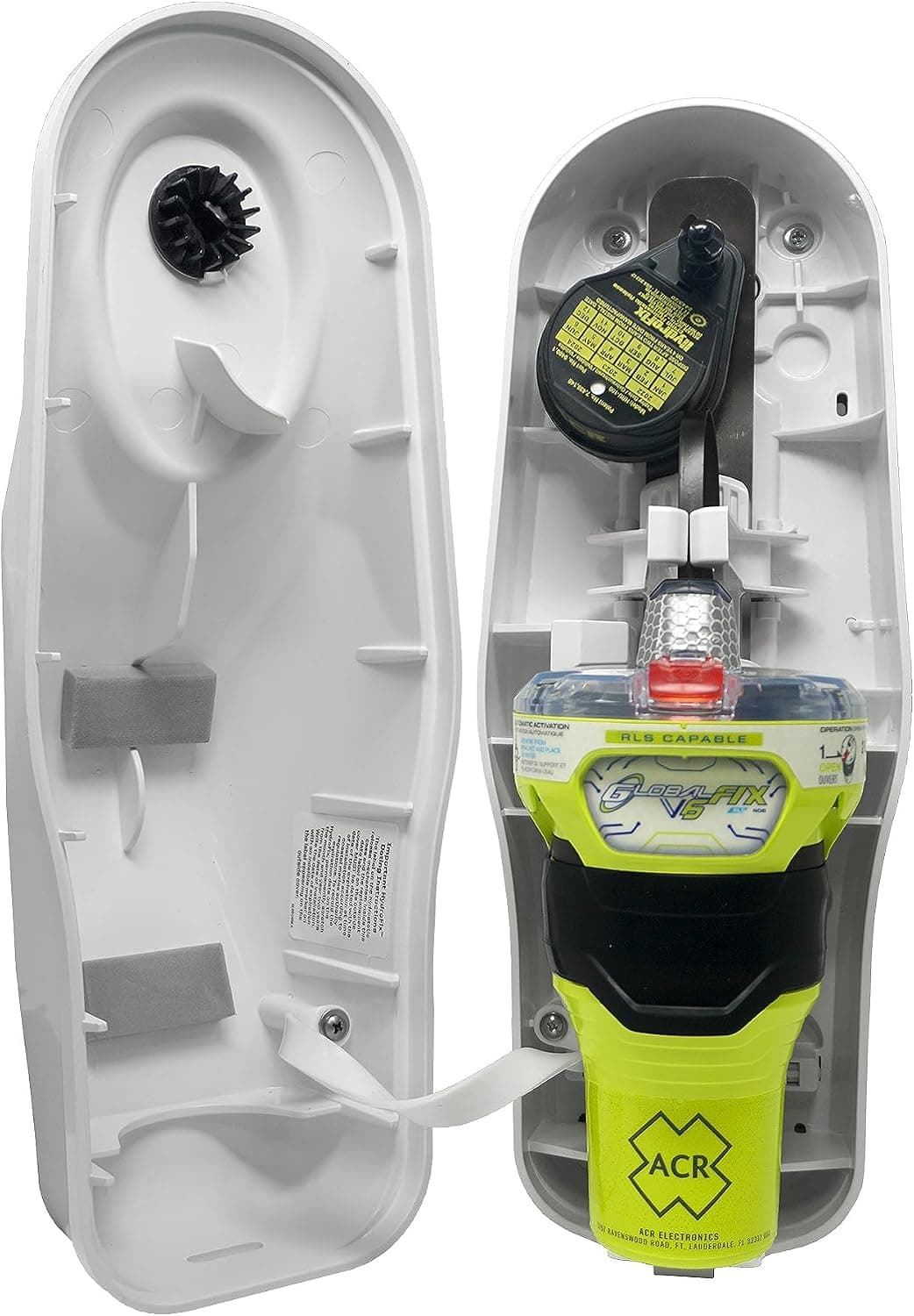
ACR's GlobalFix V6 (model RLB-43) in its Category I float-free housing; ACR's US part is 2853: GPS, Galileo and GLONASS, a 121.5 MHz homer and Return Link Service, but no AIS. ACR gives it a 10-year battery replacement period and over 48 hours at -20°C, and says only an authorized center may replace the battery. Its HydroFix release (9490.1) must be replaced two years after installation, and ACR's V6 page also caps it at three years from manufacture, so check the label; ACR lists it as an accessory, so confirm it is in the box. Check the beacon is coded for the US, and register it with NOAA before installing it.

Mustang's rearm kit for the MIT 70 models MD4041 and MD4042: one 17 g CO2 cylinder and one automatic bobbin, used on the MD4042 only. Match the kit to the model number on the jacket's label — the older MIT 70, MD4031, takes a different kit (MA4031). An inflatable must be rearmed after every inflation; under 33 CFR 175.23 it counts toward the life jackets a boat must carry only when properly armed with a full cylinder, unless it is worn inflated.
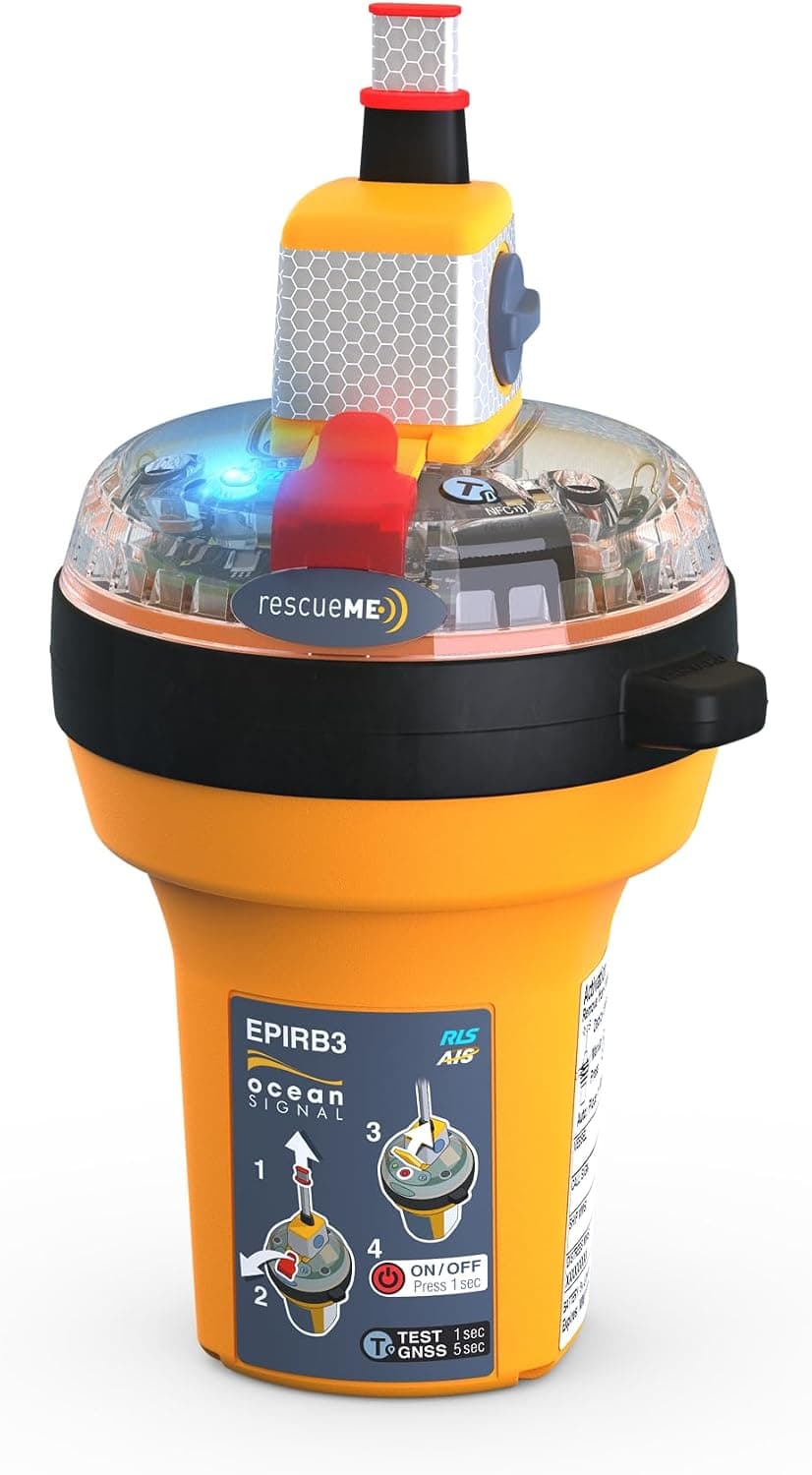
Ocean Signal's Category II EPIRB with an AIS alert (SKU 702S-03932), supplied with a manual-release bracket that Ocean Signal says to mount inside the boat. It cannot switch on in the bracket; out of it, it activates in contact with water or by hand. GPS, Galileo and GLONASS, Return Link Service and a 121.5 MHz homer; 10-year battery replacement and over 48 hours at -20°C, at an authorised centre only. Check it is coded for the US.
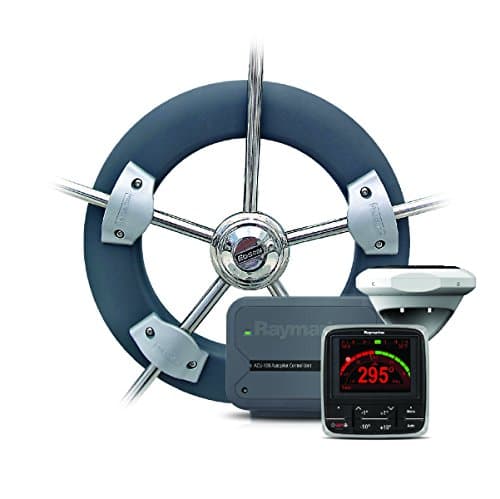
A cockpit wheel drive with Raymarine's Evolution electronics, for wheel-steered sailboats up to 7,500 kg laden displacement. Raymarine's wheel drive fits wheels with 3 to 8 spokes on steering with 1 to 3.5 turns lock to lock; its clutch returns the boat to hand steering, and Raymarine says to reach around the wheel, never through it, to work the lever. Raymarine says it is suitable for local coastal sailing only. Raymarine's complete kit is T70152, with the p70s head; it also sells versions without a head (T70248) and without the drive (T70281), and this listing names the older p70, so check the part number and what is in the box. Raymarine strongly recommends installation by an authorized service representative.
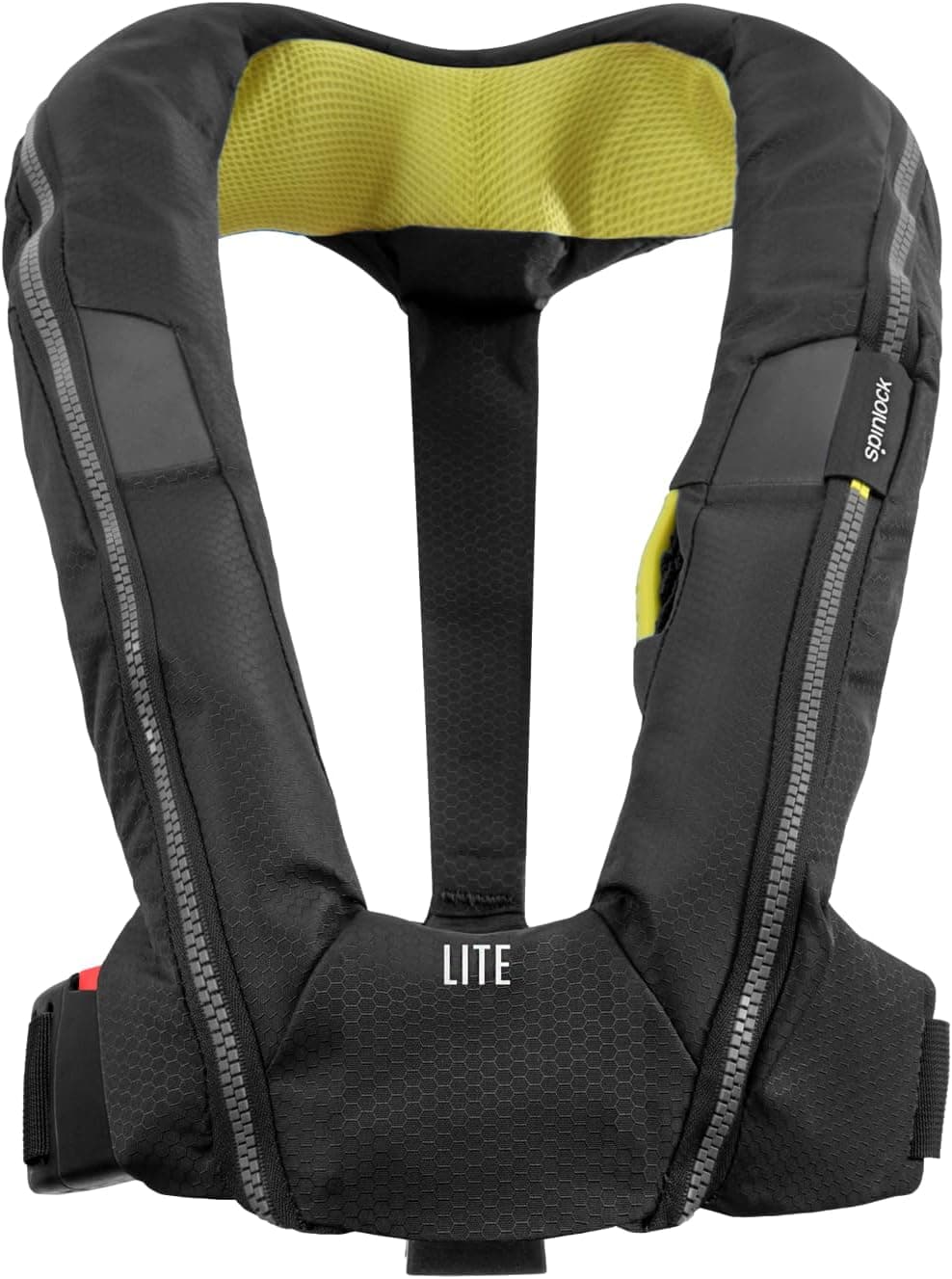
The US version of Spinlock's Deckvest LITE (DW-LCG2/R), which Spinlock lists as USCG approved with Type II performance; the UK and EU LITE is a different jacket, so check for USCG on the label. Spinlock gives it 160 N (36 lb) from a 33 g cylinder, a single crotch strap, and a fit of 60–145 cm chest for wearers over 50 kg. It has no harness — Spinlock's LITE+ USCG adds one. Rearm it with Spinlock's DW-RAR/33G kit.
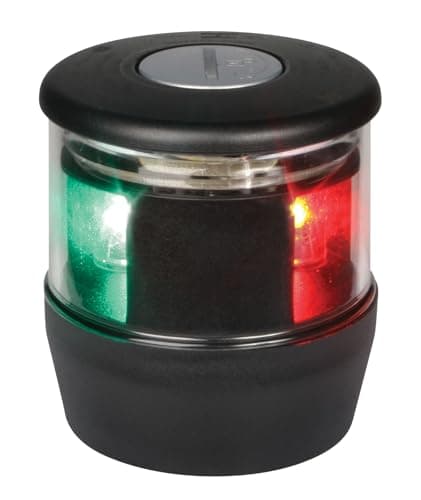
Hella's NaviLED TRIO (980650001): a 2 NM masthead tri-colour with a separate all-round white anchor light. Hella says it may be carried only by a sailing vessel under 20 m, never shown under power, and must be switched so one position shows the tri-colour and another the anchor light alone, on a 3 A maximum fuse. Hella's current sheet gives 9-33 V DC, the early version 8-28 V, so check the label; it says to replace the lamp after a maximum of 12 years' use on recreational boats.
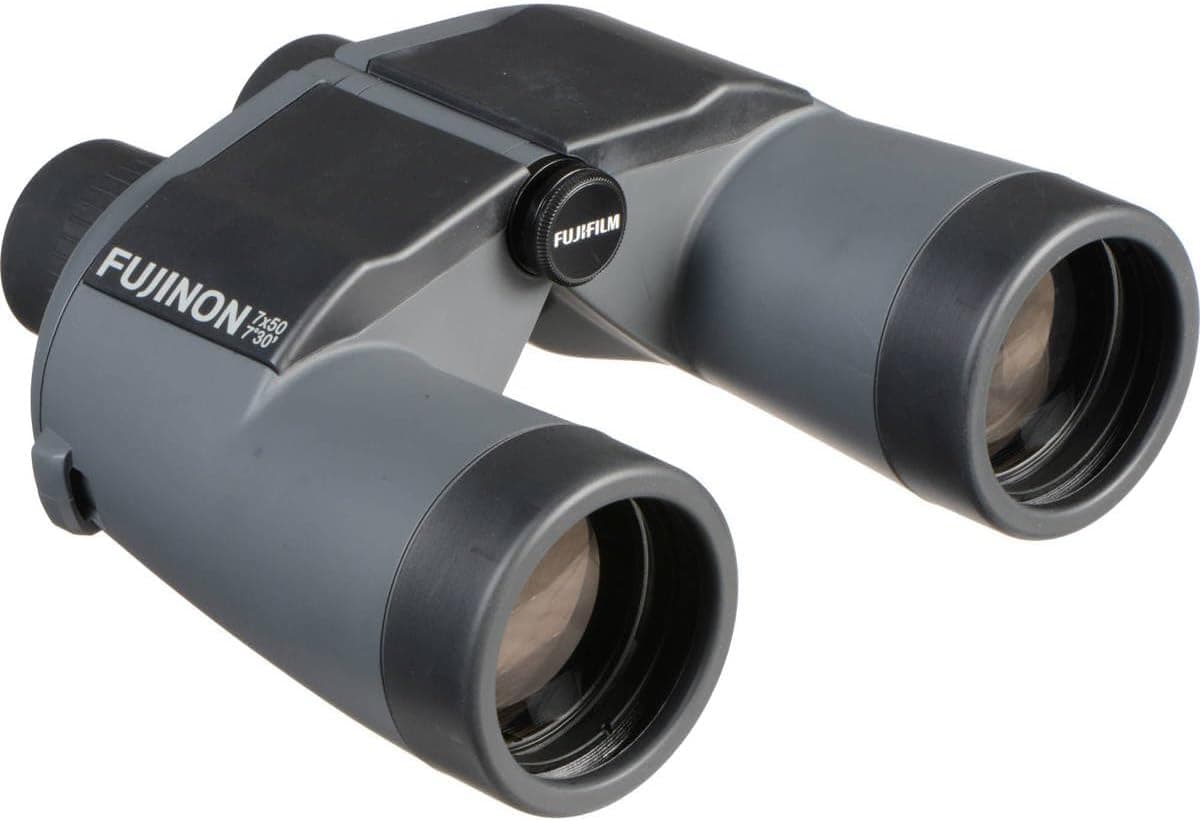
The Mariner 7x50 without a compass (WP-XL): nitrogen-filled, individually focused, 885 g, with a 7.1 mm exit pupil and a 7.5° field of view (131 m at 1,000 m), and supplied with a flotation neck strap. Fujifilm rates it water resistant to 1 m for 5 minutes, which it says does not mean it can be used in water, and says to rinse Mariner binoculars in fresh water after use around salt air or the ocean.
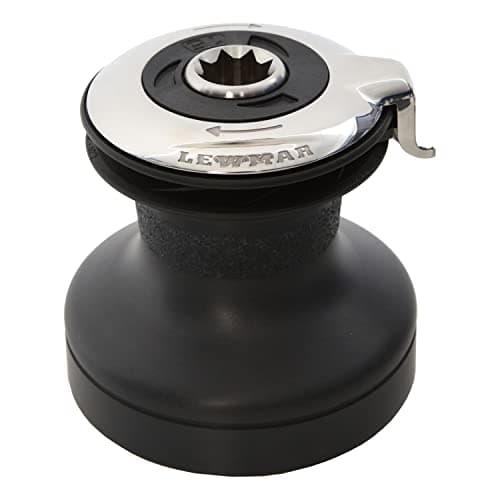
A single-speed self-tailer: spring-loaded jaws on top hold the tail, and Lewmar rates them for 8–12 mm rope. Check the bolt pattern before you order. Lewmar fixes the 15ST with five M6 bolts on a 94 mm circle, on the same template as its Ocean 14 and 16; Harken's 15STA uses a 100 mm circle.
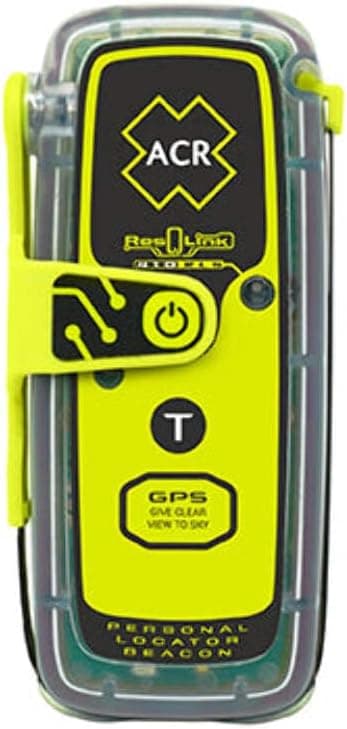
The Return Link version of the ResQLink 400 (model PLB-410; ACR's US part is 2931, but the listing shows no part number, so check it is coded for the US): GPS and Galileo, a 121.5 MHz homer, and a blue light that shows the alert was received. ACR says that light does not confirm a rescue dispatch or give an arrival time. Buoyant but, like the 400, it must be held above the water to work; the battery is replaced after 5 years or emergency use, through an authorized ACR center. Register it with NOAA.
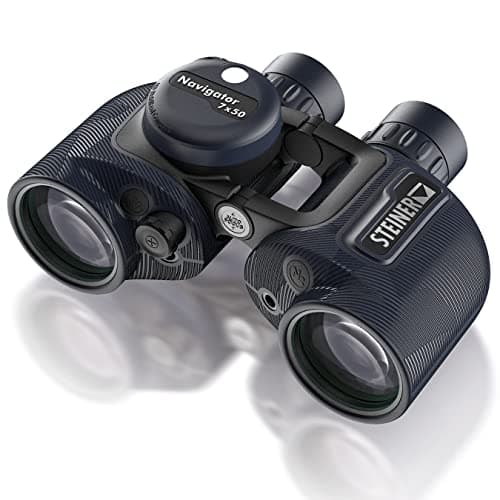
Steiner's current Navigator 7x50 with a compass (item 2343): an integrated, fluid-dampened analog compass that can be illuminated; Steiner's spec table lists a CR 1225 battery and doesn't say whether one is included. Steiner rates it water-pressure-proof to 5 m, nitrogen-filled against internal fogging, with a 7.14 mm exit pupil, and says its Auto-Focus, once set, stays sharp from 20 m to infinity. It comes with a floating strap; Steiner makes no claim that the body floats.
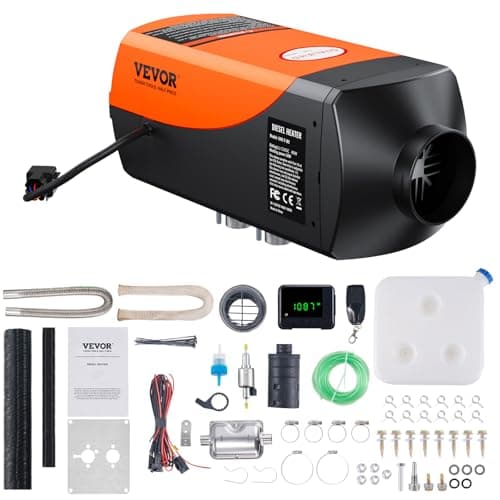
We run one of these aboard. It is a Chinese heater and we are not going to pretend otherwise — but it is surprisingly good for the money, and the real argument for it is that if it does fail you replace it without it hurting. A Webasto or Eberspächer is the better unit. Know what you are buying: VEVOR's manual gives only vehicle installation positions and has no boat section, and we found no VEVOR marine installation instructions. Webasto's marine manuals and Eberspächer UK's 2006 marine guide (for its older Airtronic heaters) forbid putting a heater or its exhaust in the accommodation, and the Coast Guard advises fitting CO alarms inside the boat.
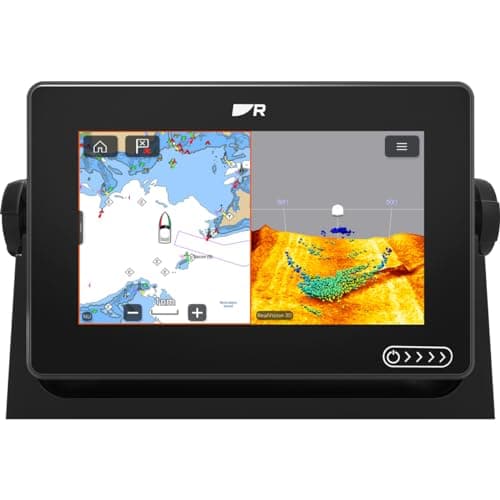
Raymarine pitches the Axiom+ RV at inshore and coastal fishing boats, and its built-in sonar has four channels: CHIRP, DownVision, SideVision and RealVision 3D. Raymarine sells it four ways: display only, with its own LightHouse Charts card, with the RV-100 transducer, or with both. This listing is E70637, which Raymarine sells as the display alone, with no transducer or chart card, so check the part number and box contents before you buy. Its laylines need the plotter set to Sailing, plus wind, speed-through-water, GNSS and heading data.
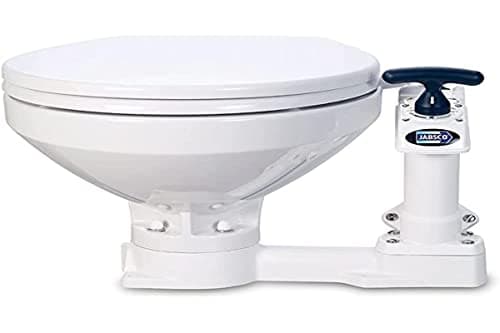
Jabsco's manual marine toilet with the compact bowl (29090-5000), 12.9 in high and 16.7 in deep by Jabsco's figures. It flushes with raw water only, and its handle locks the waste outlet valve shut to guard against flooding and waste backflow. Jabsco requires full-bore seacocks on any through-hull the toilet connects to that may be below the waterline, and a vented loop in any pipework connected to a through-hull, inlet or outlet, if the bowl rim is less than 8 in (20 cm) above the waterline at rest or could ever be below it; it says to shut both seacocks after every use and whenever the boat is unattended.
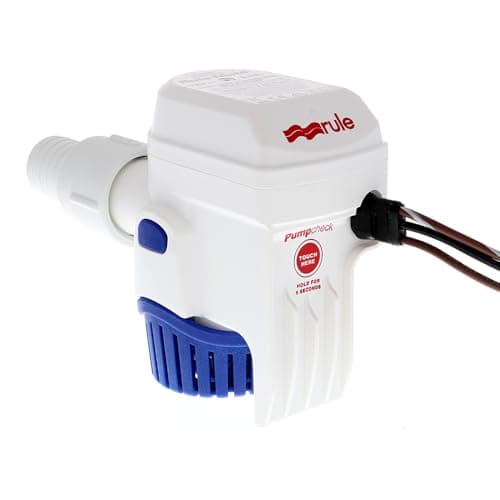
Rule's automatic 1100 GPH bilge pump (RM1100B), which senses water with an internal level sensor, so no float switch is needed; if debris fouls the sensor, it falls back to checking for water every 2.5 minutes. Rule's Rule-Mate manual (950-0535 Rev E) gives 1,128 GPH at zero head but 792 GPH at 3.3 ft and 456 GPH at 6.7 ft, without stating a test voltage. It draws 3.8 A at 12 V on a 7.5 A fuse, and Rule says it is for normal bilge water, not damage control.
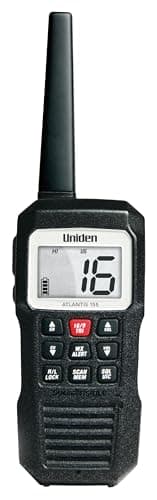
Uniden rates it IPX8 to 1.5 m for 30 minutes, and says it floats when the battery cover is securely fastened. At 3 W it sits below the 5 W Icom UK says to expect from a handheld, its four AAA cells take 13 hours to charge from empty, and it has no DSC — which makes it a spare, tender or crew radio rather than your only VHF.
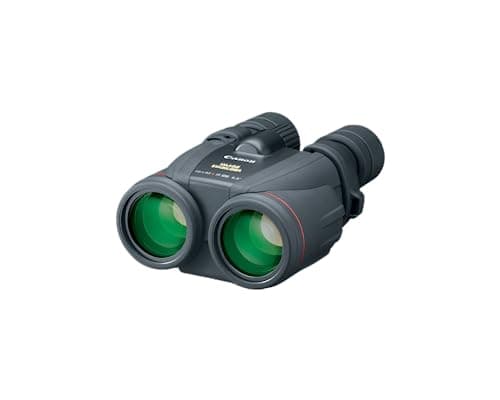
Canon's waterproof stabilized 10x42. Canon Canada calls it the first waterproof binocular with its Image Stabilizer, and Canon Asia rates it waterproof for 30 minutes at 1 m. A vari-angle prism corrects ±0.8°. On two AA cells, Canon Japan gives about 8 hours on lithium and 2.5 hours on alkaline at 25°C, but about 10 minutes on alkaline at -10°C. Canon Asia and Canon Japan give its weight as 1,110 g without batteries, while Canon Canada gives 1,030 g. It has a 4.2 mm exit pupil.
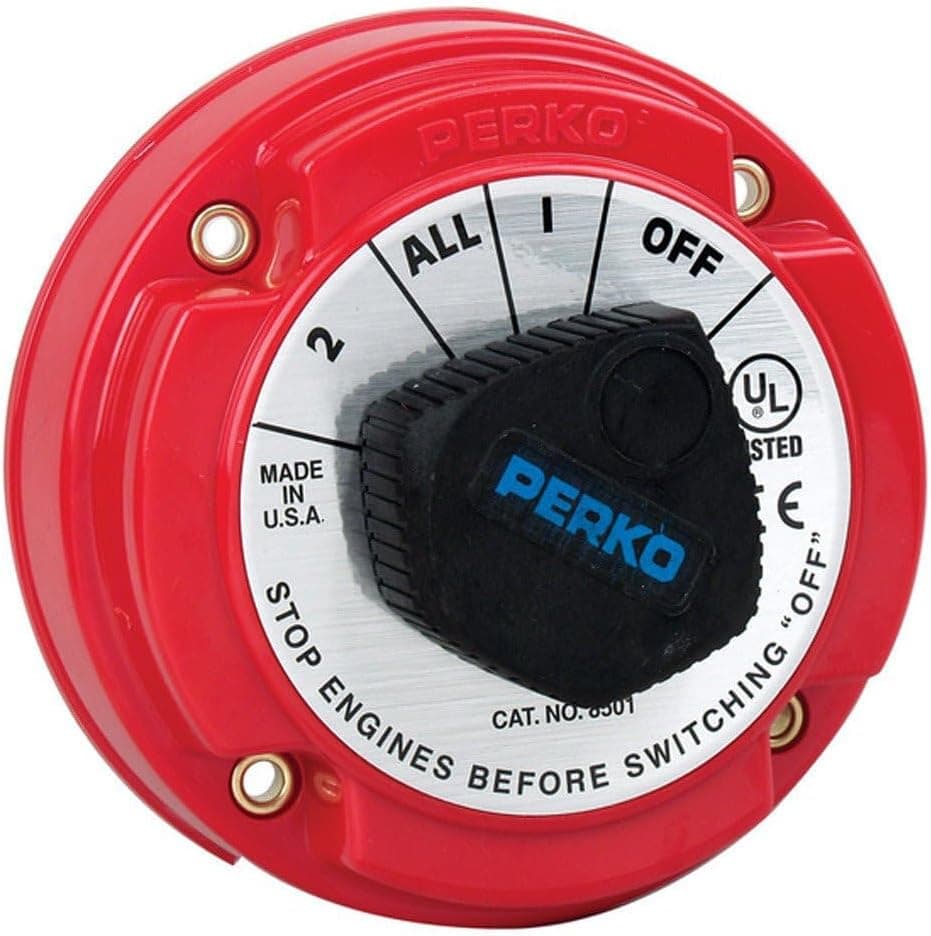
Perko's medium-duty selector, rated 250 A continuous and 360 A for 5 minutes, for 6 to 32 V systems. Perko says it is make-before-break and can be switched between 1, ALL and 2 with the engine running, and lists it as ignition protected without naming a test standard. It has no alternator field disconnect: Perko's AFD models protect non-unitized alternators if the switch is turned OFF with the engine running. Battle Born says an emergency house-to-start parallel switch is not recommended with its LiFePO4 batteries. The listing gives no Perko part number, so check it is the 8501.
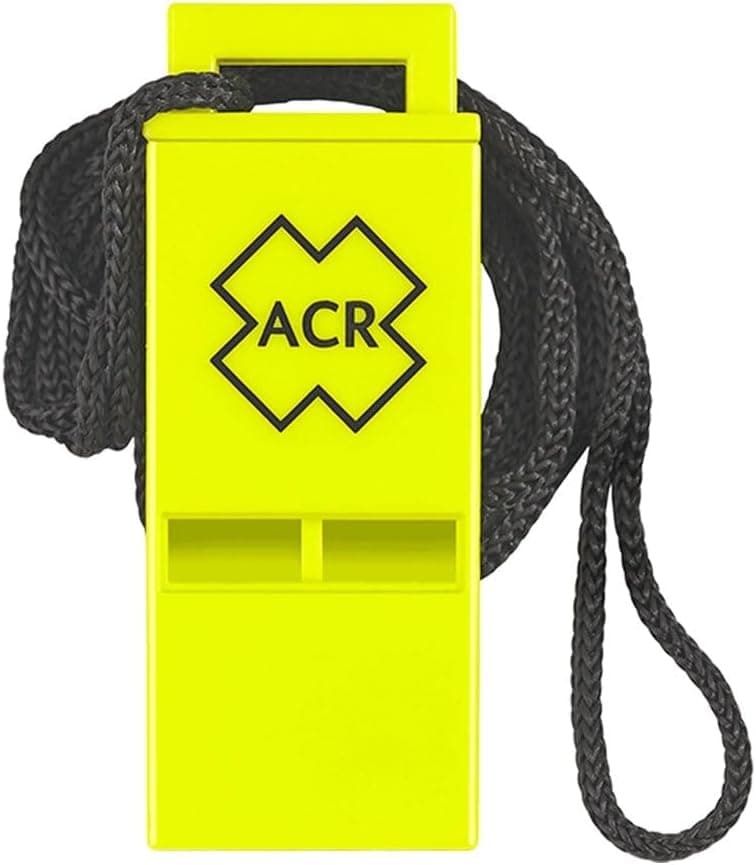
ACR's WW-3 Res-Q whistle on a lanyard (2228, carded), which ACR says gives a shrill dual tone up to 100 decibels, has a flat design that does not hold water, and meets USCG requirements; ACR gives no measuring distance. Rule 33(b) lets a vessel under 12 m skip the whistle and bell but, if it does, it must have some other means of making an efficient sound signal. The Coast Guard Auxiliary's voluntary Vessel Safety Check accepts mouth horns or whistles on a boat under 39.4 ft, and its form asks for a 4-second blast audible for half a mile.
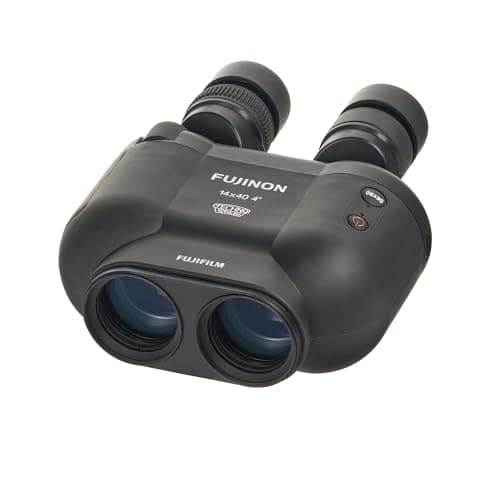
Fujifilm's 14x40 stabilized binocular (TS-X1440): a gyro and gimbal rated to correct ±6°, which Fujifilm says corrects vibration from ocean waves as well as hand shake. It runs about 30 hours on four AA cells, depending on battery type and conditions, weighs 1,300 g without batteries, has a 2.9 mm exit pupil and centre focus, and passed a 1 m, 5-minute water test, but Fujifilm says it is not usable underwater. Fujifilm calls the body non-sinking.
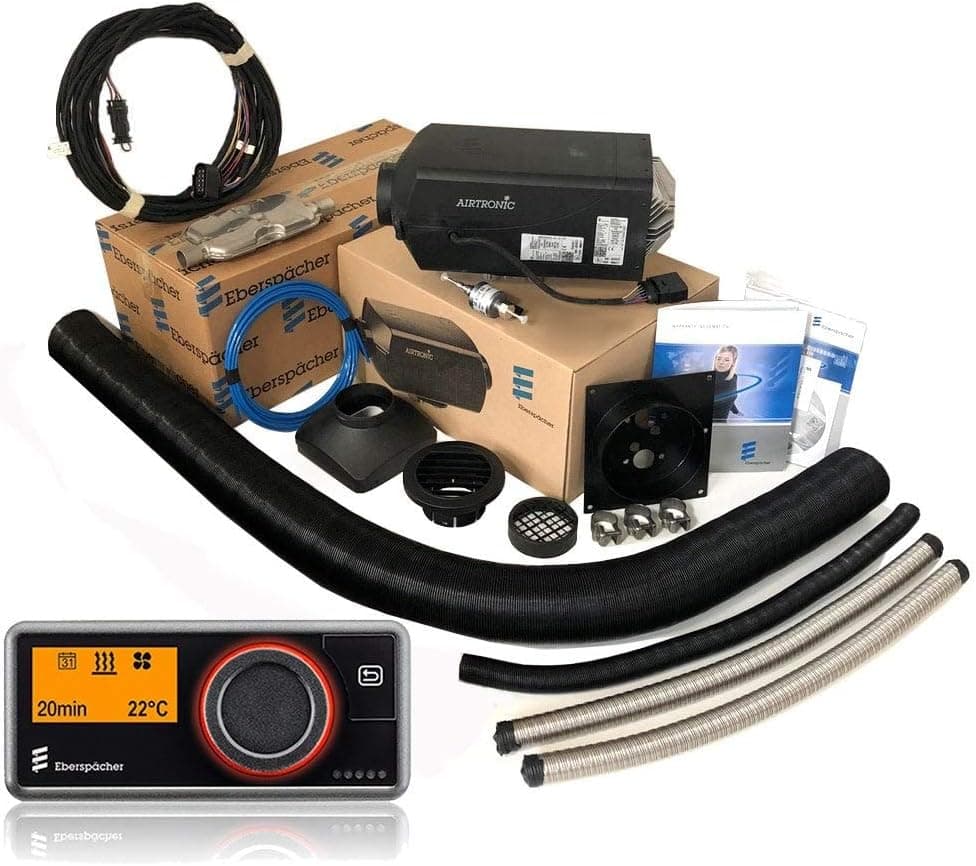
On paper it is close to the Webasto: 850–2,200 W of heat, 0.10–0.28 l/h of diesel and 6–31 W running draw, by Eberspächer's figures. Its technical description is a vehicle-heater document: it lists boats, ships and yachts among the uses for the diesel versions, but says further installation information for boats and ships is available from Eberspächer on request. Eberspächer's boat brochure says to ask your Eberspächer service partner about its marine kits for air heaters, and the technical description says to have the heater installed only by a service partner authorised by Eberspächer. The timer comes with the EasyStart Pro controller, which only some kits include.
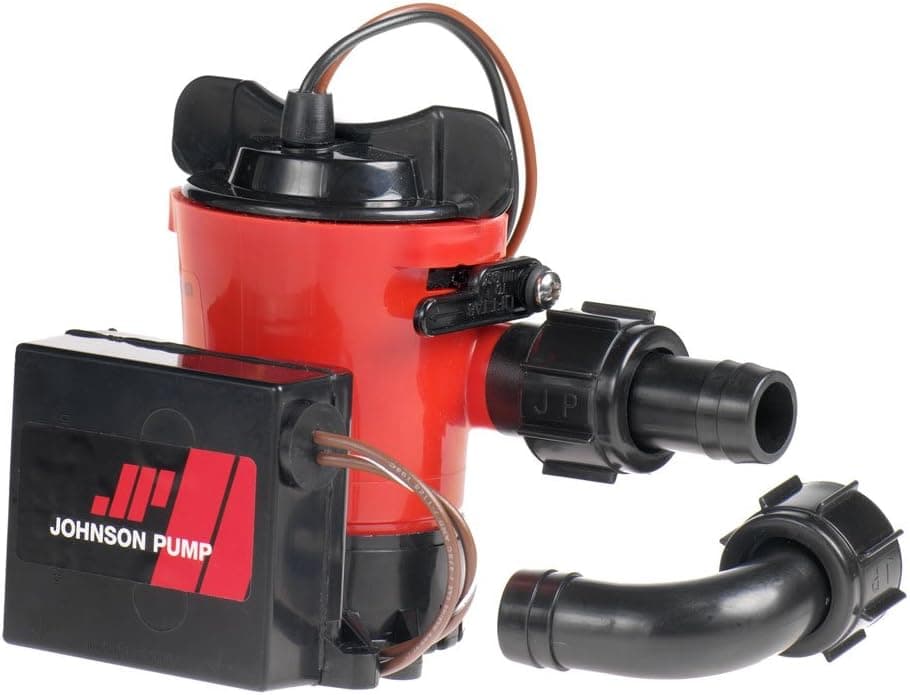
Johnson Pump's automatic submersible bilge pump (07903-00), rated at 1,000 GPH straight and 800 GPH at 3 ft of head, both at 13.6 V. Johnson lists a 3.2 A draw on a 5 A fuse, a 3/4 in hose connection and a removable check valve. Johnson says bilge pumps are for standing water, not damage control, and may not keep up with storms or leaks from damage.
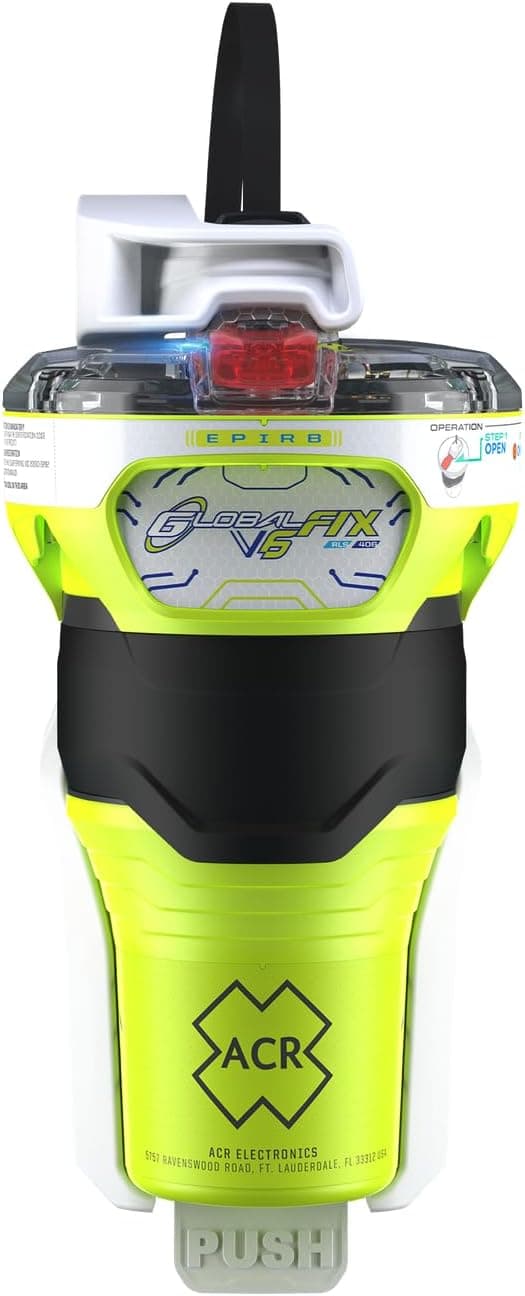
The same GlobalFix V6 in its Category II manual bracket (ACR's US part 2854). ACR says it is taken out of the bracket and switches on in contact with water, warns not to leave it in the bracket if the boat is in danger of sinking, and says never to tether it to the boat. GPS, Galileo and GLONASS, Return Link Service, no AIS; 10-year battery replacement, by an authorized center only. Check it is coded for the US and register it with NOAA.
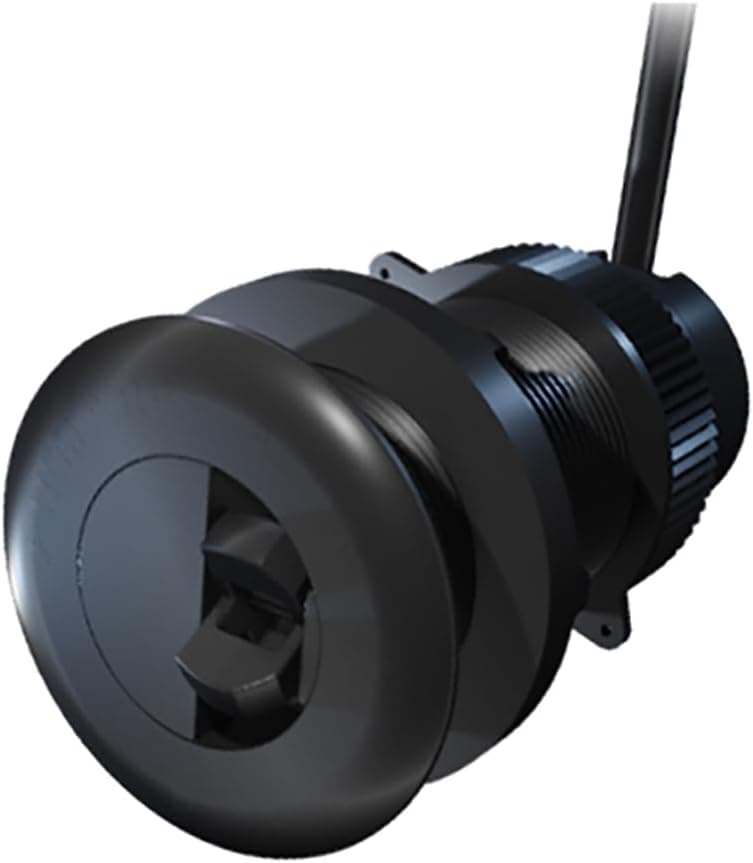
Airmar's depth, speed and temperature sensor in one through-hull fitting, sold by Raymarine with a 2.5 m cable and a SeaTalkng connector, so it plugs straight into a SeaTalkng network. Its Gen2 paddlewheel starts reading at 0.3 knots, and a built-in attitude sensor lets Airmar's CAST app calibrate speed across heel angles. The housing is plastic, for fiberglass or metal hulls: never fit plastic in a wooden hull. Airmar says the housing's valve is not a watertight seal: the insert or blanking plug must always be refitted, fully inserted, with the cap nut screwed on completely and the safety wire attached.
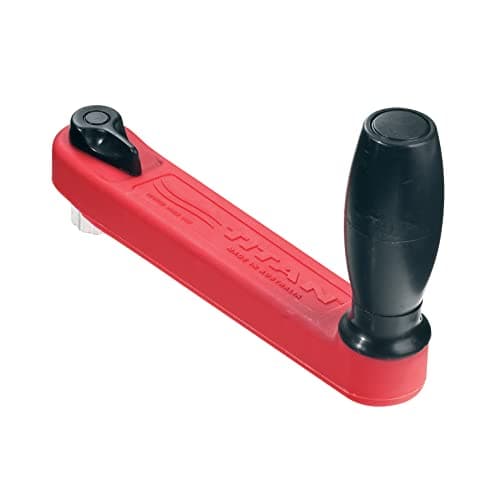
Lewmar sells its standard alloy winch handle with or without a lock, and frames the choice as security against the flexibility of a traditional design. Eight inches grinds faster; Harken says it gives 20% less power than a 10-inch and suits smaller boats and light air. Either way, take it out of the socket when you are not winding — Lewmar's own manual says so.
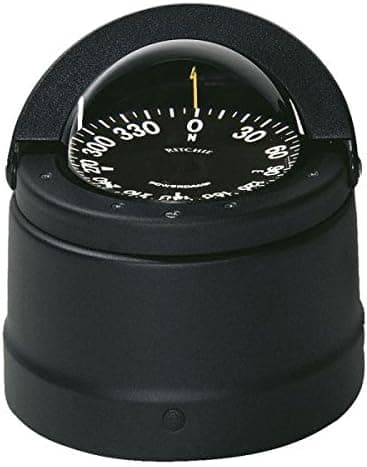
Ritchie's binnacle compass (DNB-200) for a steering pedestal, with a 4-1/2 in (115 mm) PowerDamp dial, built-in compensators and green 12 V LED lighting, with 24 V and 32 V options. Ritchie says it fits common sailboat steering pedestals and suits power and sail, that the pedestal maker usually sets the mounting surface, and that throttle and gearshift linkages must not touch its compensator rods.
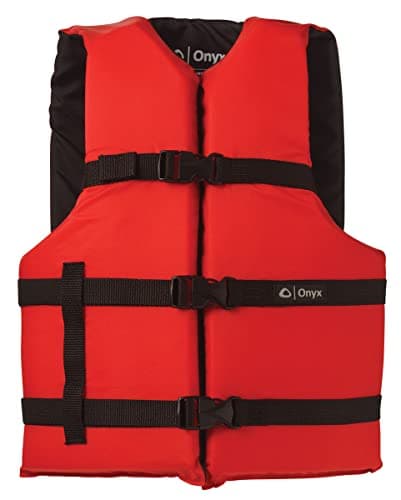
A plain foam vest for adults 90 lb and over (red, universal size, item 103000-100-004-12), which Onyx says is USCG and Transport Canada approved; Onyx states no Level or Type, so read the label. Foam floats with no action needed, and the Coast Guard says inflatables are not appropriate for weak swimmers or non-swimmers.
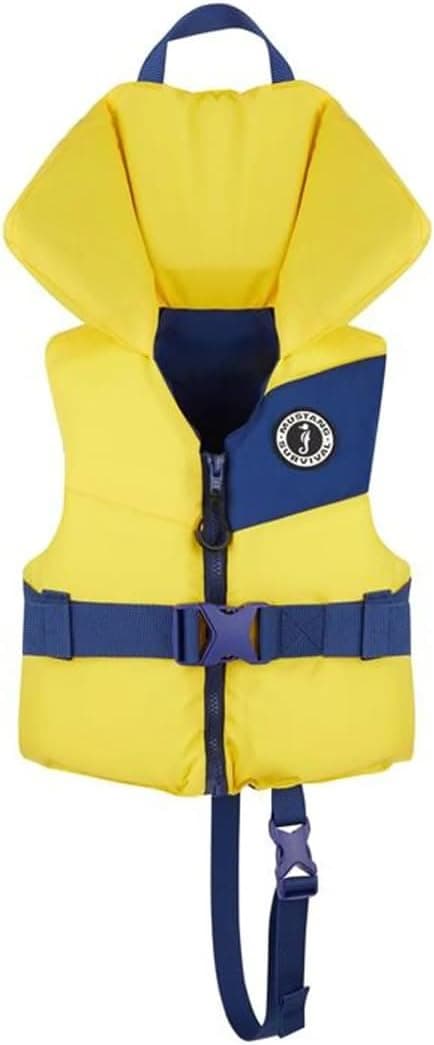
Mustang's foam vest for infants up to 33 lb (15 kg), approved as Harmonized Level 70 by the USCG and Transport Canada, with a built-in crotch strap, a grab loop and a three-piece head collar. Mustang raised the range from 30 lb, so older labels may say 30 lb: go by the weight on the label of the vest you receive. Mustang warns against buying a child's jacket a size up to grow into.
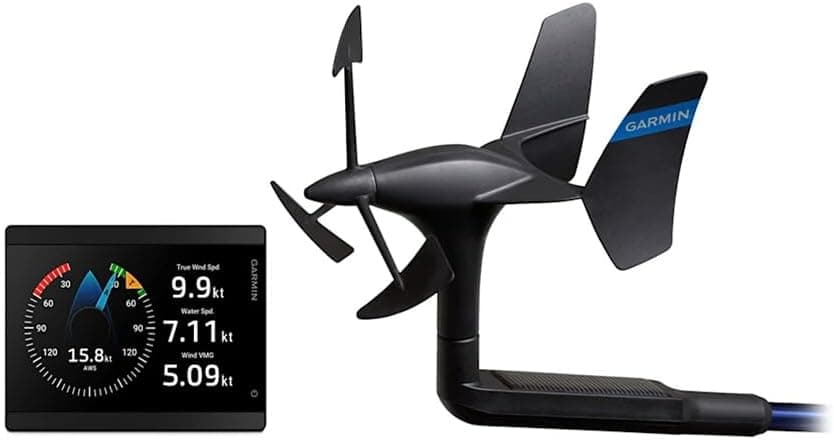
The gWind Wireless 2 masthead sensor bundled with a GMI 40 instrument display that receives its ANT signal, as Garmin part 010-03411-60. For the NMEA 2000 network, Garmin's pack also includes a 2 m backbone/drop cable, two T-connectors, a power cable and terminators. The sensor is rated for masts up to 50 ft, with a solar-charged battery Garmin says lasts three years.
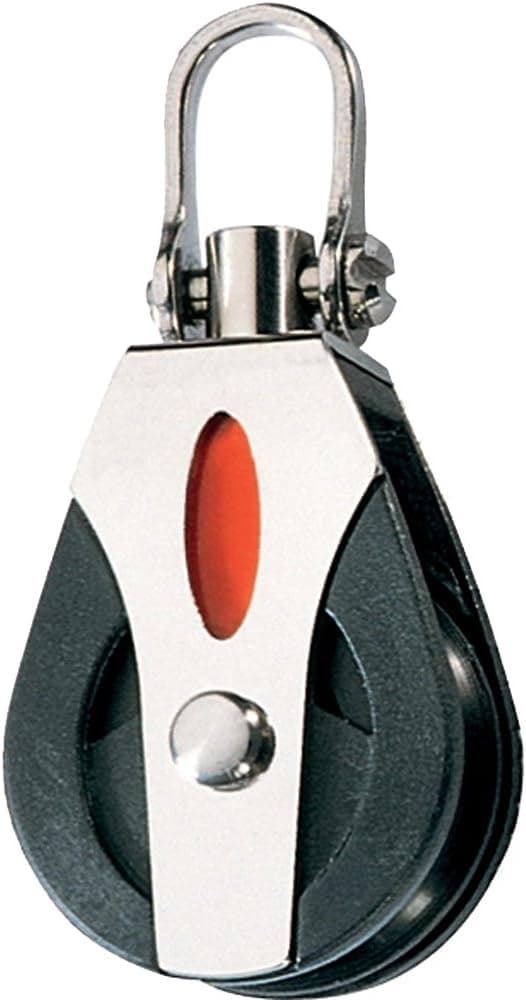
A small ball-bearing block. Harken rates ball bearings as very low friction with low to medium load capacity, and Seldén says ball-bearing blocks are used where loads are more moderate and dynamic. That is a different job from a halyard turning block, which Ronstan says may stay highly loaded for hours and for which it says a full-contact or plain bearing is often better suited.
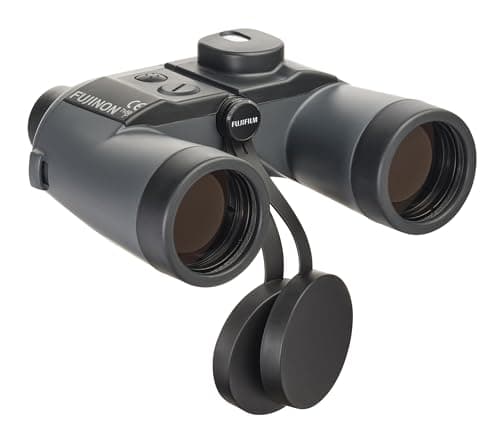
Fujifilm's Mariner 7x50 with a compass (WPC-XL), which Fujifilm rates at ±0.5° maximum error, usable in both hemispheres and internally lit, with 2 x LR43 batteries included. It is nitrogen-filled, individually focused and 910 g without battery, with a 7.1 mm exit pupil, and water resistant to 1 m for 5 minutes, which Fujifilm says does not mean it can be used in water. A flotation neck strap is included.
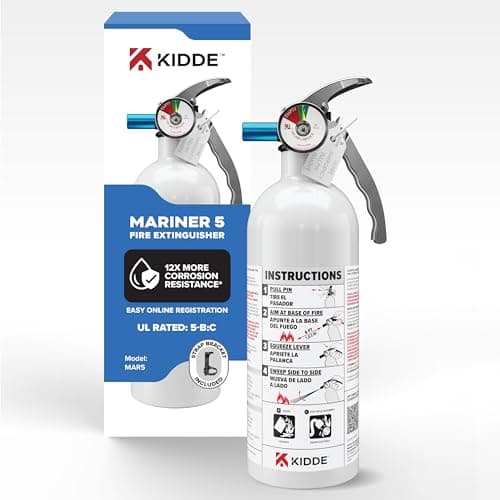
Kidde's single-use marine extinguisher (MAR5), UL rated 5-B:C, with 2.00 lb of agent on its data sheet. Kidde says it is USCG approved with the UL-approved strap bracket that comes with it (322057). The Coast Guard says a disposable extinguisher must be removed from service 12 years after the date of manufacture stamped on it, and that the year is generally on the bottom or next to the UL label.
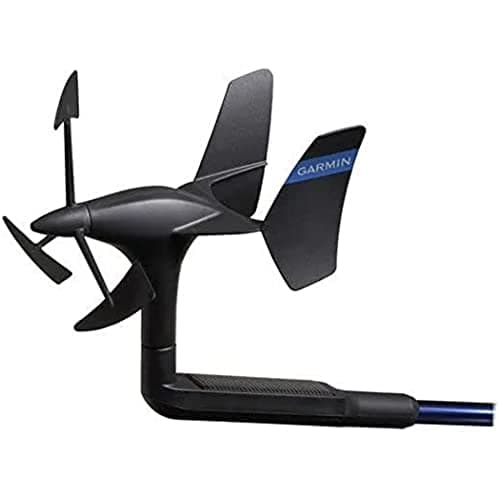
A wireless masthead wind sensor that measures speed with a three-bladed propeller and angle with a twin-fin vane, so there is no cable to run down the mast. It sends over ANT to a Garmin receiver — Garmin names its GNX Wind instrument and compatible GPSMAP plotters — and is rated for masts up to 50 ft. A solar panel charges the battery, which Garmin says lasts three years. Garmin also sells it bundled with an ANT-equipped GMI 40 display as the GMI 40 Wireless Wind Pack.
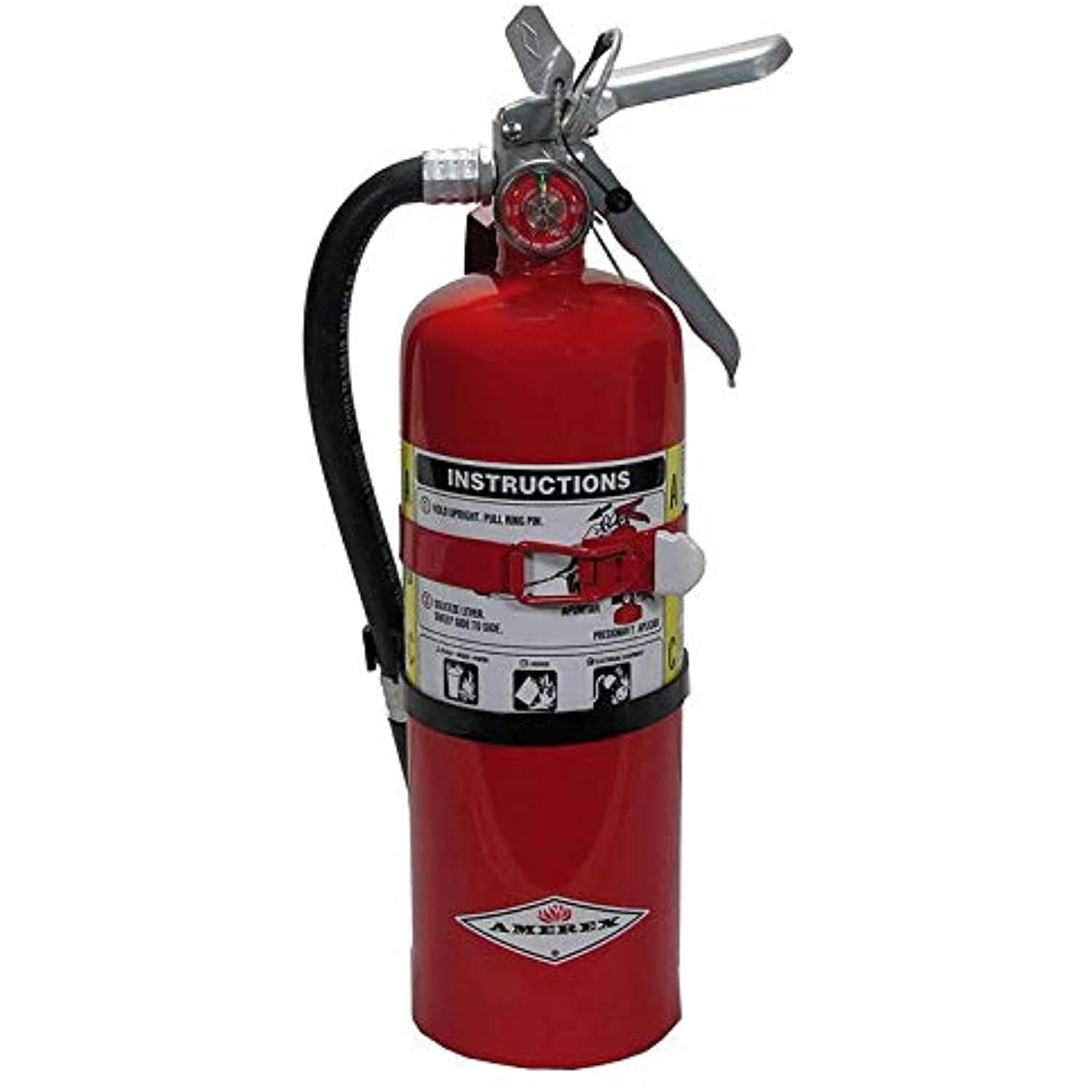
Amerex's 5 lb ABC dry chemical extinguisher with an aluminum valve, rated 2A:10B:C, supplied with its 818 vehicle bracket, which is on Amerex's list of USCG brackets. Amerex offers USCG approval as an option, with the bracket listed on the UL label, so check the label. It still counts as one 5-B. Amerex strongly recommends that maintenance be done by a trained professional, such as an authorized Amerex distributor.
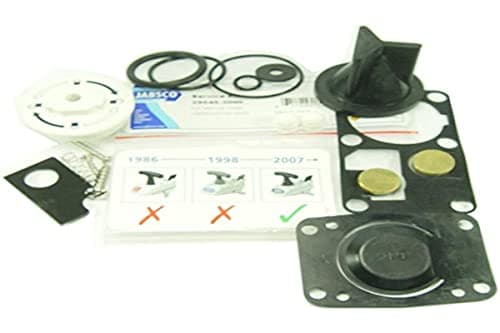
Jabsco's service kit for Twist 'n' Lock manual toilets built from 2008, which Jabsco says contains all the wearing parts. Older toilets take a different kit: 29045-2000 for 1998 to 2007, and 29045-0000 up to 1997. Jabsco says its manual toilets normally need no maintenance in season if they are winterized in the autumn and overhauled in the spring, though it still advises regularly checking all fastenings for tightness and leaks.
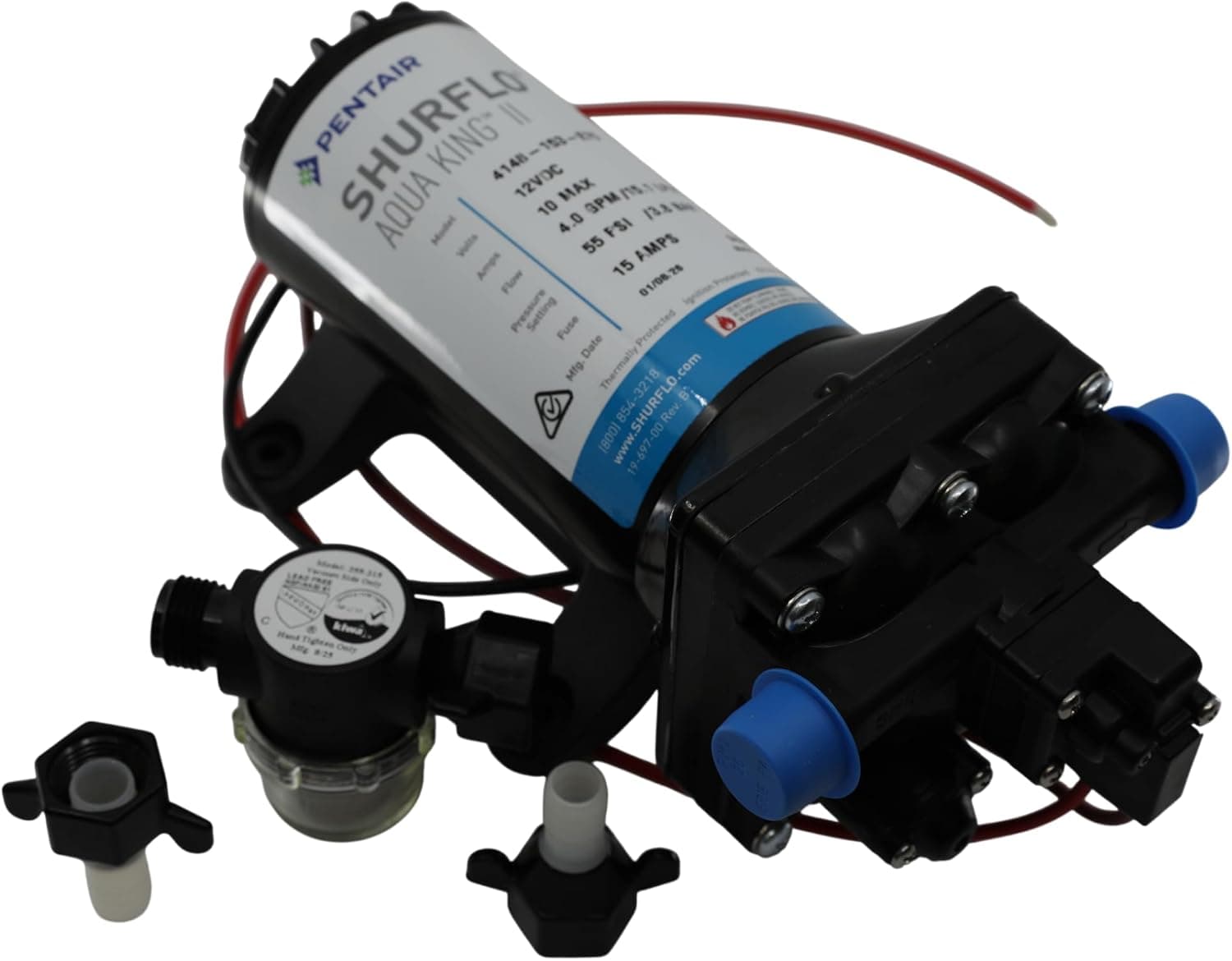
Shurflo's 12 V freshwater pump (4148-153-E75), rated for up to four fixtures: 4.0 GPM at 0 psi falling to 2.0 GPM at 40 psi, shutting off at 55 psi and restarting at 40 psi, on a 15 A fuse. Shurflo requires a 50-mesh inlet strainer and plumbing of at least 1/2 in inside diameter, and says to switch the pump off whenever the boat is unattended.
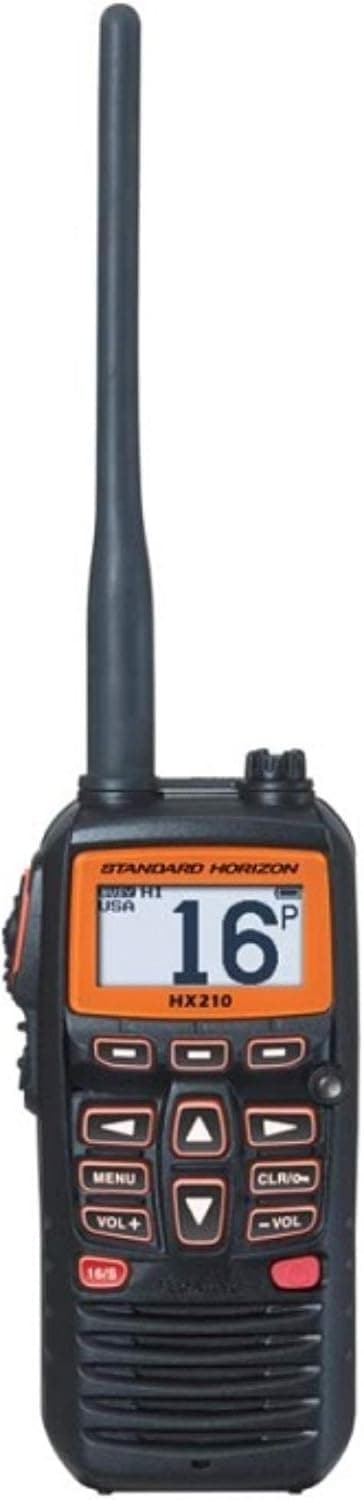
Floats face up and is IPX7 submersible (1 m for 30 minutes), both only with the speaker-mic cap fitted and properly sealed, by Standard Horizon's figures. A water-activated light blinks when it lands in the water, even with the radio off; it is a menu setting, so check it is on. It has no DSC distress button. Icom UK recommends carrying a handheld like this as backup to a fixed set, in case the boat loses power.
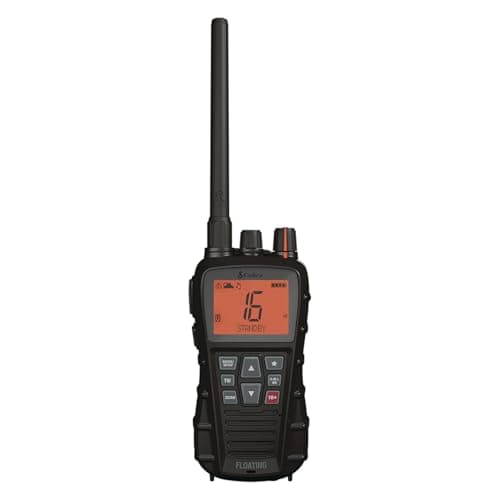
Charges in the included USB-C dock, which has a second slot for a spare battery; 12 V and AC adapters are in the box. An orange floating core keeps it up, and Cobra's Float n' Flash points the antenna down and flashes an LED until it is recovered. Rated IPX7; Cobra's product page gives no depth or time. No DSC.

Orion's 12-gauge launcher with a hammer safety lock and four aerial flares (item 584), which Orion says is meant to be combined with hand-held red and orange smoke signals. Orion gives the aerials up to 500 ft, 16,000 candela and 7 seconds each. Red aerial flares count for day and night, and Table 175.130 requires three. Orion says its launchers are for Orion signals only, and to fire aerials after sighting or hearing a potential rescue vessel.
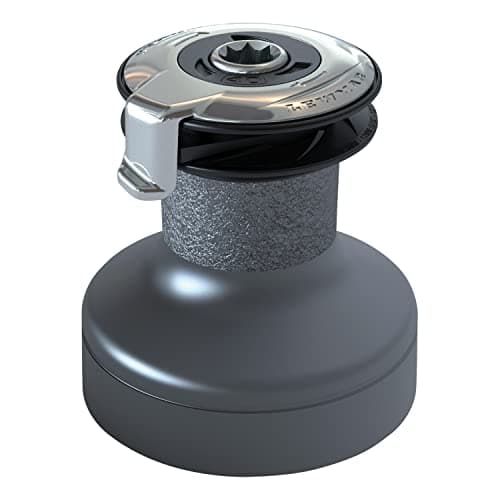
Self-tailing jaws with the same 8–12 mm range as the 15ST, plus a second gear: power ratios of 13.8:1 in first and 29.2:1 in second, by Lewmar's figures. Size it from the maker's chart rather than by feel — our winch guide walks through Lewmar's, Harken's and Andersen's. It bolts down on a 113 mm circle, the same as Lewmar's Ocean 30.
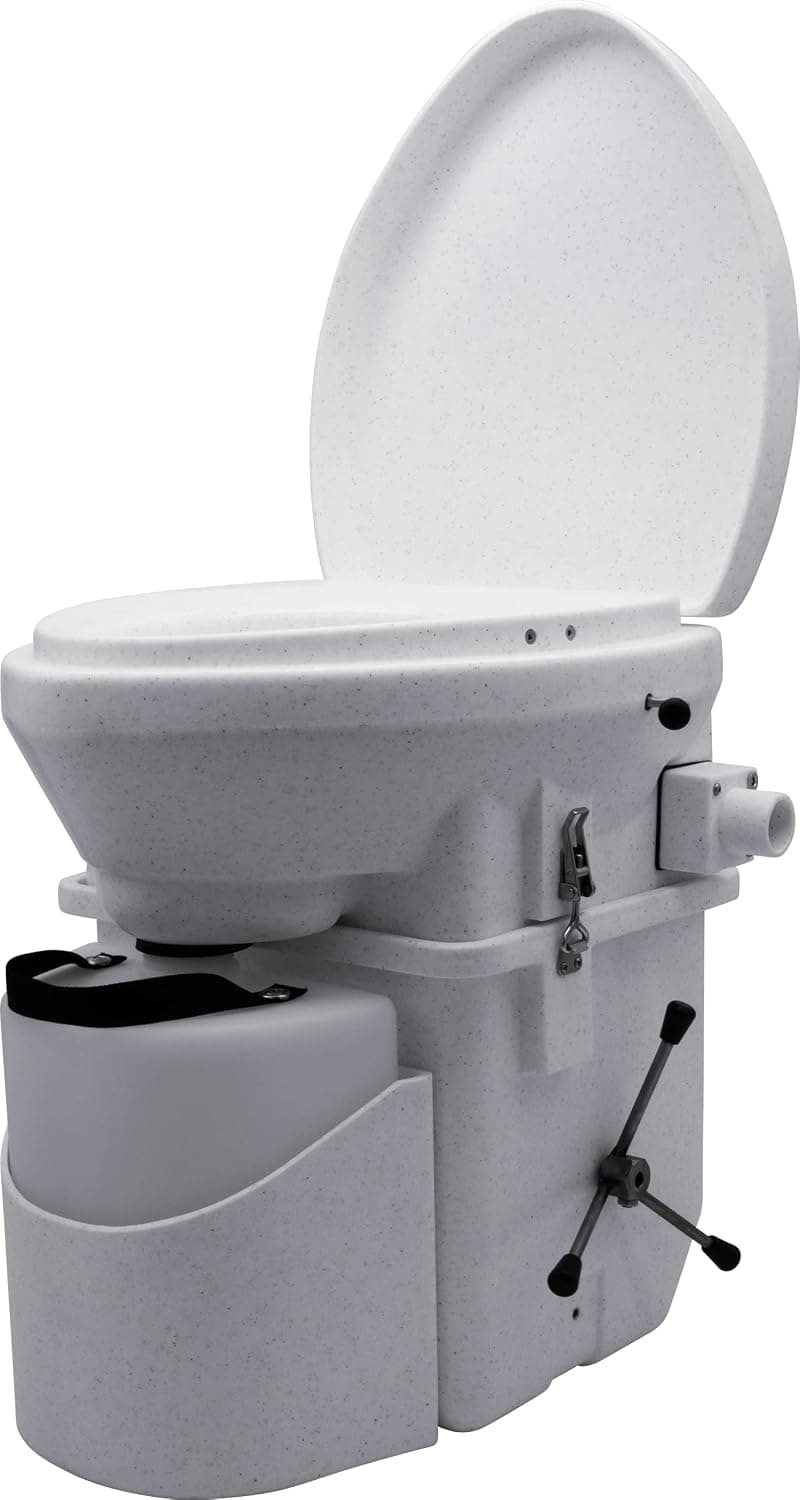
A composting toilet that sends liquids to a separate 2.2-gallon bottle; Nature's Head says the solids bin holds about 60 to 80 uses. Its fan runs continuously on less than 1.8 amp-hours a day from a 12 V hookup, with a fuse and holder supplied, but the exterior vent parts are sold separately. Nature's Head says it meets USCG requirements for a Type III head; EPA notes that most composting toilets have not been examined by the Coast Guard.
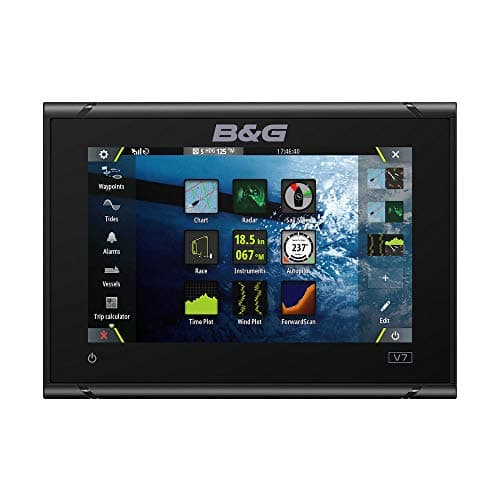
A sailing chartplotter that B&G aims at coastal cruising and club racing, with SailSteer, laylines that can correct for tide, a race panel and a wind plot. On power alone it is a plain chartplotter. B&G says to get the most from the sailing data you start with a wind sensor, then add a boat-speed sensor and a compass on the NMEA 2000 network, though its manual lets GPS speed and course stand in for boat speed and heading in the true-wind calculations. This is the no-transducer model, so budget for one if you want depth.
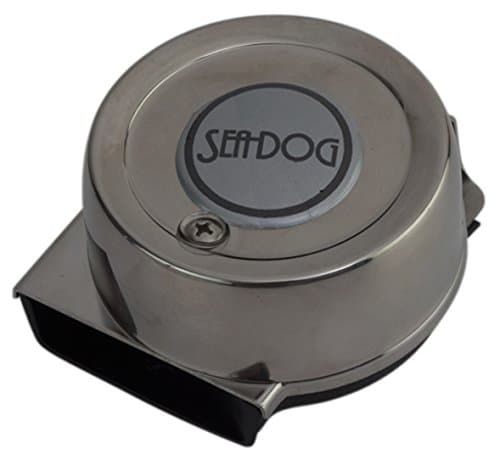
Sea-Dog's 12 V single mini compact horn with a stainless cover, which Sea-Dog says gives 108 dB at 440 ± 20 Hz and meets COLREGS and ABYC A-23 for vessels under 12 m (39 ft); it gives no measuring distance for the 108 dB. The Amazon listing quotes different figures (110 dB, 4 A) and shows no part number, so check the box. You supply a 5 A horn button and a 5 A fuse.
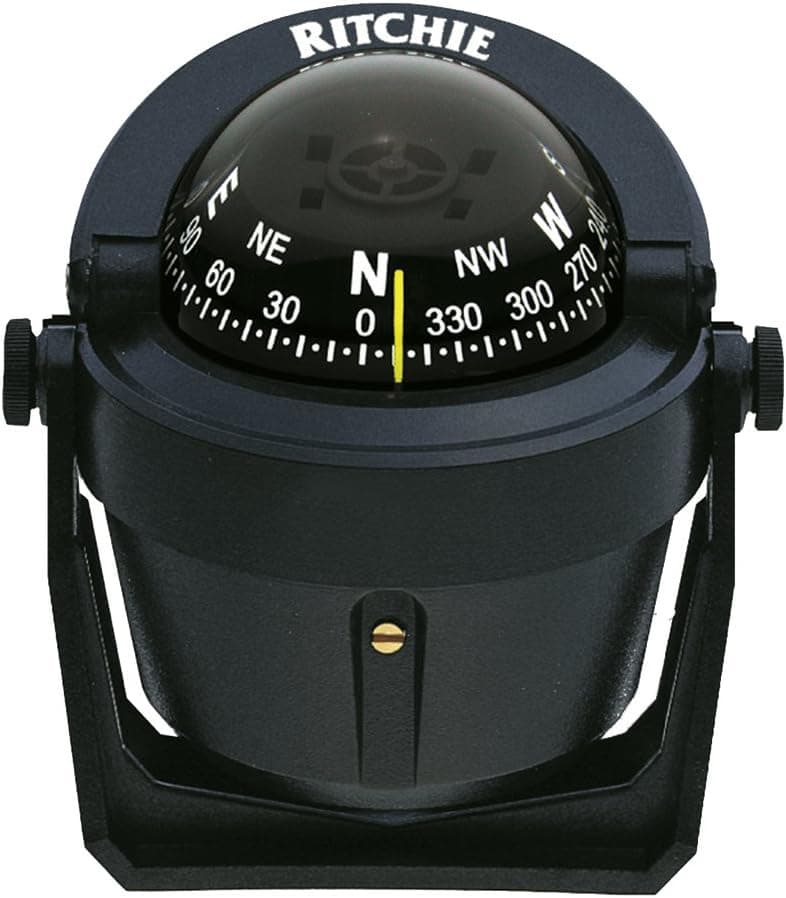
Ritchie's bracket-mount compass (B-51), with a 2-3/4 in (70 mm) direct-reading dial on a removable bracket with thumbscrews, built-in compensators, and green lighting at 12 V as standard, with 6 V and 24 V options. Ritchie balances its compasses for Zone 1, 'essentially all of the northern hemisphere', as standard, and says to wire the light to a fused circuit, allowing one amp for the compass, with a 1 A fast-acting fuse recommended for a standalone compass circuit.
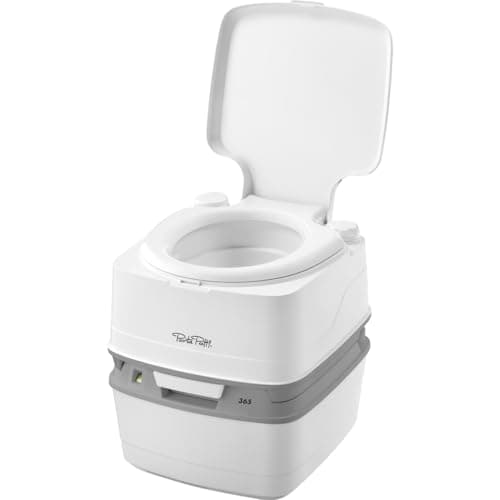
Thetford's portable toilet, with a 5.5-gallon waste tank, a 4-gallon fresh-water tank and a piston-pump flush, at 16.29 x 15.07 x 16.81 in (HxWxD). Thetford says to carry the separated waste tank to a permanent toilet to empty it. EPA says the MSD requirements do not apply to vessels without installed toilets, such as boats with only a porta-potty.
We pick marine gear we would fit ourselves, say plainly why, and link you to where it is sold. You buy from the retailer directly.
A short list someone actually stands behind.
We show no prices of our own — you see the retailer’s, current.
Nobody can buy a spot on this list.