

Photo: garrett parker on Unsplash
Handheld VHF radios, explained
A handheld VHF is the radio that still works when the boat's power doesn't, and the one you can take into the tender. What it can reach depends mostly on how high its antenna is; what happens when it goes over the side, and whether it can send a DSC distress alert, come down to a handful of specs. This guide covers each of them. Every factual statement links to the radio maker's page or manual, or to the FCC, Coast Guard, NOAA or IEC source it came from.
This guide links to products on Amazon. If you buy through those links we may earn a commission, at no extra cost to you. Each one is marked “paid link”. More in our affiliate disclosure.
Published October 11, 2026
Handheld or fixed
Icom UK says range is the main factor in choosing between a fixed and a handheld VHF, and that fixed radios outrange handhelds because of their higher power — generally 25 W — and their external antenna.[1][2]
A handheld has its own battery and antenna, so it keeps working if the boat's electrical power fails. Icom UK recommends fitting a fixed radio and carrying a handheld as backup for that reason, and lists handhelds for small boats without a battery and as personal radios for crew and tenders.[3][1][2]
On its own, Icom UK says a handheld should be enough within a mile or two of the coast, and advises a radio check to confirm it. For trips more than a few miles offshore, the Coast Guard advises adding a second VHF radio or a cell phone, an EPIRB, and an MF/HF radio or satellite phone.[1][4]
The Coast Guard calls a VHF marine radio the single most important radio a boater should buy, and does not endorse cell phones as a substitute. A distress call by cell phone is heard only by the one party you call; the Coast Guard does not monitor cell calls, and nearby boats cannot hear them.[4][5][6][7]
Power and range
Antenna height
Standard Horizon says range depends far more on the antenna — its type, gain and height — than on transmit power, and the Coast Guard says VHF coverage depends essentially on antenna height. Standard Horizon adds that the same radio reaches much further with its antenna 20 ft above the water.[8][9][11]
Handhelds transmit at lower power. Icom UK says its handhelds typically run 1–6 W, and to expect no less than 5 W from a handheld and at least 25 W from a fixed set. Under FCC rules a marine VHF ship station may not exceed 25 W and must be able to drop to 1 W or less.[3][2][10]
Standard Horizon gives more than 5 miles for a 5 W portable and more than 15 miles for a fixed 25 W set, both line of sight, and says a handheld on its stock antenna at sea level may only reach a mile or two. The Coast Guard describes VHF as short-range, generally 5 to 10 miles.[8][11][4]
The Coast Guard's Rescue 21 coverage charts are predictions for a boat transmitting 1 W or more, line of sight from an antenna six feet above the water.[12]
The FCC advises trying 1 W first for stations within a few miles, and switching to high power only if there is no answer. Icom UK notes that higher power shortens a handheld's battery life, and Standard Horizon's HX210 drops to 1 W on its own on bridge channels 13 and 67.[13][3][8]
Waterproof ratings
IEC 60529 defines IPX7 as temporary immersion of up to 1 m. Makers commonly state it as 1 m for 30 minutes; Standard Horizon does for the HX210.[14][8]
IPX8 has no fixed depth or time. IEC 60529 calls it continuous immersion under conditions agreed with the maker, so each maker sets its own: Uniden rates the Atlantis 155 IPX8 to 1.5 m for 30 minutes, and Standard Horizon its HX891BT the same.[14][15][16]
Icom UK recommends a submersible (IPX7) handheld over a splash-proof (IPX4) one.[2]
A rating holds only with the seals closed. The HX210 is submersible only with the cap fitted in its speaker-mic jack, and Uniden says to check the Atlantis 155's battery-compartment seal and replace it if it is worn, nicked or dried out.[8][15]
Floating, and finding it again
Float and flash
Icom UK notes that some handhelds, not all, have a strobe to help find them in the water. Of the radios here, the HX210 has a water-activated light (a menu setting that can be switched off) and Cobra's Float n' Flash flashes an LED on the BlueBound 350 until it is recovered; Uniden lists none for the Atlantis 155.[2][8][17][15]
Not every handheld floats on its own. Standard Horizon's HX40 floats only in its optional flotation case.[18]
Floating depends on the seals too. Standard Horizon warns that if water gets into the HX210 it will not float, and Uniden says the Atlantis 155 floats when its battery cover is securely fastened.[8][15]
The HX210's water-activated light blinks white when the radio touches water, whether it is switched on or off, and turns itself off about 15 seconds after the radio leaves the water. It is a menu setting and can be switched off, so check yours is on.[8]
Cobra's Float n' Flash floats the BlueBound 350 antenna-down and flashes an LED until it is recovered.[17]
DSC and the distress button
The distress button
On a radio with DSC, the FCC says a distress button sends your identity — and your position, if the radio has GPS — to the Coast Guard and other rescuers.[10]
None of the three handhelds we list has DSC. Standard Horizon's feature list for the HX210 includes none; Uniden's channel chart shows the Atlantis 155 cannot transmit on channel 70, the DSC channel; and Cobra lists DSC and GPS only for its BlueBound 650, not the 350.[8][15][19]
Handheld VHFs are not required to have DSC. Some do, and the US GMDSS Task Force says it is most useful on those with built-in GPS. Every fixed-mount marine radio certified by the FCC since 1999 must have it.[7][20]
Your identity is your MMSI, a nine-digit number. The FCC says a radio's DSC features cannot be used until an MMSI is programmed into it.[21][22]
Your position goes out only if the radio has built-in GPS or is connected to one, and the Coast Guard advises buying a radio with a GPS receiver. It says missing or invalid positions make a real distress much harder to tell from an accidental alert.[23][24]
Expect to enter the MMSI once. By international agreement, a stored MMSI should be changeable only with the manufacturer's cooperation: Standard Horizon's HX891BT takes one entry, and changing it needs reset codes from Standard Horizon.[25][16]
Where the number comes from matters for a handheld. Boats that need no FCC licence can get an MMSI from BoatUS, Shine Micro or the US Power Squadrons, and these work only domestically. The Coast Guard says a BoatUS or Power Squadrons MMSI is a ship-station number and should not go in a handheld unless that handheld stays with one boat, and that only the FCC and Shine Micro issue handheld-format MMSIs.[10][21][26]
Never test a DSC radio with a distress alert; the Coast Guard says to send a DSC test call to 003669999 instead. If you send a distress alert by accident, cancel it from the radio at once and announce the cancellation on channel 16 — and don't switch the radio off to cancel it, because most radios resume sending it when powered back on.[20][23]
Channels
Channel 16 is the worldwide distress, safety and calling channel, and the Coast Guard recommends boaters normally stay tuned to it. Channel 9 is a supplementary calling channel for recreational boaters, and the place for voice radio checks with other boats; the Coast Guard does not monitor it. Channel 70 is reserved for DSC, with no voice allowed.[27][4][20]
Channel sets are a legal matter, not a feature. Some international channels may not be used in US waters, and a radio left in international mode may be unable to reach a US shore station on some channels: it tunes channel 22 rather than the Coast Guard's 22A, which newer radios also number 1022.[28][29][30]
Being able to tune a channel doesn't make it legal to use: Icom notes its IC-M94D can tune channels the public may not use in US waters. The HX210 and the Atlantis 155 both offer USA, International and Canadian sets, and Standard Horizon says to set the one for your region.[31][8][15]
Weather alerts
The weather channels carry NOAA broadcasts and are receive-only. NOAA Weather Radio broadcasts around the clock on seven frequencies between 162.400 and 162.550 MHz, and typically reaches about 25 nautical miles offshore.[13][32][33][34]
Don't rely on the alert alone. The National Weather Service says few marine VHFs have SAME, that most alert best when left on an active weather channel rather than scanning, and that the 1050 Hz alert tone may not be sent for marine events — so a tone-triggered alert can stay silent. It recommends a separate weather receiver so you can watch weather and VHF channels at once.[34]
The HX210's weather alert ships switched off and has to be turned on in the menu.[8]
Batteries and charging
A battery-life figure assumes a pattern of use, and makers don't all say which. Cobra rates the BlueBound 350 at 12 hours at 90% standby, 5% transmit and 5% receive; Icom rates its IC-M94D at about 10 hours on the same split, written 5:5:90; Uniden gives the Atlantis 155 about 10 hours 'typical' without saying what that assumes.[19][17][35][15]
Batteries differ in kind, too. The HX210 has a built-in 1850 mAh lithium-ion battery that is replaced through a dealer or Standard Horizon's service; the Atlantis 155 runs on four rechargeable AAA NiMH cells; the BlueBound 350's lithium-ion pack is removable.[11][8][15][17]
Standard Horizon says to recharge a stored HX210 every six months.[8]
Licences
A recreational boat that operates only domestically, as the FCC defines it below, generally needs no FCC licence for a VHF radio. The FCC says no licence is needed aboard a 'voluntary' ship — one not required by law to carry a radio, which generally means a recreational boat — while it operates domestically, and the Coast Guard says the same of a handheld.[36][37]
'Domestically' means visiting no foreign ports and not talking to foreign stations; sailing in international waters is fine on those terms. Visiting a foreign port such as Canada, Mexico or the Bahamas requires a ship station licence and a Restricted Radiotelephone Operator Permit, which needs no test and lasts for life, though FCC fees apply.[36][13]
Licensed or not, boaters must follow the FCC's procedures for calling, keeping a safety watch and relaying distress messages. The Coast Guard says the FCC allows a portable marine VHF ashore only next to the water, such as on docks and beaches, only for the needs of its vessel, and with transmissions kept as short as practicable.[13][26]
The handhelds we list
| Standard Horizon HX210 | Uniden Atlantis 155 | Cobra BlueBound 350 | |
|---|---|---|---|
| Transmit power | 6, 2.5 or 1 W | 3 or 1 W | 6, 3 or 1 W |
| Waterproof | IPX7: 1 m for 30 min, with the speaker-mic cap fitted | IPX8: 1.5 m for 30 min | IPX7 (depth and time not on Cobra's pages) |
| Floats | Yes, face up, with the speaker-mic cap sealed | Yes, with the battery cover fastened | Yes, orange floating core |
| Light in the water | Water-activated light; can be switched off | None listed | Float n' Flash LED |
| DSC and GPS | No | No | No |
| Battery | Built-in 1850 mAh lithium-ion | Four AAA NiMH cells | Removable lithium-ion pack |
| Stated battery life | — | About 10 h (use not stated) | 12 h at 90% standby, 5% transmit, 5% receive |
| Charging | Cradle, from AC or 12 V; about 3 h | 12 V cord into the radio; 13 h from empty | USB-C dock with a spare-battery slot |
| Weather alerts | NOAA; off until switched on | NOAA weather channels and alerts | NOAA and Canadian weather, with alerts |
| Weight | About 280 g (9.9 oz) | 242 g (8.5 oz) with batteries | — |
| Warranty | 3-year waterproof | 3-year waterproof | 3-year |
 Standard Horizon · Marine Electronics
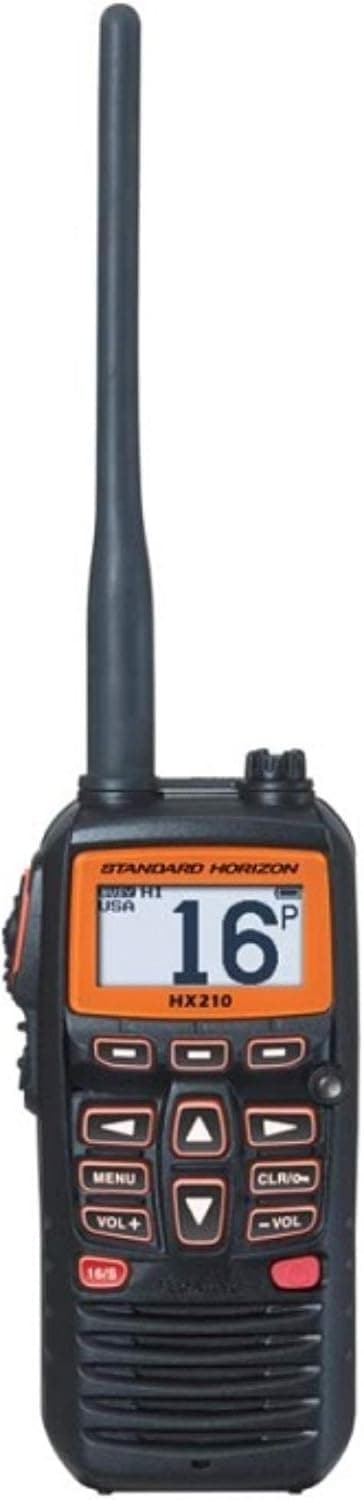
Standard Horizon HX210 Handheld VHF
Floats face up and is IPX7 submersible — 1 m for 30 minutes with the speaker-mic cap fitted, by Standard Horizon's figures. A water-activated light blinks when it lands in the water, even with the radio off; it is a menu setting, so check it is on. It has no DSC distress button. Icom UK recommends carrying a handheld like this as backup to a fixed set, in case the boat loses power.
View on Amazonpaid link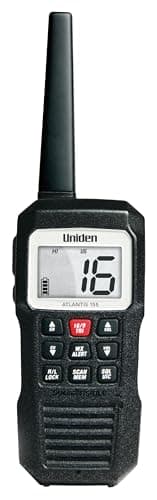 Uniden · Marine Electronics
Uniden Atlantis 155 Handheld VHF
Uniden rates it IPX8 to 1.5 m for 30 minutes, and says it floats when the battery cover is securely fastened. At 3 W it sits below the 5 W Icom UK says to expect from a handheld, its four AAA cells take 13 hours to charge, and it has no DSC — which makes it a spare, tender or crew radio rather than your only VHF.
View on Amazonpaid link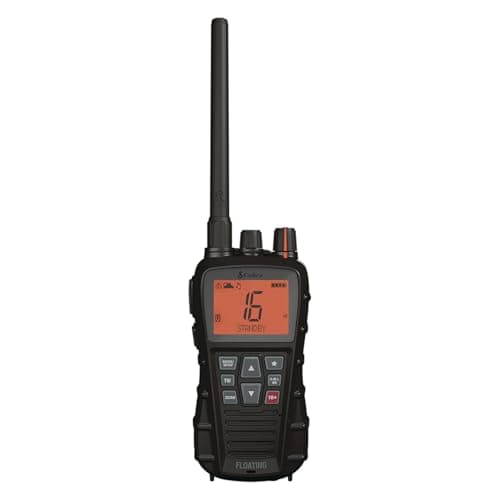 Cobra · Marine Electronics
Cobra BlueBound 350 Handheld VHF
Charges in the included USB-C dock, which has a second slot for a spare battery; 12 V and AC adapters are in the box. An orange floating core keeps it up, and Cobra's Float n' Flash points the antenna down and flashes an LED until it is recovered. Rated IPX7; Cobra's product page gives no depth or time. No DSC.
View on Amazonpaid link
What this guide leaves out
Fixed-mount radios and their antennas, AIS, and EPIRBs and personal locator beacons. Each deserves its own guide, and we have not yet sourced them well enough to publish. If you are buying a handheld as your only way to call for help, read the DSC section again: none of the three radios listed here can send a DSC distress alert.
Sources
- 1.Icom UK — Which should I buy, a fixed or a handheld VHF?
- 2.Icom UK — What to consider when choosing a VHF marine radio
- 3.Icom UK — A guide to marine radio
- 4.US Coast Guard NAVCEN — Radio information for boaters
- 5.US Coast Guard — A boater's guide to the federal requirements for recreational boats
- 6.US Coast Guard NAVCEN — Cell telephones on boats
- 7.US GMDSS Task Force — Recreational vessel information bulletin
- 8.Standard Horizon — HX210 owner's manual
- 9.US Coast Guard NAVCEN — How AIS works
- 10.FCC — Ship radio stations: equipment and MMSI
- 11.Standard Horizon — HX210
- 12.US Coast Guard NAVCEN — Rescue 21 distress system coverage
- 13.FCC — Ship radio stations: operating procedures
- 14.IEC — IEC 60529, degrees of protection (IP code), preview
- 15.Uniden — Atlantis 155 owner's manual
- 16.Standard Horizon — HX891BT owner's manual
- 17.Cobra — BlueBound marine radios (support)
- 18.Standard Horizon — HX40
- 19.Cobra — BlueBound 350
- 20.US Coast Guard NAVCEN — Performing a VHF marine radio check
- 21.FCC — Maritime Mobile Service Identities
- 22.FCC — VHF handheld stations
- 23.US Coast Guard NAVCEN — DSC distress alerts
- 24.US Coast Guard NAVCEN — Maritime Mobile Service Identity
- 25.US Coast Guard NAVCEN — MMSI frequently asked questions
- 26.US Coast Guard NAVCEN — MMSIs for VHF handhelds
- 27.US Coast Guard NAVCEN — Radio watchkeeping regulations
- 28.US Coast Guard NAVCEN — International VHF marine radio channels
- 29.Standard Horizon — HX370S owner's manual
- 30.US Coast Guard NAVCEN — US VHF channel information
- 31.Icom — IC-M94D instruction manual
- 32.NOAA National Weather Service — NOAA Weather Radio
- 33.NOAA National Weather Service — NOAA Weather Radio receivers
- 34.NOAA National Weather Service — Marine forecast dissemination
- 35.Icom America — IC-M94D
- 36.FCC — Ship radio stations: licensing
- 37.US Coast Guard NAVCEN — FCC radio licenses
- 38.Uniden — Atlantis 155
- 39.Cobra — BlueBound 350 VHF (support)