
Photo: Leslie Cross on Unsplash
Boat autopilots, explained
An autopilot steers so the crew doesn't have to, but most systems are several parts that have to match the boat, and Raymarine and Garmin both say someone must stay at the helm while it steers. This guide covers what a working system is made of, how the makers say to size one, the kinds of drive, setting it up, and what the rules and the accident investigators say about watch-keeping. Every factual statement links to the maker's page or manual, or to the official source it came from.
This guide links to products on Amazon. If you buy through those links we may earn a commission, at no extra cost to you. Each one is marked “paid link”. More in our affiliate disclosure.
Published October 15, 2026
What a working autopilot is made of
Four parts
Raymarine describes a typical autopilot as four main components: a heading sensor, an actuator control unit (ACU), a drive unit and a control head. In its Evolution systems the EV-1 sensor core is both the heading sensor and the course computer, and the ACU holds the power and drive electronics.[1][2]
Bought alone, the parts don't steer. Raymarine says its ACU-100 must be combined with an EV-1, a control head and a compatible drive to make a complete autopilot, and its EV-1 manual lists an ACU power cable as essential and not supplied. Simrad's 2017 buyers guide says its computer core packs need a separate controller and drive.[3][4][5]
Packs can leave out a major part. Raymarine's EV-200 Sail pack T70155 and its EV-400 packs have no drive unit; Garmin's basic Reactor 40 hydraulic corepack has no pump, and its mechanical corepack has no drive. Versions without a control head are run from a compatible chartplotter instead: Raymarine sells its EV-100 Tiller pack with a p70s control head (T70153) or without one (T70249), for control from an Axiom.[6][7][8][9][10]
A display that controls a pilot is not a pilot. B&G's Triton2 instrument display shows autopilot status on its own; steering from it needs the separate Triton2 Pilot keypad, a compatible autopilot computer and a drive unit.[11][12]
The exception is the self-contained tiller pilot. Raymarine's ST1000+ and ST2000+ put an electric linear drive, a fluxgate compass and the control panel in one housing.[13]
Read the box list before you buy. The same name can cover a complete kit, a kit without its drive and a kit without its control head.
Sizing
Raymarine rates its tiller, wheel and linear drives by maximum displacement, and says to size on the boat's fully laden displacement, which its product pages put at often 20% above the designed displacement. Its Evolution installation manual says to always add 20% for fuel, gear, provisions and people.[13][21][25][2]
Raymarine warns against choosing a drive that would always be working at the limits of its design capabilities. It calls its displacement figures guidance only, since the hours of use and the likely water conditions matter too, and for offshore use it advises a larger system with spare capability and a backup.[2]
Not every maker sizes this way. Simrad's 2014 user guide for its TP10, TP22 and TP32 tillerpilots rates them by boat length, up to 12 m (39 ft), with no displacement figure. Pelagic says tiller-pilot sizing is really about rudder load. Lecomble & Schmitt sizes its linear drives by calculated rudder torque. Garmin rates its SmartDrive linear actuator for sailboats and catamarans up to 45 ft and 15,000 kg (33,000 lb), without saying whether that means laden. Hydraulic pumps are sized by steering-cylinder volume, covered below.[14][15][16][17]
Tiller pilots
Raymarine's 2006 ST1000 Plus and ST2000 Plus handbook gives 57 kg (125 lb) and 77 kg (170 lb) of thrust, and 8 and 4.5 seconds lock to lock. For bigger tiller-steered boats, Raymarine rates its EV-100 Tiller pack to 6,000 kg.[18][10]
Pelagic's PA1 splits the parts: a control head with its own compass and gyros, a drive electronics unit, and a tiller actuator with deck socket and pin. Pelagic says the standard PA1 is generally good to about 30 ft and 12,000 lb, that the real limit is rudder load, and that boats with heavy weather helm may need its heavier PA8. Its electronics support neither a clutch nor a rudder sensor.[20][15]
The mounting geometry is specified, and each maker gives its own. Raymarine's handbook gives two critical dimensions: 589 mm (23.2 in) from the mounting socket to the tiller pin, and 460 mm (18 in) from the rudder-stock centerline to the pin. Simrad's 2014 guide gives 595 mm (23.5 in) from socket to pin and says the pilot must sit at exactly 90° to the tiller with the tiller amidships and the pushrod at mid-stroke. Pelagic puts its pin 18 in (457 mm) forward of the rudder axis.[18][14][15]
The loads are high. Raymarine says to drill holes to size, to reinforce the underside with bonded plywood where the cockpit structure is under 25 mm (1 in) thick, and to let epoxy harden fully before any load goes on; Simrad says not to fit the pilot to its socket and pin until the adhesive has fully set.[18][14]
A tiller pilot has its own compass, so keep it clear of the steering compass: Raymarine says at least 750 mm for the ST1000+ and ST2000+, and Simrad at least 1 m for its tillerpilots, which should also be kept away from loudspeakers.[18][14]
Wheel pilots
On the wheel
Raymarine's Mk II wheel drive fits wheels with 3 to 8 spokes on steering with 1 to 3.5 turns lock to lock, and is rated to 7,500 kg (16,500 lb) laden displacement. Disengaging its clutch returns the boat to hand steering; Raymarine warns to reach around the wheel, never through it, to work the clutch lever.[21][22]
Raymarine says its wheel drive is suitable for local coastal sailing only, and that offshore you should choose a larger drive with spare capacity and carry a backup. Depending on which slot the motor is mounted in, it can affect a compass on the pedestal.[2][22]
Below-deck drives
Raymarine's 2001 linear drive installation guide says the drive must be mounted on solid structure, such as a substantial frame member, and a special frame may have to be built. It recommends an independent tiller arm on the rudder stock, and says the steering's own end stops must stop the rudder before the drive reaches its end stop, or the drive can be damaged and the warranty is void. The steering must also be able to be turned from the rudder end.[24]
Because steering is safety-critical, Raymarine strongly recommends that an authorized service representative fit its linear drives, and warns that improper installation can severely damage the hull, structural members or steering. With a hydraulic linear drive, the mounting structure and the tiller arm or quadrant must both withstand the drive's peak thrust.[24][25][2]
Each drive needs the right control unit. Raymarine's ACU-200 runs its Type 1 drives (hydraulic pumps, mechanical linear drives and mechanical rotary drives); the ACU-400 runs Type 2 and Type 3 drives. Raymarine has recalled some ACU-150 and ACU-400 units fitted with an incorrectly specified drive component; only the serial ranges it lists are affected.[26][27][28]
Hydraulic steering
A pump teed into the steering
On hydraulic steering the autopilot's pump plumbs into the boat's existing system. Raymarine sizes its pumps by the steering cylinder's volume, not displacement: the ram on the rudder for inboards, the cylinder on the drive unit for outboards. With two rams in parallel, the volume is the total of both.[25][29][2]
Raymarine says to choose the pump whose range covers your cylinder and not to move up or down, which it says brings no improvement and can make the boat steer poorly. Its ranges are Type 0.5 50–110 cc, Type 1 80–230 cc, Type 2 230–350 cc and Type 3 350–500 cc, with a constant running pump for 500–1,200 cc; the Type 0.5 and Type 1 ranges overlap at 80–110 cc, and Raymarine gives no rule for a cylinder in the overlap.[25][29]
That is Raymarine's rule for its own pumps. Garmin markets its SmartPump v2 as one pump for most systems, rated for cylinders of 4 to 24 cu in (about 66 to 393 cc). Lecomble & Schmitt picks a power pack by the flow that moves the cylinder through its full stroke in a target time, and Octopus's 2016 installation guide sizes by cylinder volume and the autopilot maker's recommended hard-over time, and requires non-return valves in the existing steering before its pump goes in.[30][16][31]
Raymarine says an authorized dealer is best suited to installing a hydraulic autopilot, and Garmin says a qualified marine installer who knows hydraulic steering and marine electrical systems should install its own. Garmin's Shadow Drive sensor sits in the hydraulic lines and suspends autopilot control when someone turns the helm by hand. Garmin says its 1.2 L and 2.0 L pumps are only for Garmin autopilots, and that on power-assisted steering the pump goes between the cylinder and the power-assist module.[29][32][33]
Outboards and sterndrives
Raymarine's EV-100 Power Pilot pump is for outboard hydraulic steering cylinders of 50 to 110 cc. Garmin aims its Compact Reactor 40 at single-engine outboard boats under 25 ft, and does not recommend it for power-assist steering, engines over 150 hp, or hulls with more than 12° of deadrise.[34][35]
Garmin's Reactor 40 Kicker Autopilot is for small gasoline outboards up to 25 hp, with a steering actuator, a throttle actuator and a handheld remote in the box; Garmin says to know how to use the motor's kill switch, or to fit one, before installing it. Raymarine says its stern drive actuators work with many inboard/outboard systems from Volvo Penta, Mercruiser, Yamaha and OMC that use power-assisted steering.[36][37][25]
Rudder reference
Whether a rudder reference sensor comes with the system varies. Raymarine's EV-400 packs include a rotary rudder reference, while the EV-200 Sail pack lists none. Raymarine sells its M81105 sensor separately, calls it highly recommended for Evolution systems, and makes it essential with the ACU-300.[7][6][38][39]
Garmin's linear drives have rudder feedback built in, with its GRF 10 sensor an optional add-on; with a non-Garmin drive, a separate sensor is required, and the Reactor 40 Mechanical accepts only three-terminal potentiometer sensors. On the Reactor 40 for SmartPump the sensor is optional, but Garmin says it improves performance and extends the pump's life.[9][40][41]
Simrad's 2017 buyers guide says its Virtual Rudder Feedback works out rudder position in software on smaller boats, so no physical sensor is installed, and that boats with electronic steering such as Volvo IPS or Optimus EPS may not need one. Pelagic's tiller pilot does not support a rudder sensor.[5][20]
Where the heading sensor goes
Raymarine says the EV-1 must be at least 1 m (3 ft) from sources of magnetic interference such as compasses and electrical cables, and level within 5° of pitch and roll. Garmin says its heading sensor should not be within 60 cm of iron, magnets, high-current wires or intermittent pumps, nor within 1.5 m of a large speaker magnet. The Precision-9 compass should be at least 2 m from engines, and particularly away from the autopilot drive unit.[39][32][42]
Garmin gives a simple test: move a handheld compass about 6 in around the spot, and if the needle shifts more than 3°, there is magnetic interference.[32]
Setting it up
Raymarine's Evolution pack pages say the systems need no complicated setup or calibration, but its own commissioning instructions list a dockside calibration and a sea-trial calibration, and say the dockside calibration must be completed before first use. Garmin says every autopilot needs commissioning: its Dockside Wizard, then its Sea Trial Wizard, which must be done in calm water.[6][43][8][44]
Raymarine's Evolution compass linearization starts on its own after a turn of about 100° at 3 to 15 knots and needs at least 270° to finish; Raymarine says not to rely on the reported heading until linearization and alignment are complete, and highly recommends moving the sensor if the reported deviation is 45° or more. Its ST1000+ and ST2000+ correct deviation differently, in slow circles below 2 knots. On power-assisted steering, Garmin says to turn the power assist on before the Dockside Wizard to avoid damaging the steering.[43][18][44]
Power and wiring
Raymarine's 2006 handbook says the ST1000+ and ST2000+ should be powered straight from the main distribution panel through a 12 A fuse or breaker; they draw 0.5 to 1.5 A on Auto and 40 mA on Standby, and Raymarine calls cable size critical. Simrad's 2014 guide says its tillerpilots take a 10 A fuse or breaker on a supply that is not shared. Pelagic says its PA1 draws about 0.2 A on standby and 1 to 4 A engaged in low to moderate seas.[18][14][15]
For Evolution systems connected through a distribution panel, Raymarine's thermal breaker ratings are 10 A for the ACU-100, 15 A for the ACU-150 and ACU-300, 20 A for the ACU-200 and 40 A for the ACU-400, and when choosing the power and drive cables it says to consider their combined length; Garmin prefers its ECU wired straight to the battery, and requires a 40 A fuse otherwise. Raymarine recommends a battery separate from the engine-start battery to avoid erratic behavior.[2][32][39]
Wind and route modes
Steering to the wind needs wind data. Raymarine's Wind Vane mode works only when the pilot is receiving suitable wind data and was set up with a sail hull type, and Garmin's wind hold needs a compatible wind sensor on the same NMEA 2000 network. Garmin says that in sailing modes the pilot steers only the rudder; the sails are the crew's job.[45][46]
Following a route needs a connected navigation source. Raymarine's Track mode works only with a suitable chartplotter connected and autopilot control enabled, and the ST1000+ and ST2000+ follow a route only when fed cross-track error over SeaTalk or NMEA 0183. Garmin warns sailors not to follow a route on a broad reach or run, because the pilot steers to stay on the line and can cause an unintended gybe; Simrad says its tillerpilot cannot sense an impending gybe.[47][19][48][14]
Simrad's 2014 user guide says the TP22 and TP32 don't load the next waypoint until the NAV key is pressed, which it describes as a safety feature against an unexpected course change. Raymarine's Automatic Turning, which turns the boat toward the next waypoint automatically when a countdown reaches zero, is not available when the pilot is set up with a sail hull type.[14][49]
Control heads and remotes
Raymarine's p70s is its push-button control head for sailboats, with wind vane steering and AutoTack when connected to a Raymarine wind instrument; several p70-series heads can be added to one Evolution system, but an Alpha display can control the pilot only as part of a connected Axiom network. Its RCU-1 wireless remote works only with Evolution pilots and always needs the WG-1 wireless gateway.[50][51][52]
Garmin's GHC 50 works with all its GHP Reactor autopilots, and Garmin says its pilots can be controlled from a Garmin chartplotter or a GHC 50, with an optional remote or quatix watch for control elsewhere aboard.[53][54]
Keeping watch
The Inland Navigation Rules' look-out rule makes no exception for autopilots. Rule 5 of the Inland Rules says every vessel shall at all times maintain a proper look-out by sight and hearing, as well as by all available means appropriate in the prevailing circumstances and conditions; Rule 1 applies the rules to all vessels on US inland waters; and Rule 2(a) says nothing in them excuses the owner, master or crew from neglecting the Rules or the precautions of ordinary seamanship.[55][56][57]
The makers say the same. Raymarine's manuals say to keep a permanent watch, that autopilots do not respond to hazards on their own, that the operator must stay at the helm at all times, and that all crew should know how to disengage the pilot; they also note that it cannot allow for tidal set and that passage making on autopilot can lead to a relaxed watch. Garmin says its autopilot does not relieve the operator of responsibility. Simrad calls its tillerpilot an aid to navigation, not a substitute for conventional navigational practice.[58][18][59][32][14]
The UK's Marine Accident Investigation Branch found that the yacht Orca and the dredger Shoreway collided in good visibility because neither the dredger's officer nor the yacht's skipper was keeping a proper lookout. The skipper had judged there was no risk of collision, engaged the autopilot and gone below briefly; the collision came just over five minutes later. In another MAIB case, a yacht on autopilot hit a dredger after its sails cut the watchkeeper's view to starboard.[60][61]
The US National Transportation Safety Board has reached the same finding on commercial fishing vessels. On the Tremont, the probable cause was the mate not keeping a proper lookout and leaving the autopilot engaged while troubleshooting the gyrocompass that fed it. On the Sage Catherine Lane, it was the captain leaving the wheelhouse unattended on autopilot in a harbor entrance; two days earlier, pressing Standby had not released that autopilot. The NTSB's lesson: an autopilot does not relieve the operator of a proper navigation watch.[62][63]
The pilots we list
| Raymarine ST1000+ | Raymarine ST2000+ | Raymarine EV-100 Tiller | Raymarine EV-100 Wheel | Garmin Reactor 40 + SmartPump v2 | |
|---|---|---|---|---|---|
| Steering | Tiller | Tiller | Tiller | Wheel, 3–8 spokes | Hydraulic |
| Rated for | Up to 3,000 kg | Up to 4,500 kg | Up to 6,000 kg | Up to 7,500 kg laden | Cylinders of 4–24 cu in |
| Parts | One unit: drive, compass, controls | One unit: drive, compass, controls | EV-1, ACU-100, tiller drive; p70s in T70153 | Evolution core and wheel drive; control head in T70152 | Reactor 40 CCU, SmartPump v2, GHC 50, Shadow Drive |
| Use | Coastal cruising only | Coastal cruising only | Local coastal sailing only | Local coastal sailing only | Fitted by a qualified marine installer, Garmin says |
 Raymarine · Navigation
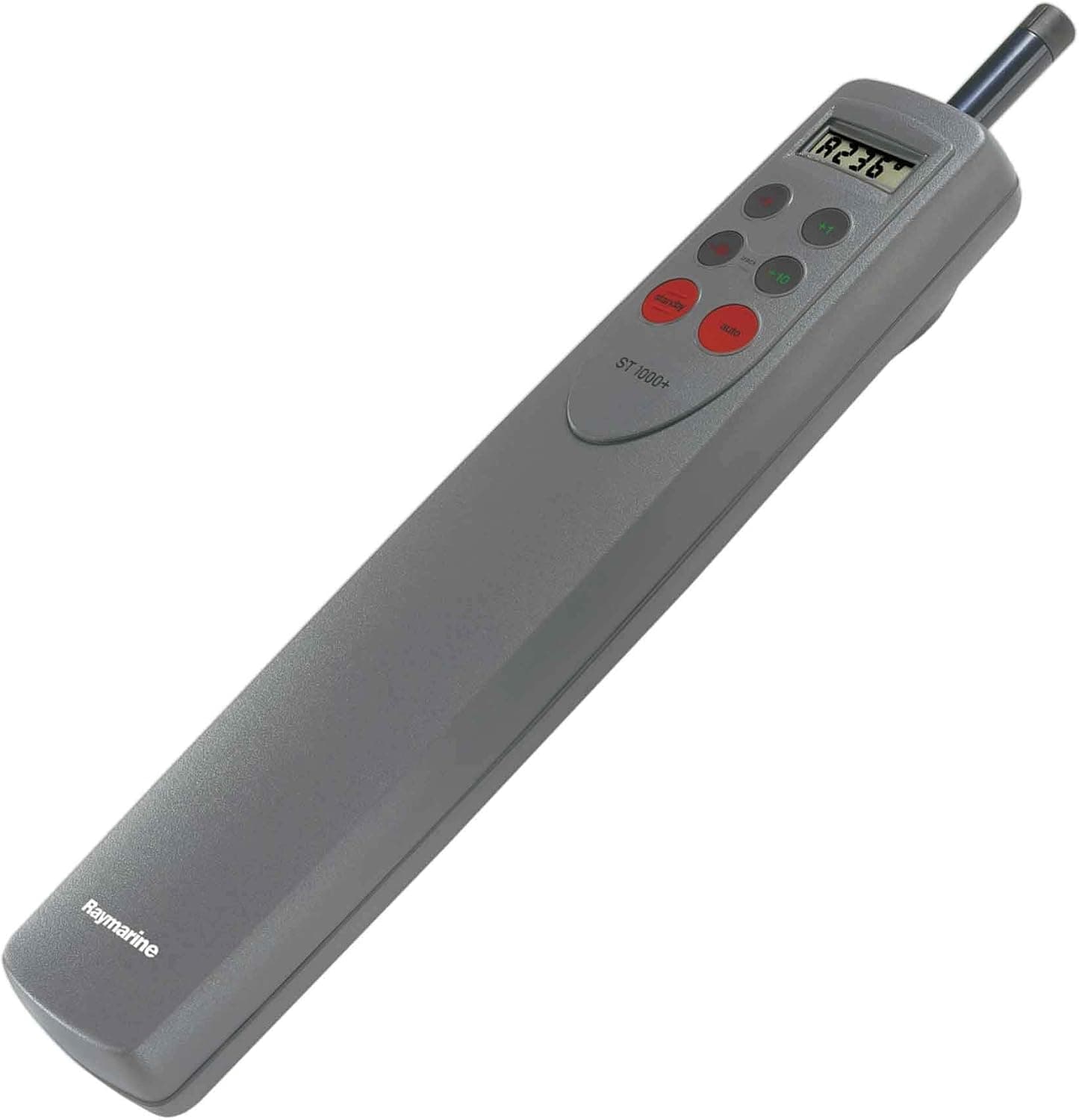
Raymarine ST1000+ Tiller Pilot
Raymarine's smaller self-contained tiller pilot: an electric linear drive, a fluxgate compass and the control panel in one housing. Raymarine rates it for boats up to 3,000 kg (6,600 lb) maximum displacement, and says to size on the fully laden weight, often 20% above the designed displacement. It is for coastal cruising, not offshore passage making, and its handbook says someone must be at the helm at all times.
View on Amazonpaid link Raymarine · Navigation
Raymarine ST2000+ Tiller Pilot
The larger of Raymarine's self-contained tiller pilots, rated for boats up to 4,500 kg (10,000 lb) maximum displacement, which Raymarine says to read against the fully laden weight, often 20% above the designed displacement. Its 2006 handbook gives 77 kg of thrust and 4.5 seconds lock to lock, against 57 kg and 8 seconds for the ST1000+, and two critical mounting dimensions: 589 mm (23.2 in) from socket to tiller pin, and 460 mm (18 in) from the rudder-stock centerline to the pin. Raymarine says it is for coastal cruising, not offshore passage making.
View on Amazonpaid link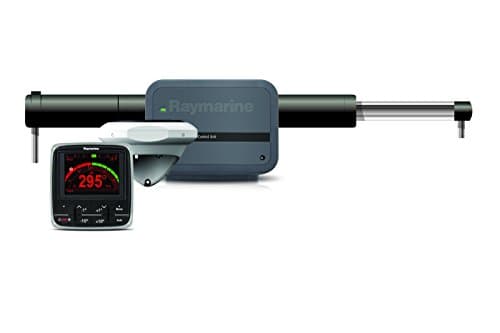 Raymarine · Navigation
Raymarine EV-100 Tiller Pilot Pack
A tiller drive run by Raymarine's Evolution electronics, rated for tiller-steered sailboats up to 6,000 kg displacement, read against the fully laden weight. The electronics are the EV-1 sensor core, both heading sensor and course computer, and the ACU-100. Raymarine's T70153 pack lists the p70s control head, but this listing's title names the older p70, so check the box. Raymarine's EV-1 manual lists an ACU power cable as essential and not supplied, calls its M81105 rudder reference (sold separately) highly recommended, and strongly recommends installation by an authorized Raymarine service representative, tying full warranty benefits to it.
View on Amazonpaid link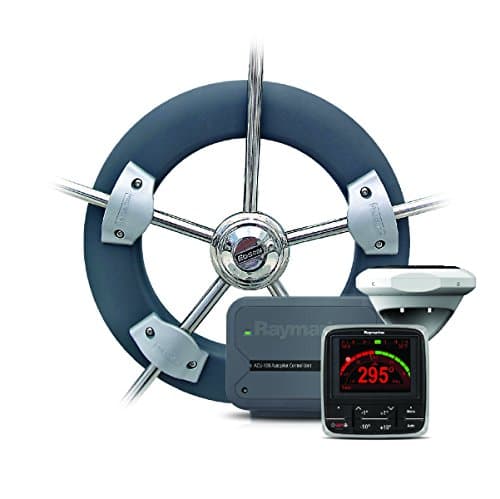 Raymarine · Navigation
Raymarine EV-100 Wheel Pilot Pack
A cockpit wheel drive with Raymarine's Evolution electronics, for wheel-steered sailboats up to 7,500 kg laden displacement. Raymarine's wheel drive fits wheels with 3 to 8 spokes on steering with 1 to 3.5 turns lock to lock; its clutch returns the boat to hand steering, and Raymarine says to reach around the wheel, never through it, to work the lever. Raymarine says it is suitable for local coastal sailing only. Raymarine's complete kit is T70152, with the p70s head; it also sells versions without a head (T70248) and without the drive (T70281), and this listing names the older p70, so check the part number and what is in the box. Raymarine strongly recommends installation by an authorized service representative.
View on Amazonpaid link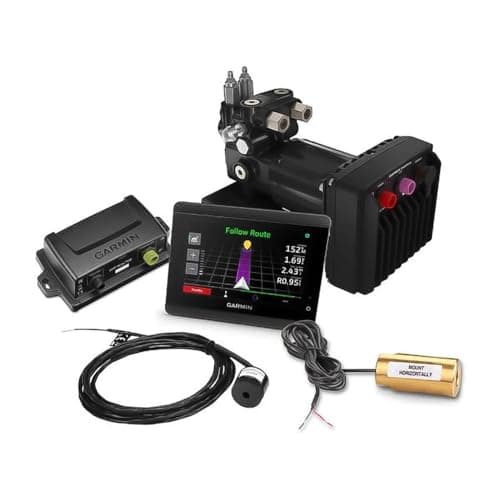 Garmin · Navigation
Garmin Reactor 40 Hydraulic Autopilot with SmartPump v2
Garmin's Reactor 40 for hydraulic steering, with its SmartPump v2 and GHC 50 control head, as part 010-02794-01. Garmin rates SmartPump v2 for steering cylinders of 4 to 24 cu in, and its Shadow Drive sensor suspends autopilot control when someone turns the helm by hand. Hydraulic hoses and fittings are not in the box, and Garmin says a qualified marine installer should fit it, followed by its Dockside and Sea Trial wizards, the second in calm water.
View on Amazonpaid link
What this guide leaves out
Prices, which change; Simrad's current range, which we could not confirm on its own site; specs for drives the makers' pages did not give us; and installation steps in full. A below-deck pilot is part of the steering, so follow the maker's installation manual for your exact system, and use the installer the maker recommends.
Sources
- 1.Raymarine — What are the different types of boat autopilot?
- 2.Raymarine — Evolution autopilot installation instructions, 87180 (copy hosted by distributor Seatronic)
- 3.Raymarine — ACU-100
- 4.Raymarine — EV-1 installation instructions, required additional components
- 5.Simrad — Autopilot buyers guide, 985-11738-001, 2017 (copy hosted by dealer Aegean Electronics)
- 6.Raymarine — EV-200 Sail Pilot
- 7.Raymarine — EV-400 Sail Pilot
- 8.Garmin — Reactor 40 hydraulic corepack
- 9.Garmin — Reactor 40 mechanical corepack
- 10.Raymarine — EV-100 Tiller Pilot
- 11.B&G — Triton2 digital display (archived product page, April 2024)
- 12.B&G — Triton2 operator manual
- 13.Raymarine — ST1000+ and ST2000+ tiller pilots
- 14.Simrad — TP10/TP22/TP32 tillerpilot user guide, 988-10413-003, 2014 (copy hosted by distributor Seatronic)
- 15.Pelagic Autopilot — FAQ
- 16.Lecomble & Schmitt — Power packs and linear drives for autopilots, 2024 catalogue (copy hosted by distributor PYI)
- 17.Garmin — SmartDrive linear actuator
- 18.Raymarine — ST1000 Plus / ST2000 Plus owner's handbook, 81130-6, 2006 (copy hosted by retailer 180sails)
- 19.Raymarine — ST1000 Plus / ST2000 Plus owner's handbook (copy hosted by distributor Seatronic)
- 20.Pelagic Autopilot — PA1 system with tiller actuator
- 21.Raymarine — Cockpit Mk II wheel drive
- 22.Raymarine — Wheel drive installation instructions (copy hosted by distributor Seatronic)
- 23.Raymarine — Type 1 linear drive unit
- 24.Raymarine — Linear drive installation guide, 2001 (copy hosted by Trans-Ocean)
- 25.Raymarine — Selecting your Raymarine drive unit
- 26.Raymarine — ACU-200
- 27.Raymarine — ACU-400
- 28.Raymarine — ACU-150 and ACU-400 product recall
- 29.Raymarine — How to select the right autopilot hydraulic drive
- 30.Garmin — SmartPump v2
- 31.Octopus — Autopilot pump installation guide, 2016 (copy hosted by retailer Defender)
- 32.Garmin — Reactor 40 hydraulic autopilot installation instructions
- 33.Garmin — 1.2 L and 2.0 L pump installation instructions
- 34.Raymarine — EV-100 Power Pilot
- 35.Garmin — Compact Reactor 40 hydraulic autopilot
- 36.Garmin — Reactor 40 Kicker Autopilot
- 37.Garmin — Reactor 40 Kicker installation instructions
- 38.Raymarine — Evolution example minimum system, ACU-100
- 39.Raymarine — EV-1 installation instructions, 87472
- 40.Garmin — Reactor 40 mechanical installation instructions
- 41.Garmin — Reactor 40 for SmartPump installation instructions
- 42.Precision-9 compass installation guide (copy hosted by retailer Defender)
- 43.Raymarine — p70/p70s operation and commissioning instructions, 81402
- 44.Garmin — Reactor 40 hydraulic configuration guide, GHC 50
- 45.Raymarine — p70 series operation instructions, Wind Vane mode
- 46.Garmin — GHC 50 owner's manual
- 47.Raymarine — p70 series operation instructions, Track mode
- 48.Garmin — GPSMAP 8400/8600 owner's manual, autopilot route warning
- 49.Raymarine — p70 series operation instructions, Automatic Turning
- 50.Raymarine — p70s autopilot control head
- 51.Raymarine — Autopilot control heads
- 52.Raymarine — RCU-1 wireless remote
- 53.Garmin — GHC 50 marine autopilot instrument
- 54.Garmin — What autopilot system to choose for your boat
- 55.33 CFR 83.05 — Inland Navigation Rules, Rule 5 (look-out)
- 56.33 CFR 83.01 — Inland Navigation Rules, Rule 1 (application)
- 57.33 CFR 83.02 — Inland Navigation Rules, Rule 2 (responsibility)
- 58.Raymarine — p70 series operation instructions, autopilot usage
- 59.Raymarine — EV-1 installation instructions, maintain a permanent watch
- 60.UK Marine Accident Investigation Branch — Report 10/2015, Shoreway and Orca
- 61.UK Marine Accident Investigation Branch — Safety Digest 1/2024
- 62.US National Transportation Safety Board — Marine investigation report MIR-23-27
- 63.US National Transportation Safety Board — Marine investigation report MIR-22-14, Sage Catherine Lane
- 64.Raymarine — EV-100 Wheel Pilot
- 65.Garmin — Reactor 40 hydraulic corepack with SmartPump v2 and GHC 50