
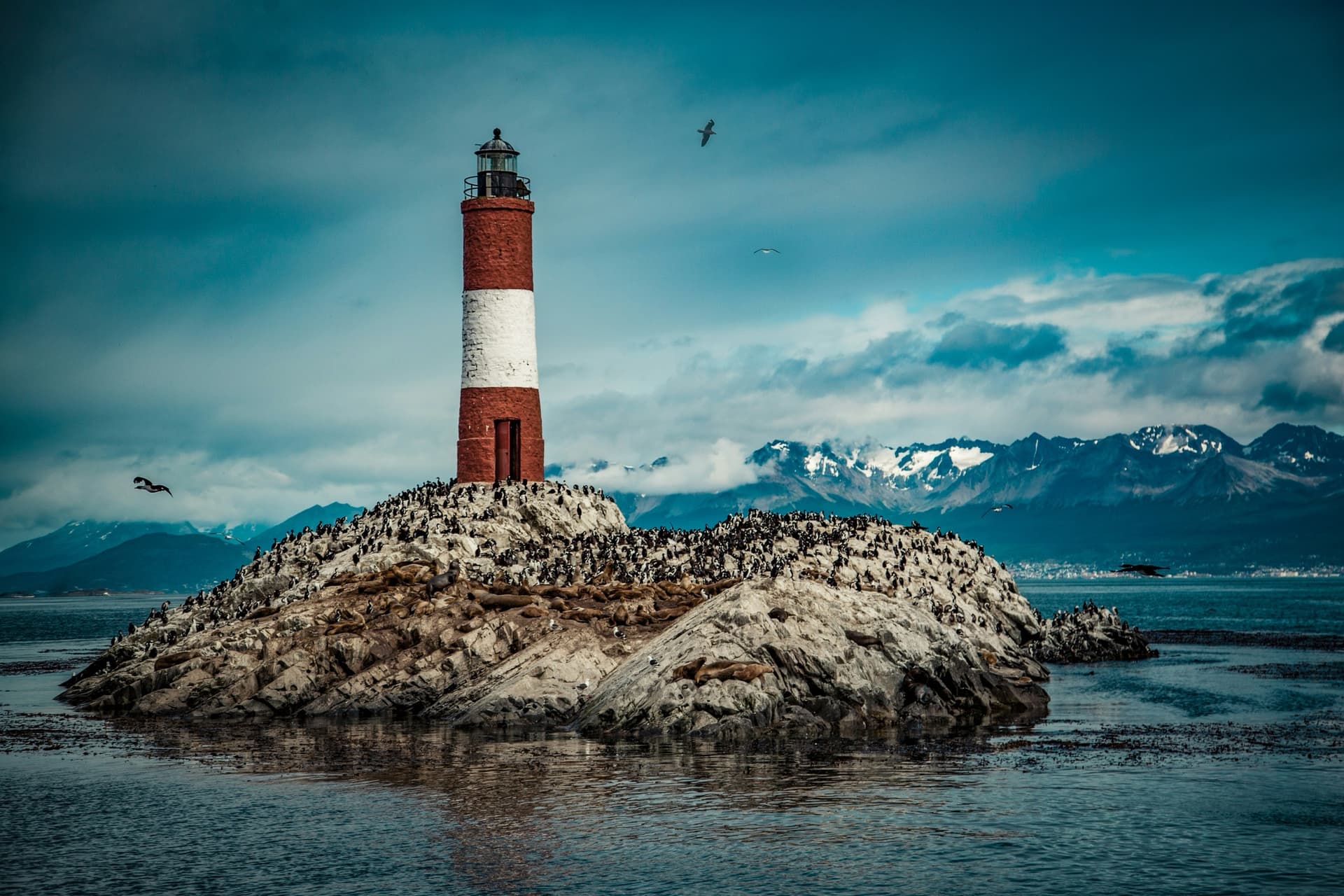
Photo: Luuk Wouters on Unsplash
Marine binoculars, explained
On a boat, binoculars are a lookout tool: for finding a mark, reading a buoy and watching another vessel. This guide covers what magnification and objective size mean at sea, what image stabilisation does and what it costs, what the makers' waterproof and flotation claims actually say, how built-in compasses and reticles work, and how to look after a pair in salt air. Every factual statement links to the maker's page or manual, or to the Navigation Rules.
This guide links to products on Amazon. If you buy through those links we may earn a commission, at no extra cost to you. Each one is marked “paid link”. More in our affiliate disclosure.
Published October 18, 2026
Magnification and steadiness
Steiner calls 7x 'the marine standard' and says its Marine 7x50 gives a wide, stable image for tracking other boats, buoys and bridge numbers in turbulent water; it says the 7x magnification and 50 mm objectives of its Navigator give a stable image even in rough seas.[1][2]
Fujifilm says higher magnification narrows the field of view and makes the image more sensitive to hand shake, and Nikon says the higher the magnification, the more hand movement makes the image unstable. Nikon recommends binoculars of up to 12x for general use; that advice is not specific to boats.[3][4][5]
Exit pupil and low light
Exit pupil
Steiner's glossary defines the exit pupil, in millimetres, as the objective diameter divided by the magnification, so a 7x50's is about 7 mm. Steiner and Nikon say the eye's pupil opens from about 2 mm in bright light to about 7 mm in the dark, and Nikon says a 7x50's 7.1 mm exit pupil roughly matches it, so in low light the view looks about as bright as the naked eye.[6][7]
Nikon says that in daylight a 7 mm and a 2 mm exit pupil give the same brightness, and that a large exit pupil matters in the dark. Nikon USA says its OceanPro 7x50's large exit pupils make it easier to keep the image in view when the boat is moving. Fujifilm says larger objectives gather more light, at the cost of a bigger, heavier binocular.[7][8][3]
Image stabilisation
Fujifilm's Techno-Stabi TS-X1440 (14x40) uses an electronic gyro with a gimbal, rated to correct ±6°, and Fujifilm says it corrects vibration from ocean waves as well as hand shake. It runs on four AA or NiMH cells for about 30 hours of continuous use, which Fujifilm says depends on the battery type and conditions. It has a 2.9 mm exit pupil and centre focus and weighs 1,300 g without batteries. It passed a water-resistance test at 1 m for 5 minutes, but its spec sheet says 'Not usable underwater'.[9][10][11]
Canon calls its 10x42 L IS WP the first waterproof binocular with its Image Stabilizer, and names marine use among what it suits. Canon rates it waterproof for 30 minutes at 1 m; its vari-angle prism corrects ±0.8°, and it has a 4.2 mm exit pupil and weighs 1,110 g without batteries. On two AA cells, Canon Japan gives about 8 hours on lithium and about 2.5 hours on alkaline at 25°C, but about 3.5 hours on lithium and about 10 minutes on alkaline at -10°C.[12][13][14]
Not every stabilised binocular carries a waterproof rating. Canon Canada describes its 18x50 IS All Weather as having 'water-resistant construction', and Canon Hong Kong's spec page gives no water-resistance rating for the 12x36 IS III. Canon Japan gives the 12x36 IS III (about 660 g without batteries) about 9 hours on alkaline at 25°C and about 1 hour at -10°C.[15][16][17]
Waterproofing and fogging
Ratings vary widely, so read each one with its own conditions. Steiner rates its Commander 7x50 waterproof to 10 m and its Navigator 7x50c water-pressure-proof to 5 m. Fujifilm rates its FMT 7x50 models water resistant to 2 m for 5 minutes, and its Mariner 7x50s to 1 m for 5 minutes, with a footnote that this does not mean they can be used in water. Nikon rates its 7x50CF WP waterproof to 1 m for 5 minutes and says binoculars should not be used underwater.[18][19][20][21][22][5]
Makers tie fogproofing to the same sealing. Nikon says the airtight, nitrogen-filled construction that makes its binoculars waterproof also prevents fogging. Steiner pressure-fills its Navigator with nitrogen against internal fogging, Fujifilm fills its Mariners with nitrogen and purges and O-ring-seals its Polaris series, and Celestron nitrogen-purges its Oceana. Weems & Plath fills its 7x50s with argon instead, and its catalog calls its binoculars 'water resistant and fog-proof'.[5][19][23][24][25][26][27]
Which binoculars float
Floating strap
Several makers supply a floating strap and say nothing about the body: Steiner with its Navigator 7x50c (and a 'swim strap' with its Commander), Nikon with its 7x50CF WP and Fujifilm with its Mariner 7x50s. Steiner says its floating strap keeps the binoculars above water and protects them from sinking. Its discontinued Navigator Pro 7x50c came with a standard neoprene strap instead.[19][18][22][21][28][29]
Two makers claim the body itself: Weems & Plath says its Wayfinder 7x50 floats, not tied to a strap, and Fujifilm calls the TS-X1440's body non-sinking. Others make no flotation claim at all, such as Celestron's page for its Oceana 7x50, so check what the maker says before relying on it.[26][10][25]
Compasses and reticles
Built-in compass
Steiner's Navigator 7x50c has an integrated, fluid-dampened analog compass that can be illuminated; its spec table gives a CR 1225 battery without saying whether one is included. Fujifilm rates the compass in its Mariner 7x50 WPC-XL at ±0.5° maximum error, usable in both hemispheres and internally lit, and its manual says the lower part of the scale shows the bearing to the object.[19][23][30]
The makers add caveats. Fujifilm warns that the built-in compass may read the heading wrong if the binocular is tilted, and Bushnell reminds users to allow for local variation between magnetic and true north. Weems & Plath says its Wayfinder's compass appears next to the image, so you can take a bearing on what you are looking at.[30][32][26]
Focus
Fujifilm says centre focus is somewhat challenging to waterproof, so its Porro-prism binoculars use individual focus, which it says is well accepted for marine use, where you seldom need to refocus. Not every maker agrees: Nikon says centre focus that moves internal lenses allows a highly airtight build, and recommends that design for waterproof centre-focus binoculars. Nikon's 7x50CF WP and Celestron's Oceana are both waterproof centre-focus marine 7x50s.[3][33][22][25]
Whether individual focus stays set depends on the model. Steiner says its Auto-Focus, once set, keeps the Navigator sharp from 20 m to infinity; its technology page says 20 yards. Steiner's own glossary defines individual focus as adjusting each eyepiece independently each time you refocus, and Fujifilm's Mariner manual says to refocus each eye when the distance changes.[19][34][6][30]
Care after salt water
Fujifilm says Mariner binoculars used around salt air or the ocean should be rinsed in fresh water before being put away, and Bushnell says to flush its Marine 7x50 with fresh water and wipe it dry after exposure to salt water or spray. Steiner says to wipe salt water off the lenses with a damp cloth and then dry them, and that only binoculars that resist water pressure can be rinsed under running water with liquid soap.[30][32][31]
Keeping a lookout
Rule 5 of the Inland Navigation Rules (33 CFR 83.05) says: 'Every vessel shall at all times maintain a proper look-out by sight and hearing as well as by all available means appropriate in the prevailing circumstances and conditions so as to make a full appraisal of the situation and of the risk of collision.' The rule does not mention binoculars.[35]
The binoculars we list
| Steiner Navigator 7x50c | Fujinon Mariner 7x50 WPC-XL | Fujinon Mariner 7x50 WP-XL | Fujinon TS-X1440 | Canon 10x42 L IS WP | |
|---|---|---|---|---|---|
| Exit pupil | 7.14 mm | 7.1 mm | 7.1 mm | 2.9 mm | 4.2 mm |
| Water | Water-pressure-proof to 5 m | Water resistant, 1 m for 5 min; Fujifilm says this does not mean it can be used in water | Water resistant, 1 m for 5 min; Fujifilm says this does not mean it can be used in water | 1 m for 5 min; not usable underwater | Waterproof, 30 min at 1 m |
| Floats | Floating strap | Flotation strap | Flotation strap | Non-sinking body | No claim |
| Compass | Illuminated | ±0.5°, lit | None | None | None |
| Power | CR 1225 (inclusion not stated) | 2 x LR43, included | None | 4 AA or Ni-MH, about 30 h (depends on battery type and conditions) | 2 AA |
 Steiner · Navigation
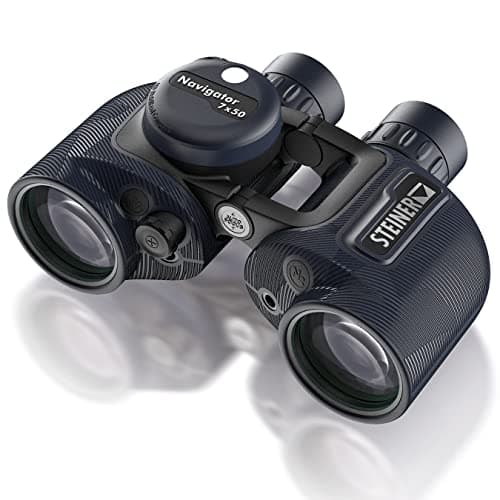
Steiner Navigator 7x50c Marine Binoculars
Steiner's current Navigator 7x50 with a compass (item 2343): an integrated, fluid-dampened analog compass that can be illuminated, on a CR 1225 battery Steiner doesn't say is included. Steiner rates it water-pressure-proof to 5 m, nitrogen-filled against internal fogging, with a 7.14 mm exit pupil, and says its Auto-Focus, once set, stays sharp from 20 m to infinity. It comes with a floating strap; Steiner makes no claim that the body floats.
View on Amazonpaid link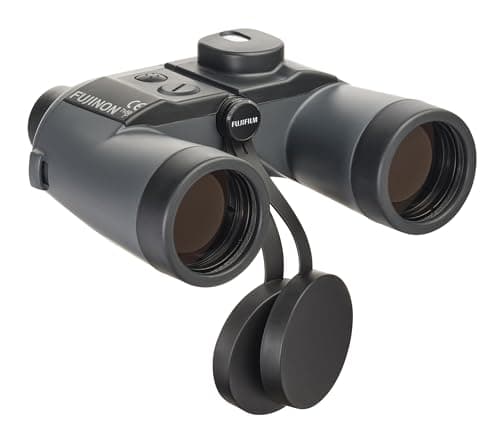 Fujinon · Navigation
Fujinon Mariner 7x50 WPC-XL Binoculars with Compass
Fujifilm's Mariner 7x50 with a compass (WPC-XL), which Fujifilm rates at ±0.5° maximum error, usable in both hemispheres and internally lit, with 2 x LR43 batteries included. It is nitrogen-filled, individually focused and 910 g without battery, with a 7.1 mm exit pupil, and water resistant to 1 m for 5 minutes, which Fujifilm says does not mean it can be used in water. A flotation neck strap is included.
View on Amazonpaid link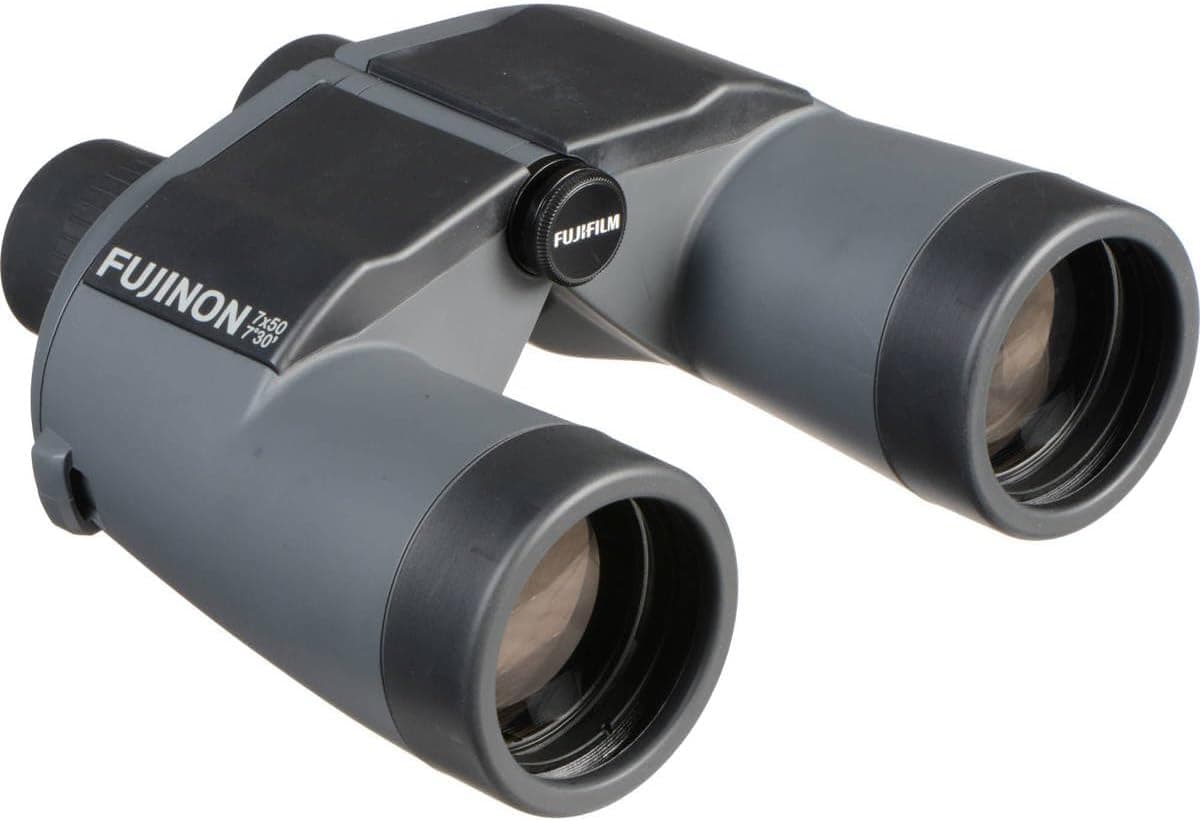 Fujinon · Navigation
Fujinon Mariner 7x50 WP-XL Binoculars
The Mariner 7x50 without a compass (WP-XL): nitrogen-filled, individually focused, 885 g, with a 7.1 mm exit pupil and a 7.5° field of view (131 m at 1,000 m), and supplied with a flotation neck strap. Fujifilm rates it water resistant to 1 m for 5 minutes, which it says does not mean it can be used in water, and says to rinse Mariner binoculars in fresh water after use around salt air or the ocean.
View on Amazonpaid link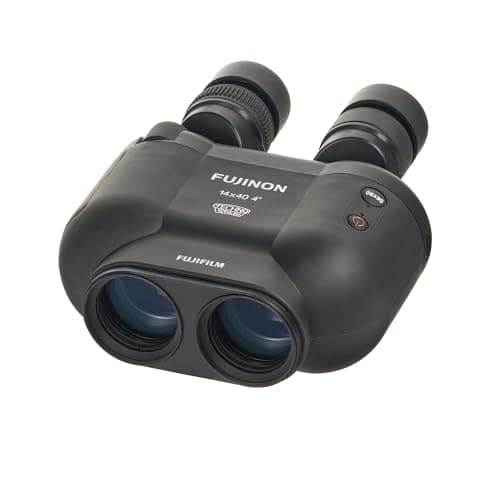 Fujinon · Navigation
Fujinon Techno-Stabi TS-X1440 Stabilized Binoculars
Fujifilm's 14x40 stabilized binocular (TS-X1440): a gyro and gimbal rated to correct ±6°, which Fujifilm says corrects vibration from ocean waves as well as hand shake. It runs about 30 hours on four AA cells, depending on battery type and conditions, weighs 1,300 g without batteries, has a 2.9 mm exit pupil and centre focus, and passed a 1 m, 5-minute water test, but Fujifilm says it is not usable underwater. Fujifilm calls the body non-sinking.
View on Amazonpaid link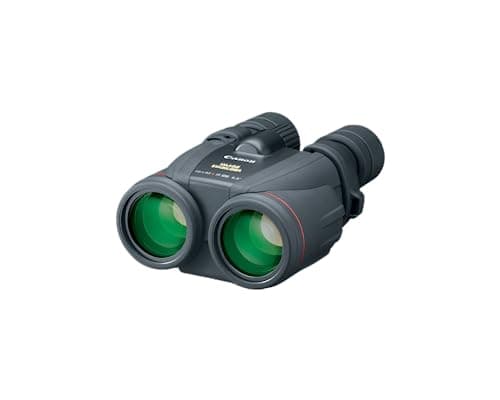 Canon · Navigation
Canon 10x42 L IS WP Image Stabilized Binoculars
Canon's waterproof stabilized 10x42, which Canon calls the first waterproof binocular with its Image Stabilizer, rated waterproof for 30 minutes at 1 m. A vari-angle prism corrects ±0.8°. On two AA cells, Canon Japan gives about 8 hours on lithium and 2.5 hours on alkaline at 25°C, but about 10 minutes on alkaline at -10°C. It weighs 1,110 g without batteries and has a 4.2 mm exit pupil.
View on Amazonpaid link
What this guide leaves out
IP ratings, which none of these makers quoted; how long Steiner's 5 m and 10 m ratings hold; weights where a maker's own sites disagree; Vortex, Bushnell's current range and US Canon pages, which we could not read; and the makers' marketing superlatives.
Sources
- 1.Steiner — Marine 7x50
- 2.Steiner — Navigator 7x50
- 3.Fujifilm — Binoculars basic knowledge
- 4.Nikon — Binoculars guide: magnification
- 5.Nikon — Binoculars guide: choosing binoculars
- 6.Steiner — Binoculars glossary
- 7.Nikon — Binoculars guide: exit pupil and brightness
- 8.Nikon USA — OceanPro 7x50
- 9.Fujifilm — Techno-Stabi TS-X1440 specification sheet
- 10.Fujifilm — Techno-Stabi
- 11.Fujifilm — Techno-Stabi specifications
- 12.Canon Canada — 10x42 L IS WP
- 13.Canon Asia — 10x42L IS WP specifications
- 14.Canon Japan — 10x42L IS WP specifications
- 15.Canon Canada — 18x50 IS All Weather
- 16.Canon Hong Kong — 12x36 IS III
- 17.Canon Japan — 12x36 IS III specifications
- 18.Steiner — Commander 7x50c
- 19.Steiner — Navigator 7x50c
- 20.Fujifilm — FMT series binoculars
- 21.Fujifilm — Mariner specifications
- 22.Nikon — 7x50CF WP marine binoculars
- 23.Fujifilm — Mariner
- 24.Fujifilm — Polaris
- 25.Celestron — Oceana 7x50 Porro marine binoculars
- 26.Weems & Plath — Wayfinder binocular
- 27.Weems & Plath — Catalog, 08-2024
- 28.Steiner (Germany) — Floating strap for Navigator models, 76990000
- 29.Steiner — Navigator Pro 7x50c (discontinued)
- 30.Fujifilm — Mariner 7x50 WP-XL and WPC-XL manual
- 31.Steiner — Navigator Pro 7x50 user manual
- 32.Bushnell — Marine 7x50 binocular manual (linked from bushnell.com)
- 33.Nikon — Binoculars guide: focusing technologies
- 34.Steiner — Optics technology
- 35.33 CFR 83.05 — Rule 5, look-out (Inland Navigation Rules; govinfo, 2024)