

Photo: Hendrik Cornelissen on Unsplash
Navigation lights and horns, explained
The Navigation Rules say which lights a boat shows and which sound signals it makes, and both change with the boat's length, how it is driven and where it is. This guide covers which rules apply, when to show lights, what each light is, the arrangements for power boats, sailboats, paddle craft and anchored boats, certified lights and LED replacements, mounting, and the sound signals and the horns and whistles that make them. Every factual statement links to the rule, the Coast Guard guidance or the maker's page it came from.
This guide links to products on Amazon. If you buy through those links we may earn a commission, at no extra cost to you. Each one is marked “paid link”. More in our affiliate disclosure.
Published October 19, 2026
Which rules apply
The Coast Guard's demarcation lines divide the waters where the Inland Navigation Rules apply, inside the lines, from those where the International Rules (COLREGS) apply, outside them. Under Inland Rule 1(b)(ii), a vessel that complies with the International Rules' construction and equipment requirements is considered to comply with the Inland Rules.[1][2]
Length means length overall, and the thresholds that follow (7, 12, 20 and 50 meters) are measured against it. A power-driven vessel is any vessel propelled by machinery; a sailing vessel is one under sail with any propelling machinery not in use. The Coast Guard's guide puts it plainly: a sailboat or human-powered boat under mechanical propulsion is a power-driven vessel.[3][21]
When to show lights
Rule 20(b), the same in both rule sets, says the light rules 'shall be complied with from sunset to sunrise, and during such times no other lights shall be exhibited, except such lights as cannot be mistaken for the lights specified in these Rules or do not impair their visibility or distinctive character, or interfere with the keeping of a proper lookout.' Inland Rule 20(c) says the prescribed lights, if carried, must also be shown from sunrise to sunset in restricted visibility. The Coast Guard's guide says recreational vessels must show navigation lights between sunset and sunrise and in restricted visibility such as fog, rain or haze.[4][19][21]
NAVCEN discourages lights other than those the Rules prescribe, saying decorative, strobe or other high-intensity lighting could confuse other boaters, obscure your navigation lights, hinder a proper lookout or be mistaken for other lights.[20]
The lights, their arcs and their ranges
Masthead light
White, over the centerline (as nearly as practicable on a vessel under 12 m), showing 225 degrees: from dead ahead to 22.5 degrees abaft the beam on each side (Inland Rule 21(a)).[5]
Sidelights
Green to starboard and red to port, each showing 112.5 degrees from dead ahead to 22.5 degrees abaft the beam on its own side (Inland Rule 21(b)).[5]
Sternlight
White, at or near the stern, showing 135 degrees, 67.5 degrees either side of dead astern (Inland Rule 21(c)).[5]
All-round light
An unbroken 360 degrees (Inland Rule 21(e)).[5]
On a vessel under 20 m the sidelights may be combined in one lantern on the centerline; under 12 m that lantern goes as nearly as practicable on the centerline (Inland Rule 21(b)).[5]
| Vessel length | Masthead | Sidelights | Sternlight | All-round |
|---|---|---|---|---|
| Under 12 m | 2 | 1 | 2 | 2 |
| 12 m to under 20 m | 3 | 2 | 2 | 2 |
| 20 m to under 50 m | 5 | 2 | 2 | 2 |
Annex I sets the intensity behind those ranges: at least 0.9 candela for a range of 1 nautical mile, 4.3 for 2, 12 for 3, 27 for 4 and 52 for 5 (33 CFR 84.14).[14]
Power boats
A power-driven vessel underway shows a masthead light, sidelights and a sternlight (Inland Rule 23(a)). Under 12 m it may instead show an all-round white light and sidelights (Inland Rule 23(d)). International Rule 23(d)(ii) adds an option the Inland Rules do not have: under 7 m with a maximum speed of 7 knots, an all-round white light, with sidelights if practicable.[7][19]
Under 12 m, Annex I puts the masthead light or the all-round white light at least one meter higher than the sidelights (33 CFR 84.02(d)), and on boats built after July 31, 1983 it must be screened so it does not shine directly on the boat forward of the operator (84.05(b)). An all-round light must be located so that masts, topmasts or structures do not obscure it over angular sectors of more than 6 degrees (84.15(b)(i)); anchor lights are excepted from the impracticable-height requirement.[14]
Sailboats
A sailing vessel underway shows sidelights and a sternlight. Under 20 m, it may combine them in one lantern carried at or near the top of the mast (Rule 25(b), the same in both rule sets). It may also carry red-over-green all-round lights at the masthead, but not together with that combined lantern (Inland Rule 25(c)).[8][19]
A sailboat under power is a power-driven vessel and shows power-driven lights; Hella says its TRIO masthead tri-colour must not be shown under power, or under sail and power. Annex I asks more of the electric lights of a sailing vessel underway: the minimum intensity from 5 degrees above to 5 degrees below the horizontal, and at least 50 percent of it from 25 degrees above to 25 degrees below (33 CFR 84.16(b)).[21][31][14]
At anchor, and under oars
A vessel under 50 m at anchor may show a single all-round white light where it can best be seen (Rule 30(b), both rule sets). Inland Rule 30(e) excuses a vessel under 7 m from anchor lights unless it is in or near a narrow channel, fairway or anchorage, or where other vessels normally navigate, and Inland Rule 30(g) excuses a vessel under 20 m in a Coast Guard special anchorage area (33 CFR 110.1).[9][19][16]
A vessel under oars, a kayak or canoe included (NAVCEN), may show the sailing-vessel lights. If it does not, Inland Rule 25(d)(ii) requires it to exhibit an all-round white light or have ready at hand an electric torch or lighted lantern showing a white light, which must be shown in time to prevent collision; the International rule has no all-round option, only the torch or lantern.[8][19][20]
Certified lights and LED replacements
33 CFR 183.810 requires each navigation light to be certified by a Coast Guard-listed laboratory to ABYC A-16 or an equivalent (portable battery-powered lights need only meet the standard that applies to them), and labelled 'USCG Approval 33 CFR 183.810' with, among other things, the light's visibility in nautical miles and the bulb used in the test; a light too small for the label is marked 'USCG' and its range, for example 'USCG 2nm'. Under 183.801 that applies to manufacturers, distributors and dealers installing lights in new recreational boats built after November 1, 2002, and the Coast Guard says lights an owner installs afterward are not covered.[17][22]
When it wrote the rule in 2001, the Coast Guard chose ABYC A-16 for recreational boats, calling it the most basic standard, in place of UL 1104, and said the rule does not apply to the replacement of existing navigation lights on vessels completed before the effective date. It stopped issuing voluntary 'Letters of Acceptance' for lights in April 1997, because the public read 'U.S. Coast Guard Accepted' as 'approved'.[18]
The Coast Guard warns that replacement navigation lighting may be improper because makers have not met certification requirements, and that LED, rope, underwater and decorative lighting may violate the navigation-light provisions. Perko says substituting a bulb other than the one it specifies voids all certifications and Coast Guard acceptance of its lights. Dr. LED says certification of its Polar Star 40 bulbs applies to the tested combination of fixture, lens, bulb and operating voltage, and that a white LED behind a coloured lens may not supply enough red or green light.[23][26][27]
In its 2007 Boating Safety Circular 85 the Coast Guard names, as the major installation issue, lights not positioned to the fixture maker's instructions for centerline and vertical orientation. It also reports small fixtures mounted below the sheer that fail to show over the required sectors, and too little vertical separation between the sidelights and the masthead or all-round light, where it says a minimum of one meter is required.[22]
Sound signals
A short blast is about one second and a prolonged blast four to six seconds (Rule 32). A vessel of 12 m or more must have a whistle, and one of 20 m or more a bell as well (Inland Rule 33(a)). Under 12 m, Rule 33(b) in both rule sets says a vessel need not carry them but must have some other means of making an efficient sound signal.[10][11][19]
The maneuvering signals differ between the rule sets. Inland Rule 34(a), for power-driven vessels in sight of one another and meeting or crossing within half a mile: one short blast means 'I intend to leave you on my port side', two short 'I intend to leave you on my starboard side', three short 'I am operating astern propulsion'. International Rule 34(a), for a power-driven vessel underway when vessels are in sight of one another: one short means 'I am altering my course to starboard', two short 'to port', three short 'I am operating astern propulsion'. The Coast Guard's guide sums it up: inland, signals of intent; international, signals of action.[12][19][21]
At least five short and rapid blasts mean you do not understand the other vessel's intentions or doubt it is doing enough to avoid a collision (Rule 34(d)). Inland Rule 34(g) adds one prolonged blast when a power-driven vessel leaves a dock or berth.[12][19]
In or near restricted visibility, Inland Rule 35 calls for one prolonged blast at intervals of not more than 2 minutes from a power-driven vessel making way, and one prolonged and two short from a sailing vessel; at anchor, a bell rung rapidly for about 5 seconds at least every minute. Rule 35(j), as the eCFR and the International text print it: 'A vessel of less than 12 meters in length shall not be obliged to give the above-mentioned signals but, if she does not, shall make some other efficient sound signal at intervals of not more than 2 minutes.' The Coast Guard handbook's Inland column words it differently. Inland Rule 35(l) excuses vessels under 20 m anchored in a special anchorage area from the anchor signals. The Coast Guard's guide says recreational boats must use sound signals in reduced visibility and at anchor.[13][19][21]
Choosing a horn or whistle
Annex III sets the specification for the Rule 32(a) 'whistle'. For a whistle on a vessel under 75 m the fundamental frequency must be between 250 and 700 Hz, and for a vessel under 20 m the sound level at 1 m, in a one-third-octave band, must be at least 120 dB between 180 and 450 Hz, 115 dB between 450 and 800 Hz, or 111 dB between 800 and 2,100 Hz. The sources we read do not say these levels apply to the other means of sound signal a vessel under 12 m may carry instead. It gives an audibility range of half a nautical mile for information only, saying the real range varies critically with weather and may be reduced in strong wind or high ambient noise (33 CFR 86.01).[15]
Annex III says to place a whistle as high as practicable, and Kahlenberg says to mount horns facing forward and as high as possible. Makers measure loudness differently: Annex III uses 1 meter, Orion quotes its 8 oz. air horn at 10 feet, and Sea-Dog's and ACR's pages give no distance for their figures, so they cannot be compared directly.[15][34][35][32][36]
The Coast Guard Auxiliary's voluntary Vessel Safety Check manual (October 2014) accepts mouth horns or whistles as the efficient sound signal on a vessel under 39.4 ft, and its form 7012 asks that a sound device be capable of a 4-second blast audible for half a mile; that figure is the Auxiliary's, not a Rules requirement. The Coast Guard's guide suggests a whistle on a wearable life jacket as a worthwhile extra.[24][25][21]
The lights and horns we list
| Attwood NV2002SS-7 | Attwood 5530-24A7 | Hella NaviLED TRIO | |
|---|---|---|---|
| Light | Bi-color sidelights, deck mount | All-round light, 24 in. pole | Tri-colour with all-round white anchor |
| Range | 2 nm | 2 nm | 2 nm |
| For | Boats up to 65.6 ft (20 m) | Boats up to 39.4 ft (12 m) | Sailboats up to 20 m |
| Sea-Dog Single Mini Compact | Orion 509 air horn | ACR WW-3 whistle | |
|---|---|---|---|
| Type | 12 V electric horn | Air horn, 8 oz | Whistle on a lanyard |
| Maker's figures | 108 dB, 440 ± 20 Hz | 120 dB at 10 ft; up to 106 blasts a can | Up to 100 decibels |
| For | Vessels under 12 m (39 ft), per Sea-Dog | Boats up to 65 ft (20 m), per Orion | 'Meets USCG requirements', per ACR |
Rule 23(d) lets a power-driven vessel under 12 m show an all-round white light and sidelights, and Inland Annex I puts that all-round light at least one meter above the sidelights (33 CFR 84.02(d)). Attwood rates its bi-color light for boats up to 65.6 ft (20 m) and its all-round light for boats up to 39.4 ft (12 m). Hella's current instruction sheet (09.26) says the TRIO may be carried only by a sailing vessel under 20 m, at or near the masthead, needs switching so one position shows the tri-colour and another the anchor light alone, and must be fused at 3 A maximum, and says to replace the lamp after a maximum of 12 years' use on recreational boats; the listing we link describes the earlier 8-28 V DC version. Sea-Dog lists a 5 A horn button and fuse among the parts you supply.[28][29][7][31][33]
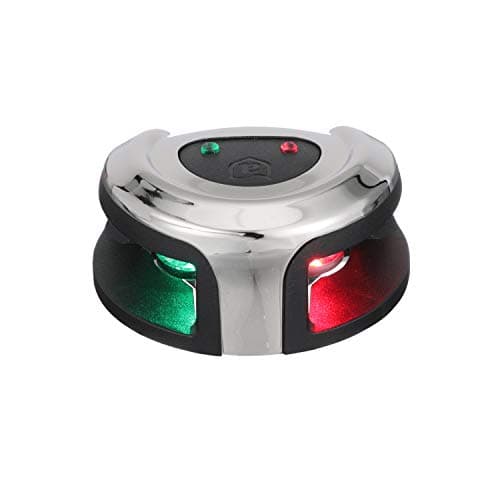 Attwood · Navigation
Attwood LightArmor Round Bi-Color LED Deck-Mount Light, 2 NM
Attwood's round stainless bi-color deck-mount light (NV2002SS-7, the aftermarket version of NV2002SS-1), which its 2025 catalog lists as a 2-NM light for boats up to 65.6 ft (20 m). Inland Rule 21(b) lets a vessel under 20 m combine its sidelights in one lantern on the centerline (as nearly as practicable under 12 m). On a power-driven vessel under 12 m it pairs with the Rule 23(d) all-round white light, which Inland Annex I puts at least one meter higher than the sidelights.
View on Amazonpaid link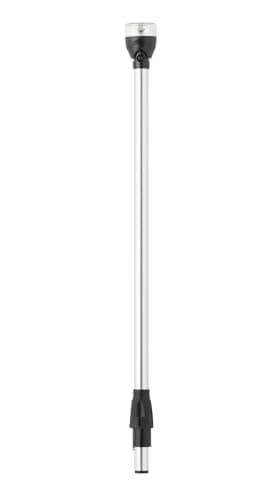 Attwood · Navigation
Attwood LightArmor LED All-Round Pole Light, 24 in.
Attwood's LED all-round articulating light on a 24 in. pole (5530-24A7), which Attwood rates for 2-mile, 360-degree visibility on boats up to 39.4 ft (12 m) and says carries USCG certification. Used as the Rule 23(d) all-round white light on a power-driven vessel under 12 m, Inland Annex I puts it at least one meter above the sidelights and, on boats built after July 31, 1983, requires it to be screened to prevent direct illumination of the vessel forward of the operator's position; masts and structures may not obscure it over sectors of more than 6 degrees.
View on Amazonpaid link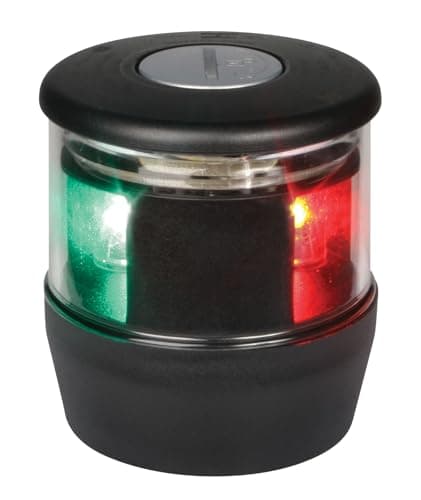 Hella · Navigation
Hella Marine NaviLED TRIO 2 NM Tri-Colour and Anchor Light
Hella's NaviLED TRIO (980650001): a 2 NM masthead tri-colour with a separate all-round white anchor light. Hella says it may be carried only by a sailing vessel under 20 m, never shown under power, and must be switched so one position shows the tri-colour and another the anchor light alone, on a 3 A maximum fuse. Hella's current sheet gives 9-33 V DC, the early version 8-28 V, so check the label; it says to replace the lamp after a maximum of 12 years' use on recreational boats.
View on Amazonpaid link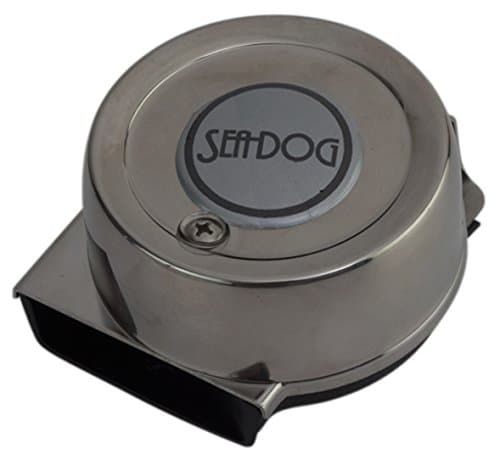 Sea-Dog · Safety Equipment
Sea-Dog Single Mini Compact Electric Horn, 12 V
Sea-Dog's 12 V single mini compact horn with a stainless cover, which Sea-Dog says gives 108 dB at 440 ± 20 Hz and meets COLREGS and ABYC A-23 for vessels under 12 m (39 ft); it gives no measuring distance for the 108 dB. The Amazon listing quotes different figures (110 dB, 4 A) and shows no part number, so check the box. You supply a 5 A horn button and a 5 A fuse.
View on Amazonpaid link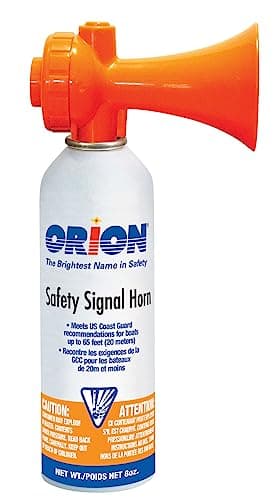 Orion · Safety Equipment
Orion 509 Safety Air Horn, 8 oz.
Orion's 8 oz. air horn (item 509): up to 106 blasts per can and a 120 dB blast measured at 10 feet, where Annex III measures at 1 meter. Orion says it meets USCG requirements for boats up to 65 feet (20 m). Refill cans are a separate item (510).
View on Amazonpaid link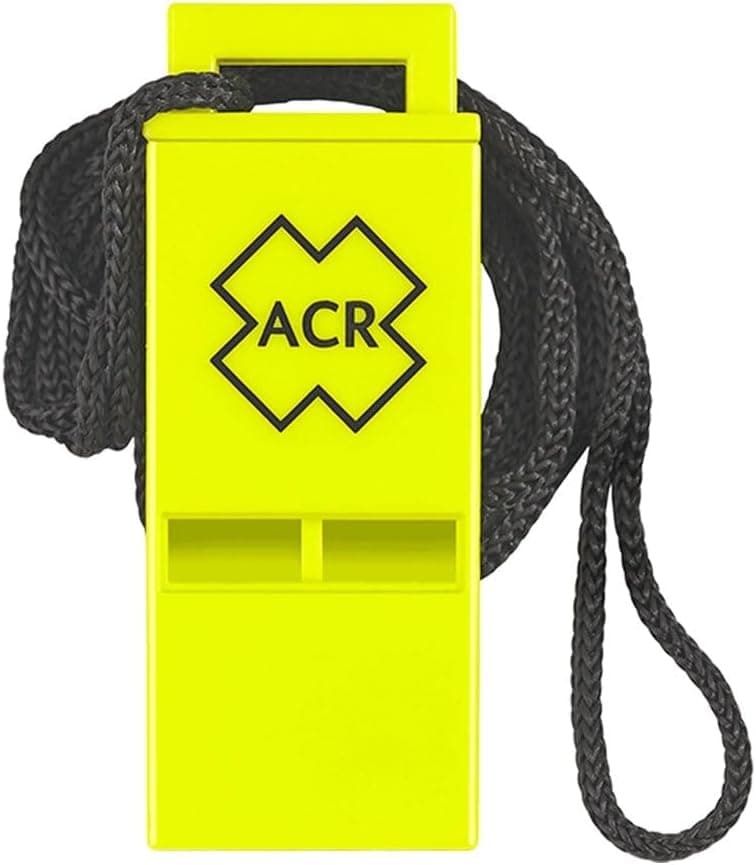 ACR · Safety Equipment
ACR WW-3 Res-Q Whistle
ACR's WW-3 Res-Q whistle on a lanyard (2228, carded), which ACR says gives a shrill dual tone up to 100 decibels, has a flat design that does not hold water, and meets USCG requirements; ACR gives no measuring distance. Rule 33(b) lets a vessel under 12 m skip the whistle and bell but, if it does, it must have some other means of making an efficient sound signal. The Coast Guard Auxiliary's voluntary Vessel Safety Check accepts mouth horns or whistles on a boat under 39.4 ft, and its form asks for a 4-second blast audible for half a mile.
View on Amazonpaid link
What this guide leaves out
Lights for towing, fishing, vessels not under command or restricted in their ability to maneuver; overtaking and bend signals; distress signals, which our flares guide covers; the full restricted-visibility signals for other vessels; vessels of 50 m and more; and state rules, which can add to these. Rule 35(j) is quoted rather than explained because official texts word it differently. Check the label of any light you buy for its certified range, and the maker's vessel-length limit.
Sources
- 1.33 CFR 80.01 — COLREGS demarcation lines: general basis and purpose (eCFR)
- 2.33 CFR 83.01 — Inland Navigation Rules, Rule 1: application (eCFR)
- 3.33 CFR 83.03 — Rule 3: definitions (eCFR)
- 4.33 CFR 83.20 — Rule 20: application (lights and shapes; eCFR)
- 5.33 CFR 83.21 — Rule 21: definitions (lights; eCFR)
- 6.33 CFR 83.22 — Rule 22: visibility of lights (eCFR)
- 7.33 CFR 83.23 — Rule 23: power-driven vessels underway (eCFR)
- 8.33 CFR 83.25 — Rule 25: sailing vessels underway and vessels under oars (eCFR)
- 9.33 CFR 83.30 — Rule 30: anchored vessels (eCFR)
- 10.33 CFR 83.32 — Rule 32: definitions (sound signals; eCFR)
- 11.33 CFR 83.33 — Rule 33: equipment for sound signals (eCFR)
- 12.33 CFR 83.34 — Rule 34: maneuvering and warning signals (eCFR)
- 13.33 CFR 83.35 — Rule 35: sound signals in restricted visibility (eCFR)
- 14.33 CFR part 84 — Annex I: positioning and technical details of lights and shapes (eCFR)
- 15.33 CFR part 86 — Annex III: technical details of sound signal appliances (eCFR)
- 16.33 CFR 110.1 — Special anchorage areas: general (eCFR)
- 17.33 CFR part 183, subpart M — Navigation light certification (eCFR)
- 18.US Coast Guard — Navigation light certification, final rule, 66 FR 55086, 1 November 2001 (govinfo)
- 19.US Coast Guard — Navigation Rules and Regulations Handbook (International and Inland), corrected 12 August 2024
- 20.US Coast Guard Navigation Center — Navigation Rules FAQs
- 21.US Coast Guard — A boater's guide to the federal requirements for recreational boats, November 2023
- 22.US Coast Guard — Boating Safety Circular 85: navigation lights
- 23.US Coast Guard Boating Safety Division — Navigation light alert
- 24.US Coast Guard Auxiliary — Vessel Safety Check manual, October 2014
- 25.US Coast Guard Auxiliary — Vessel Safety Check form 7012 (copy hosted by the Auxiliary)
- 26.Perko — Frequently asked questions
- 27.Dr. LED — Polar Star 40 navigation light bulb
- 28.Attwood — Catalog 2025: LightArmor deck-mount navigation lights (copy hosted by parent company Navico)
- 29.Attwood — Catalog 2025: LED all-round articulating light (copy hosted by parent company Navico)
- 30.Hella Marine — NaviLED TRIO tri-colour navigation lamp
- 31.Hella Marine — NaviLED TRIO instruction sheet, 980 650-xxx (959 150-90)
- 32.Sea-Dog — Single mini compact horn
- 33.Sea-Dog — Compact horn installation sheet
- 34.Kahlenberg — International rules for sound signaling (IMO 72 COLREGS)
- 35.Orion — Safety air horn, 8 oz., item 509
- 36.ACR — WW-3 Res-Q whistle