

Boat compasses, explained
A magnetic compass needs no electrical power to work; Ritchie says a power failure affects only its night lighting. This guide covers why to carry one, how to choose the mount and dial, what variation and deviation are, how to install and compensate a compass, zone balancing and lighting, handbearing compasses, and how electronic heading sensors differ. Every factual statement links to the maker's page or manual, or to the official source it came from.
This guide links to products on Amazon. If you buy through those links we may earn a commission, at no extra cost to you. Each one is marked “paid link”. More in our affiliate disclosure.
Published October 18, 2026
Why carry a magnetic compass
Ritchie says a magnetic compass needs no electrical power to work, and that a loss of power affects only its night lighting. Plastimo calls it a safety element that stays fully operational when an electrical failure stops you relying on GPS.[1][2]
Ritchie says a GPS receiver gives course over ground, calculated from past positions, not heading. It recommends using the two together, the GPS for position, speed and direction travelled and the compass for real-time heading, and warns that relying only on GPS compromises both performance and safety. Silva's view is that a recreational boat should carry a magnetic compass.[3][4][5]
It is a recommendation, not a federal rule for recreational boats: the Coast Guard's November 2023 guide to the federal requirements for recreational boats lists no compass in its required equipment. Some commercial vessels are different. Small passenger vessels under 46 CFR 184.402 need a suitable marine magnetic compass at the primary operating station, illuminated unless limited to daytime operations, with exceptions such as river-route vessels; and commercial fishing industry vessels covered by Subpart C of 46 CFR Part 28 need a magnetic steering compass with a deviation table at the operating station.[6][7][8]
Mounts
Binnacle
Sits on a steering pedestal. Ritchie's Navigator binnacle fits common sailboat pedestals, and Ritchie says it suits power and sail. Ritchie says the pedestal maker usually determines the mounting surface, that extra adapters may be needed, and that throttle and gearshift linkages must not touch the compensator rods: contact bends a rod and throws the compass out of adjustment.[9][10]
Bulkhead
Plastimo describes a bulkhead compass as usually mounted on the cockpit side of the cabin bulkhead, and Ritchie says bulkhead mounts are often used on sailboats to keep the compass clear of lines and save space. Ritchie requires a fairing block when a bulkhead is not square to the centerline or vertical to the waterline; Plastimo's Contest 101 comes in vertical and 10-25 degree inclined versions, per its 2022 catalog.[2][4][10]
Bracket
Ritchie says a bracket mount can sit on the deck or dash at the proper viewing angle, and Plastimo says bracket mounts are popular on powerboats because they mount quickly almost anywhere. Ritchie says flush or surface mounts suit compact helms, and dash mounts suit powerboats with little dash space.[4][2]
Ritchie names dial size and mounting style as the most important criteria when choosing a compass, and weighs them with card readability and the design of the boat. Some compasses take more than one mount: Silva says its 100NBC/FBC comes with two mounting options, a bracket or flush or bulkhead mounting at any angle, and Plastimo's 2022 catalog lists a bracket kit for its flush-mounting Offshore 105.[4][11][2]
Dials, size and readability
Ritchie defines three dial types. A flat card is read from above; a direct-read dial is read from directly in front, at eye level; and its CombiDial can be read either way. Ritchie says a direct-read dial must be read at its front, not its back, and that this is the type most often mistaken for reading 180 degrees off.[3]
Ritchie states dial sizes as apparent visual size, and its guide gives models from 2 in to 6 in; its catalog says the dome magnifies the dial. It says crowded dashboards lead sail and power owners alike to fit compasses that are too small or badly placed. Plastimo's 2022 catalog benchmark is an apparent card diameter of 70-90 mm for a 5-9 m (17-30 ft) boat. Don't read size from a model number: the same catalog gives the Offshore 105 a 91 mm apparent card.[3][4][2]
Ritchie's installation sheet says to mount the compass close to the helmsman and below their line of sight, and says direct-read and CombiDamp models can go higher, near or at eye level. Its catalog puts the ideal position directly in front of the helm and over the hull centerline, or else parallel to it, and says powerboats with an upper station should have a compass at both helms.[10][4]
Ritchie's guide says gimbaled compasses are always used on sailboats and can improve readability by letting the dial move freely in rough conditions or when the boat heels, and its PowerDamp baffle stops a flat card spinning and jumping at speed or in rough water. Silva's 102B/H has two extra lubber lines at 45 degrees so it can be read from the rail, and its 100BC has a scale on top and another on the vertical edge, for a sitting or standing helmsman.[3][12][13]
Variation
Variation
NOAA defines magnetic declination, also called variation, as the angle between magnetic north and true north: positive when east of true north, negative when west, and changing over time and with location. To get a true bearing from a magnetic one, add the declination. A compass points along the horizontal component of the local field, not toward the magnetic pole.[14]
NOAA's online declination calculator, linked from its declination page, uses the World Magnetic Model and the IGRF. The current model, WMM2025, was released on December 17, 2024 and is valid until late 2029. NOAA says the models are accurate to within about 30 minutes of arc for declination, but that rare local anomalies of more than 10 degrees exist.[14][15][16]
On a NOAA chart, the compass rose gives the variation, the year it was computed and its annual change, so you can bring it up to date; US Chart No. 1 gives a worked example. Charts also mark local magnetic anomalies, where variation can differ from the normal value by the amount shown.[17]
Deviation
Bowditch defines deviation as the angle between magnetic north and compass north. Aboard, it comes from induced magnetism in metal structure and from the fields around DC circuits. Because it depends on the individual boat, its loading, its heading and where the compass is mounted, no chart can show it, and a deviation table is entered by the boat's heading, never by a bearing.[18]
Ritchie names magnets (speakers, microphones), ferrous metals and current-carrying devices as common causes, and its catalog adds iron, engines, electric motors, electronics with speaker magnets, batteries, instruments, tachometers, engine controls, steering wheels and appliances. Ritchie says the owner or helmsman is responsible for making sure the compass is properly installed and compensated.[10][19]
Installing a compass
Ritchie's test before mounting: set the compensator slots horizontal, read the compass away from interference, then move it into position. A changed reading with no change in direction is deviation. Then work the wheel, throttle and electrical devices to check for changing fields. Its current instructions say to pick a spot with no more than 15 degrees of deviation on any cardinal heading.[10]
Ritchie says compensation cannot correct a changing magnetic field, such as one from wipers, high-current wiring or some steering wheels; if the field changes, the compass has to move. Mounting hardware must be non-magnetic: hold a fastener against the compass, and it should have no effect on the dial.[10]
Published distances differ. Ritchie's older guide to compass navigation says to keep the compass at least 2 feet from engine instruments, radios, bilge vapor indicators, electric gauges and any iron or steel; its current installation instructions (SH-0221 Rev F) give no distance, only the deviation test above. Silva says to check the spot with a handheld compass with all nearby electrical equipment switched on, and that 0.5-1 m from a disturbing source is enough in most cases. Bowditch says that, where it can be done, no source of magnetism other than the boat's own structure should be within a radius of several feet of the compass, and lists easily overlooked ones such as DC wiring, electronics, wipers, steering gear, fire extinguishers, flashlights and keys.[3][10][20][18]
Electronics makers' manuals give their own compass-safe distances, and the figures differ by product: Garmin gives 30 cm (11.81 in) for its GPSMAP 9x3 chartplotters but 81 cm (32 in) for the GPSMAP 9x27, and Raymarine says to keep its i70 display at least 1 m (3.3 ft) from any compass and its Evolution EV-2 autopilot unit at least 1 m from magnetic interference, compasses included. Ritchie says to run the wiring under the compass and instrument panel in twisted pairs, so the two wires create no magnetic field.[21][22][23][24][3]
Compensating and the deviation card
Ritchie defines built-in correctors as two rotatable magnet rods that create a field equal and opposite to the boat's own. Its manual says most of its compasses correct fixed deviation of up to 15 degrees, and its FAQ says that with more than that the built-in compensators will not be enough and a professional compass adjuster may be the way to go. Not every compass has them: Ritchie's instructions for its X-21 dash mount say it has no internal compensators, its Venture SR-2's compensation module is sold separately, Silva sells the compensator for its 70P and 100P as an accessory, and Plastimo's 2022 catalog says the flush-mount Offshore 75 cannot take its optional compensation box.[25][10][1][26][27][28][2]
When to compensate differs by maker. Silva says to compensate if deviation exceeds 5 degrees, and that below that a deviation table is enough; Plastimo's 2022 catalog recommends compensating between 7 and 20 degrees, ideally by a professional adjuster, with a new deviation table afterwards. Ritchie says steel-hulled boats need special compass models, special compensation and a professional adjuster.[20][2][10]
Ritchie's preferred method uses a range: with the compass mounted but not yet fixed, line up two charted aids within 10 degrees of north-south and adjust one compensator until the compass reads correctly, then repeat on an east-west range with the other; follow your own model's instructions for which compensator is which. Its GPS method needs the GPS set to magnetic, not true, and because a GPS gives course over ground, Ritchie recommends running at 10 knots or more. Running the reciprocal of the north-south heading checks alignment: if the compass is still off, Ritchie says there is likely an alignment error, and to rotate the compass, where possible, to remove half of it.[10]
Afterwards, Ritchie's instructions say to check deviation every 30 degrees and record it on a deviation card, and to recheck at the start of each season and whenever new equipment goes in near the compass; its older guide says a table usually has one entry per 15 degrees. Ritchie says a lightning strike aboard or nearby, or electric welding, can change the boat's magnetic field, so check deviation afterwards. Bowditch says to swing the compass with the equipment normally in use switched on, and the boat at normal trim with no list.[10][3][18]
Plastimo's catalogue describes a way to find deviation without a range: on each heading, compare the steering compass with a handbearing compass held clear of interference, often at the stern. A handbearing reading of 30 degrees against a steering compass reading of 34 degrees means minus 4 degrees of deviation on that course.[29]
Zone balancing
Magnetic dip is the vertical angle between the horizontal and the Earth's field lines, and Ritchie says compass dials should be balanced to compensate for it. Plastimo's catalogue says the field's vertical component tilts the card toward north or south and changes with location, so a compass balanced in France is not level in Sydney.[18][30][29]
Balance systems are each maker's own. Ritchie balances all its compasses for Zone 1, 'essentially all of the northern hemisphere', as standard, says zone balance cannot be changed in the field, and advises buying the zone central to where you boat; its examples are Panama Zone 2, Guam Zone 3, Brazil Zone 4 or 5 and Australia Zone 6. Ritchie's guide says a compass balanced for one zone stays accurate one zone north or south of it.[30][3]
Plastimo says its recent compasses are balanced to sail around the world with one compass, but its 2022 catalog still lists Zone A, B and C versions of some models, among them the Iris 50 and the conical-card Offshore 135; the same catalog lists the flat-card Offshore 135 as universally balanced. Suunto says its own mechanical compasses use either two zones or one global needle, and Weems & Plath sells a separate Southern Hemisphere version of its hand bearing compass, the 2005-S.[2][31][32]
Lighting
Lighting colour varies by maker and model. Ritchie's B-51, SS-1002 and Navigator binnacle have green lighting as standard, its Navigator BN-202 amber, and its Globemaster flush mounts let the buyer choose green or red; a red replacement kit is listed for the SS-1002. Silva's 70NBC/FBC has red lighting. Ritchie says its NiteVu lighting illuminates the dial and lubber lines without hindering night vision, a maker's claim that names no colour.[33][34][9][35][36][20][3]
Ritchie says to put compass lights on a fused circuit, allowing one amp for the compass, and recommends a 1 A fast-acting AGC fuse for a standalone compass circuit. Most Ritchie compasses come with 12 V lighting, some are available at 6 V or 24 V, and Ritchie offers dropping resistors for boats up to 32 V. Bowditch says to twist the wires of a DC compass light together.[10][18]
Handbearing compasses
Taking a bearing
Weems & Plath's instructions for its 2005 hand bearing compass: hold it at eye level and sight the object, and the number under it is the bearing. Its infinity prism keeps the card in focus from the eye to arm's length. Weems & Plath rates it accurate to within 1 degree, with a liquid-damped card graduated every degree and photoluminescent night lighting that needs no batteries.[37][38]
Plastimo's 2022 catalog lists its Iris 50 with 1-degree graduations, a 20-degree field of view, a weight of 105 g and photoluminescent lighting. Suunto describes its KB-20/360R G as a floating, lightweight hand-bearing compass for marine use. Ritchie's SportAbout X-11Y is a handheld compass with a 2 in direct-reading dial, a V-notch sight and non-electric chemical-stick lighting, and Silva's 70UN works as a bracket-mounted steering compass or comes off its bracket for handheld sighting.[2][39][40][41]
Rule 7(d) of the Inland Navigation Rules lists, among the considerations in deciding whether risk of collision exists: '(i) Such risk shall be deemed to exist if the compass bearing of an approaching vessel does not appreciably change' and '(ii) Such risk may sometimes exist even when an appreciable bearing change is evident, particularly when approaching a very large vessel or a tow or when approaching a vessel at close range.'[42]
A handbearing compass is a simple way to watch an approaching vessel's bearing. That is our suggestion, not part of the rule.
Electronic heading sensors
Bowditch says fluxgate compasses have no moving parts and can compensate themselves for deviation and variation to give a true heading. Garmin's installation instructions for its SteadyCast electronic heading sensor say it runs on NMEA 2000 power at 9-32 Vdc, must be calibrated after installation for best results, should not be mounted near ferrous objects such as a toolbox or a compass, and can be damaged by strong magnets.[18][43]
Care
Ritchie says its compasses should be completely full of fluid, and that a bubble or missing fluid most likely means one needs repair or replacement. Bowditch says a bubble or discoloured fluid should be looked into at once, that large bubbles mean serious leakage needing a professional repair facility, and that not every compass fluid suits every compass, so if you are unsure of the fluid type, ask a professional before adding any. Ritchie says to keep the compass out of the sun when the boat is not in use, because strong sunlight may shorten its life, and sells custom-fit covers.[1][18][44]
The compasses we list
| Ritchie Explorer B-51 | Ritchie SuperSport SS-1002 | Ritchie Navigator BN-202 | Ritchie Navigator DNB-200 | Weems & Plath 2005 | |
|---|---|---|---|---|---|
| Mount | Bracket | Flush, 4 in hole | Bulkhead, 5.75 in hole | Binnacle, sailboat pedestals | Handheld |
| Dial | 2-3/4 in direct-read | 3-3/4 in open-face | 4-1/2 in CombiDial | 4-1/2 in PowerDamp | Prism, 1° graduations |
| Compensators | Built in | Built in | Built in | Built in | — |
| Lighting | Green, 12 V | Green LED, 12 V | Amber LED, 12 V | Green LED, 12 V | Photoluminescent |
 Ritchie · Navigation
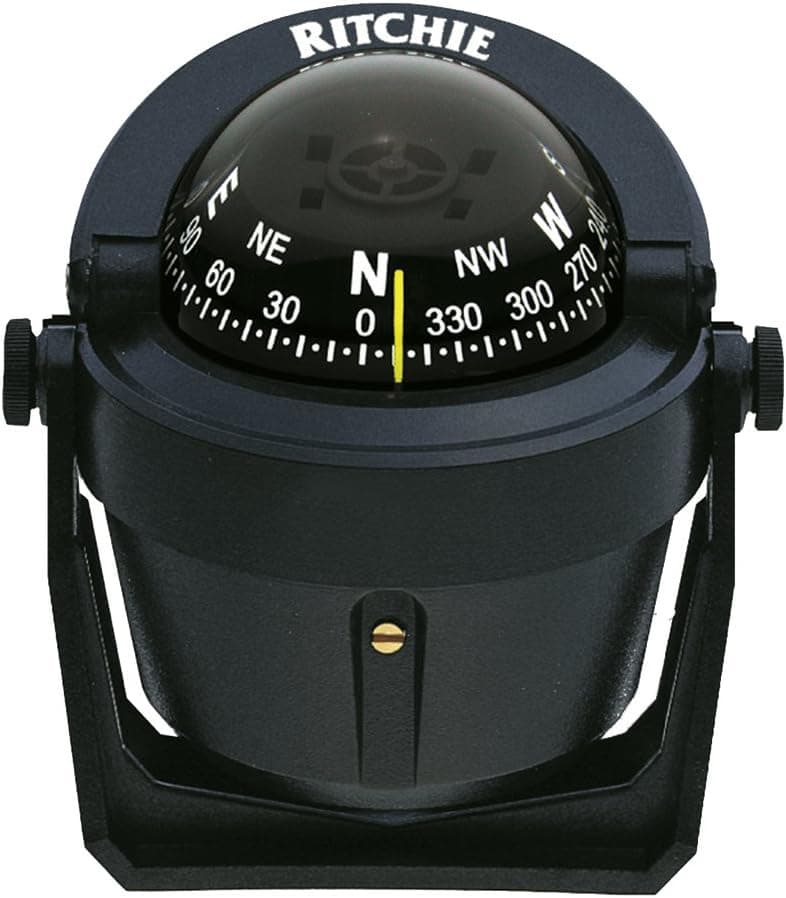
Ritchie Explorer B-51 Bracket Mount Compass
Ritchie's bracket-mount compass (B-51), with a 2-3/4 in (70 mm) direct-reading dial on a removable bracket with thumbscrews, built-in compensators, and green lighting at 12 V as standard, with 6 V and 24 V options. Ritchie balances its compasses for Zone 1, 'essentially all of the northern hemisphere', as standard, and says to wire the light to a fused circuit, allowing one amp for the compass, with a 1 A fast-acting fuse recommended for a standalone compass circuit.
View on Amazonpaid link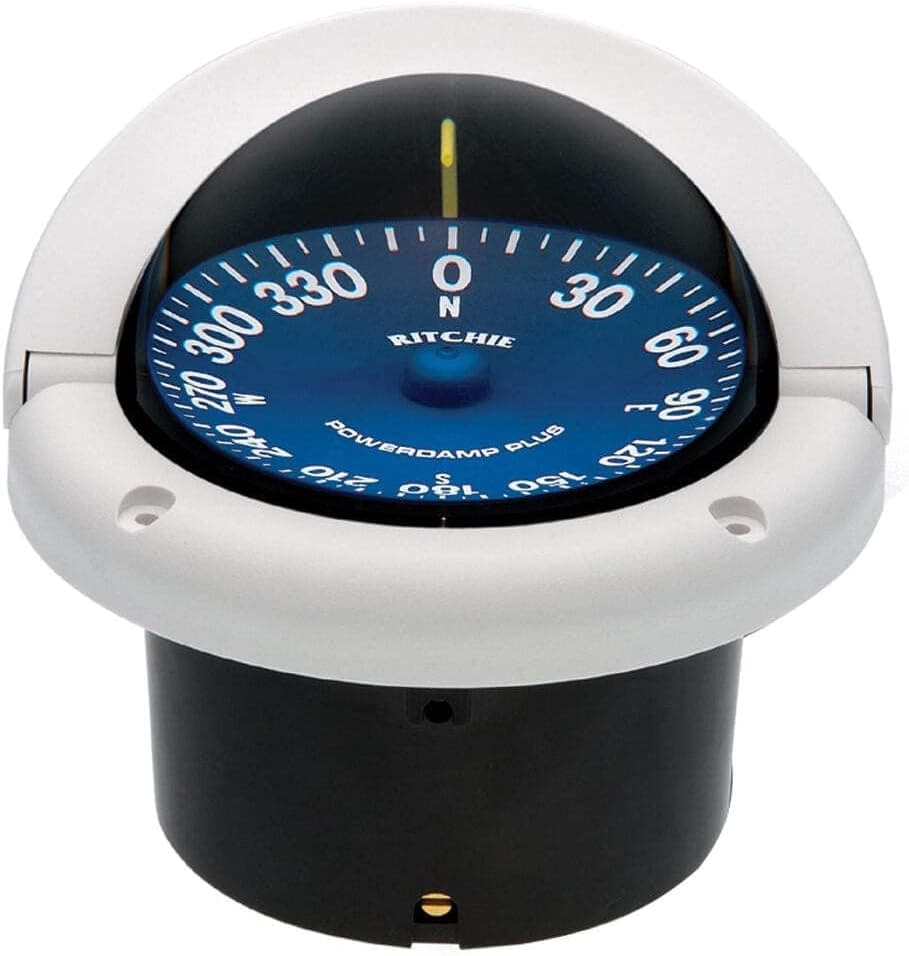 Ritchie · Navigation
Ritchie SuperSport SS-1002 Flush Mount Compass
Ritchie's flush-mount compass (SS-1002) for a 4 in hole, with a 3-3/4 in (96 mm) PowerDamp Plus open-face dial, built-in compensators, and 12 V green LED lighting in a movable sun shield; 24 V and 32 V lighting are options, and Ritchie lists a red replacement kit and adapter rings for a 6 in hole.
View on Amazonpaid link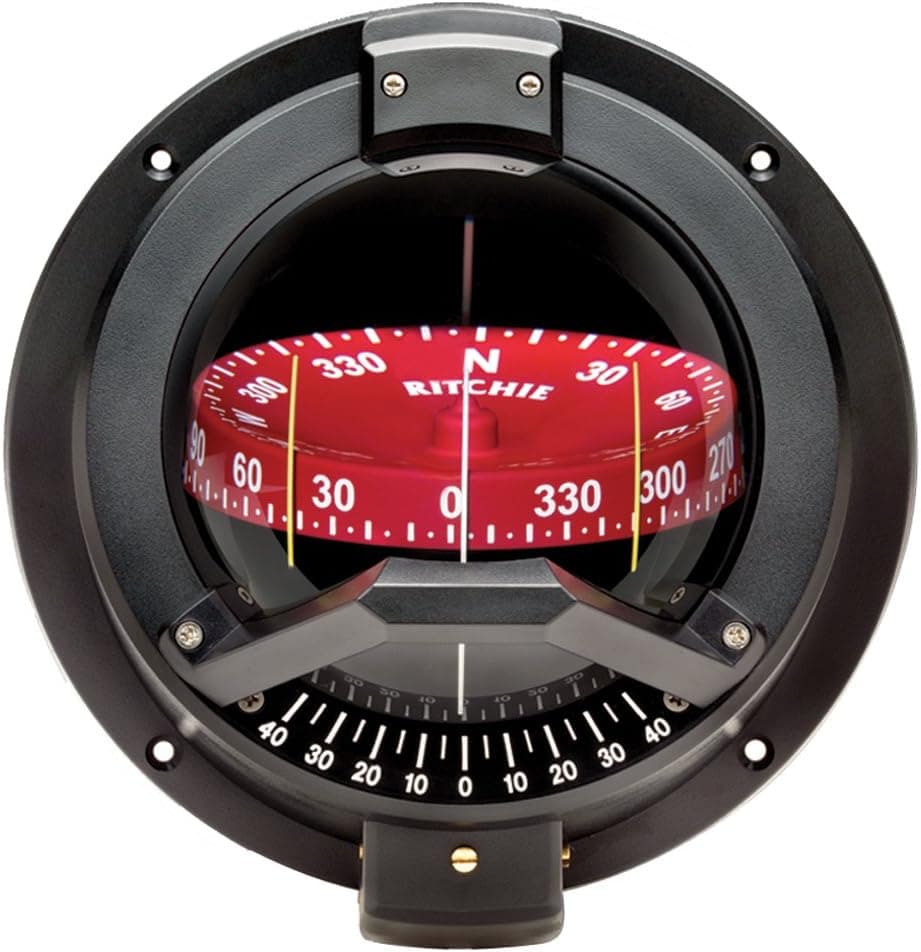 Ritchie · Navigation
Ritchie Navigator BN-202 Bulkhead Compass
Ritchie's sailboat bulkhead compass (BN-202), with a 4-1/2 in (115 mm) CombiDial that reads from above or in front, a built-in inclinometer, internal gimbals and built-in compensators, for a 5.75 in (146 mm) hole. Its lighting is amber LED at 12 V; for boats with 24 V or 32 V systems, Ritchie says dropping resistors are available.
View on Amazonpaid link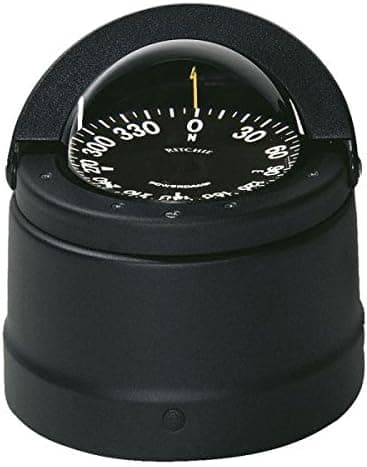 Ritchie · Navigation
Ritchie Navigator DNB-200 Binnacle Compass
Ritchie's binnacle compass (DNB-200) for a steering pedestal, with a 4-1/2 in (115 mm) PowerDamp dial, built-in compensators and green 12 V LED lighting, with 24 V and 32 V options. Ritchie says it fits common sailboat steering pedestals and suits power and sail, that the pedestal maker usually sets the mounting surface, and that throttle and gearshift linkages must not touch its compensator rods.
View on Amazonpaid link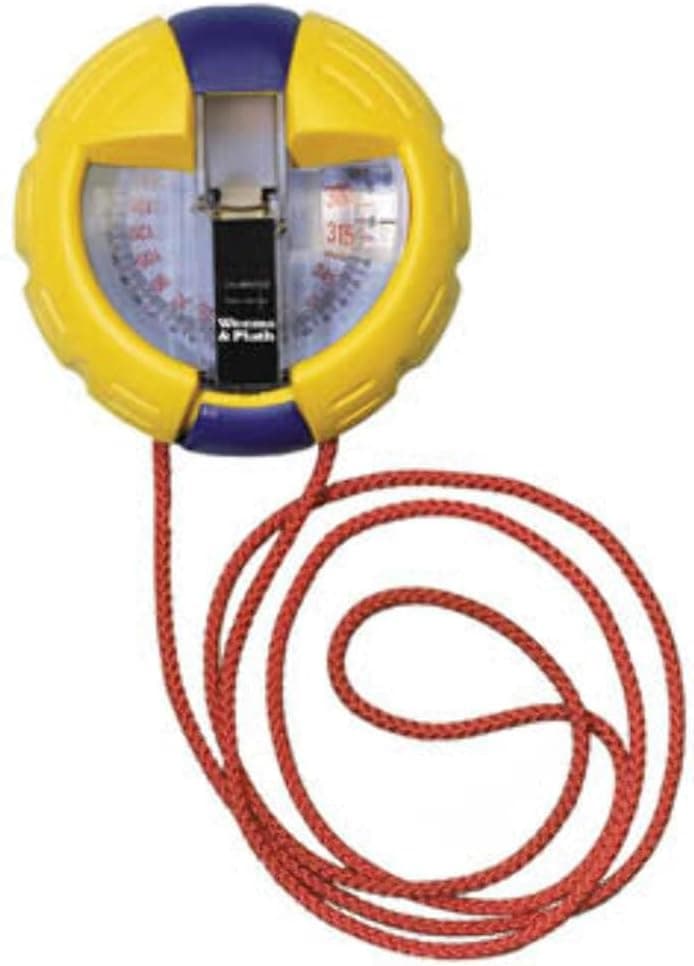 Weems & Plath · Navigation
Weems & Plath Hand Bearing Compass 2005
Weems & Plath's hand bearing compass (item 2005): hold it at eye level, sight the object and read the bearing under it. Weems & Plath rates it accurate to within 1 degree, with a liquid-damped card graduated every degree, an infinity prism that keeps the card in focus from eye to arm's length, and photoluminescent lighting that needs no batteries. A Southern Hemisphere version, the 2005-S, is sold separately.
View on Amazonpaid link
What this guide leaves out
Accuracy figures for steering compasses, which no maker we read publishes; compass fluids; Airguide and B&G, which we could not source; whether Plastimo's 2022 models are still current, since its own site was unreachable; and which zone a given Amazon listing ships in, so check with the seller if you will boat far from the northern hemisphere.
Sources
- 1.Ritchie — Frequently asked questions
- 2.Plastimo — Compass catalog, 2022 (copy hosted by US distributor Bainbridge International)
- 3.Ritchie — Ritchie's guide to compass navigation
- 4.Ritchie — Catalog, 2018
- 5.Silva — Marine guide: features and uses
- 6.US Coast Guard — A boater's guide to the federal requirements for recreational boats, November 2023
- 7.46 CFR 184.402 — Compasses (small passenger vessels; eCFR)
- 8.46 CFR 28.230 — Compasses (commercial fishing industry vessels; eCFR)
- 9.Ritchie — Navigator binnacle mount (DNB-200, DNP-200, DNW-200)
- 10.Ritchie — Installation, compensation and maintenance instructions, SH-0221 Rev F
- 11.Silva — 100NBC/FBC
- 12.Silva — 102B/H
- 13.Silva — 100BC
- 14.NOAA — Magnetic declination
- 15.NOAA NCEI — World Magnetic Model
- 16.NOAA NCEI — Geomagnetism frequently asked questions
- 17.NOAA — US Chart No. 1, 13th edition
- 18.NGA — The American Practical Navigator (Bowditch), Vol. I, 2024
- 19.Ritchie — Catalog, 2024
- 20.Silva — 70NBC/FBC manual, 37168-0151
- 21.Garmin — GPSMAP 9x3 owner's manual: compass-safe distance
- 22.Garmin — GPSMAP 9x27 owner's manual: compass-safe distance
- 23.Raymarine — i70 installation: compass safe distance
- 24.Raymarine — Evolution EV-1 and EV-2 location requirements, 87181
- 25.Ritchie — Glossary
- 26.Ritchie — X-21 dash mount instructions, RS-0154
- 27.Ritchie — Venture
- 28.Silva — Compensator for 70P, 100P and PT 103P
- 29.Plastimo — Catalogue technical pages, 2010-13 edition (copy hosted by retailer Maritimo)
- 30.Ritchie — Zone balancing
- 31.Suunto — Understanding balancing zones
- 32.Weems & Plath — Southern Hemisphere hand bearing compass, 2005-S
- 33.Ritchie — Explorer bracket mount (B-51, B-51W)
- 34.Ritchie — SuperSport Helmsman flush mount (SS-1002, SS-1002W)
- 35.Ritchie — Navigator bulkhead mount (BN-202)
- 36.Ritchie — Globemaster flush mounts (FB)
- 37.Weems & Plath — Hand bearing compass 2005 instructions
- 38.Weems & Plath — Hand bearing compass, 2005
- 39.Suunto — KB-20/360R G compass
- 40.Ritchie — SportAbout handheld (X-11Y)
- 41.Silva — 70UN
- 42.33 CFR 83.07 — Rule 7, risk of collision (Inland Navigation Rules; govinfo, 2024)
- 43.Garmin — SteadyCast heading sensor installation instructions, 190-02192-02
- 44.Ritchie — Compensation instructions