

Photo: antony whittaker on Unsplash
EPIRBs and PLBs, explained
A 406 MHz distress beacon sends an alert by satellite to search and rescue, with your position if it has a GPS receiver. An EPIRB is designed to be mounted on a vessel, and a PLB is a portable, handheld beacon for personal use. This guide covers how they work, which kind to carry, registering one with NOAA, mounting and switching it on, testing it without setting off a real alert, what to do after a false alert, and battery service. Every factual statement links to the regulation, the agency guidance or the maker's page it came from.
This guide links to products on Amazon. If you buy through those links we may earn a commission, at no extra cost to you. Each one is marked “paid link”. More in our affiliate disclosure.
Published October 19, 2026
How a 406 MHz beacon works
Cospas-Sarsat, the international satellite system, stopped processing 121.5 and 243 MHz beacons on 1 February 2009, so only 406 MHz beacons alert by satellite. The 121.5 MHz transmitter inside a 406 MHz beacon is a local homing signal for rescuers, which the change did not affect; 47 CFR 80.1061 requires every 406 MHz EPIRB to contain one. Class A, B, S and INMARSAT-E EPIRBs may not be made, imported, sold or used (47 CFR 80.1053).[15][20][2][1]
NOAA says the US Mission Control Center receives the alert, matches the beacon's ID against the registration database and adds the registration data, then passes it to the closest US search and rescue service, such as an Air Force or Coast Guard rescue coordination center. The Coast Guard says one of the first things its rescue coordination center watchstanders do is try to reach the owner, to rule out an accidental activation.[8][9][15]
The Coast Guard recommends a 406 MHz EPIRB, preferably with an integral GPS receiver. It says an alert through the geostationary satellites carries no location unless the EPIRB has one; its federal requirements guide says that without a GPS position the system takes about an hour on average, almost always under two, to work one out, while a GPS-equipped EPIRB gives an immediate position.[15][19]
NOAA says an EPIRB transmits for at least 48 hours once activated, and a PLB for at least 24.[10]
EPIRB or PLB
The Coast Guard says EPIRBs are designed to be mounted on a vessel and are typically larger and more powerful than PLBs. ACR's comparison: an EPIRB floats upright to transmit, runs at least 48 hours at -20°C, can be water-activated and is registered to the vessel; a PLB need not float, runs at least 24 hours, is activated by hand and is registered to the person. NOAA says a PLB used on a boat should be registered with the boat's call sign, MMSI, AIS MMSI, name and home port as well.[16][25][12]
ACR calls an EPIRB generally preferred for boaters, and suggests a PLB as a backup carried on the person and as the main beacon for someone alone on deck.[25]
A satellite messenger is a different service. Garmin says its inReach Mini 2 needs an active satellite subscription before its SOS can be used, and that pressing SOS sends a message to the Garmin Response team, which notifies emergency responders. The NTSB says alerts from such devices go to a commercial satellite and a coordination center run by the device's service company.[35][22]
Do you have to carry one?
The Coast Guard's federal requirements guide does not list an EPIRB as required for recreational boats; it lists one under equipment beyond the minimum federal requirements that boats operating offshore should consider. It also says the FCC does not require most recreational operators to hold an individual license to operate an EPIRB. If you do carry a 406 MHz beacon, registering it is mandatory.[19][2][5]
Registering with NOAA
47 CFR 80.1061(f) makes it mandatory to register each 406 MHz EPIRB with NOAA before installation and to keep the information up to date, and requires owners to tell NOAA in writing when the vessel or EPIRB changes hands, the EPIRB moves to another vessel, or any other registration information changes. 47 CFR 95.2905 requires each PLB owner to register with NOAA and report any change of ownership or other registration information.[2][5]
NOAA says registration is free, is valid for two years and must be renewed, with reminders by email or letter starting two months before. A second-hand beacon is registered by its new owner as if new, and the Coast Guard says the seller must first change its status to sold or transferred. A beacon must be registered in the country it is coded for, and NOAA recommends owning one coded for the country where you live.[12][11][15]
An unregistered or lapsed beacon still transmits, but the Coast Guard says an unregistered EPIRB's alert may take as much as two hours longer to reach it. NOAA says failing to register a beacon, or to report a change of ownership, could bring penalties or fines from the FCC, and a Coast Guard bulletin of April 2025 (MSIB 02-25) says the Coast Guard is continuing to enforce the registration rule.[12][15][18]
Return Link Service and AIS
Return Link Service shows on the beacon that the distress alert was received and forwarded to the authorities; NOAA and ACR both say it does not mean a rescue has been launched. NOAA says RLS-equipped EPIRBs and PLBs coded for the US have been legal for sale and use in the US since 1 June 2022. ACR says the acknowledgement is aimed to reach its GlobalFix V6 within 30 minutes of activation, though it may take significantly longer.[9][24]
Some EPIRBs and PLBs also transmit an AIS alert. Ocean Signal says an AIS EPIRB alarms AIS-equipped vessels within VHF range soon after activation, often the quickest help. When you register one, NOAA says to enter the beacon's own AIS MMSI, which should start with 970, 972 or 974. ACR's GlobalFix V6 has no AIS; ACR's AIS EPIRB is the GlobalFix V5 AIS.[34][12][23]
Mounting an EPIRB
The Coast Guard's guide says to mount an EPIRB to float free, following the maker's instructions, if possible, and otherwise to make sure it is readily accessible. The Coast Guard says a Category I EPIRB should be purchased if it can be installed properly, and NOAA says it is very important to mount one outside the cabin, where it can float free of a sinking vessel.[19][15][10]
The makers give their own rules. ACR says the GlobalFix V6 housing is for external installation only, on a vertical surface where the beacon can float free, at least 1.0 m from any steering compass, away from strong magnets such as loudspeakers and out of a radar beam. Ocean Signal says to mount its EPIRB3 Pro housing high on the superstructure, free from obstruction and where it cannot be trapped whatever the angle of the sinking vessel, with at least 150 mm (6 in) clear around it and 1.0 m from a steering compass, and to install the EPIRB3's manual bracket inside the vessel, so heavy seas cannot dislodge and set off the beacon.[24][32][34]
There is no single release depth. ACR's V6 manual gives 4 m maximum, a Coast Guard inspection sheet says a hydrostatic release usually acts at 3 to 5 meters, and NOAA gives 3 to 10 feet; check the figure for your model.[24][17][10]
The hydrostatic release has its own expiry. ACR says to check monthly that the V6's HydroFix release (P/N 9490.1, the only one to use) is within its expiry, two years after installation, and its V6 page says to mark the installation date and that the unit is good three years from manufacture. Ocean Signal says to replace the EPIRB3 Pro's HR1E (P/N 701S-00608) two years after installation, with the expiry label no more than three years from its date of manufacture.[24][23][32]
NOAA says to keep a Category II EPIRB in the most accessible spot on board. ACR says some owners keep one without its bracket in an abandon-ship bag, which it calls OK if the bag stays in a dry spot.[10][25]
Switching one on
ACR's GlobalFix V6 Category II is taken out of its bracket and put in the water, where it switches on; ACR says not to leave it in the bracket if the boat is in danger of sinking, and never to tether an activated V6 to the boat, because a sinking boat can pull it under or you can drift away from it. Ocean Signal's EPIRB3 cannot switch on in its bracket; out of it, it activates on contact with water, with the antenna fully extended, or by hand on deck or in a life raft.[24][34]
The Coast Guard says some EPIRBs must be floating in the water for their antenna to work at peak efficiency, and that the maker's instructions say whether yours should be.[17]
On ACR's ResQLink 400, you unclip the antenna latch, rotate the antenna 90 degrees upright and hold the ON/OFF button for 2 seconds. ACR says not to cover the activated beacon with any body part, water or clothing, because that blocks its GPS; that it will not work submerged and must be held above the water; and to leave it on until you are rescued.[30][29]
Testing, and false alerts
EPIRB transmissions may be used only in emergencies (47 CFR 80.1161), and PLBs only for distress and safety of life (47 CFR 95.2931). The Coast Guard says testing a 406 MHz EPIRB by letting it radiate outside a shielded container is illegal. NOAA says the beacon's own self-test changes its code so ground stations ignore it and no rescue center is notified, needs no approval, and that any activation other than self-test is read as a distress signal.[3][6][15][14]
The Coast Guard's EPIRB inspection sheet makes monthly testing mandatory only on vessels required to carry a 406 MHz EPIRB. ACR recommends a ResQLink self-test once a month, or at least two weeks before a trip, in the first 5 minutes of an hour; it says the battery allows 60 self-tests and 20 GPS self-tests over its 5-year life. Its V6 manual recommends a monthly self-test and a GNSS test at least every six months, with 60 GNSS tests over the battery's life, and says to test the V6 only in the first five minutes of an hour, because the test sends a short burst on 121.5 MHz.[17][30][24]
If an EPIRB goes off by mistake, 47 CFR 80.335(e) says to contact the nearest Coast Guard unit or appropriate rescue coordination center immediately and cancel the alert. NOAA says to call the Coast Guard for an EPIRB (1-855-406-8724) and the Air Force for a PLB (1-800-851-3051). ACR says its V6 sends its first alert about 50 seconds after switch-on, so switching it off within that time means no distress alert has been sent, but its manual still says to contact the nearest search and rescue authority and report any false alert. Thresholds differ by model, so follow your maker's manual. A 2013 FCC advisory says even a brief inadvertent activation can generate a false alert and is a rule violation that may bring monetary penalties.[4][13][24][21]
NOAA says most false alerts happen during testing, handling, repair and installation. The Coast Guard's MSIB 02-25 gives NOAA's figures for distress alert devices: 88, 78, 80, 60 and 104 distress alerts in 2020 to 2024, against 2,014, 1,971, 2,209, 2,066 and 2,149 false alerts.[13][18]
Batteries, service and disposal
NOAA says to replace the battery no later than the date on the beacon's label, or after an activation in an emergency. The Coast Guard says to use the battery the maker specifies, fitted by a dealer the maker approves; the wrong type may not run for the full duration.[12][15]
For the models we cover, the makers say the owner must not replace the battery. ACR gives the GlobalFix V6 a 10-year battery replacement period, says to replace it after any activation, even a brief one, and not to replace it yourself; Ocean Signal gives the EPIRB3 10 years and says replacement must be done at its authorised centres; ACR's ResQLink battery is replaced after 5 years or emergency use, through a factory-authorized battery replacement center. ACR's battery page says you may have to ship the beacon, and gives no price.[24][34][30][26]
NOAA says a beacon you dispose of must be made inoperable and must not go in the trash, because that could set off a false alert, and asks you to update its registration. The makers say the owner must not replace the battery, so ask the maker or an authorised centre to deal with it.[9][13][24][34]
The beacons we list
| ACR GlobalFix V6, Cat I | ACR GlobalFix V6, Cat II | Ocean Signal EPIRB3 Pro | Ocean Signal rescueME EPIRB3 | |
|---|---|---|---|---|
| Part number | 2853 | 2854 | 702S-03933 | 702S-03932 |
| Category | I, float-free housing | II, manual bracket | I, auto-release housing | II, manual bracket |
| Positioning | GPS, Galileo, GLONASS | GPS, Galileo, GLONASS | 72-channel multi-GNSS | GPS, Galileo, GLONASS |
| AIS | No | No | Yes | Yes |
| Return Link | Yes | Yes | Yes | Yes |
| Battery | 10-year replacement; over 48 h at -20°C | 10-year replacement; over 48 h at -20°C | 10-year replacement; over 48 h at -20°C | 10-year replacement; over 48 h at -20°C |
| ACR ResQLink 400 | ACR ResQLink 410 RLS | |
|---|---|---|
| Part number | 2921 (PLB-400) | 2931 (PLB-410) |
| Positioning | GPS and Galileo | GPS and Galileo |
| 121.5 MHz homing | Yes | Yes |
| Return Link | No | Yes |
| Battery | Replace after 5 years or emergency use; 24+ hours | Replace after 5 years or emergency use; 24+ hours |
The two ACR V6 listings are the same beacon in its Category I housing and its Category II bracket. ACR lists the HydroFix release (9490.1) among accessories rather than clearly in the Category I box, so confirm it is included. The EPIRB3 Pro is Ocean Signal's Category I version of the EPIRB3, with a hydrostatic release in its housing. Of the PLBs, the 410 RLS is the Return Link version of the 400; ACR says its RLS light does not confirm a rescue dispatch or give an arrival time.[23][33][31][28]
 ACR · Safety Equipment
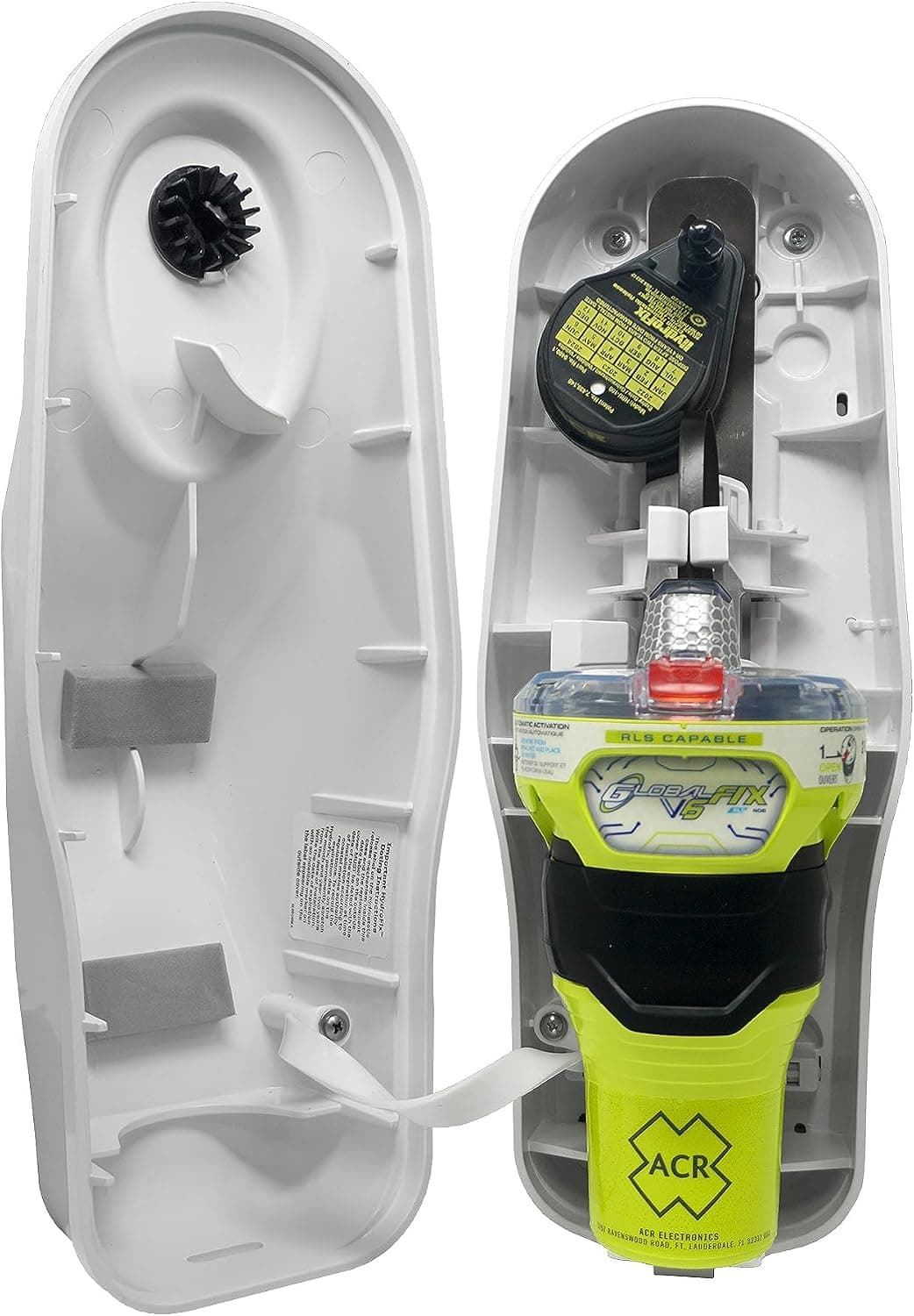
ACR GlobalFix V6 EPIRB, Category I Float-Free
ACR's GlobalFix V6 (model RLB-43) in its Category I float-free housing; ACR's US part is 2853: GPS, Galileo and GLONASS, a 121.5 MHz homer and Return Link Service, but no AIS. ACR gives it a 10-year battery replacement period and over 48 hours at -20°C, and says only an authorized center may replace the battery. Its HydroFix release (9490.1) must be replaced two years after installation, and ACR's V6 page also caps it at three years from manufacture, so check the label; ACR lists it as an accessory, so confirm it is in the box. Check the beacon is coded for the US, and register it with NOAA before installing it.
View on Amazonpaid link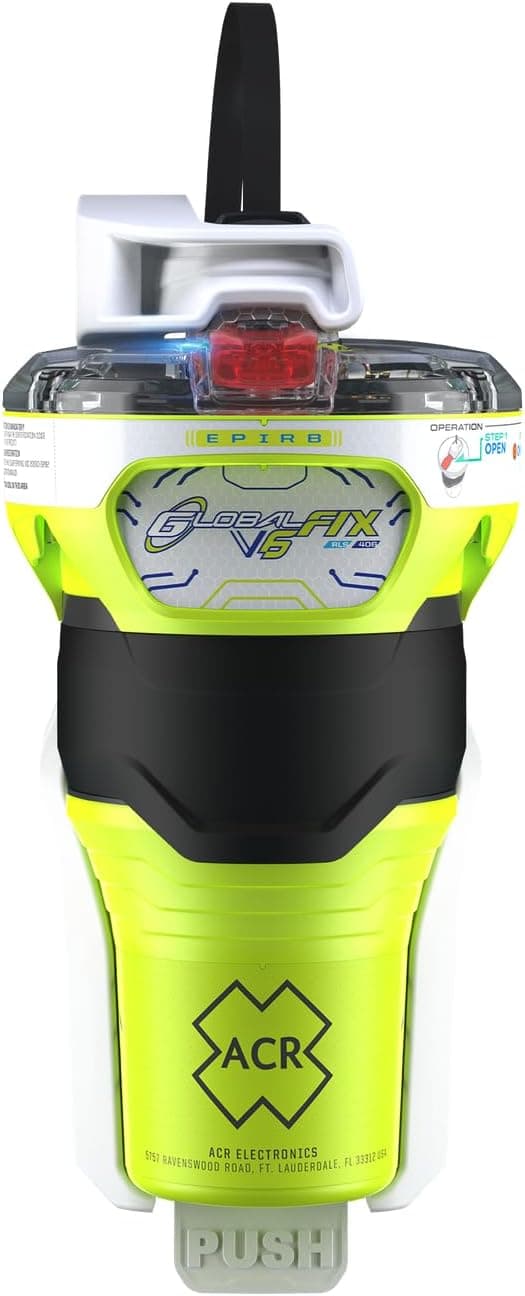 ACR · Safety Equipment
ACR GlobalFix V6 EPIRB, Category II Manual Bracket
The same GlobalFix V6 in its Category II manual bracket (ACR's US part 2854). ACR says it is taken out of the bracket and switches on in contact with water, warns not to leave it in the bracket if the boat is in danger of sinking, and says never to tether it to the boat. GPS, Galileo and GLONASS, Return Link Service, no AIS; 10-year battery replacement, by an authorized center only. Check it is coded for the US and register it with NOAA.
View on Amazonpaid link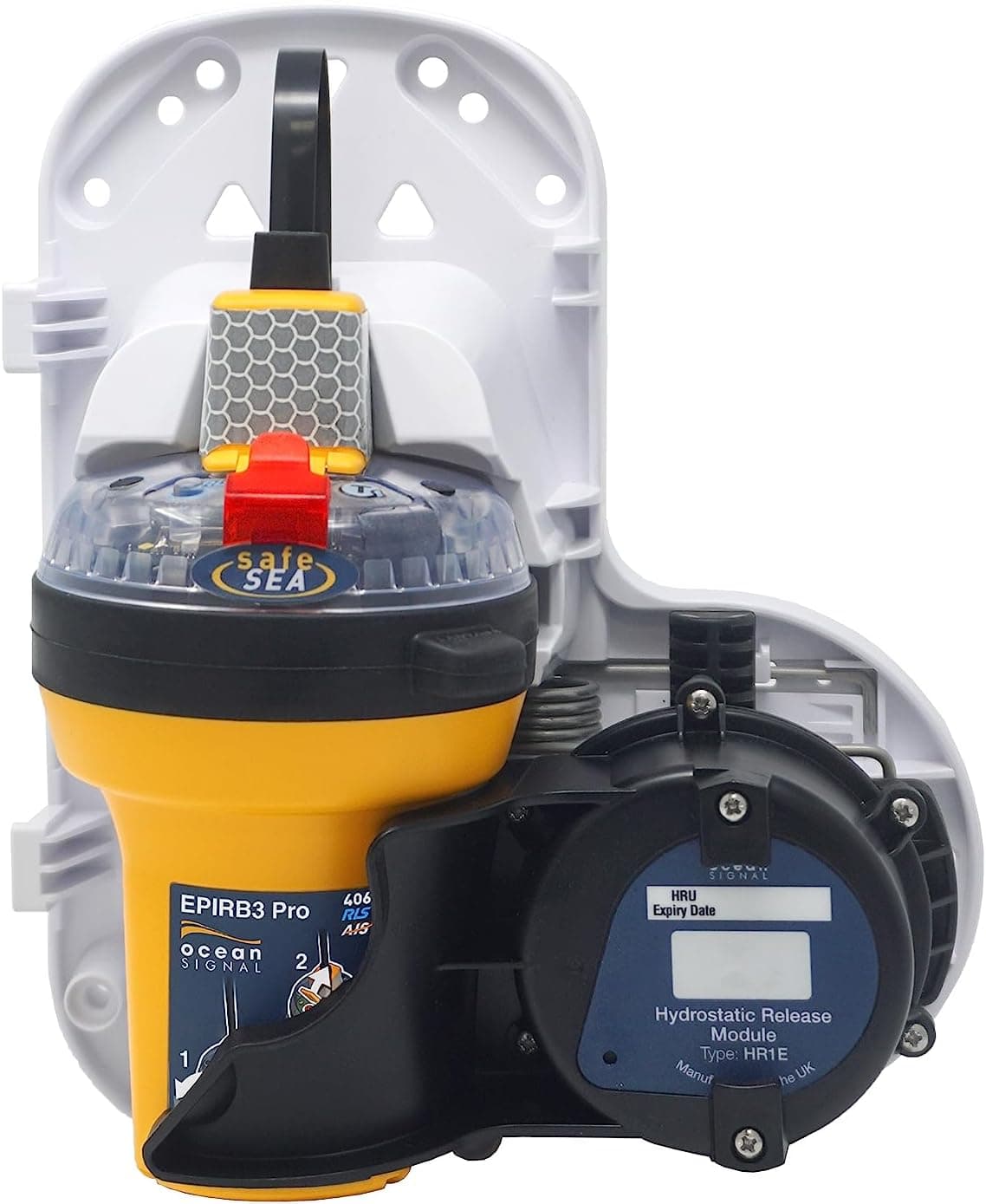 Ocean Signal · Safety Equipment
Ocean Signal EPIRB3 Pro, Category I with AIS
Ocean Signal's Category I EPIRB with an AIS alert (SKU 702S-03933), in an auto-release housing with an HR1E hydrostatic release, plus Return Link Service, a 72-channel multi-GNSS receiver and a 121.5 MHz homer. Ocean Signal gives a 10-year battery replacement period and over 48 hours at -20°C, and says to replace the HR1E (701S-00608) two years after installation, with an expiry label no more than three years from its date of manufacture. When registering, NOAA says to enter the beacon's own AIS MMSI. Check it is coded for the US.
View on Amazonpaid link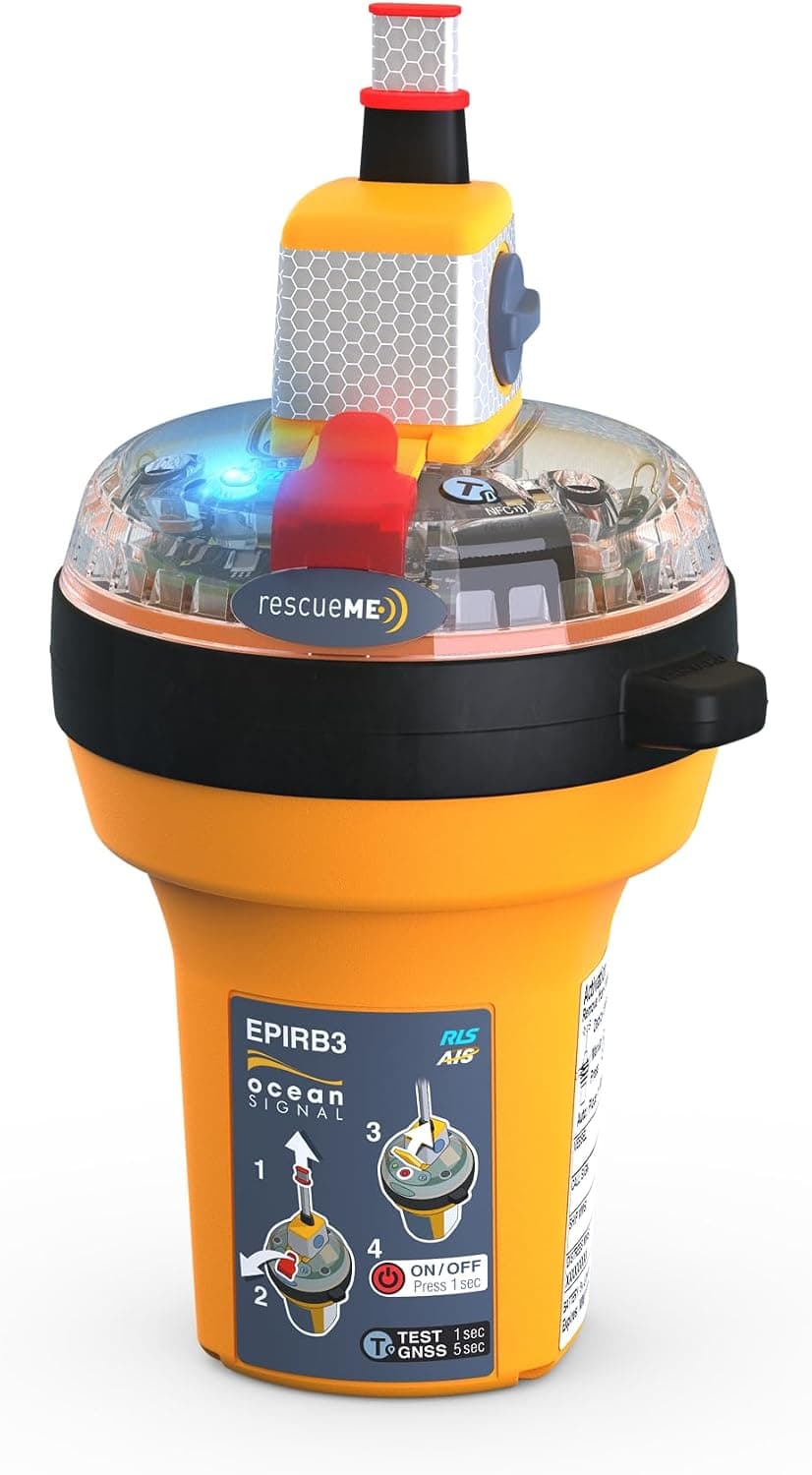 Ocean Signal · Safety Equipment
Ocean Signal rescueME EPIRB3, Category II with AIS
Ocean Signal's Category II EPIRB with an AIS alert (SKU 702S-03932), supplied with a manual-release bracket that Ocean Signal says to mount inside the boat. It cannot switch on in the bracket; out of it, it activates in contact with water or by hand. GPS, Galileo and GLONASS, Return Link Service and a 121.5 MHz homer; 10-year battery replacement and over 48 hours at -20°C, at an authorised centre only. Check it is coded for the US.
View on Amazonpaid link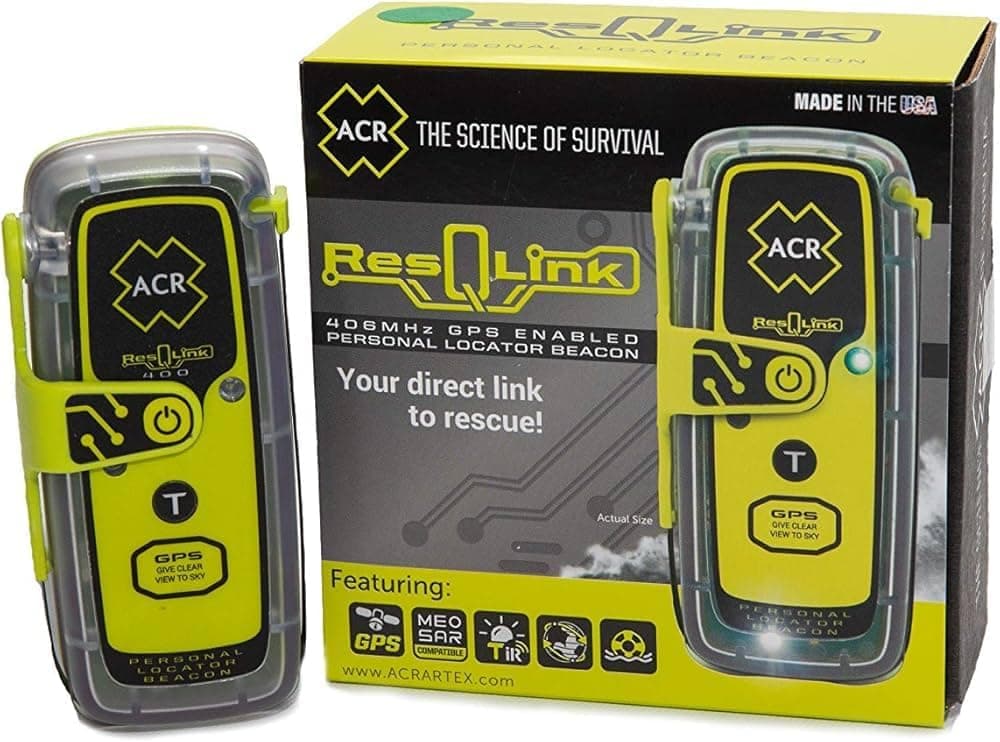 ACR · Safety Equipment
ACR ResQLink 400 Personal Locator Beacon
ACR's ResQLink 400 PLB (model PLB-400, US part 2921), with GPS and Galileo, a 121.5 MHz homer and visible and infrared strobes, and no Return Link Service or AIS. ACR calls it buoyant, so it can be retrieved, but says it will not work submerged: hold it above the water with the antenna up. The battery is replaced after 5 years or emergency use, through ACR's authorized centers. Register it with NOAA.
View on Amazonpaid link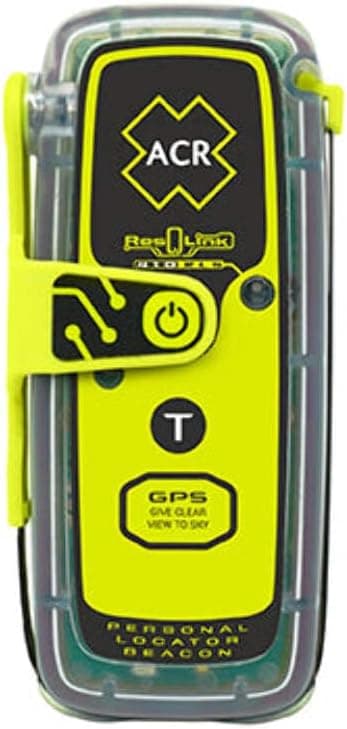 ACR · Safety Equipment
ACR ResQLink 410 RLS Personal Locator Beacon
The Return Link version of the ResQLink 400 (model PLB-410; ACR's US part is 2931, but the listing shows no part number, so check it is coded for the US): GPS and Galileo, a 121.5 MHz homer, and a blue light that shows the alert was received. ACR says that light does not confirm a rescue dispatch or give an arrival time. Buoyant but, like the 400, it must be held above the water to work; the battery is replaced after 5 years or emergency use, through an authorized ACR center. Register it with NOAA.
View on Amazonpaid link
What this guide leaves out
Carriage rules for commercial vessels, which do not apply to recreational boats; state rules; fine amounts, since the official sources disagree and the figures we found were out of date; McMurdo and Kannad EPIRBs whose pages say US authorization is pending; ACR's older GlobalFix V4, which ACR lists as Legacy; and coverage, range and position-accuracy claims beyond NOAA's own. Check that any beacon you buy, new or used, is authorized for sale in the US and coded for the US.
Sources
- 1.47 CFR 80.1053 — Prohibition on Class A, B, S and INMARSAT-E EPIRBs (eCFR)
- 2.47 CFR 80.1061 — Special requirements for 406 MHz EPIRB stations (eCFR)
- 3.47 CFR 80.1161 — Emergency position indicating radiobeacon (eCFR)
- 4.47 CFR 80.335 — Procedures for canceling false distress alerts (eCFR)
- 5.47 CFR 95.2905 — PLB registration (eCFR)
- 6.47 CFR 95.2931 — Permissible use of PLBs (eCFR)
- 7.46 CFR 161.011-5 — EPIRB types (eCFR)
- 8.NOAA SARSAT — Cospas-Sarsat system overview
- 9.NOAA SARSAT — Frequently asked questions
- 10.NOAA SARSAT — 406 MHz emergency beacons
- 11.NOAA SARSAT — Register your beacon
- 12.NOAA — 406 MHz beacon registration FAQ
- 13.NOAA SARSAT — Preventing false alerts
- 14.NOAA SARSAT — Emergency beacon testing
- 15.US Coast Guard Navigation Center — Emergency position indicating radiobeacon (EPIRB)
- 16.US Coast Guard Navigation Center — SARSAT beacons
- 17.US Coast Guard Navigation Center — Monthly EPIRB inspection procedures
- 18.US Coast Guard — MSIB 02-25, Registration of distress alert devices and cancelling false distress alerts, April 2025
- 19.US Coast Guard — A boater's guide to the federal requirements for recreational boats, November 2023
- 20.Cospas-Sarsat — Phase-out of 121.5/243 MHz satellite alerting
- 21.FCC — Enforcement advisory on 406 MHz beacons, DA 13-239, 2013
- 22.NTSB — Personal locator devices
- 23.ACR — GlobalFix V6 EPIRB
- 24.ACR — GlobalFix V6 user manual, 912S-04458 issue 01.00 (copy hosted by ACR on Dropbox)
- 25.ACR — A boater's guide to EPIRBs
- 26.ACR — Beacon battery replacement
- 27.ACR — ResQLink 400
- 28.ACR — ResQLink 410 RLS
- 29.ACR — PLB-400 specification sheet
- 30.ACR — ResQLink user manual, Y1-03-0343 Rev. C (copy hosted by ACR on Dropbox)
- 31.Ocean Signal — safeSEA EPIRB3 Pro
- 32.Ocean Signal — EPIRB3 Pro user manual, 912S-03968 issue 01.06, December 2025
- 33.Ocean Signal — rescueME EPIRB3
- 34.Ocean Signal — rescueME EPIRB3 user manual, 912S-03967 v01.04
- 35.Garmin — inReach Mini 2 owner's manual: SOS