

Photo: Mick Haupt on Unsplash
Boat batteries and chargers, explained
Marine batteries are built for different jobs: a short, heavy burst to start an engine, or a steady draw over hours for everything else. This guide covers which kind to buy, what the ratings on the label mean, group sizes, flooded, AGM, gel and lithium, charging from shore power and the alternator, the federal rules for installing a battery, battery switches, testing, winter storage and recycling. Every factual statement links to the regulation, the industry body or the maker's page it came from.
This guide links to products on Amazon. If you buy through those links we may earn a commission, at no extra cost to you. Each one is marked “paid link”. More in our affiliate disclosure.
Published October 20, 2026
Starting, deep-cycle or dual-purpose
Battery Council International (BCI), an industry trade association, describes three roles. A starting battery delivers a short burst of strong power to start an engine; a deep-cycle battery provides a low, steady level of power for longer; a dual-purpose battery is designed for a balanced combination of the two. BCI says that historically most RV and marine batteries have been dual-purpose, with limited deep-cycle capability for house loads when the engine is not running.[15]
Optima says a starting battery such as its 34M BlueTop will do if you only need to start an engine and have no significant electrical accessories, and that a deep-cycle load such as a trolling motor or live well calls for a marine battery designed and warrantied for deep-cycle use. Interstate says the long, repeated draining of a trolling motor will kill most lead-acid batteries, particularly a starting battery.[41][40]
Whether a lithium battery may start an engine depends on the model. Optima says not all lithium batteries are designed or warrantied for engine starting. Interstate describes its LI24MDP12V100 as providing both starting and deep-cycle power, while Lifeline's lithium manual says its low-temperature models (LL-12V100-24, LL-12V128-GC2 and LL-12V300-8DL) are for auxiliary use only, not engine starting.[42][38][27]
Flooded, AGM, gel or lithium
Which way up a battery may go is the maker's call, model by model. Trojan says its 31-AES can be installed horizontally or vertically, and Interstate that its 27M-AGM-A can be mounted in almost any position; Lifeline says its AGM batteries are designed to be installed upright with the terminals facing up, and to contact Concorde, its maker, about any other orientation.[20][37][24]
A lithium battery can look like a lead-acid one. A July 2025 Coast Guard safety alert, written for inspected vessels, notes that lithium packs often look like lead-acid batteries and says the best way to identify them is to read the nameplate specifications.[11]
Reading the label
BCI defines cold cranking amps (CCA) as the rating a battery maker sets for the current a new, fully charged, conditioned battery at 0°F (-18°C) can deliver for 30 seconds while holding at least 1.20 volts per cell, 7.2 V on a 12 V battery. It notes that European (EN) CCA is defined somewhat differently.[12]
Marine labels often give cranking amps (CA), which Optima says are sometimes called marine cranking amps (MCA): the same test run at 32°F (0°C), so the number is higher than the CCA; Interstate's page for its 27M-AGM-A, for one, lists 750 CCA and 900 CA. A lithium figure can rest on another basis again: Interstate's manual gives marine cranking amps for its LI24MDP12V100 as 1000 A for 5 seconds at 32°F, or 800 A for 8 seconds at 20°F.[44][37][39]
BCI defines reserve capacity as a rating the maker publishes: the minutes a new, fully charged battery at 80°F (26.7°C) can be discharged continuously at 25 amperes before reaching 1.75 volts per cell, which works out to 10.5 V on a 12 V battery.[12]
An amp-hour is current times hours of discharge, so 5 A for 20 hours is 100 Ah. BCI says a battery's rated capacity is specified at a particular discharge rate, temperature and cutoff voltage, so an amp-hour figure needs its rate. Trojan's GR31-AES data sheet shows why: 83 Ah at the 5-hour rate, 92 at 10 hours, 104 at 20 and 115 at 100.[12][21]
Group sizes
A BCI group number is a fit designation. BCI groups batteries by voltage, maximum overall dimensions, terminal arrangement and special features that may affect fit. It issues the groups to identify batteries for automotive applications, but its group-size table includes marine terminal types and an 8-volt marine section.[13][14]
| Group 24 | Group 27 | Group 31A | Group 34 | |
|---|---|---|---|---|
| Maximum size, L x W x H | 260 x 173 x 225 mm (10 1/4 x 6 13/16 x 8 7/8 in) | 306 x 173 x 225 mm (12 1/16 x 6 13/16 x 8 7/8 in) | 330 x 173 x 240 mm (13 x 6 13/16 x 9 7/16 in) | 260 x 173 x 200 mm (10 1/4 x 6 13/16 x 7 7/8 in) |
| Terminal types | A, A2 | A, A2 | A, M, M1 | A |
| CCA range at 0°F, reference only | 200-1000 A | 240-810 A | 660-1000 A | 235-1000 A |
BCI lists 31A and 31T and has no plain Group 31, so take a battery's real dimensions and terminals from its maker. Trojan gives its Group 31 version of the 31-AES as 12.80 x 6.81 in and 69 lb, with a height of 9.37 in in its group table and 9.43 in on its data sheet. Battle Born calls its BB10012 a drop-in replacement for Group 27 and Group 31 batteries and lists it at 12.76 x 6.86 x 8.95 in, longer than BCI's Group 27 maximum of 12 1/16 in, so measure the tray before you buy.[14][20][21][32]
Lithium: the management system, the alternator and the cold
Battle Born's BB10012 data sheet lists an internal BMS with high- and low-voltage, low-temperature charging, short-circuit and high- and low-temperature protection, and cell balancing. Victron's Lithium Battery Smart needs one of Victron's external BMS units, and Victron says an external safety relay is mandatory; its BMS stops charging when a cell passes 3.75 V or the temperature is too high or too low.[33][28][29][30]
Battle Born warns that a BMS shutdown leaves the vessel without power, and that one during alternator charging can severely damage the alternator and the boat's electrical system. It says an emergency house-to-start parallel switch is not recommended with LiFePO4 batteries and should be replaced, for example with a DC-to-DC charger.[36][35]
Each maker sets its own alternator rules. Battle Born says charging its lithium house bank directly from the engine alternator needs a high-quality external regulator, and calls a DC-to-DC charger a simple and safe way to use alternator charging. Victron says lithium accepts much higher charging current than lead-acid, so special care is needed not to overload the alternator; for its Lithium Smart batteries it lists four measures: an alternator rated at least twice the battery's capacity; an alternator with a temperature-controlled regulator; a current-limiting device such as a DC-DC charger between the alternator and the starter battery; and a BMS with a current-limited alternator port (its Smart BMS CL 12/100 or Smart BMS 12/200). Interstate says to test the whole charging system before fitting its LI24MDP12V100, and lists 150 A as the largest alternator for it.[35][29][39]
There is no one low-temperature limit for charging. Victron says its Lithium Smart battery can be charged between 5°C and 50°C (41°F and 122°F), that charging below 5°C permanently damages a cell, and that setting the BMS's minimum charge temperature below 5°C voids the warranty; Victron's Blue Smart charger manual says never to charge a lithium battery below 0°C (32°F). Interstate lists a charge range of -4°F to 113°F for its LI24MDP12V100, with a lower optimal charge current, 10 A, between -4°F and 14°F.[29][31][39]
The Coast Guard calls ABYC E-13, Lithium Batteries, a voluntary standard and recommends that builders consider it for recreational boats with electric propulsion. Its July 2025 alert requiring engineering review, testing and inspection of integrated lithium-ion battery systems covers inspected vessels, not recreational boats. NMMA advises contacting the boat's manufacturer or a certified technician before replacing lead-acid batteries with lithium-ion ones.[10][11][17]
Charging
NMMA says charging sources must meet the charging profile the battery or cell manufacturer recommends. As the table below shows, those profiles differ by maker even within one chemistry, so set the charger from the battery maker's figures.[17][21][24][32][30]
| Charge voltage | Float | |
|---|---|---|
| Trojan GR31-AES (AGM) | 14.40 V | 13.50 V |
| Lifeline AGM, 12 V | 14.3 V ± 0.1 V | 13.3 V ± 0.1 V |
| Battle Born BB10012 (LiFePO4) | 14.2 V to 14.6 V | 13.4 V to 13.8 V |
| Victron Lithium Smart, 12.8 V | 14.2 V recommended (14.0 V to 14.4 V) | 13.5 V |
A charger's presets are its maker's, not the battery's. ProMariner's ProSportHD AGM profile charges to 14.7 V and maintains at 13.6 V; Victron's Blue Smart charger has a NORMAL 14.4 V mode and a HIGH 14.7 V mode that Victron recommends for flooded lead-calcium, Optima spiral-cell and Odyssey batteries. Optima warns against gel or gel/AGM charger settings for its AGM batteries, saying they may not fully charge them and could damage them over time.[52][31][43]
For lead-acid, Trojan says temperature-compensated charging should always be used with AGM and gel batteries, and Lifeline recommends a three-stage charger that compensates for battery temperature, because no single charge voltage works over a wide temperature range. The two lithium makers cited here say the opposite: Victron's Lithium Smart manual says temperature compensation is not required and should be disabled, and Battle Born says to remove it from charging devices used with LiFePO4 batteries.[22][24][29][36]
A lithium battery needs a charger that can follow its maker's profile. Battle Born tells owners to check that every charging component can be programmed to its profile, and says a charger without multi-stage charging must at least let you set the bulk/absorption voltage, with equalization and temperature compensation disabled; Victron recommends a charger with a LiFePO4 profile or a custom one adjustable to the battery. Not every charger can: Xantrex's Truecharge2 guide says to charge only lead-acid batteries with it, and ProMariner's charge-profile page says to charge only approved LiFePO4 batteries on its ProSportHD lithium profile.[34][29][54][52]
Trojan says to fully charge its batteries after each use of 30 minutes or more. Lifeline says 102 to 110 percent of the discharged amp-hours must typically be returned for a full recharge, that falling short lets the state of charge walk down, causing sulfation and premature failure, and to charge its AGM batteries to 100 percent at least once every eight days.[22][24][26]
ProMariner recommends a charger of about 10 percent of the batteries' total amp-hour capacity, with one charger output for each battery, and says its waterproof chargers are for batteries that are not in use while charging; its dry-mount chargers can charge under load. Its ProSportHD manual says the AC plug must go into a GFCI-protected outlet. Victron says to install its charger in a well-ventilated area close to the battery but, because of possible corrosive gases, not above it.[50][53][31]
The federal installation rules
33 CFR 183 subpart I, the Coast Guard's electrical standard for boats, applies to boats that have a gasoline engine, except an outboard, for electrical generation, mechanical power or propulsion (183.401), so a gasoline generator counts. A boat with only outboards, or no gasoline engine, is outside it. On a boat it covers, each electrical component must meet the subpart unless it is part of an outboard engine or of portable equipment (183.405). The Coast Guard says federal requirements are minimums and do not guarantee a boat's safety.[1][2][9]
Held down
On a boat that subpart I covers, under a pull of 90 lb or twice the battery's weight, whichever is less, applied through its center of gravity, an installed battery must not move more than one inch in any direction: one minute each vertically, fore, aft, to starboard and to port (183.420(a)). It is a builder's test, not an owner's checklist.[4]
Terminals covered
On a boat that subpart I covers, metal objects must not be able to touch the ungrounded battery terminals (183.420(b)). A continuously energized ungrounded terminal needs a boot, nipple, cap, cover or shield unless it meets the overcurrent rule in 183.455 (183.445(b)), and a battery terminal connector may not depend on spring tension (183.420(g)).[4][5]
Clear of fuel
On a boat that subpart I covers, a battery may not be directly above or below a fuel tank, fuel filter or fitting in a fuel line (183.420(d)), and metallic fuel lines and fuel system components within 12 inches and above the horizontal plane of the battery's top surface must be shielded with dielectric material (183.420(c)).[4]
Subpart I requires a vent system or other means to let the hydrogen a battery releases leave the boat, and gives no size, duct or airflow figure (183.420(e)). The makers add their own warnings: Lifeline says hydrogen can ignite at concentrations as low as 4 percent in air and never to install its AGM batteries in a sealed or airtight container; Trojan's data sheet says not to install or charge its batteries in a sealed or non-ventilated compartment; Odyssey says not to charge in an airtight compartment.[4][25][21][45]
On a boat subpart I covers, each ungrounded output conductor from a storage battery needs a manually reset, trip-free circuit breaker or fuse within 72 inches of the battery, measured along the conductor, unless it is the main feed to an engine's cranking motor (183.460(a)). For boats built before August 1, 1985, the 72-inch placement does not apply if the circuit has a switch that disconnects the battery.[6]
On these boats an electrical component must not ignite a 4.25 to 5.25 percent propane-air mixture around it at its rated voltages and currents, unless it is isolated from gasoline fuel sources: by a qualifying bulkhead, by sitting lower with a means to keep leaked fuel and vapor off it or higher with a deck or enclosure between, or by at least two feet of space open to the atmosphere (183.410). Separately, a compartment holding a permanently installed fuel tank and an electrical component that is not ignition protected needs natural ventilation unless it is open to the atmosphere (183.620(a)(3)); that rule, in subpart K, does not exclude outboard boats (183.601).[3][8][7]
Ignition protection on a charger or switch is the maker's statement. Perko lists its 8501 selectors as ignition protected and says its compact 8511 can be installed in the engine rooms of gasoline-powered boats, naming no test standard; ProMariner lists ignition protection among the ProSportHD's safety features and the series as listed to UL Marine 1236; Xantrex says its non-IEC Truecharge2 can be installed where ignition-protected equipment is required but recommends that it is safest not to install any electrical equipment there, and that IEC models must not be.[47][49][51][54]
Battery switches
Perko says its battery selector switches are make-before-break and can be switched between 1, ALL and 2 with the engine running, and that they facilitate putting batteries in parallel for emergency starting when one or both are substantially discharged. Battle Born advises against an emergency house-to-start parallel connection with its LiFePO4 batteries (see the lithium section). It rates its medium-duty 8501 at 250 A continuous and 360 A for 5 minutes, for 6 to 32 volt systems, and its compact 8511 at 315 A continuous and 450 A for 5 minutes.[47][49][36]
The 8501 has no alternator field disconnect. Perko says its AFD models, such as the 8504DP, protect non-unitized alternators if the switch is accidentally turned OFF with the engine running.[47][48]
Bank size, mixing and testing
For their lead-acid batteries, Lifeline's manual says to size the bank at least twice the capacity the load needs, so 100 Ah of average need calls for at least 200 Ah, keeping the average depth of discharge to 50 percent of the 20-hour rating for best cycle life; Trojan says not to discharge beyond 80 percent depth of discharge.[24][22]
NMMA says not to mix battery chemistries or types in the same bank, and the makers add their own limits. Lifeline says every battery in a series string must be the same model and size. Victron allows its Lithium Smart batteries of different capacities and ages in parallel, but in series wants the same capacity and part number, no more than 3 years apart in age. Battle Born says not to run its battery in series or parallel with any other type, and Interstate's LI24MDP12V100 manual says never to mix capacities, voltages, models, brands, types or technologies in a bank.[17][24][29][34][39]
A voltage reading means little until the battery has rested, and each maker sets its own rest and table. Trojan says at least 6 hours, preferably up to 24; Lifeline at least four, with charger and loads disconnected, and its table puts a 12 V battery at 75 percent charge at 12.48 V (it says a new battery reads somewhat higher); Odyssey at least 12, with a healthy, fully charged Odyssey at 12.84 V or more at 25°C. Victron's Lithium Smart has no built-in state-of-charge monitoring, so it needs a Lynx Smart BMS or a battery monitor.[22][24][45][29]
Winter storage
Trojan says to check stored flooded batteries every 4 to 6 weeks and stored AGM or gel batteries every 2 to 3 months, to charge AGM and gel when they fall to 75 percent, and never to charge a frozen battery. Lifeline says to boost-charge every 90 days or when a 12 V battery's resting voltage drops to 12.5 V, and that a fully charged battery will not freeze even in the coldest weather while a discharged one will freeze even when moderately cold. Odyssey says to fully charge its battery before off-season storage.[22][24][46]
For lithium the makers disagree: Battle Born recommends storing its battery at 100 percent state of charge, while Lifeline's lithium manual says to discharge to 40 to 50 percent for extended storage. Follow the manual for the battery you have.[34][27]
Recycling an old battery
Lifeline says spent batteries should be returned to a local or regional collection center and never discarded in the trash or a landfill. New York's DEC says it is illegal to put lead-acid batteries in the trash, listing boats among their common uses, and that a retailer charges a $5 return incentive when you buy a battery without returning one, refunded if you bring one back within 30 days. In California a battery dealer must accept used lead-acid batteries, including starting and motive-power batteries for watercraft, without a fee, though it need not take more than six per person per day. Rules and amounts differ by state.[24][18][19]
BCI reports a recent lead-battery recycling rate of about 98 percent. Interstate's lithium manual says not to put lithium batteries into lead-acid battery recycling.[16][39]
The batteries, charger and switch we list
| Trojan 31-AES | Victron Lithium Battery Smart 12.8 V 100 Ah | |
|---|---|---|
| Chemistry | AGM (VRLA) | Lithium iron phosphate (LiFePO4) |
| Capacity | 104 Ah at the 20-hour rate (83 Ah at 5 hours) | 100 Ah nominal at 25°C |
| Cranking and discharge | 540 CCA at 0°F, 648 CA at 32°F; 178 min reserve capacity | 200 A maximum continuous discharge, 100 A or less recommended |
| Charge and float | 14.40 V and 13.50 V at 77°F | 14.2 V recommended (14.0 V to 14.4 V) and 13.5 V |
| Also | Installs horizontally or vertically; 3-year warranty | Charges at 5°C to 50°C; needs an external Victron BMS and safety relay |
ProMariner's 44021 is the ProSportHD 20 Plus: a three-bank, 20 A, IP67 charger for three 12 V batteries, which ProMariner says gives a full charge in 8 to 10 hours. ProMariner lists it for LiFePO4, flooded, AGM and gel batteries, but ProMariner's charge-profile page says to charge only approved LiFePO4 batteries, so check its approved list before pairing the charger with any lithium battery. Perko's 8501 is the medium-duty selector above, with no alternator field disconnect.[50][52][47]
 Trojan · Electrical
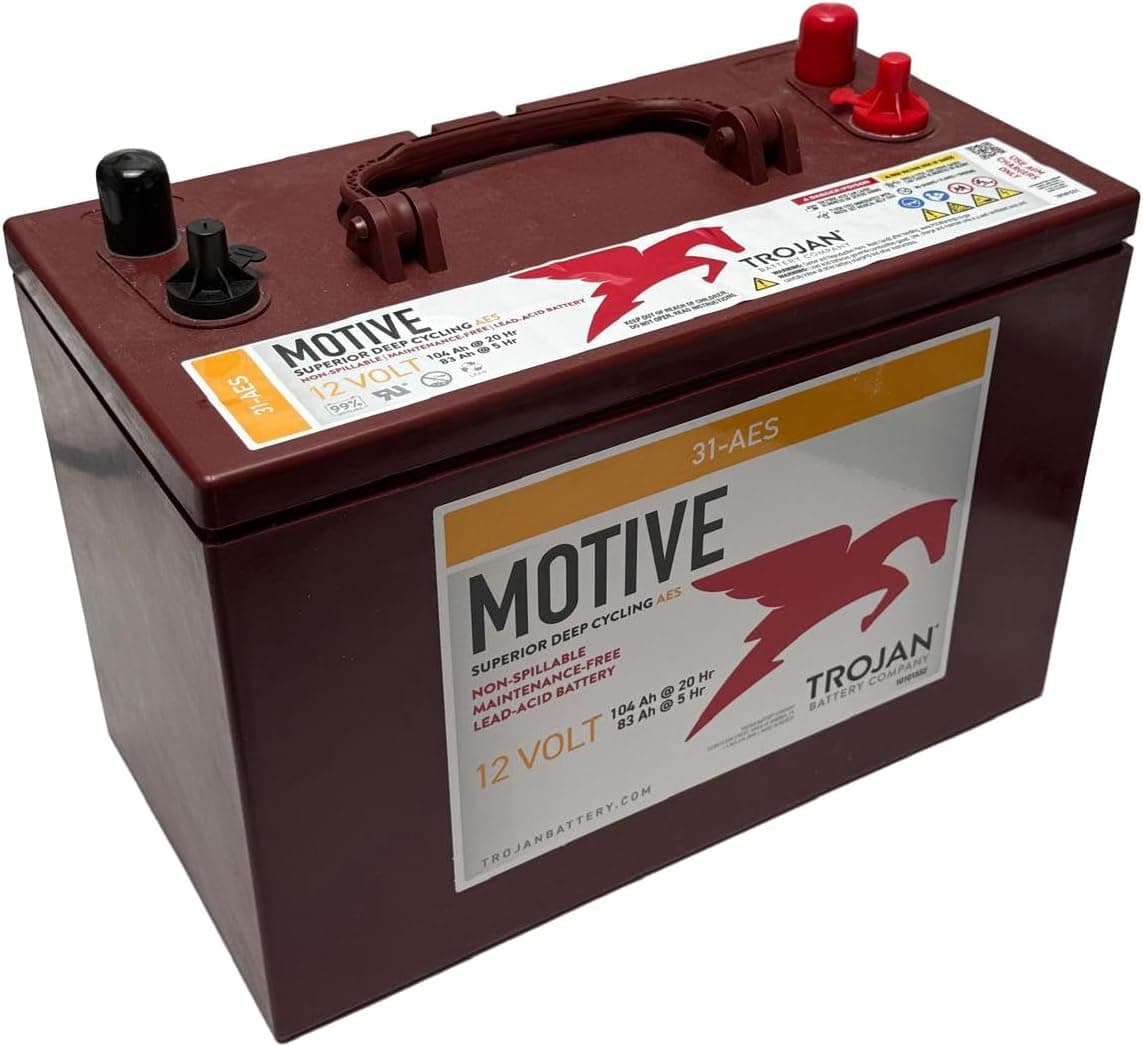
Trojan 31-AES 12V AGM Deep-Cycle Battery
A valve-regulated AGM battery that Trojan makes in Groups 29 and 31; the listing's dimensions match the Group 31, which Trojan gives as 12.80 x 6.81 in and 69 lb, 9.37 in high in its group table and 9.43 in on its data sheet. Trojan's data sheet gives 104 Ah at the 20-hour rate (83 Ah at 5 hours), 540 CCA at 0°F and 178 minutes of reserve capacity, and charger settings at 77°F of 14.40 V absorption and 13.50 V float. Trojan says it can be installed horizontally or vertically and that no watering is required, and backs it with a 3-year warranty.
View on Amazonpaid link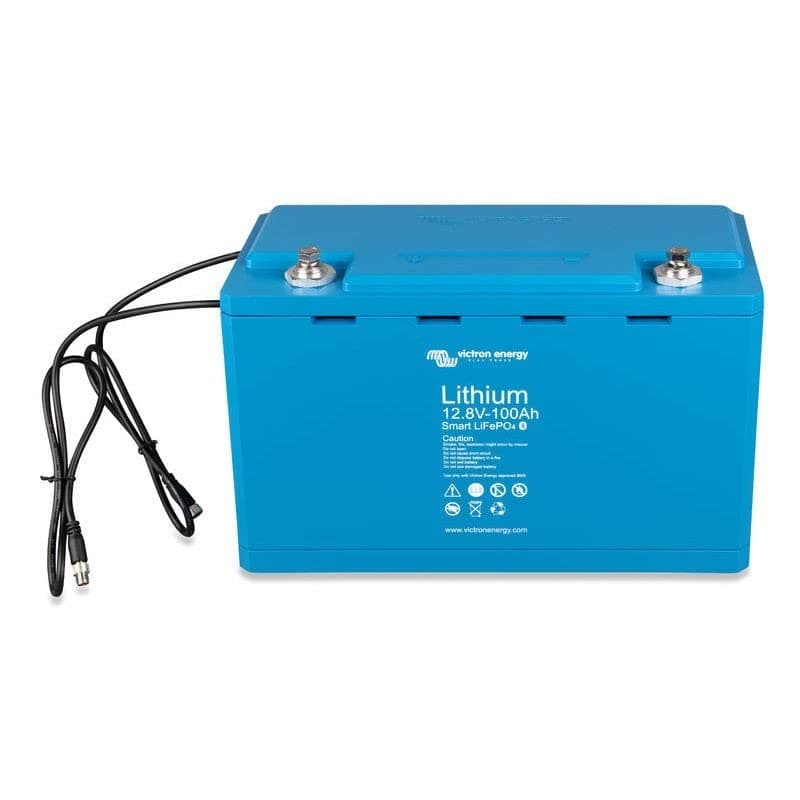 Victron Energy · Electrical
Victron Lithium Battery Smart 12.8V 100Ah
Victron's 12.8 V, 100 Ah lithium iron phosphate battery. It needs one of Victron's external BMS units, and Victron says an external safety relay is mandatory. Victron recommends charging at 14.2 V with a 13.5 V float, only between 5°C and 50°C, and continuous discharge of 100 A or less (200 A maximum). Victron recommends a charger with a LiFePO4 profile or a custom profile adjustable to the battery, and says to disable temperature compensation. For alternator charging, Victron's manual lists four measures, among them a DC-DC charger and a BMS with a current-limited alternator port.
View on Amazonpaid link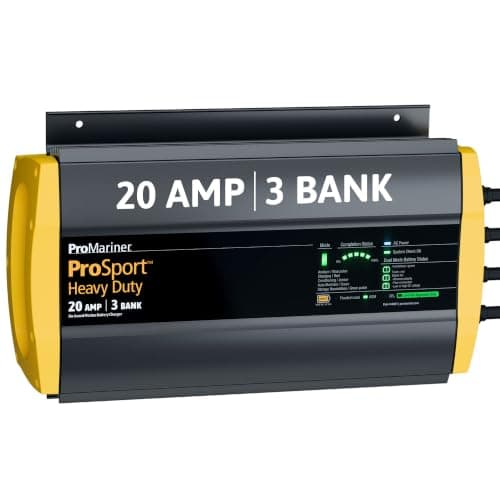 ProMariner · Electrical
ProMariner ProSportHD 20 Plus 3-Bank Charger (44021)
A 20 A, three-bank, IP67 waterproof onboard charger for three 12 V batteries, which ProMariner says gives a full charge in 8 to 10 hours. Its AGM profile charges to 14.7 V and maintains at 13.6 V, so compare that with your battery maker's settings; its LiFePO4 profile is for ProMariner-approved lithium batteries only. ProMariner says waterproof chargers are for batteries not in use while charging and recommends a charger of about 10 percent of the bank's total amp-hours, and its manual asks for a GFCI-protected outlet.
View on Amazonpaid link Perko · Electrical
Perko Medium Duty Battery Selector Switch (8501)
Perko's medium-duty selector, rated 250 A continuous and 360 A for 5 minutes, for 6 to 32 V systems. Perko says it is make-before-break and can be switched between 1, ALL and 2 with the engine running, and lists it as ignition protected without naming a test standard. It has no alternator field disconnect: Perko's AFD models protect non-unitized alternators if the switch is turned OFF with the engine running. Battle Born says an emergency house-to-start parallel switch is not recommended with its LiFePO4 batteries. The listing gives no Perko part number, so check it is the 8501.
View on Amazonpaid link
What this guide leaves out
Cable sizing and wiring, inverters, solar and shore-power systems; the texts of ABYC's standards, which we did not read; any vent size for a battery box, since the regulation gives none; the Coast Guard handbook's interpretations of the electrical rules; and one-number answers to questions the makers answer differently: the lowest temperature at which a lithium battery may be charged, a charge voltage for a whole chemistry, a temperature-compensation coefficient, a state-of-charge voltage table and a lithium storage level. Go by the manual for the battery and charger you have.
Sources
- 1.33 CFR 183.401 — Electrical systems: purpose, applicability (eCFR)
- 2.33 CFR 183.405 — Electrical systems: general (eCFR)
- 3.33 CFR 183.410 — Ignition protection (eCFR)
- 4.33 CFR 183.420 — Batteries (eCFR)
- 5.33 CFR 183.445 — Conductors: protection (eCFR)
- 6.33 CFR 183.460 — Overcurrent protection: special applications (eCFR)
- 7.33 CFR 183.601 — Ventilation: applicability (eCFR)
- 8.33 CFR 183.620 — Natural ventilation system (eCFR)
- 9.US Coast Guard — A boater's guide to the federal requirements for recreational boats, November 2023
- 10.US Coast Guard — Boating Safety Circular 99, Fall 2022
- 11.US Coast Guard — Safety Alert on integrated lithium-ion battery systems, July 2025 (as reprinted by MarineLink)
- 12.Battery Council International — BCIS-101, glossary of common battery terms (January 2025)
- 13.Battery Council International — BCI group sizes
- 14.Battery Council International — group size table (PDF)
- 15.Battery Council International — About lead batteries
- 16.Battery Council International (industry trade association) — Lead battery recycling
- 17.NMMA (Discover Boating) — Marine batteries: what to know (brochure)
- 18.New York State DEC — Lead-acid batteries
- 19.California Health and Safety Code 25215.2 — dealer acceptance of used lead-acid batteries (CDTFA)
- 20.Trojan — 31-AES 12V AGM battery
- 21.Trojan — GR31-AES data sheet (2023032)
- 22.Trojan — Battery user's guide (2019 edition)
- 23.Trojan — Quick battery watering guide
- 24.Lifeline (Concorde) — AGM battery technical manual, Rev F, 2019
- 25.Lifeline (Concorde) — AGM battery technical manual, Rev G, November 2019
- 26.Lifeline — Marine batteries
- 27.Lifeline — Lithium battery owner's manual
- 28.Victron Energy — Lithium Battery Smart 12,8V and 25,6V
- 29.Victron Energy — Lithium Smart battery manual
- 30.Victron Energy — 12,8 and 25,6 volt lithium iron phosphate batteries Smart, data sheet
- 31.Victron Energy — Blue Smart IP67 charger 120V manual
- 32.Battle Born — 100Ah 12V LiFePO4 deep cycle battery (BB10012)
- 33.Battle Born — BB10012 data sheet
- 34.Battle Born — BB10012 and BB10012H manual
- 35.Battle Born — Alternator charging 101 for marine applications
- 36.Battle Born — Important considerations when upgrading to lithium on your sailboat
- 37.Interstate — 27M-AGM-A dual purpose marine battery
- 38.Interstate — LI24MDP12V100 marine lithium battery
- 39.Interstate — Dual purpose lithium battery safety manual
- 40.Interstate — Marine trolling motor batteries
- 41.Optima — What is different about a marine battery?
- 42.Optima — What type of battery is best for a boat?
- 43.Optima — What is the best way to charge a boat battery?
- 44.Optima — What does cold cranking amps (CCA) mean?
- 45.Odyssey (EnerSys) — Battery owner's manual, November 2018
- 46.Odyssey — Marine battery general FAQ
- 47.Perko — Medium duty battery selector switch (8501)
- 48.Perko — Medium duty battery selector switch with alternator field disconnect and key lock (8504)
- 49.Perko — Compact medium duty battery selector switch (8511)
- 50.ProMariner — Battery chargers
- 51.ProMariner — ProSportHD series (catalog page)
- 52.ProMariner — ProSportHD charge profiles (catalog page)
- 53.ProMariner — ProSportHD owner's manual, 08/19 (copy hosted by Defender)
- 54.Xantrex — Truecharge2 battery charger owner's guide