

Photo: Brandon Hoogenboom on Unsplash
Marine toilets, explained
A boat's toilet, or head, is plumbing with a legal side: US rules decide what it may discharge, and where. This guide covers what the law requires, the kinds of head and what each needs in power, plumbing and upkeep, where smells come from, and how to keep a head below the waterline from siphoning the sea in. Every factual statement links to the maker's page or manual, or to the regulation or agency it came from.
This guide links to products on Amazon. If you buy through those links we may earn a commission, at no extra cost to you. Each one is marked “paid link”. More in our affiliate disclosure.
Published October 18, 2026
What the law requires
Under 33 CFR 159.7(a), any vessel with installed toilet facilities must have an operable marine sanitation device (MSD) that is labeled or certified. A Type II or Type III device is allowed on any vessel; a Type I only on vessels 65 feet (19.7 m) or less in length.[1]
33 CFR 159.3 defines the three types. Under the regulation's test conditions, a Type I device produces effluent with no more than 1,000 fecal coliform per 100 milliliters and no visible floating solids, and a Type II no more than 200 per 100 milliliters, with suspended solids of no more than 150 milligrams per liter. A Type III is 'designed to prevent the overboard discharge of treated or untreated sewage or any waste derived from sewage', and EPA describes it as typically a holding tank. Under 33 CFR 159.12a, a Type III that only stores sewage and flushwater at ambient air pressure and temperature is considered certified without a Coast Guard label, provided it is designed to prevent overboard discharge.[2][3][4]
EPA says untreated sewage may not be discharged within three miles from shore: inside three miles, sewage must be treated by a Coast Guard-approved Type I or Type II MSD or held in a Type III holding tank. EPA's boater guide says the ban on untreated discharge covers all inland waters, the Great Lakes, and coastal waters out to three miles. The regulation's definition of the territorial seas says '3 miles'; the Coast Guard's boater guide says 3 nautical miles.[5][6][2][7]
In a No Discharge Zone, EPA says, treated and untreated sewage discharge are both prohibited, so boats must hold their sewage for a pump-out ashore or discharge it at sea beyond three miles. The Clean Water Act lets a state ban all discharge in some or all of its waters once EPA determines that adequate pump-out facilities are reasonably available. And in landlocked freshwater lakes and reservoirs, and in rivers that interstate vessel traffic cannot navigate, EPA's standard requires MSDs to prevent any overboard discharge, treated or not.[8][9][10]
Zones are set water by water. In California, for example, the ten older bay and marina zones still apply to all vessels, including recreational boats, while EPA's 2012 California marine-waters zone covers large passenger vessels of 300 gross tons or more with berths or overnight accommodations, and large oceangoing vessels of 300 gross tons or more with a holding tank that has remaining capacity or contains sewage.[11]
The Clean Water Act sets a civil penalty for violating the MSD regulations, and each violation is a separate offense. The Coast Guard's inflation-adjusted maximum for 'Marine Sanitation Devices; Operating' is $9,956 per violation.[9][12]
Securing the overboard valve
33 CFR 159.7(c) reads: 'When operating a vessel on a body of water where the discharge of untreated sewage is prohibited by the Environmental Protection Agency under 40 CFR 140.3, the operator must secure each Type III device in a manner which prevents discharge of sewage. Acceptable methods of securing the device include— (1) Closing each valve leading to an overboard discharge and removing the handle; (2) Padlocking each valve leading to an overboard discharge in the closed position; or (3) Using a non-releasable wire-tie to hold each valve leading to an overboard discharge in the closed position.'[1]
For Type I and Type II devices, 159.7(b) requires the operator, where the discharge of treated or untreated sewage is prohibited by EPA under 40 CFR 140.3 or 140.4, to secure each device in a manner which prevents discharge, and lists four acceptable methods. One of them, locking the door to the space enclosing the toilets with a padlock or door handle key lock, is not among the methods 159.7(c) lists for Type III devices.[1]
The regulation ties the Type III duty to waters where EPA prohibits the discharge of untreated sewage under 40 CFR 140.3, and the Type I and II duty to waters where it prohibits the discharge of treated or untreated sewage under 40 CFR 140.3 or 140.4. The Coast Guard's boater guide says the securing methods are only required when operating in a No Discharge Zone, and that state and local laws may add restrictions. EPA's boater guide tells holding-tank boats in a No Discharge Zone to close the Y-valve's overboard leg and remove its handle, or hold it closed with a padlock or a non-releasable wire tie.[1][7][6]
State agencies give their own instructions. Florida DEP, citing federal law, says a Y-valve that allows direct overboard discharge of untreated waste must be closed in all inland and coastal waters, suggests securing it with a non-releasable wire tie, a lock or by removing the handle, and says it may be opened only more than three miles offshore in the Atlantic, but only more than nine miles offshore on Florida's Gulf coast. Maryland permits a Y-valve but requires it to be secured in all Maryland waters, by a non-reusable wire tie, a padlock or removing the handle.[15][16]
Kinds of head
Manual
Jabsco says manual heads need no electricity, work like a hand pump and need only basic skills to service. Its Twist 'n' Lock flushes with raw water only, from the sea, river or lake, and its handle locks the waste outlet valve shut to guard against flooding and waste backflow. Raritan's PHII is a manually operated, double-action piston toilet, and Raritan's Fresh Head manual toilet flushes with pressurized fresh water instead.[17][14][18][19][20]
Composting
Nature's Head says its solids bin holds about 60 to 80 uses, with liquids going to a separate 2.2-gallon urine bottle, and that its fan runs continuously on less than 1.8 amp-hours per 24 hours. It needs a 12-volt hookup and comes with a fuse and fuse holder, but the exterior part of the vent system must be bought separately. Air Head says its toilet needs no through-hull fittings, and that its solids tank averages 80 uses, about a month for two people using it daily.[21][22][23][24]
Electric heads come in two designs, Jabsco says. All-in-one heads are typically noisier, need moderate skill to service and flush only with outside water; models with a separate waste pump and water feed are typically quieter and let you leave the bowl dry underway. Some swaps are designed in: Jabsco's Lite Flush retrofits its manual toilets using the same footprint, fixing points and hose attachments, and Jabsco sells conversion kits that upgrade an existing toilet without replacing it.[17][14][13]
Water per flush is each maker's own figure for its own model. Jabsco's Quiet Flush E2 uses 1.0 L on its eco flush and 2.0 L on normal; Raritan's Marine Elegance uses 2 pints in Water Saver mode, which needs a timing adjustment, and 2 quarts on a regular flush; and Thetford rates the Tecma Silence Plus 2G at 0.5 to 2.7 L (0.1 to 0.7 gal).[25][26][27]
A Dometic VacuFlush vacuums waste out of the bowl and pumps it to a holding tank, and needs a vacuum source bought separately: a vacuum generator, a vacuum holding tank or a holding tank system. Dometic's manual says it typically uses about 1 pint (0.5 L) a flush with the pedal held for 3 seconds, and its page for the 5148 rates it at under one pint (0.10 gal / 0.39 L). The vacuum takes about a minute to recharge between flushes, and a red 'Do Not Flush' light means it is recharging or the holding tank is full.[28][29][30]
Air Head says its Classic and Tejo composting toilets are classified as Type III MSDs, and Nature's Head says its toilet meets USCG requirements for a Type III marine head. EPA says the Coast Guard may consider a composting toilet a Type III device, but that most have not been examined by the Coast Guard and the manufacturer usually attests to compliance. EPA also says the contents of both the liquid waste container and the compost chamber must be disposed of so that no overboard discharge occurs.[24][31][5]
Thetford lists its Porta Potti 365 with a 5.5-gallon waste tank, a 4-gallon fresh-water tank and a piston-pump flush, at 16.29 x 15.07 x 16.81 in (HxWxD); the 565E has the same tanks and flushes with a battery-powered electric pump. EPA says the MSD requirements do not apply to vessels without installed toilets, such as boats with only a porta-potty. Thetford's manual says to carry the separated waste tank to a permanent toilet to empty it, and Maryland says portable toilets should be emptied at shoreside dump stations, never overboard.[32][33][3][34][16]
Bowl size and space
Jabsco says compact bowls suit tight spaces, while regular bowls feel more like a household toilet, are generally more comfortable, and are what Jabsco recommends. Raritan offers every one of its manual toilets with either a smaller marine-size bowl or a larger household-size bowl. On the Twist 'n' Lock, Jabsco gives the compact bowl as 12.9 in (330 mm) high and 16.7 in (425 mm) deep, and the regular bowl as 18.5 in (470 mm) wide and 19.1 in (485 mm) deep; its documents differ on the compact bowl's width and weight.[17][35][14]
Measure the compartment for more than the bowl. Jabsco says an electric toilet needs more space at the rear than a manual one and, in its advice on choosing an electric toilet, that its 17-inch-tall Deluxe Flush is the only toilet it offers that can be installed directly onto the cabin sole. Raritan says its Marine Elegance is 'just 13.5 inches high', but it also comes in a tall-bowl version.[17][36]
Power for electric heads
Fuse each head to its own manual. Jabsco's 37045 Quiet Flush manual gives a 10 A draw on a 25 A fuse at 12 V, and 5 A on a 15 A fuse at 24 V; its Quiet Flush E2 data sheet gives a maximum draw of 20 A at 12 V and 10 A at 24 V. Raritan specifies a 25 A breaker or fuse and an 18 A draw for the 12 V pressurized fresh-water Marine Elegance, and a 30 A breaker for the raw-water model, because its remote intake pump adds 10 A.[37][25][26]
Dometic lists its MasterFlush 7100 and 7200 macerating toilets at 20 A at 12 V and 10 A at 24 V, on 25 A and 15 A breakers, and a VacuFlush vacuum pump at 6 A at 12 V and 3 A at 24 V, on a 10 A or 5 A breaker or fuse. Thetford's US product page gives no running draw for the Tecma Silence Plus 2G, only a recommended fuse for its MAC 11 macerator pump of 40 A at 12 V and 30 A at 24 V; in the US, its control panel is sold separately.[38][28][27]
Check the boat's discharge hose before buying an electric toilet: Jabsco says to confirm whether it is 1 in or 1-1/2 in, and warns that reducing the discharge size may cause a blockage.[17]
Flush water and smells
Raritan says head odor rarely comes from the toilet itself, and names three causes that can be told apart by the smell: raw water, the holding tank and permeated hose. With raw water, marine life drawn in gets trapped in the bowl rim or sits in the intake line, and its decay produces a rotten-egg smell. A smell of waste, rather than rotten eggs, usually points to the holding tank.[39]
Jabsco says freshwater-rinse heads reduce smells compared with heads that flush with sea, river or lake water, and that its freshwater models use a solenoid valve on the cold side of the pressurized water system; on its electric toilets, it says, raw-water rinse conserves the boat's fresh water. Raritan calls converting to pressurized freshwater flush one fix for raw-water odor, and the most expensive, and says its optional KO2 kit reduces the rotten-egg smell that comes from flushing with salt or brackish water.[17][39][19]
Tecma, sold by Thetford Marine, says to check first that the smell really comes from the toilet, since dried-out shower or sink traps also cause it; if it does, the toilet is not isolated from the tank by a water trap.[40]
Hoses and tank vents
Raritan says discharge hose must not run horizontally or dip where sewage can stand; it should run downhill, with sweep elbows instead of 90-degree fittings. Dometic says odor permeation almost always happens in hose runs that hold sewage while the system is not in use, so hose runs should drain, and that holding-tank vent lines must have no low points that can trap liquid and block the flow of gas and air.[39][41]
Raritan says poor or badly routed sanitation hose eventually permeates and has to be replaced. Its test: wrap a hot wet rag around the hose, let it cool, then smell the rag. If the odor has transferred, replace the hose.[39]
Below the waterline: vented loops and seacocks
Vented loop
Jabsco warns that a hose loop without a vent can still siphon: the vent, not the loop, is what stops the siphon. For its Twist 'n' Lock, a vented anti-siphon loop is required on any line connected to a through-hull whenever the bowl rim is less than 20 cm (8 in) above the waterline at rest or could ever be below it, and Jabsco's vented loop diagrams put the top of the loop at least 200 mm (8 in) above both the static and the heeled waterline.[18][42][43]
Each maker gives its own height, so follow the one for your toilet and loop. Raritan's FAQ puts the top of the loop at least 4 in (10 cm) above the waterline at the boat's greatest angle of heel, while its current Marine Elegance manual defers to the loop maker's instructions. Groco's HF series sheet calls for a 1-1/2 in vented loop between the toilet and the holding tank, treatment system or overboard seacock, 12 in or higher above the outside waterline, and Groco says to mount loops near the boat's centerline, because on a heeling sailboat an off-center loop can end up below the waterline and fail to break a siphon.[39][26][44][45]
Where the loop goes matters too. For its own toilets, Jabsco says not to fit a vented loop in a pump's inlet (suction) pipework, where it admits air and can impede or prevent priming; on its manual toilets, the inlet loop goes in the pipe between the pump and the bowl, and on its electric toilets, where the inlet line needs a vented loop, a solenoid valve must also be fitted. Raritan says a PHII that sits at or below the waterline at greatest heel and is connected to through-hulls must have vented loops in the discharge line and between the intake pump and the bowl, with all hose connections double-clamped.[43][19]
For its Twist 'n' Lock, Jabsco requires full-bore seacocks on any through-hull the toilet connects to that may be below the waterline at any time, so they can be shut off, and says both seacocks must be shut after every use and whenever the boat is unattended, even briefly.[18][42]
Upkeep and winterizing
What may go in is the maker's call. Jabsco says to put nothing in its Twist 'n' Lock except what you have eaten and toilet paper; Raritan says not to flush hard, stringy items such as feminine products, paper towels or wet wipes in its PHII; and Dometic says to flush only water, bodily wastes and rapid-dissolving tissue paper in its VacuFlush 5000 series.[42][19][46]
Pump service kits depend on the model and its year. Jabsco says its service kit 29045-3000 contains all the wearing parts for Twist 'n' Lock toilets built from 2008, and lists 29045-2000 for 1998 to 2007 and 29045-0000 for up to 1997. Raritan's PHII manual names the PHRKIIU Universal Repair Kit, which also covers the PH Superflush and Powerflush; Raritan's FAQ identifies the current PH II (June 1992 on) by its cartridge-type pump shaft seal and gives kit PHRKIIC.[18][19][39]
Jabsco says its manual toilets do not normally need maintenance during the season if they are winterized in the autumn and overhauled in the spring, though it still advises regularly checking all fastenings for tightness and leaks. Raritan says to lubricate the PHII's piston rod with Super Lube every spring and fall, or more often with frequent use. Dometic's VacuFlush service schedule replaces the duckbill valves in the vacuum generator or vacuum pump every three years.[42][19][46]
Winterizing differs by maker. Jabsco says to drain the complete Twist 'n' Lock system and does not recommend antifreeze, because it cannot be relied on to reach the whole system; any antifreeze used must be glycol-based. Raritan says to pump nontoxic antifreeze into the PHII through the intake and leave it until recommissioning, because pouring it into the bowl protects only the discharge side.[42][19]
The heads we list
| Jabsco Twist 'n' Lock, compact bowl | Raritan PHII, household bowl | Nature's Head | Thetford Porta Potti 365 | |
|---|---|---|---|---|
| Type | Manual, raw-water flush | Manual, double-action piston | Composting, liquids separated | Portable, piston-pump flush |
| Power | None | None | 12 V fan, under 1.8 Ah per 24 hours | None |
| Fitting | Full-bore seacocks on any through-hull that may be below the waterline; a vented loop on every through-hull line if the bowl rim is less than 20 cm (8 in) above the waterline at rest or could ever be below it | If the toilet sits at or below the waterline at greatest heel and connects to through-hulls: vented loops in the discharge line and between intake pump and bowl; all hose connections double-clamped | 12 V hookup; exterior vent parts sold separately | Waste tank carried to a permanent toilet to empty |
| Upkeep | Service kit 29045-3000 (from 2008) | Repair kit PHRKIIU; lube the piston rod spring and fall | Solids bin about 60–80 uses; 2.2 gal urine bottle | 5.5 gal waste tank; 4 gal flush water |
 Jabsco · Plumbing & Pumps
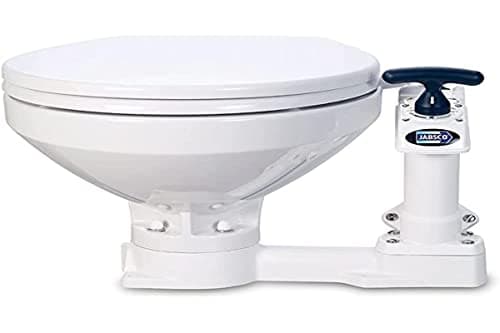
Jabsco Twist 'n' Lock Manual Toilet, Compact Bowl
Jabsco's manual marine toilet with the compact bowl (29090-5000), 12.9 in high and 16.7 in deep by Jabsco's figures. It flushes with raw water only, and its handle locks the waste outlet valve shut to guard against flooding and waste backflow. Jabsco requires full-bore seacocks on any through-hull the toilet connects to that may be below the waterline, and a vented loop on each such line if the bowl rim is less than 8 in (20 cm) above the waterline at rest or could ever be below it; it says to shut both seacocks after every use and whenever the boat is unattended.
View on Amazonpaid link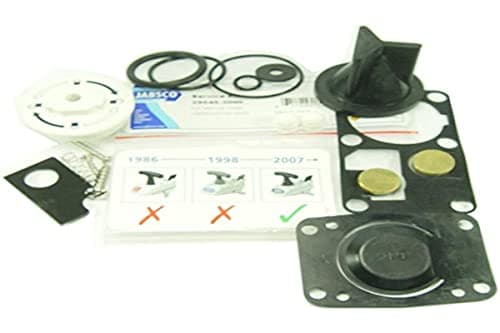 Jabsco · Plumbing & Pumps
Jabsco Twist 'n' Lock Service Kit 29045-3000
Jabsco's service kit for Twist 'n' Lock manual toilets built from 2008, which Jabsco says contains all the wearing parts. Older toilets take a different kit: 29045-2000 for 1998 to 2007, and 29045-0000 up to 1997. Jabsco says its manual toilets normally need no maintenance in season if they are winterized in the autumn and overhauled in the spring, though it still advises regularly checking all fastenings for tightness and leaks.
View on Amazonpaid link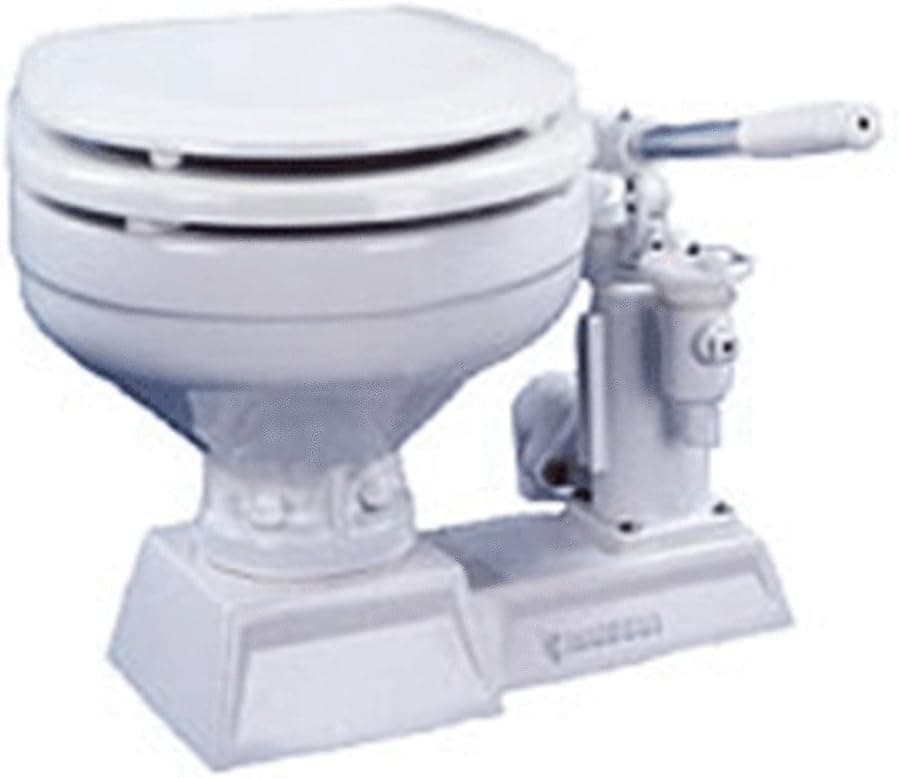 Raritan · Plumbing & Pumps
Raritan PHII Manual Toilet, Household Bowl
Raritan's manually operated, double-action piston toilet with the household-size bowl (PHHBII), which Raritan says is still in production. If it sits at or below the waterline at greatest heel, Raritan requires vented loops in the discharge line and between the intake pump and the bowl, with every hose connection double-clamped. Its PHII manual names the PHRKIIU overhaul kit (its FAQ gives PHRKIIC for units from June 1992 on), and says to lubricate the piston rod every spring and fall, or more often with frequent use.
View on Amazonpaid link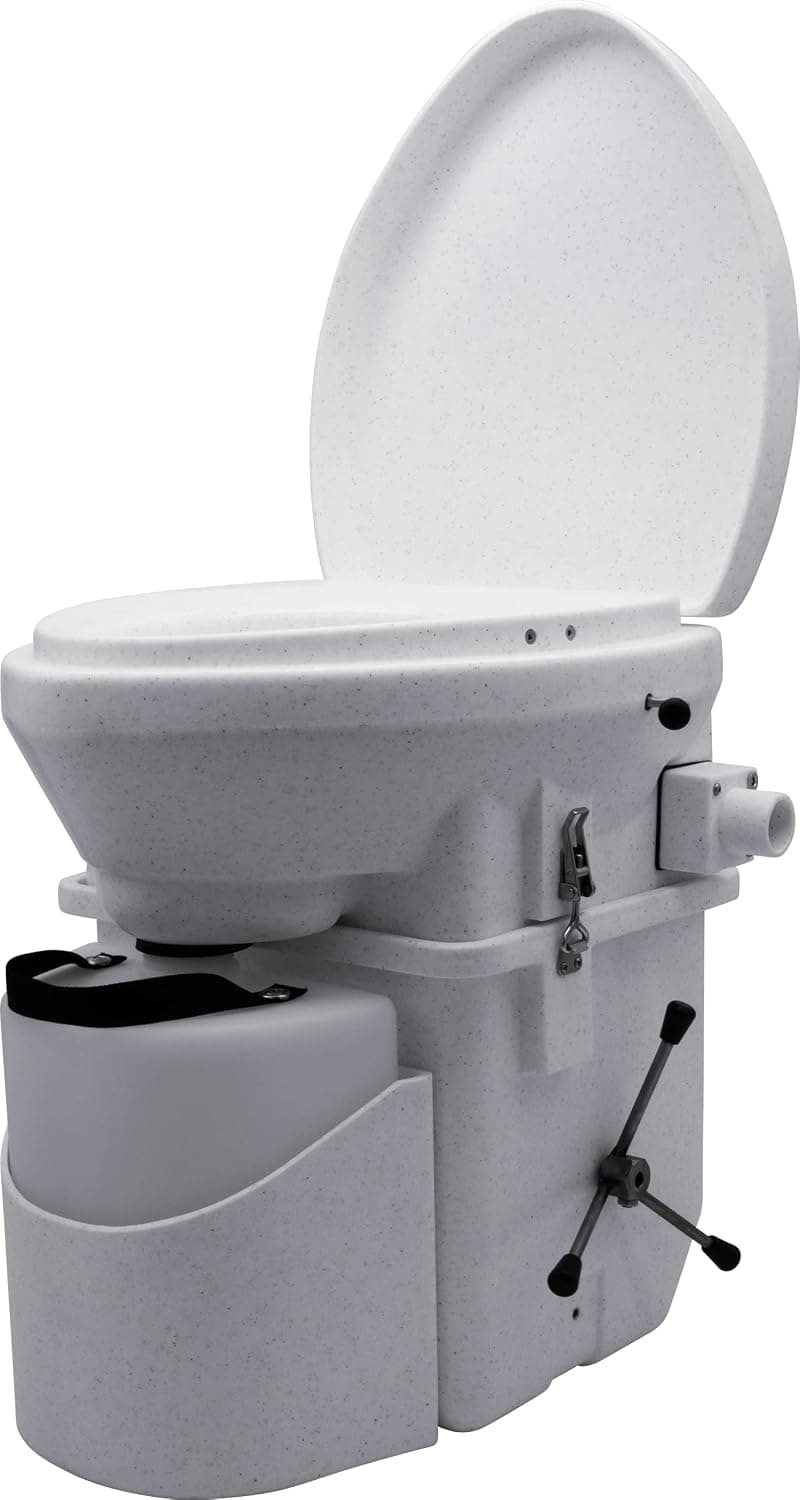 Nature's Head · Plumbing & Pumps
Nature's Head Composting Toilet
A composting toilet that sends liquids to a separate 2.2-gallon bottle; Nature's Head says the solids bin holds about 60 to 80 uses. Its fan runs continuously on less than 1.8 amp-hours a day from a 12 V hookup, with a fuse and holder supplied, but the exterior vent parts are sold separately. Nature's Head says it meets USCG requirements for a Type III head; EPA notes that most composting toilets have not been examined by the Coast Guard.
View on Amazonpaid link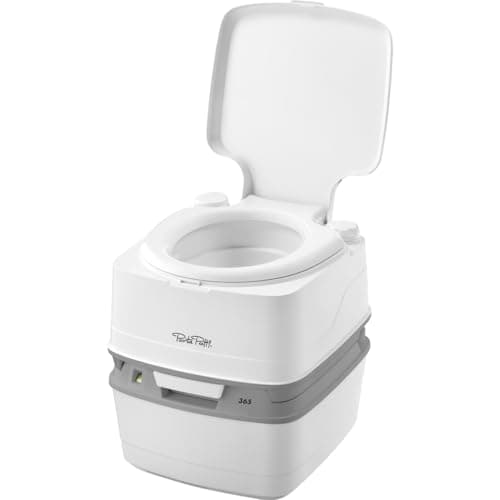 Thetford · Plumbing & Pumps
Thetford Porta Potti 365 Portable Toilet
Thetford's portable toilet, with a 5.5-gallon waste tank, a 4-gallon fresh-water tank and a piston-pump flush, at 16.29 x 15.07 x 16.81 in (HxWxD). Thetford says to carry the separated waste tank to a permanent toilet to empty it. EPA says the MSD requirements do not apply to vessels without installed toilets, such as boats with only a porta-potty.
View on Amazonpaid link
What this guide leaves out
Type I and II treatment devices, holding-tank pumps, deck pump-out fittings and tank gauges, which we did not research; holding-tank sizes and materials, where the only sizing rule we found is a UK maker's, in unstated gallons; where to find pump-out stations; Canadian rules; and prices. No Discharge Zones are designated water by water, so we don't reproduce the list: EPA's No Discharge Zone page, cited above, is the place to check for your own waters.
Sources
- 1.33 CFR 159.7 — Requirements for vessel operators (Cornell Legal Information Institute)
- 2.33 CFR 159.3 — Definitions (Cornell Legal Information Institute)
- 3.US EPA — Marine sanitation devices (MSDs)
- 4.33 CFR 159.12a — Certification of certain Type III devices (Cornell Legal Information Institute)
- 5.US EPA — Vessel sewage frequently asked questions
- 6.US EPA — A recreational boater's guide to vessel sewage, EPA 840-B-21-003
- 7.US Coast Guard — A boater's guide to the federal requirements for recreational boats, November 2023
- 8.US EPA — Vessel sewage No Discharge Zones
- 9.Clean Water Act section 312, 33 U.S.C. 1322 (Cornell Legal Information Institute)
- 10.40 CFR 140.3 — Standard (Cornell Legal Information Institute)
- 11.US EPA — Fact sheet for the California No Discharge Zone, 2012
- 12.33 CFR 27.3 — Penalty adjustment table (Cornell Legal Information Institute)
- 13.Jabsco (Xylem) — Marine toilets portfolio, F100-480 Rev A, 2025
- 14.Jabsco (Xylem) — Marine toilets catalog, F100-459, 2016 (copy hosted by retailer Defender)
- 15.Florida Department of Environmental Protection — Clean boater FAQ
- 16.Maryland Department of the Environment — Guidelines for boaters
- 17.Jabsco (Xylem) — Which marine toilet is right for your boat?, 2024
- 18.Jabsco (Xylem) — Twist 'n' Lock manual toilet user guide, 43000-0905 Rev E, 2023
- 19.Raritan — PHII installation, operation and maintenance instructions, L584 0126
- 20.Raritan — Fresh Head manual, L524 0726
- 21.Nature's Head — Composting toilet
- 22.Nature's Head — FAQs
- 23.Air Head — Marine composting toilets
- 24.Air Head — FAQ
- 25.Jabsco (Xylem) — Quiet Flush E2 data sheet, 43000-0620 Rev A, 2022 (copy hosted by retailer Toplicht)
- 26.Raritan — Marine Elegance installation, maintenance and operation instructions, L490 0126
- 27.Thetford Marine — Tecma Silence Plus 2G (US)
- 28.Dometic — 5000 Series VacuFlush toilets operation manual, 600345075 Rev A
- 29.Dometic — VacuFlush 5148
- 30.Dometic — VacuFlush quick-start guide, 600346874
- 31.Nature's Head — Marine composting toilets
- 32.Thetford — Porta Potti 365 support
- 33.Thetford — Porta Potti 565E support
- 34.Thetford — Portable toilets owner's manual, 35346A
- 35.Raritan — Manual marine toilets
- 36.Raritan — Marine Elegance
- 37.Jabsco (Xylem) — Quiet Flush 37045 series manual, 43000-0618 Rev H, 2023
- 38.Dometic — MasterFlush 7100/7200 series sheet
- 39.Raritan — FAQ
- 40.Thetford Marine — Tecma Silence Plus 2G
- 41.Dometic — HTS series waste holding tank installation manual
- 42.Jabsco (Xylem) — Twist 'n' Lock manual toilet instructions, 43000-0905 Rev D, 2017 (copy hosted by retailer Defender)
- 43.Jabsco (Xylem) — Vented loops, 29015 series instructions (copy hosted by retailer Defender)
- 44.Groco — HF series marine toilets
- 45.Groco — HVL and PVL series vented loops instructions
- 46.Dometic — VacuFlush 5000 series pedal-flush toilet operation manual