
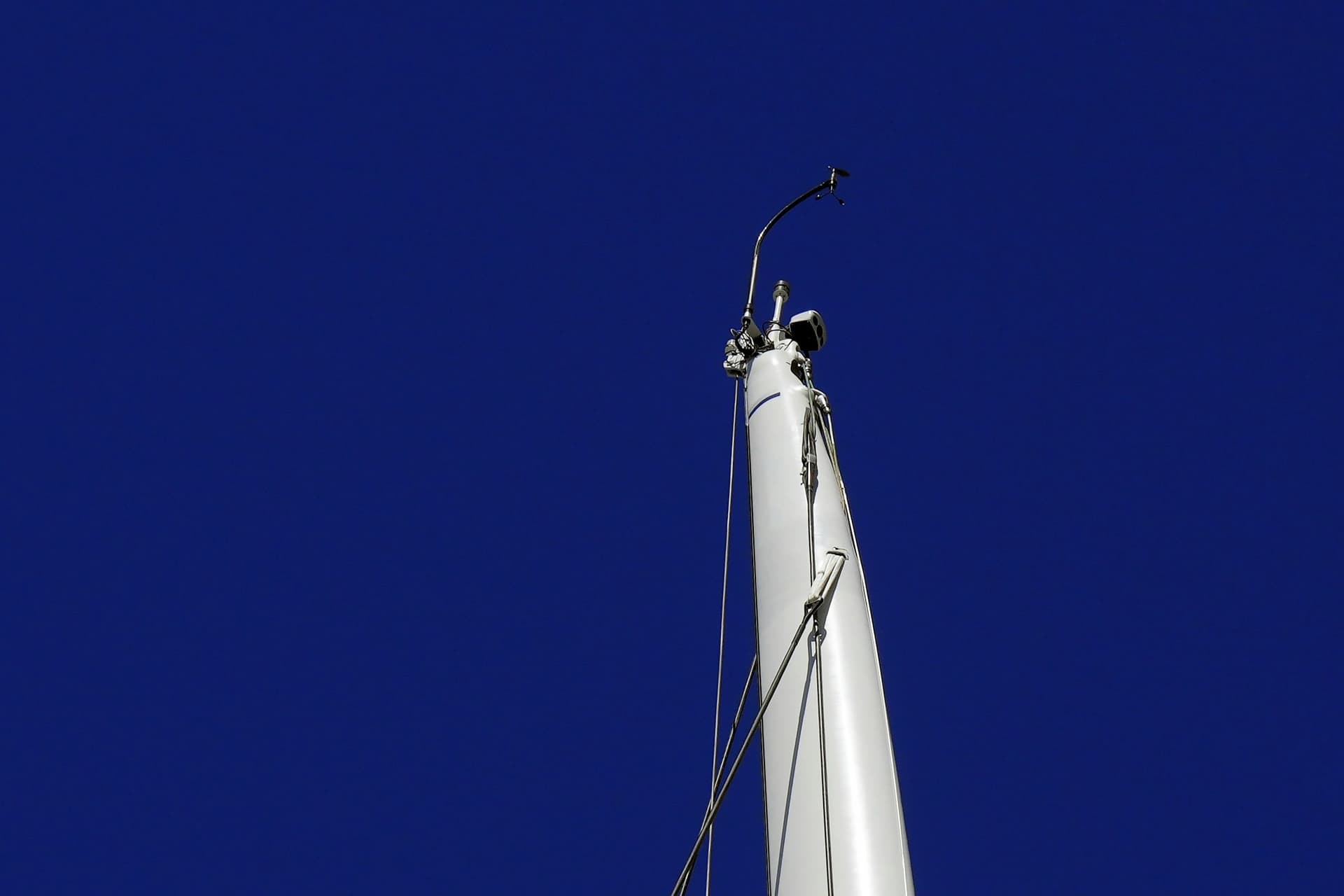
Photo: boris misevic on Unsplash
Wind, depth and speed sensors, explained
A boat's instruments only show what its sensors measure: wind from the masthead, and depth, speed through the water and water temperature from below the waterline. This guide covers how each kind of sensor works, what it needs before a display can read it, and how to fit the ones that go through the hull. Every factual statement links to the maker's page or manual, or to the NMEA.
This guide links to products on Amazon. If you buy through those links we may earn a commission, at no extra cost to you. Each one is marked “paid link”. More in our affiliate disclosure.
Published October 15, 2026
Wind sensors: moving parts or none
Raymarine's RSW pairs a vane and anemometer with a built-in gyro, accelerometer and magnetometer. Raymarine says its 3D motion sensor accounts for pitch and roll and improves true wind accuracy, and that its software also corrects for mast twist and bend and for upwash off the sails. That is the maker's claim; Raymarine gives no figure for the improvement.[5][6][7]
None of the makers' pages we checked compares moving-part and ultrasonic wind sensors on durability or price, so this guide doesn't either.
Wired or wireless
A wired sensor means a cable down the mast. B&G's installation guide for its wired WS310 lists 20, 35, 50 and 80 m of mast cable; Raymarine's wired masthead transducer comes with 30 m on the short arm and 50 m on the long arm; Garmin's wired gWind comes with 25 m.[8][1][2]
A wireless sensor saves the cable but puts a solar-charged battery aloft and needs a receiver below. B&G's WS320 talks to a Bluetooth base station on the NMEA 2000 network, with wireless connectivity up to 30 m (98 ft), and outputs apparent wind at 5 Hz, against 10 Hz for the wired WS310. Garmin's gWind Wireless 2 sends over ANT to a GNX Wind instrument or a compatible Garmin GPSMAP, on masts up to 50 ft. Raymarine's T120 needs the optional MicroTalk gateway (E70361) to reach a wired SeaTalkng network.[9][8][10][15]
The battery needs looking after. B&G says the WS320 should be paired with its base station before it goes up, within 0.5 m of it, and recommends taking the masthead unit down for winter and removing the battery so it doesn't drain, after which it must be paired again. Garmin says the gWind Wireless 2's battery lasts three years and is easily replaced, but to replace it at the start of each season if the unit was stored in the dark.[9][10][11]
Garmin says the gWind Wireless 2 must sit on a horizontal surface at the masthead, with a shim added if there isn't one.[11]
What else the sensor needs
Not every masthead sensor plugs straight into an NMEA 2000 backbone. B&G's wired WS310 outputs NMEA 0183, and the network interface that reaches NMEA 2000 comes in the Wind pack, not in the sensor-only box. Garmin's wired gWind needs a GND 10 bridge, which comes in its box. Garmin's first-generation gWind Wireless needed two boxes, a WSI and a GND 10; its successor, the gWind Wireless 2, needs no extra box with a GNX Wind or a compatible GPSMAP.[8][2][13][12]
Raymarine's analog masthead transducer connects to an i60 Wind display, which has a built-in interface, to ST60 and ST60+ instruments, or to an iTC-5 converter, which puts analog wind, depth, speed and rudder signals onto SeaTalkng. Through an iTC-5, only an i70 display can fully calibrate those transducers. The RSW Wired comes with its own gateway and a SeaTalkng-to-DeviceNet adaptor cable; no iTC-5 appears in its box list.[1][17][18][7]
Read the box contents before you buy. The only B&G WS320 listing we found on Amazon is titled as the sensor alone, without the Bluetooth base station that B&G's guide connects it through.
Apparent and true wind
Makers differ on what true wind needs. Garmin's NMEA 2000 reference lists a wind sensor and a water speed sensor, and no heading sensor, for true wind speed and angle; it adds a heading sensor for opposite-tack heading, and a heading sensor and GPS antenna for wind direction. Without water speed, Garmin says a less accurate value is calculated from GPS. Raymarine's i70 instructions say the display needs speed through water and heading from a heading sensor, and Raymarine treats GPS-based 'ground wind' as a separate value.[19][20][21]
Wind relative to the water and wind relative to the ground are different numbers. Airmar's WeatherStation uses its own GPS and compass to calculate what it calls theoretical wind, relative to the ground, and when it is given water-speed data it gives that wind speed relative to the water instead. Raymarine's i70 falls back to speed over ground for true wind direction when speed through water is missing.[22][23]
Depth: frequency, cone and power
Raymarine's general guidance is 200 kHz for water under about 60 m (200 ft) and for accurate readings at higher speeds, and 50 kHz for deep water. Raymarine says a wider cone covers more of the bottom but loses resolution, and that lower frequencies give wider cones; Airmar, for example, rates its P79 at 45° on 50 kHz and 12° on 200 kHz.[24][25]
Raymarine defines transducer power as ping strength in watts RMS and says more power generally reaches deeper. Frequency matters as much: Airmar rates the same 600 W P79 to 305 m at 50 kHz and 183 m at 200 kHz. Published wattage can differ for the same sensor: Airmar lists the DST810 at 80 W, and Garmin's spec table lists it at 100 W.[24][25][26][27]
Instrument depth sensors often run at one fixed frequency, so there is no choice to make. Airmar's UDST800 and DST820 run at 235 kHz, and Airmar says that frequency prevents interference with other echosounders aboard; it rates the DST820 to 100 m. Garmin's GDT 43 runs at 200 kHz, and Garmin quotes 275 m (900 ft), depending on water conditions.[28][29][30]
Set the depth offset on the display, and check which way its sign runs. Raymarine's LightHouse 4 instructions enter a keel offset as a negative number and a waterline offset as a positive one; Garmin's ECHOMAP Ultra manual uses the opposite convention. Airmar's TriSonic stores offsets set in its CAST app and sends them out on NMEA 2000.[31][32][33]
Speed: paddlewheel or ultrasonic
Both kinds foul. Airmar says growth can impede or freeze a paddlewheel within weeks. Its UDST800 guide says growth also seriously affects the ultrasonic insert, reducing performance within weeks, and requires antifouling in salt water and cleaning of the active face.[34][37]
Ultrasonic has limits of its own. Airmar says the UDST800's speed reading will be wrong if the boat goes airborne, even briefly, or runs through highly aerated water, and does not recommend it for hulls designed to pull air under them.[37]
Calibrate boat speed once it is fitted. Raymarine says the reading depends on where the transducer sits, the hull shape and the water flow, and to calibrate in calm conditions with no tide or current. Garmin says its GST 43 must be calibrated before use, or connected devices may show no speed at all. Airmar's DST810 uses its built-in attitude sensor and the CAST app to calibrate speed across several heel angles.[38][39][26]
One fitting, several sensors
Airmar calls its bronze B744V a triducer: depth, speed and temperature in one housing, which Airmar says must be installed with a fairing. Its DST820 reports depth, speed through water, water temperature, and heel and trim from one fitting.[40][41][42]
The DST820 replaces the DST810, adding a more secure QR-code Bluetooth pairing. Other brands sell Airmar's sensors under their own part numbers: Raymarine sells the DST810 Gen2 as E70667, and Garmin the DST820 as 010-11051-30.[42][43][44]
Networking
NMEA 2000 is the NMEA's standard under which compatible equipment shares data on one network, and the NMEA requires every NMEA 2000 product to be certified.[45]
A different plug is not the barrier. Raymarine's DST810 Gen2 has a 2.5 m cable with a SeaTalkng connector and plugs straight into SeaTalkng; Airmar's own DST820 uses a 6 m DeviceNet (NMEA 2000) cable; and Raymarine sells adaptor cables between DeviceNet and SeaTalkng. An analog transducer is different: to join SeaTalkng it needs a converter such as Raymarine's iTC-5.[43][29][46][18]
Through-hull, in-hull or transom
Three places a depth sensor goes
Raymarine offers in-hull transducers as the way to avoid a hole, but only where the bottom is solid fiberglass. It says they lose performance against a transducer in contact with the water, and do not work in wood, aluminum, steel or foam-sandwich hulls. Airmar recommends its P66 transom mount for boats up to 8 m (25 ft), not for inboards or stepped hulls.[24][47][48]
Airmar says its P79 in-hull depth transducer needs solid fiberglass beneath it and will not transmit through foam or balsa coring, and that shooting through the hull costs performance because the hull absorbs acoustic energy. Its guide has you compare a candidate spot against a reading taken over the side.[49]
Housing material and your hull
| Housing | Fiberglass hull | Wood hull | Metal hull |
|---|---|---|---|
| Plastic | Yes | Never: swelling wood can fracture it | Yes (Airmar) |
| Bronze | Recommended (Airmar) | Recommended by Airmar; Raymarine says required | Never: electrolytic corrosion |
| Stainless steel | Compatible | Compatible | Recommended, isolated from the hull |
Never fit a metal housing, bronze or stainless, on a boat with a positive-ground electrical system. Airmar and Raymarine both say so.[34][24]
Fitting a through-hull
Pulling the insert
Airmar's DST800 and DST810 housings have a self-closing valve that limits the water coming in while the insert is out, and Raymarine says its ST900's valve does the same. Airmar says the valve is not a watertight seal: the insert or blanking plug must always be refitted, fully inserted, with the cap nut screwed on completely and the safety wire attached so it cannot back out.[34][50]
Airmar says to fit the blanking plug in place of the paddlewheel when the boat will sit in salt water for more than a week, or is hauled. Garmin's GST 43 guide describes a plug to keep for cleaning or servicing, and no valve.[34][39]
Where it goes. On a fin-keel sailboat, Airmar puts the DST800 or DST810 on or near the centerline, 300 to 600 mm (1 to 2 ft) ahead of the keel; Garmin's general through-hull instructions say 25 to 75 cm ahead and within 10 cm of the centerline. Airmar says to keep it away from water intakes and discharges and out from behind strakes and fittings, immersed at all speeds, with its beam clear of the keel and propeller shafts. Garmin says to keep it out of the propeller's path on a single-drive boat.[34][51]
Whether it needs a fairing depends on the sensor. Garmin's general guide calls for one where the deadrise exceeds 5°, and Airmar requires one for its B744V; but Airmar says never to use a fairing with the plastic flush DST800 or DST810 housing. For its High-Performance Fairing, Airmar makes the anti-rotation bolt mandatory and warns that a fairing that rotates underway can cause violent movement and loss of steering.[51][41][34][52]
Airmar specifies a 2 mm layer of below-waterline marine sealant and gives no torque figure: plastic hull nuts are tightened by hand only, metal ones with slip-joint pliers, and a cored hull must not be crushed. In a cored hull the core must be cut and sealed against water, and the hull reinforced so it cannot crush under the hull nut and let the housing work loose; Garmin warns that water seeping into an unsealed core can severely damage the boat.[34][39]
Check for leaks as soon as the boat is in the water, and again within three hours: Airmar says even a small leak can put considerable water in the bilge within 24 hours. Garmin says its through-hull transducers should be installed by a qualified marine installer.[34][51]
Antifouling has rules too. Airmar says to use only water-based antifouling made for transducers, never ketone-based paint, which can attack the plastic, and to recoat every six months or at the start of each season; it makes antifouling mandatory in salt water for the DST800 and DST810. Garmin's guide also says to apply water-based antifouling every six months.[34][51]
Calibrating the wind sensor
Wind angle needs aligning once the sensor is up. Raymarine says to align its wind transducer underway in calm conditions with a steady breeze; heading straight into the wind, the apparent wind angle should read 0°. For its legacy long- and short-arm wind vane transducers, Raymarine's wind calibration has you turn the boat in slow circles below 2 knots. B&G says the WS320's wind angle can be calibrated after it is mounted, from the calibration option in the network settings, and Garmin's gWind takes an angle offset in degrees clockwise from the bow if the sensor does not face exactly forward.[53][54][55][9][14]
For long lay-ups, Garmin recommends taking the gWind down and storing it somewhere dry.[14]
The sensors we list
| Raymarine RSW Wired | Garmin gWind Wireless 2 | Raymarine DST810 Gen2 | |
|---|---|---|---|
| Measures | Wind speed and angle | Wind speed and angle | Depth, speed and temperature, with an attitude sensor for heel-compensated speed calibration |
| How | Vane and anemometer, with gyro, accelerometer and magnetometer | Three-bladed propeller and twin-fin vane | Gen2 paddlewheel; 235 kHz depth |
| Connects by | Cable down the mast (30 m on the short arm); own gateway and a SeaTalkng-to-DeviceNet adaptor in the box | ANT, to a Garmin GNX Wind or compatible GPSMAP; masts up to 50 ft | 2.5 m cable with a SeaTalkng connector |
| Power | Over SeaTalkng, 12 V nominal, under 100 mW | Solar-charged battery; Garmin says it lasts three years | — |
| Fits | Masthead | Masthead, on a horizontal surface | Plastic retractable housing with a valve, for fiberglass or metal hulls |
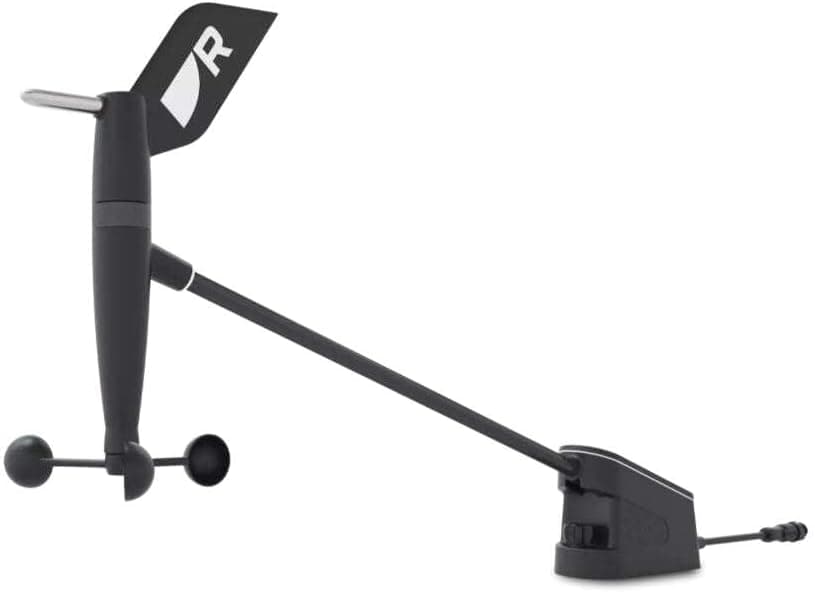 Raymarine · Marine Electronics
Raymarine RSW Wired Smart Wind Transducer
A wired masthead wind sensor: a vane and anemometer with a built-in gyro, accelerometer and magnetometer. Raymarine says these correct for pitch and roll and improve true wind accuracy, but gives no figure. This is the short-arm version with a 30 m mast cable, and the box includes Raymarine's own gateway and a SeaTalkng-to-DeviceNet adaptor. Raymarine's i70s instructions say the display also needs speed through water from a speed transducer and heading from a heading sensor to show true wind.
View on Amazonpaid link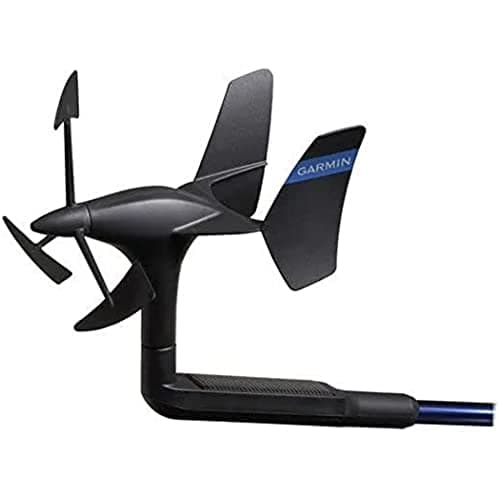 Garmin · Marine Electronics
Garmin gWind Wireless 2 Wind Transducer
A wireless masthead wind sensor that measures speed with a three-bladed propeller and angle with a twin-fin vane, so there is no cable to run down the mast. It sends over ANT to a Garmin receiver — Garmin names its GNX Wind instrument and compatible GPSMAP plotters — and is rated for masts up to 50 ft. A solar panel charges the battery, which Garmin says lasts three years. Garmin also sells it bundled with an ANT-equipped GMI 40 display as the GMI 40 Wireless Wind Pack.
View on Amazonpaid link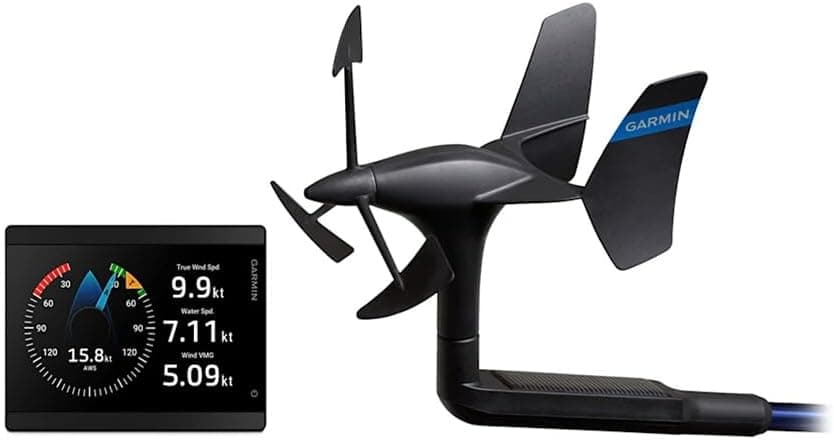 Garmin · Marine Electronics
Garmin GMI 40 Wireless Wind Pack
The gWind Wireless 2 masthead sensor bundled with a GMI 40 instrument display that receives its ANT signal, as Garmin part 010-03411-60. For the NMEA 2000 network, Garmin's pack also includes a 2 m backbone/drop cable, two T-connectors, a power cable and terminators. The sensor is rated for masts up to 50 ft, with a solar-charged battery Garmin says lasts three years.
View on Amazonpaid link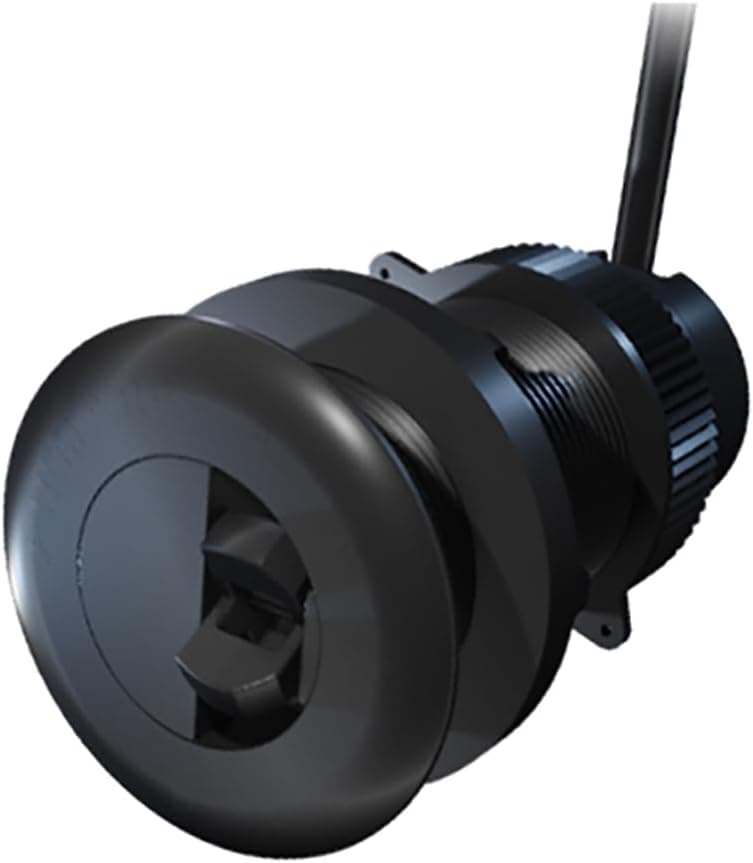 Raymarine · Marine Electronics
Raymarine DST810 Gen2 Smart Transducer
Airmar's depth, speed and temperature sensor in one through-hull fitting, sold by Raymarine with a 2.5 m cable and a SeaTalkng connector, so it plugs straight into a SeaTalkng network. Its Gen2 paddlewheel starts reading at 0.3 knots, and a built-in attitude sensor lets Airmar's CAST app calibrate speed across heel angles. The housing is plastic, for fiberglass or metal hulls: never fit plastic in a wooden hull. Airmar says the housing's valve is not a watertight seal: the insert or blanking plug must always be refitted, with the cap nut screwed on and the safety wire attached.
View on Amazonpaid link
What this guide leaves out
Prices, which change; any durability or price comparison between moving-part and ultrasonic wind sensors, for which we found no maker source; hull-nut torque figures, which Airmar does not give; and ABYC or Coast Guard rules for fitting transducers, which we could not read in full. A through-hull sensor is a hole below the waterline, so follow the maker's installation guide for your exact model.
Sources
- 1.Raymarine — Wired masthead wind transducer
- 2.Garmin — gWind transducer
- 3.Airmar — PB200 WeatherStation
- 4.Calypso Instruments — Ultrasonic Portable solar wind meter (CMI1006)
- 5.Raymarine — RSW Smart Wind transducer wins DAME award (newsroom)
- 6.Raymarine — Smart Wind
- 7.Raymarine — RSW Wired
- 8.B&G — WS310 wind sensor installation guide, 988-12013-001 (copy hosted by distributor Seatronic)
- 9.B&G — WS320 wind sensor installation guide, 988-12029-002
- 10.Garmin — gWind Wireless 2 transducer
- 11.Garmin — gWind Wireless 2 installation instructions
- 12.Garmin — Garmin announces gWind Wireless 2 transducer for sailors (2016)
- 13.Garmin — gWind Wireless (first generation) installation instructions
- 14.Garmin — gWind installation instructions
- 15.Raymarine — Wireless wind transmitter T120
- 16.Raymarine — Wireless vertical wind transducer T222
- 17.Raymarine — i60 Wind
- 18.Raymarine — iTC-5 transducer converter
- 19.Garmin — Technical reference for NMEA 2000 products, wind data
- 20.Garmin — Technical reference for NMEA 2000 products, weather data
- 21.Raymarine — i70s installation instructions, RSW transducer connection
- 22.Airmar — WX Series WeatherStation owner's guide
- 23.Raymarine — i70s operation instructions, wind data items
- 24.Raymarine — Choosing a transducer
- 25.Airmar — P79 in-hull transducer
- 26.Airmar — DST810 Smart multisensor
- 27.Garmin — AIRMAR DST810 Smart Transducer
- 28.Airmar — UDST800 ultrasonic Smart sensor
- 29.Airmar — DST820 Smart multisensor brochure
- 30.Garmin — GDT 43 installation instructions
- 31.Raymarine — LightHouse 4 operation instructions, depth offset
- 32.Garmin — ECHOMAP Ultra owner's manual, keel offset
- 33.Airmar — TriSonic
- 34.Airmar — DST800/DST810 owner's guide and installation instructions, 17-435-01
- 35.Airmar — UST800/UST850/UDST800 Smart sensor brochure
- 36.Airmar — UST800 Smart sensor
- 37.Airmar — UDST800 owner's guide and installation instructions, 17-633-01
- 38.Raymarine — i70s operation instructions, speed calibration
- 39.Garmin — GST 43 installation instructions
- 40.Airmar — B744V
- 41.Airmar — B744V owner's guide and installation instructions, 17-438-01
- 42.Airmar — DST820 Smart multisensor
- 43.Raymarine — DST810 Gen2 Smart Transducer
- 44.Garmin — AIRMAR DST820 Smart Transducer
- 45.NMEA — NMEA 2000
- 46.Raymarine — NMEA 2000 DeviceNet to SeaTalk NG adaptor cables
- 47.Raymarine — Types of transducers
- 48.Airmar — P66 transom-mount owner's guide and installation instructions
- 49.Airmar — P79 in-hull owner's guide and installation instructions, 17-217-01
- 50.Raymarine — ST900 speed and temperature transducer
- 51.Garmin — Thru-hull transducer installation instructions
- 52.Airmar — High-Performance Fairing installation instructions, 17-276-01
- 53.Raymarine — i70s operation instructions, aligning the wind transducer
- 54.Raymarine — i70s operation instructions, adjusting the wind transducer
- 55.Raymarine — i70s operation instructions, calibrating wind speed