
Photo: Agê Barros on Unsplash
Flares and distress signals, explained
On the coastal waters of the United States, federal rules require boats to carry visual distress signals: red flares, orange smoke, an orange flag or an electric distress light, in the numbers the rules set. This guide covers which boats need which signals and when, what counts for day and for night, electronic flares, launchers, expiry dates, storage, disposal and the 2025 recall of one Orion aerial flare. Every factual statement links to the regulation, Coast Guard document, state law or maker's page it came from.
This guide links to products on Amazon. If you buy through those links we may earn a commission, at no extra cost to you. Each one is marked “paid link”. More in our affiliate disclosure.
Published October 19, 2026
Who has to carry them, and where
Under 33 CFR 175.110, no one may use a boat 16 feet or more in length, or a boat operating as an uninspected passenger vessel, without visual distress signals from the accepted list aboard in the number required: devices suitable for day use and devices suitable for night use, or devices suitable for both. A boat under 16 feet that is not operating as an uninspected passenger vessel needs only signals suitable for night use, and only between sunset and sunrise (175.110(b)).[3]
33 CFR 175.115 excepts three groups from that rule: people competing in an organized marine parade, regatta, race or similar event; people using a manually propelled boat; and people using a sailboat of completely open construction, under 26 feet, with no propulsion machinery. They must still carry signals suitable for night use, in the number required, between sunset and sunrise.[5]
The rules apply to boats on the coastal waters of the United States, and on the high seas beyond the territorial seas to boats owned in the United States (33 CFR 175.101). Coastal waters include the US waters of the Great Lakes, the territorial seas, and waters directly connected to them, such as bays, sounds, harbors, rivers and inlets, where any entrance exceeds 2 nautical miles between opposite shorelines, up to the first point where the largest distance between shorelines narrows to 2 miles, as shown on the current National Ocean Service chart (33 CFR 175.105). The Coast Guard's guide puts it as up to the point where the waterway is less than two nautical miles wide.[1][2][20]
Where the rules do not apply, the Coast Guard's guide still recommends signaling devices wherever you operate your boat.[20]
What counts, day and night
33 CFR 175.130 lists what counts: an electric distress light meeting 46 CFR 161.013, one of which meets the night-only requirement; an orange flag meeting 46 CFR 160.072, one of which meets the day-only requirement; and the pyrotechnics in its Table 175.130.[9]
Orange smoke
Day only, three required: hand-held orange smoke (46 CFR 160.037) or floating orange smoke (160.022 or 160.057).[9]
| Signal | Standard, 46 CFR | Counts for | Number required |
|---|---|---|---|
| Hand-held red flare | 160.021 | Day and night | 3 |
| Floating orange smoke | 160.022 or 160.057 | Day only | 3 |
| Parachute red flare | 160.024 | Day and night | 3 |
| Hand-held rocket-propelled parachute red flare | 160.036 | Day and night | 3 |
| Hand-held orange smoke | 160.037 | Day only | 3 |
| Red aerial pyrotechnic flare | 160.066 | Day and night | 3 |
| Orange distress flag | 160.072 | Day only | 1 |
| Electric distress light | 161.013 | Night only | 1 |
Any combination of these, carried in the number required, may be used to meet both requirements (33 CFR 175.130(b)). The regulation's own examples: two hand-held red flares and one parachute red flare (160.024 or 160.036) meet both day and night requirements, and so do three hand-held orange smoke signals with one electric distress light.[9]
The Coast Guard's guide puts the pyrotechnic rule plainly: if you choose pyrotechnics, a minimum of three signals for day use and three for night use, and some pyrotechnic signals meet both. Orion says that while three signals are the legal minimum, search and rescue experts recommend carrying at least six; that is Orion's advice, not the rule.[20][31]
The Coast Guard notes that all distress signals have distinct advantages and disadvantages, and that no single device is ideal under all conditions or suitable for all purposes. Each pyrotechnic device has a different burning time, shown on its label, and the guide says to choose the device best suited to the conditions where your boat is typically used.[20]
A flashing white light is a different thing. Under the Inland Navigation Rules, a high-intensity white light flashing at regular intervals from 50 to 70 times a minute is considered a distress signal, but the Coast Guard says such devices do not meet the visual distress signal carriage requirement.[20]
A kit's name is not proof that it meets the rule on its own. Orion's Lake Boat Day/Night Signal Kit (item 236) holds one hand-held flare and one smoke signal, and Orion's page says it does not meet the Coast Guard requirements and is designed for non-regulated waters.[29]
Electronic flares
The Coast Guard's guide lists the electronic visual distress signal device as acceptable for night use only; it flashes the international SOS distress signal automatically. The Coast Guard says the standards for daytime signaling devices, such as handheld flares and the orange distress flag, have not changed. So on a boat that must carry day signals too, an electronic flare covers the night and a day signal is still needed.[20][21][3]
There are two kinds. 46 CFR 161.013 is the standard for an electric distress light, and it requires a white light that floats and flashes S-O-S automatically. The Coast Guard also accepts lights meeting RTCM Standard 13200.0, which flash S-O-S in a dual-colour cyan and red-orange sequence, as nighttime signals under 33 CFR 175.130, through CG-ENG Policy Letter 03-18, and has deemed them equivalent to lights meeting 161.013.[19][21]
The marking tells you which you have. A 161.013 light must be marked with the maker's name, the replacement battery type, the lamp size and the words 'Night Visual Distress Signal for Boats Complies with U. S. Coast Guard Requirements in 46 CFR 161.013. For Emergency Use Only.' The Coast Guard's guide says an RTCM light must be marked as meeting RTCM Std. 13200.0 for an eVDSD, with the words 'Night Visual Distress Signal for Boats. For Emergency Use Only. USCG accepted for nighttime distress signal per 33 CFR 175.130 by CG-ENG Policy Letter 03-18.'[19][20]
The Coast Guard's guide says non-pyrotechnic signals, the flag and the electric light, must be certified by the manufacturer as complying with Coast Guard requirements.[20]
For a 161.013 light, the regulation sets the endurance: each power source must still produce a recognizable S-O-S at a rate of between 3 and 5 times per minute after six hours of continuous display. That figure is for 161.013 lights. Electronic flares have no pyrotechnic expiry date, but they run on batteries: Sirius recommends checking the C-1003's batteries and replacing them at the start of each season.[19][34]
A Coast Guard Ninth District bulletin of May 2025 (MSIB 002-25) calls an electric distress light combined with an orange distress flag a Coast Guard approved alternative that meets the requirements for day and night use, and says the alternative is only authorized for recreational vessels and uninspected passenger vessels carrying fewer than 6 passengers for hire.[24]
The orange flag
46 CFR 160.072-3 requires the flag to be a square or rectangle at least 90 cm (36 inches) wide and 90 cm long, with at least 70% of its area bright red-orange, and a black disc and a black square on both sides. The disc's diameter and the square's side are equal, each a third of the flag's longest side or 30 cm (12 inches), whichever is greater, and they are separated by a sixth of the longest side or 15 cm (6 inches), whichever is greater. The Coast Guard's guide says at least 3 x 3 feet, with a black square and ball, and a day signal only.[17][20]
The flag is certified by its manufacturer, and must be marked with the maker's name, 'Day Visual Distress Signal for Boats. Complies with U.S. Coast Guard Requirements in 46 CFR 160.072.' and 'For Emergency Use Only'.[18]
The Coast Guard says the flag is most visible attached and waved on a paddle or boat hook, or flown from a mast.[20]
Launchers and aerial flares
If a signal you carry to meet the rule needs a launcher to fire, 33 CFR 175.113 requires a launcher approved under 46 CFR 160.028 aboard too. Table 175.130 says the parachute red flare (160.024) needs one, and that some red aerial flares (160.066) may. Under 33 CFR 175.135, launchers made before 1 January 1981 without approval numbers are acceptable for meteor or parachute signals while they remain serviceable.[4][9][10]
Orion says all its launchers are designed to be used exclusively with Orion signals, and that its launcher-fired signals may only be fired from Orion launchers, so buy the launcher and its shells from the same maker. The item 244 kit and the item 584 pack each come with a 12-gauge safety launcher with a hammer safety lock.[26][27][30]
The Coast Guard says pistol-launched and hand-held parachute flares and meteors have many characteristics of a firearm and must be handled with extreme caution, and that in some states and Canada they may be considered a firearm and prohibited from use. It says to check with your state boating agency.[20]
Orion warns that signal launchers launch burning flares at high velocity, and that a hang-fire, a delayed launch after squeezing the trigger, is rare but can be very dangerous: point the launcher overboard towards the water, wait at least 5 seconds, then open it and replace the signal.[32]
Using them
33 CFR 175.140 prohibits displaying a visual distress signal on these waters except where assistance is needed because of immediate or potential danger to the persons on board. The Ninth District bulletin notes that pyrotechnics may not be discharged in a non-emergency situation, so the vast majority expire unused.[11][24]
The Coast Guard warns that pyrotechnics produce a very hot flame that can cause burns and ignite flammable materials if not handled properly.[20]
For its hand-held flares, Orion's manual says to point away from face and body and aim downwind (its FAQ says aim downward), then hold the burning flare over the side of the boat, not wave it overhead, and avoid breathing the smoke. Orion suggests carrying at least 12 minutes of total burn time in hand-held signals, to keep a homing signal going until help arrives.[32][30]
Expiry dates and markings
33 CFR 175.125 says each required signal must be in serviceable condition and, if its service life is shown by a date marked on it, that date must not have passed. 175.128 says each must be legibly marked with its approval number or certification statement.[7][8]
For hand-held red flares (46 CFR 160.021), red aerial flares (160.066), hand-held orange smoke (160.037) and floating orange smoke (160.057), the expiration date may be no more than 42 months from the date of manufacture, and an aerial flare must be marked with the month and year it expires. It is the marked date that counts, not 42 months from when you bought it.[12][15][16][13][14][7]
The Coast Guard's guide says expired signals may be carried as extra equipment but do not count toward the requirement.[20]
Storage
33 CFR 175.120 says the required signals must be readily accessible whenever the boat is used. The Coast Guard recommends storing pyrotechnics in a cool, dry place if possible, in a watertight container painted red or orange and prominently marked 'DISTRESS SIGNALS' or 'FLARES'.[6][20]
Orion says to store its aerial and hand-held flares on board under cover in a secure, safe, dry place, to remove them during long periods of boat storage, and to inspect signals and launchers at least once a year for damage from moisture or mishandling.[32]
Disposing of expired flares
The Coast Guard's boating safety FAQ says expired pyrotechnics should be disposed of in accordance with local county and state hazardous waste regulations, and to check with those local authorities for the correct procedure. Orion's safety manual says never to throw flares overboard or put them in household trash.[22][32]
Maine, for example, runs one: its law has its Commissioner of Public Safety run a program for the convenient and safe collection of expired marine flares, through sites such as fire departments, marinas and annual community events, and collection by designated fire inspectors. Orion's manual lists donating expired flares to the Coast Guard Auxiliary or a Power Squadron for their training classes; the Coast Guard's FAQ does not mention it, so call first.[25][32][22]
The Skyblazer II recall
Coast Guard Safety Alert 21-25, of 24 December 2025, reports Orion's recall of its Skyblazer II Red XLT Aerial Signal after three incidents of spontaneous combustion, with no injuries reported, and the withdrawal of its approval, 160.066/8/4. Affected signals were made between March 1 and November 24, 2025, and carry expiration dates of August 2028 through April 2029. The Coast Guard says to remove item numbers 769, 859 and 855 with those dates from service immediately, and to quarantine them in a safe and secure location away from combustible products until Orion gives further direction. It says signals made before March 1, 2025, are unaffected.[23]
That is the position as of the December 2025 alert. Orion has posted later recall notices that we have not read, so check Orion's recall page for where things stand now.
The signals we list
| Orion 244 kit | Orion 584 | Orion 925 flag | Sirius C-1003 | |
|---|---|---|---|---|
| Type | Pyrotechnic kit | Launcher and aerial flares | Orange distress flag | Electric distress light, flag and whistle |
| Counts for | Day and night | Day and night | Day only | Light: night only |
| Contents | 12-gauge launcher, 4 aerial flares, 3 hand-held red flares, 2 hand-held orange smoke, floating case | 12-gauge launcher, 4 aerial flares | One 3 x 3 ft flag, four 12 in nylon ties | Light, three C batteries, orange flag, whistle |
| Maker's figures | Aerials up to 500 ft, 16,000 cd, 7 s; hand-helds up to 950 cd, 3 min; smoke up to 1 min | Aerials up to 500 ft, 16,000 cd, 7 s | Heavy-duty vinyl | S-O-S for up to 60 hours, 75 cd |
The 244 kit's red flares alone, three hand-held and four aerial, are more than the three day and three night signals the Coast Guard's guide asks for with pyrotechnics. The 584 is Orion's launcher with four aerial flares, which Orion pitches as a base to combine with hand-held red and orange smoke signals. The 925 flag is a day signal only, so on a boat that must carry night signals it needs a night signal beside it. Sirius says the C-1003 light is built to comply with 46 CFR 161.013 and meets all visual distress signal requirements when paired with its distress flag; its page does not give the flag's size or a 160.072 marking, so check the flag's own label.[26][27][28][33][20][9]
 Orion · Safety Equipment
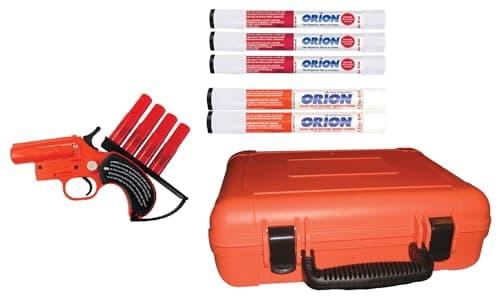
Orion 244 Coastal Alert/Locate Plus Signal Kit
Orion's 12-gauge kit in a hard, floating case (item 244, which replaces item 544): a 12-gauge safety launcher with a hammer safety lock, four aerial flares, three hand-held red flares and two hand-held orange smoke signals, per Orion's page; the Amazon listing says one smoke signal, so count what arrives. Orion gives the aerials up to 500 ft, 16,000 candela and 7 seconds each, the hand-helds up to 950 candela and 3 minutes, and the smoke up to 1 minute. Red flares count for day and night, smoke for day only, and each pyrotechnic expires no more than 42 months after it was made, so read the date. Orion says its launchers are for Orion signals only.
View on Amazonpaid link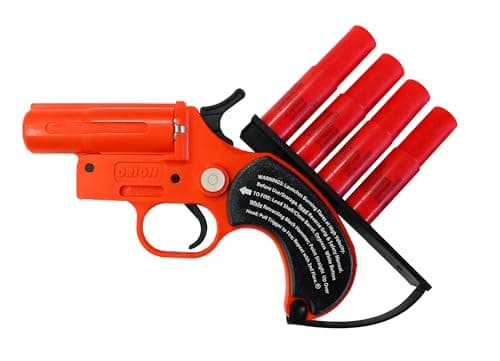 Orion · Safety Equipment
Orion 584 Alerter Basic 4, 12-Gauge Launcher and Aerial Flares
Orion's 12-gauge launcher with a hammer safety lock and four aerial flares (item 584), which Orion says is meant to be combined with hand-held red and orange smoke signals. Orion gives the aerials up to 500 ft, 16,000 candela and 7 seconds each. Red aerial flares count for day and night, and Table 175.130 requires three. Orion says its launchers are for Orion signals only, and to fire aerials after sighting or hearing a potential rescue vessel.
View on Amazonpaid link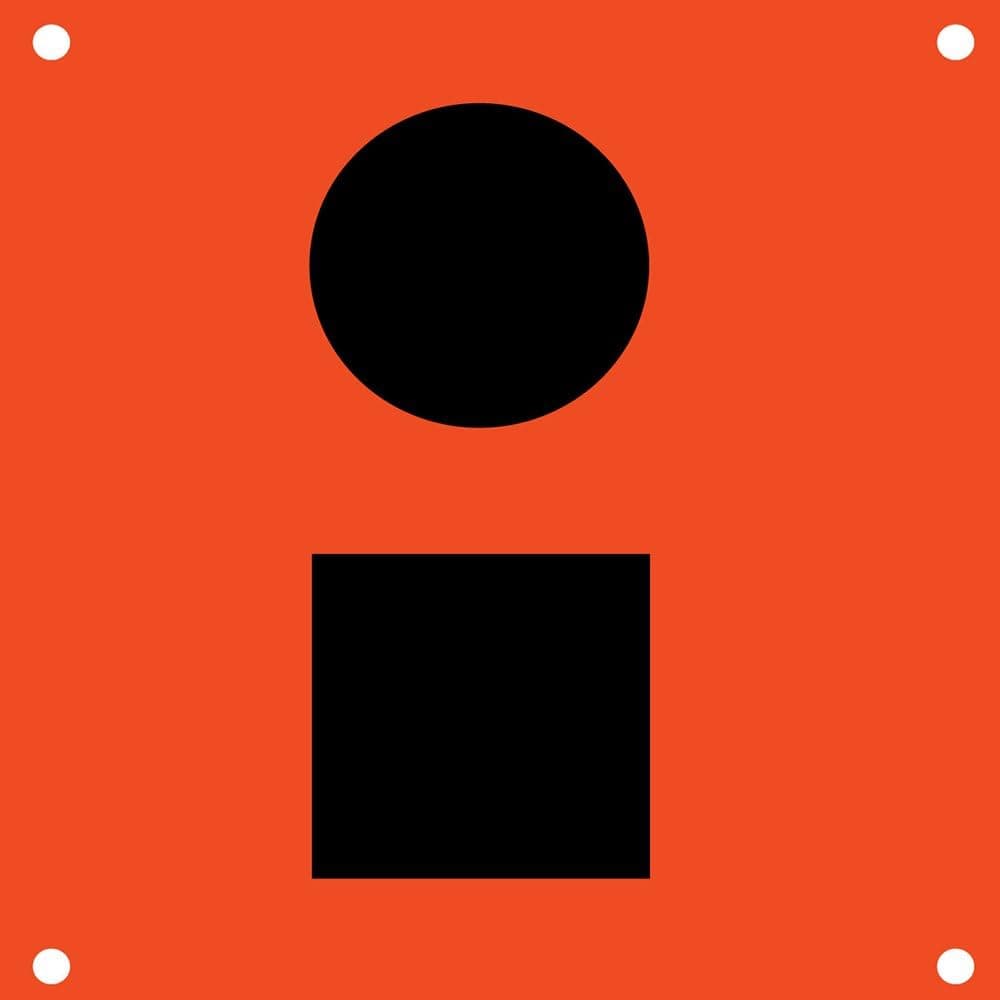 Orion · Safety Equipment
Orion 925 Orange Distress Flag, 3 x 3 ft
Orion's orange distress flag (item 925): 3 ft x 3 ft heavy-duty vinyl with four 12 in nylon ties, which Orion lists as USCG approved as a daytime signal. The federal minimum is 36 x 36 in with a black square and a black disc. A flag counts for day only, so it needs a night signal beside it; the Coast Guard says it is most visible waved on a paddle or boat hook, or flown from a mast.
View on Amazonpaid link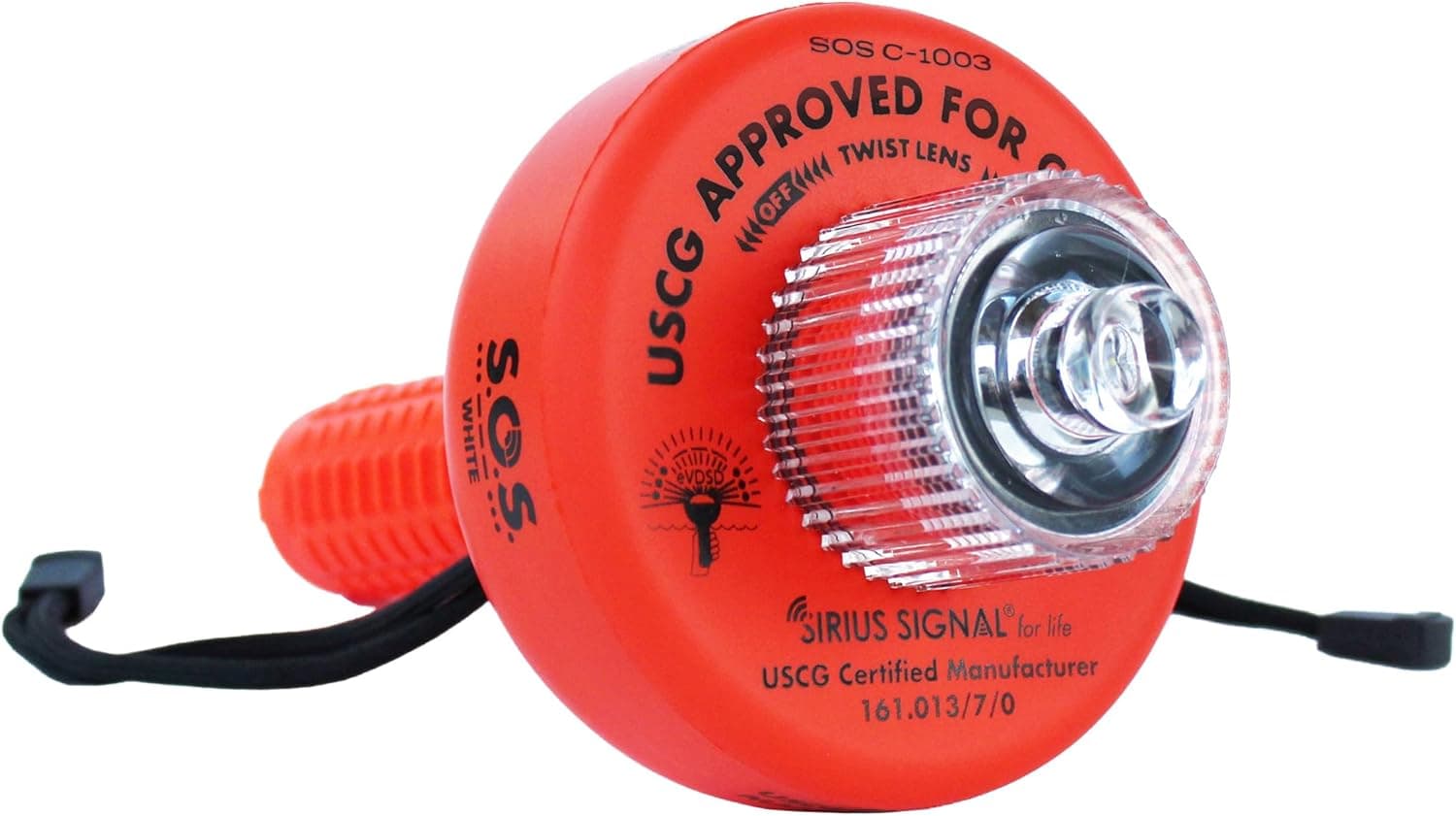 Sirius Signal · Safety Equipment
Sirius Signal C-1003 SOS Distress Light, Flag and Whistle
Sirius's electronic distress light (C-1003), with an orange daytime distress flag and a whistle. Sirius says the light is built to comply with 46 CFR 161.013, flashes S-O-S for up to 60 hours, lists the LED at 75 candelas, and comes with three C alkaline batteries; it recommends checking and replacing them at the start of each season. An electric distress light counts for night only. Sirius's page does not give the flag's size or a 160.072 marking, so check the flag's label.
View on Amazonpaid link
What this guide leaves out
Two-colour electronic flares such as ACR's ResQFlare PRO and Ocean Signal's EDF2: the makers say they are certified, but the only Coast Guard record we found, for the EDF2, lists its approval as 'former, may use', and we could not reach the Coast Guard's equipment list to check, so we list neither. Also left out: Orion's offshore kit (item 211) and orange smoke 3-pack (item 958), which we could not find on Amazon; SOLAS-grade flares; state rules on launchers, which the Coast Guard says to check with your state boating agency; and penalties. The Amazon listings we checked for Orion's pyrotechnics say they ship by ground only and cannot be returned.
Sources
- 1.33 CFR 175.101 — Applicability (visual distress signals; eCFR)
- 2.33 CFR 175.105 — Definitions (eCFR)
- 3.33 CFR 175.110 — Visual distress signals required (eCFR)
- 4.33 CFR 175.113 — Launchers (eCFR)
- 5.33 CFR 175.115 — Exceptions (eCFR)
- 6.33 CFR 175.120 — Stowage (eCFR)
- 7.33 CFR 175.125 — Serviceability (eCFR)
- 8.33 CFR 175.128 — Marking (eCFR)
- 9.33 CFR 175.130 — Visual distress signals accepted, with Table 175.130 (eCFR)
- 10.33 CFR 175.135 — Existing equipment (eCFR)
- 11.33 CFR 175.140 — Prohibited use (eCFR)
- 12.46 CFR 160.021-5 — Hand red flare distress signals: labeling and marking (eCFR)
- 13.46 CFR 160.037-5 — Hand orange smoke distress signals: labeling and marking (eCFR)
- 14.46 CFR 160.057-5 — Floating orange smoke distress signals: labeling and marking (eCFR)
- 15.46 CFR 160.066-9 — Red aerial pyrotechnic flares: marking (eCFR)
- 16.46 CFR 160.066-10 — Red aerial pyrotechnic flares: expiration date (eCFR)
- 17.46 CFR 160.072-3 — Distress flag: general performance requirements (eCFR)
- 18.46 CFR 160.072-7 — Distress flag: manufacturer certification and labeling (eCFR)
- 19.46 CFR 161.013 — Electric distress light for boats (eCFR)
- 20.US Coast Guard — A boater's guide to the federal requirements for recreational boats, November 2023
- 21.US Coast Guard Office of Auxiliary and Boating Safety — What is an equivalent eVDSD?
- 22.US Coast Guard Boating Safety Division — Frequently asked questions
- 23.US Coast Guard — Safety Alert 21-25, Orion Skyblazer II Red XLT recall, 24 December 2025 (copy hosted by the Coast Guard Auxiliary)
- 24.US Coast Guard Ninth District — Marine Safety Information Bulletin 002-25, May 2025 (copy hosted by the Coast Guard Auxiliary)
- 25.Maine Revised Statutes, Title 25, Chapter 318-A — Expired marine flares
- 26.Orion — Coastal Alert/Locate Plus Signal Kit in hard, floating case, item 244
- 27.Orion — Alerter Basic 4, 12-gauge launcher and aerial signal pack, item 584
- 28.Orion — Orange distress flag, item 925
- 29.Orion — Lake Boat Day/Night Signal Kit, item 236
- 30.Orion — Marine FAQ
- 31.Orion — USCG FAQ
- 32.Orion — Safety manual: 12-gauge and 25 mm launchers, aerial flares and hand-helds, v1.21
- 33.Sirius Signal — C-1003 SOS distress light, flag and whistle
- 34.Sirius Signal — C-1003 instructions (copy hosted by retailer Boat Accessories Australia)