

Photo: Egor Myznik on Unsplash
Sailboat winches, explained
A winch's size number, its gears, its jaws and its footprint decide whether it suits the job, and whether it bolts down where the old one was. This guide covers each of them, and the handle that turns it. Every factual statement links to the maker's page or manual it came from.
This guide links to products on Amazon. If you buy through those links we may earn a commission, at no extra cost to you. Each one is marked “paid link”. More in our affiliate disclosure.
Published October 10, 2026
Size numbers and power ratio
Harken's handle manual says the length of the handle determines a winch's power ratio: the ratio of handle length to drum radius is the measure of the leverage you get.[1]
Handle against drum
Seen from above: the thick line is the handle, the thin one the drum's radius. The longer the handle against the same drum, the more leverage.[1]
A published power ratio assumes a handle length. Harken bases its figures on a 10 in (254 mm) handle, and notes that the theoretical power ratio takes no account of friction.[2][3]
In the makers' tables we checked, the size number sits close to the winch's top power ratio. At size 40 the three makers we checked publish nearly the same figure in second gear: Lewmar's 40ST EVO 40.2:1, Harken's 40.2 39.90:1, and Andersen's 40ST 40.0:1. Ronstan, which sells Andersen winches, describes that 40:1 as defined by the winch size.[4][5][6][7]
It is close, not exact. Lewmar's 15ST EVO is 15.8:1 and its 30ST EVO 29.2:1, and Lewmar does not state the size number as a rule. First-gear power ratios vary more: at size 40, Andersen's is 8.9:1 and Harken's 13.50:1, and Ronstan notes that first-gear ratios can differ between brands at the same size.[4][6][5][7]
One, two and three speeds
A single-speed winch has one gear. Lewmar's 15ST EVO is single-speed; the 30ST to 65ST EVO are two-speed.[8]
On a two-speed winch you change gear by reversing the handle. Lewmar's guide calls first the fastest gear and second the slowest, and Harken describes first as fast trimming and second as more power.[8][9][10]
Second gear is not one fixed ratio. It grows with the winch: Lewmar's 30ST EVO is 4.2:1 in second, its 40ST EVO 5.8:1, and Harken's 50.2 10.90:1.[4][11]
Three-speed winches add a gear. On Harken's three-speed Radials, a button next to the handle socket engages first speed, and later changes happen automatically when you reverse the handle.[9]
Which way to turn for each gear varies between winches, so we don't print it. The manual for your winch will say.
Self-tailing
Standard winch
The drum alone, with no jaws on top. Lewmar's EVO Sport is a standard winch, and Lewmar says sizes 30 and 40 can be converted to self-tailing after purchase.[12]
The jaws have a range. Lewmar gives 8–12 mm (5/16–1/2 in) for the 15ST, 30ST and 40ST EVO, and says the winch should only be used with ropes of the recommended sizes. Harken gives 8–12 mm for its 40.2, and 6–10 mm on its 15STA product page.[8][13][14]
Lewmar says there must be at least three turns of rope on the drum.[8]
Mount a self-tailer so the loose tail falls into a secure stowage spot. Lewmar's stripper arm adjusts to suit, and on the EVO it moves in eight 45° steps with the winch still bolted down. On Andersen's 40ST and larger, the arm rotates through 360°.[8][6]
Drum finishes
Choosing a size
Each maker publishes its own chart, and they work differently. Lewmar's cross-references the job against yacht length for masthead rigs, or sail area for fractional rigs, and Lewmar offers individual recommendations from your deck and sail plans. Harken's selects by job and rig dimensions — sail area, I and P — rather than boat length.[15][16]
In Harken's chart, a size 15 covers a genoa sheet up to a 135 sq ft (12.5 m²) foretriangle, a genoa halyard up to an I of 39 ft, and a reef line up to a P of 43 ft. A size 40 covers a genoa sheet up to 270 sq ft (25 m²).[16]
| Boat length | Genoa sheet winch |
|---|---|
| 25–28 ft | 12, 16 or 18 |
| 29–32 ft | 28, 34 or 40 |
| 33–35 ft | 40 |
| 36–39 ft | 46 or 50 |
| 40–43 ft | 50 or 52 |
Andersen's halyard and reef-line sizes run smaller than its sheet sizes. For a 25–28 ft boat it lists a 10 or 12 for the genoa halyard, and a 10 for the main halyard and the reef line.[17]
Some boats need bigger winches than the tables suggest. Andersen advises going larger than its table for heavy-displacement or high-righting-moment boats, and for catamarans and trimarans. Lewmar says multihulls need larger winches than monohulls of the same length, because of their higher dynamic loading.[17][15]
Runner and mainsheet winches are a special case. Lewmar says their size depends on the purchase system fitted and the expected loads, and that dynamic sail loads can increase those loads dramatically.[15]
These are each maker's typical figures, and their size numbers and bands do not line up exactly. Use the chart from the maker whose winch you are buying, and ask the maker or a rigger about anything unusual.
Replacing a winch
Changing maker can mean new holes. At size 40, Andersen's 40ST uses five holes on a 100 mm circle with a 152 mm base, while Harken's 40.2STA uses five on a 123 mm circle with a 157 mm base. Ronstan says existing mounting holes are unlikely to suit its Orbit winches when they replace another make.[21][5][22]
Within one maker, a footprint can carry over. Lewmar's Ocean 16ST and Ocean 30ST use the same bolt patterns as the EVO 15 and EVO 30, Lewmar's drilling-template sheet puts each pair on one template, and one Lewmar spares kit covers both the Ocean 14/16 and the EVO 15.[23][24][25]
The makers disagree about the bolts. Harken does not supply them, and Lewmar's electric and hydraulic winch manual says deck fastenings are not supplied. Lewmar and Andersen specify countersunk heads; Harken says not to use countersunk bolts, and to use only A4 stainless steel.[19][3][26][20]
The deck has to carry the load. Harken says the winch must sit on a flat area of deck, reinforced if necessary to bear at least twice the winch's maximum working load, and warns that the wrong fasteners or a weak deck can let a winch pull off the deck suddenly under high load. Lewmar says to consult the boat's builder if you have any doubt about the mounting spot, and Andersen calls for large washers or a backing plate.[20][19][26]
Bed it in sealant. Lewmar says to apply bedding compound or marine silicone around the bolt holes and under the screw heads, fit an insulation gasket on an aluminium base, and tighten the bolts progressively. Its powered-winch manual says not to use a permanent adhesive sealant such as 5200. Harken says to fill the mounting holes with marine sealant.[8][19][20]
Which way round it sits matters. Harken says to place the drive gear where the sheet enters the drum, warning that a wrongly placed drive gear can weaken the winch. Lewmar says to position the base for the best output-gear support, leave room to remove the gears for servicing, and allow the handle to turn a full 360°.[20][8][19]
If you might go electric later: Harken says its manual Radial winches convert to electric or hydraulic power on the same stud pattern, with no adaptor plate. Lewmar converts EVO winches from size 40 up, so the 15ST and 30ST are not convertible.[10][4]
Handles
The lengths are nominal. Barton's "8 inch" aluminium handle measures 225 mm, and its "10 inch" 280 mm.[27]
Locking or plain is a trade-off, and the makers present it as one. Lewmar sells its handle with or without a lock, and frames the choice as the security of a lock-in handle against the flexibility of a traditional design. Harken's lock-in handles release with a thumb switch, and Harken says racers prefer plain handles because they are faster to insert.[28][2]
Take the handle out when you're not winding. Lewmar says to always remove it when it is not in use, and Andersen to remove it when the winch is under load but not being worked. Harken warns not to leave the handle in the socket while a sheet is eased or hauled, because the fast-turning drum can make it disengage from the socket.[19][26][1]
Some handles float. Lewmar's composite Titan handles float if dropped overboard.[29]
Servicing
The makers' intervals differ, so follow the one for your winch. Lewmar says to strip, clean and re-lubricate its winches two or three times during the active season, and strip and check them completely between seasons. Harken says at least every 12 months, and twice a season in salt water where seasons are long. Andersen says every second year in normal use, and yearly under heavy use.[30][3][13][26]
The pawls are where the makers differ most. Lewmar and Harken say to oil them, not grease them: both warn that grease can make the pawls stick, and Harken says the winch can then spin backwards. Andersen instead recommends its own Andersen Winch Grease, and says most other greases, marine grease included, are unsuitable for its winches.[30][13][26]
On the EVO, the top cap unscrews by hand to take off the drum and reach the gears.[4]
The winches we list
| 15ST EVO | 30ST EVO | |
|---|---|---|
| Speeds | 1 | 2 |
| Gear ratio | 2:1 | 2:1 and 4.2:1 |
| Power ratio | 15.8:1 | 13.8:1 and 29.2:1 |
| Rope | 8–12 mm (5/16–1/2 in) | 8–12 mm (5/16–1/2 in) |
| Drum diameter | 66.8 mm | 74 mm |
| Base diameter | 121 mm | 138 mm |
| Height | 119 mm | 145.85 mm |
| Mounting | 5 × M6 countersunk, 94 mm circle | 5 × M6 countersunk, 113 mm circle |
| Weight, alloy | 2.6 kg (5.7 lb) | 4 kg (8.8 lb) |
| Weight, chrome bronze | 3.9 kg (8.6 lb) | 5.4 kg (11.9 lb) |
| Working load limit | 570 kg (1257 lb) | 685 kg (1510 lb) |
| Convertible to electric | No | No |
 Lewmar · Deck Hardware
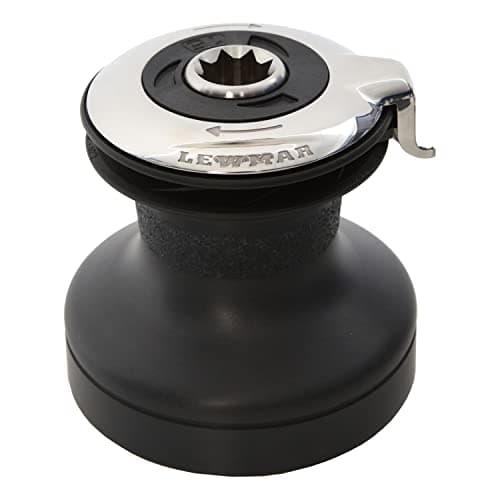
Lewmar 15ST EVO Self-Tailing Winch
A single-speed self-tailer: spring-loaded jaws on top hold the tail, and Lewmar rates them for 8–12 mm rope. Check the bolt pattern before you order. Lewmar fixes the 15ST with five M6 bolts on a 94 mm circle, on the same template as its Ocean 14 and 16; Harken's 15STA uses a 100 mm circle.
View on Amazonpaid link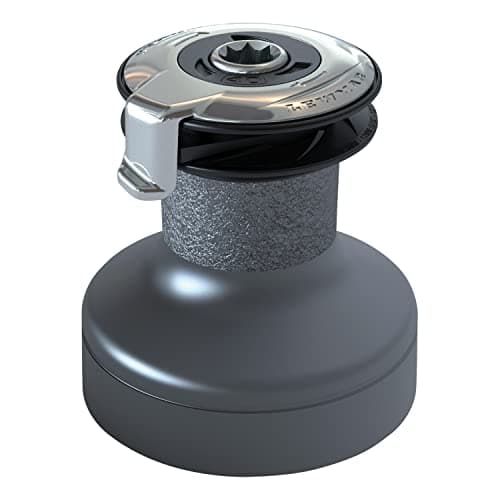 Lewmar · Deck Hardware
Lewmar 30ST EVO Self-Tailing Winch
Self-tailing jaws with the same 8–12 mm range as the 15ST, plus a second gear: power ratios of 13.8:1 in first and 29.2:1 in second, by Lewmar's figures. Size it from the maker's chart rather than by feel — our winch guide walks through Lewmar's, Harken's and Andersen's. It bolts down on a 113 mm circle, the same as Lewmar's Ocean 30.
View on Amazonpaid link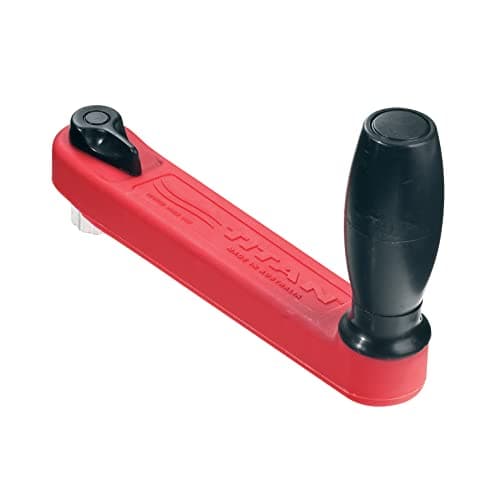 Lewmar · Deck Hardware
Lewmar 8" Locking Winch Handle
Lewmar sells its standard alloy winch handle with or without a lock, and frames the choice as security against the flexibility of a traditional design. Eight inches grinds faster; Harken says it gives 20% less power than a 10-inch and suits smaller boats and light air. Either way, take it out of the socket when you are not winding — Lewmar's own manual says so.
View on Amazonpaid link
What this guide leaves out
Electric winch installation — current draw, cable and breaker sizes — and choosing the rope itself. We have not yet sourced either well enough to publish. For loads beyond the makers' figures quoted here, ask the maker.
Sources
- 1.Harken — Winch handle user and maintenance manual
- 2.Harken — Aluminum and chrome bronze winch handles
- 3.Harken — Radial 40.2 ST installation and maintenance manual
- 4.Lewmar — EVO self-tailing winches, catalogue pages
- 5.Harken — 40 self-tailing Radial winch, 2-speed
- 6.Andersen (Ronstan) — 40ST Full Stainless winch
- 7.Ronstan — Andersen winches vs Orbit winches
- 8.Lewmar — EVO winch installation guide
- 9.Harken — Radial winch user's manual
- 10.Harken — Electric winches Q&A
- 11.Harken — 50 self-tailing Radial winch, 2-speed
- 12.Lewmar — EVO Sport winches, catalogue pages
- 13.Harken — Winches Q&A
- 14.Harken — 15 self-tailing Radial winch
- 15.Lewmar — Winch selection guide (copy hosted by Defender)
- 16.Harken — Ordering winches
- 17.Andersen (Ronstan) — Winch selection guide
- 18.Lewmar — EVO winch range drilling templates
- 19.Lewmar — Ocean and EVO electric/hydraulic winch manual
- 20.Harken — Radial 20 ST installation manual (copy hosted by Defender)
- 21.Andersen (Ronstan) — Size 40 self-tailing mounting template
- 22.Ronstan — Orbit winch FAQ
- 23.Lewmar — Ocean self-tailing winches, catalogue pages
- 24.Lewmar — Winch range drilling templates, EVO and Ocean
- 25.Lewmar — Spares kit, Ocean ST14-16 and EVO ST15
- 26.Andersen (Ronstan) — 40ST self-tailing winch product manual
- 27.Barton Marine — Aluminium winch handle
- 28.Lewmar — Winch handle
- 29.Lewmar — Titan winch handles
- 30.Lewmar — Winch service manual