
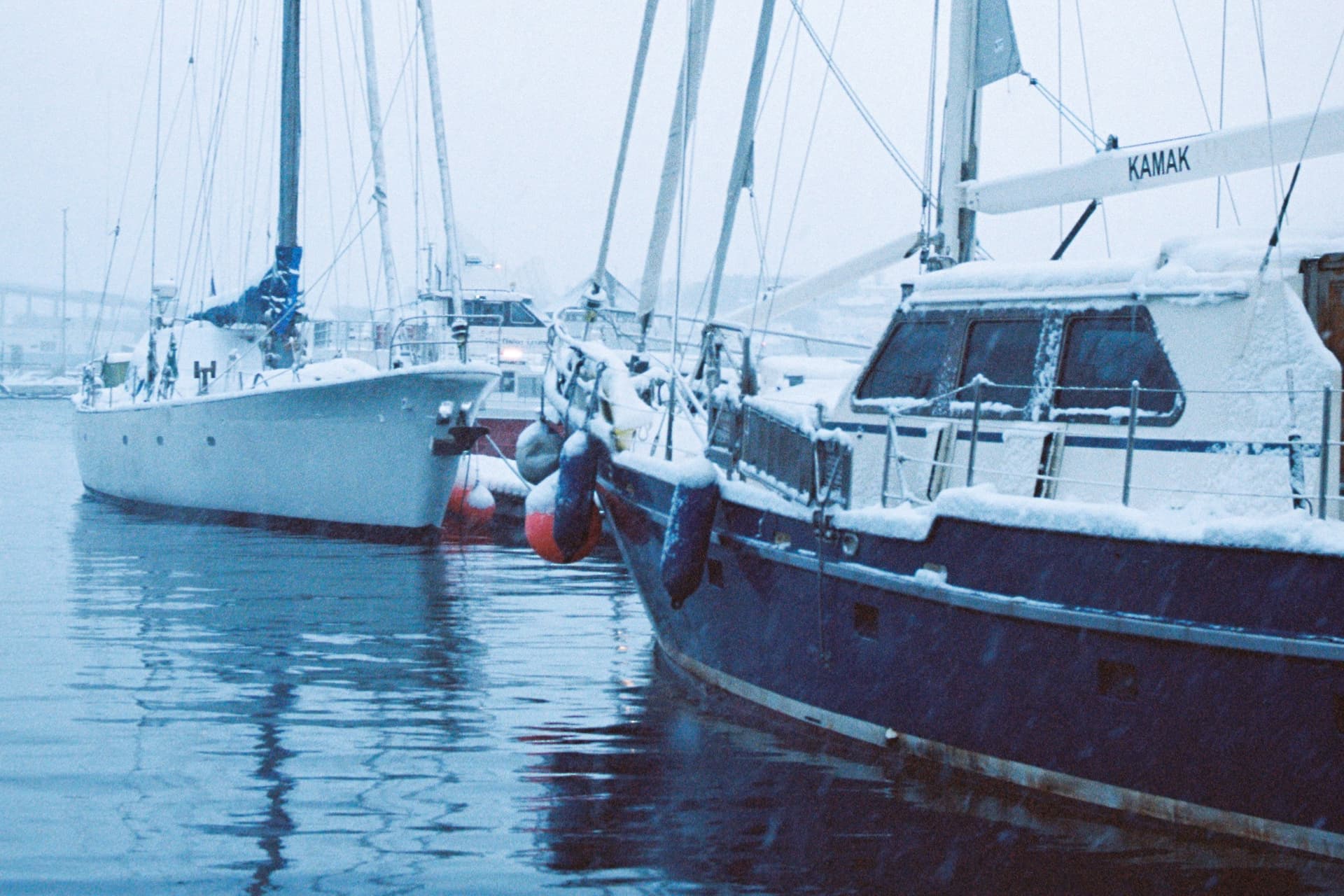
Photo: Lawrence Chismorie on Unsplash
Diesel cabin heaters for boats, explained
A forced-air diesel heater makes a boat usable in the cold season, and it burns fuel a few feet from where people sleep. The heater matters less than how it is fitted: where it sits, where it takes its air from, and where its exhaust goes. This guide covers those first, then power, fuel, sizing and alarms. Every factual statement links to a heater maker's document or an official source.
This guide links to products on Amazon. If you buy through those links we may earn a commission, at no extra cost to you. Each one is marked “paid link”. More in our affiliate disclosure.
Published October 14, 2026
Why the installation matters most
The US Coast Guard lists space heaters among the sources of carbon monoxide on a boat. It gives the early symptoms as irritated eyes, headache, nausea, weakness and dizziness — often mistaken for seasickness or drink — and warns that at high enough concentrations a few breaths can kill.[1][2]
Webasto warns that improper installation or repair can cause a fire or a deadly carbon monoxide leak, and says installers need to have completed Webasto training.[3]
In December 2019 two men died aboard the motor cruiser Diversion in York after its diesel heater leaked exhaust into the cabin. The UK's Marine Accident Investigation Branch found no CO alarm was fitted, and the owner-installed heater had never been professionally checked or serviced.[4]
The MAIB found the heater sat in a cabinet in the main cabin and drew both its combustion air and its circulating air from there. Its exhaust silencer was a non-marine part designed for external fitting, which leaked from its seams, its condensate drain hole and a mismatched joint — and the exhaust insulation hid the leaks.[5]
The UK's Boat Safety Scheme warns that diesel exhaust, not only petrol, has been linked to illness and deaths on boats.[6]
Where the heater goes
Webasto's marine instructions forbid installing the heater or its exhaust in accommodation areas, under a danger-of-suffocation warning, and Eberspächer's marine guide forbids any accommodation area too.[3][7]
Webasto's marine instructions recommend a well-ventilated locker or rudder box, or the engine compartment of an inboard diesel, with heating air from outside and combustion air from outside or a well-ventilated engine space — but its 2013 US marine manual's safety list says not to install fuel-fired heaters in engine compartments or areas needing ignition-proof equipment, so follow the manual for your heater. Eberspächer names a cockpit locker or an engine or machinery space, and rules out the engine compartment on petrol-engine boats.[3][10][7]
Road-vehicle manuals say otherwise, and they are not written for boats. Eberspächer's Airtronic S2 technical description is a road-vehicle document that approves mounting in vehicle interiors and refers boat installations to the maker. VEVOR's manual gives only road-vehicle positions — the cab's back wall, under a seat, the passenger room, the trunk — and has no boat section.[8][9]
Petrol-engine boats have extra rules. Webasto requires a separate diesel tank for the heater, no installation where petrol vapour can form, and combustion air from outside, and its US manual says a diesel heater in a gasoline-powered boat must be fitted by an authorised Webasto marine installation centre.[3][10]
Air in, air out
Combustion air must not come from the cabin. Eberspächer forbids drawing it from accommodation areas, and Autoterm forbids the living space and the engine compartment. Webasto allows a locker or engine space only if it is at ambient pressure, ventilated to the outside, and free of exhaust from the heater or the engine.[7][11][3]
The air the heater warms must be clean too. Webasto says it must come from an area free of exhaust, and never from the engine compartment.[3]
Keep one outlet open. Eberspächer and Autoterm both require one outlet that cannot be closed. Webasto says one non-closable outlet is enough for a small boat with one main cabin; for two cabins and a head it recommends an outlet per cabin, with the main duct to the saloon left non-closable.[7][12][13]
The exhaust
Up, then out above the waterline
Webasto says the last section of the exhaust should be a gooseneck at least 20 cm high, sloping down to the outlet, and that the outlet must not sit below or next to vents, windows or the heater's own air inlet.[3]
The exhaust must end in the open air, routed so it cannot be drawn into the fresh-air intake or used as combustion air, Eberspächer says. Webasto requires a genuine Webasto through-hull fitting, of a type that cannot be closed and has no self-opening flaps.[8][3]
How high above the waterline depends on whose manual you read. Webasto's marine instructions say at least 60 cm; its 2013 US marine manual says at least 500 mm; Eberspächer's 2006 marine guide says at least 300 mm, with a bend so water cannot collect; Autoterm says at least 60 cm, and on sailboats only at the stern. Follow the manual for the heater you fit.[3][10][7][12]
Never join the heater's exhaust to the engine's or a generator's — Webasto and Eberspächer both forbid it. And never drill a condensation drain hole in the silencer, Webasto says, because exhaust escapes through it.[3][7]
Where people or objects could touch the exhaust, Webasto says to insulate it or fit a barrier.[3]
Fuel
Give the heater its own pickup. Webasto's US marine manual requires a separate standpipe in the tank, never a tee into the engine's supply or return lines. Eberspächer prefers a dedicated standpipe in the top of the tank and allows teeing into an engine line only with its own approval and the engine or boat maker's; Autoterm says the pickup goes through the top of the tank, never the side.[10][7][11]
Keep fuel away from heat. Eberspächer says never to fasten fuel lines to the exhaust, and Webasto says to run them through cool areas, because heat forms bubbles that can make the heater malfunction.[7][3]
Marine fuel parts are specified. Webasto's marine manual requires copper fuel lines and connecting hoses fire-resistant to ISO 7840, and a fuel pump fitted in a dry, cool place — not in the bilge. Eberspächer's Airtronic 3 document requires metal fuel lines for marine use.[14][15][16]
Power
Starting is the expensive part. Webasto Australia says the Air Top 2000 STC draws 72–85 W (6–7 A) during start-up, and that cigarette-lighter or accessory sockets are not adequate supplies. Eberspächer gives the Airtronic S2 D2L up to 100 W while starting; VEVOR's manual says start-up current is high and asks for a 12 V supply of at least 15 A.[17][8][9]
Running is cheap. Webasto rates the Air Top 2000 STC at 1.2–2.4 A at 12 V, and Eberspächer the S2 D2L at 6–31 W.[18][8]
Wire it to the service battery, not the engine start battery, Webasto says, with supply cables of at least 4 mm² (6 mm² beyond 7.5 m) and a 20 A main fuse at 12 V within 1 m of the battery positive.[3]
Don't cut the shut-down cycle. Webasto Australia says to wire the heater straight to the house battery, not through a master switch, so its shut-down is never cut short; Eberspächer UK prefers the main isolator but says the after-run must not be cut short except in an emergency. The makers differ, so follow your heater's manual.[17][7]
Some heaters switch themselves off at low voltage, and they draw a little even when off. Eberspächer's S2 shuts down at about 10.5 V on 12 V systems, and Autoterm below 10 V. Switched off, an Autoterm heater still draws 30–40 mA, and Autoterm advises disconnecting it for long-term storage.[8][12]
Choosing a size
The makers size 2 kW heaters for small boats. Eberspächer's boat brochure puts its 2.2 kW Airtronic S2 at roughly 13–22 ft on a sailing yacht; its 2013 marine catalogue gives the 2.2 kW D2 up to about 8 m, the 4 kW D4 Plus about 8–12 m and the 5.5 kW D5 about 12–14 m. Autoterm rates its 2 kW Air 2D marine kits up to 33 ft and its 4 kW Air 4D kits up to 48 ft.[19][20][21]
Webasto says its 2 kW Air Top 2000 STC can suit smaller boats with one main cabin, or larger boats with several cabins through several outlets, and sells its 4–5.5 kW Air Top Evo 40 and 55 as marine heaters for yachts and larger boats.[22][23]
Treat every band as rough. Webasto's own figures disagree — its marine datasheet says its range suits boats up to 40 ft, its installation instructions about 8 to 24 m — and Eberspächer calls its length bands rough averages that vary with layout, season, cruising area, the temperature you want and the insulation.[24][3][20]
Altitude compensation only matters high up. Eberspächer's S2 adjusts itself up to 3,000 m, and its earlier Airtronic heated without limit up to 1,500 m.[8][25]
Using it
These are not houseboat heaters. Webasto's marine instructions say its air heaters are not suitable for continuous heating of living areas or houseboats, and Eberspächer says the Airtronic S2 is not approved for long-term continuous operation such as heating homes or houseboats.[3][8]
Before you leave one running on an empty boat, Eberspächer tells owners to check with their marina and insurer. It also warns against running the heater in a boat shed or under a winter cover.[7]
Timers belong to the controller, not the heater. Webasto's 7-day timer is a feature of its UniControl panel, and its MultiControl stores up to three start times a day. Eberspächer sells the S2 D2L without a controller or with the EasyStart Pro, which has three timer slots that can cover any days of the week. VEVOR's controller sets one start time.[26][24][8][27][9]
Run it monthly, even out of season. Eberspächer says to run the heater for about 10 minutes once a month and give it a trial run before the heating season; Webasto says about 10 minutes every four weeks, with a check by Webasto-trained staff at least at the start of each heating season. Eberspächer requires the heat exchanger to be replaced 10 years after first commissioning.[8][28]
Carbon monoxide alarms
The last line of defence
Because people cannot detect carbon monoxide until poisoning has begun, the MAIB concluded that a CO alarm may be the last line of defence.[5]
The Coast Guard advises installing and maintaining CO alarms inside the boat, replacing them as the maker recommends, and testing each one with its test button every time you go on a boat trip.[29][30]
The Coast Guard's guide to the federal requirements for recreational boats covers CO under safety tips, not as required equipment. ABYC's voluntary standard A-24 (2020) calls for detectors on boats with an enclosed accommodation compartment — one in the main cabin and one in each sleeping space closed off by solid bulkheads and doors — tested to UL 2034. ABYC says the 2025 revision bases placement on 'habitable spaces' instead.[31][32][33]
Minnesota does: its Sophia's Law requires a working marine CO detector on any motorboat with an enclosed accommodation compartment, whatever its fuel. In the UK, the Boat Safety Scheme has required at least one CO alarm on nearly all boats in its scope since April 2019.[34][35]
An alarm is not a substitute for a proper installation. The Boat Safety Scheme says so in as many words, and recommends alarms to BS EN 50291-2 as best suited for boats.[36]
The heaters we list
| Webasto Air Top 2000 STC | Eberspächer Airtronic S2 D2L | VEVOR 2 kW | |
|---|---|---|---|
| Heat output | 0.9–2.0 kW | 850–2,200 W | 2 kW (listing); the manual says '2/5/8 kW' |
| Diesel use | 0.12–0.24 l/h | 0.10–0.28 l/h | 0.12–0.26 l/h (one listing) |
| Running draw | 1.2–2.4 A at 12 V | 6–31 W | 3 A at 12 V (one listing) |
| Start-up draw | 72–85 W (Webasto Australia) | Up to 100 W | Manual asks for a 15 A supply |
| Marine installation manual | Yes | None found for the S2: its technical description is for road vehicles and says boat installation information is available from Eberspächer on request; marine kits via service partners | No — road vehicles only |
| Timer | Depends on the controller in the kit | With EasyStart Pro only | One start time |
| Installer | Webasto-trained | Authorised service partner | — |
| Warranty | 2-year / 2,000-hour limited (US marine kit) | — | 1 year, on VEVOR-site purchases |
VEVOR's listing markets its heater for use in a car, boat or small room and claims its exhaust design minimises CO, while its own manual forbids using it in closed or unventilated places and covers road vehicles only. In 2025 the UK's Office for Product Safety and Standards rated a different VEVOR diesel heater, the portable XMZ-W-D3, a serious suffocation risk because it came without adequate safety information, and the import was rejected at the border.[37][9][40]
 Webasto · Cabin & Galley
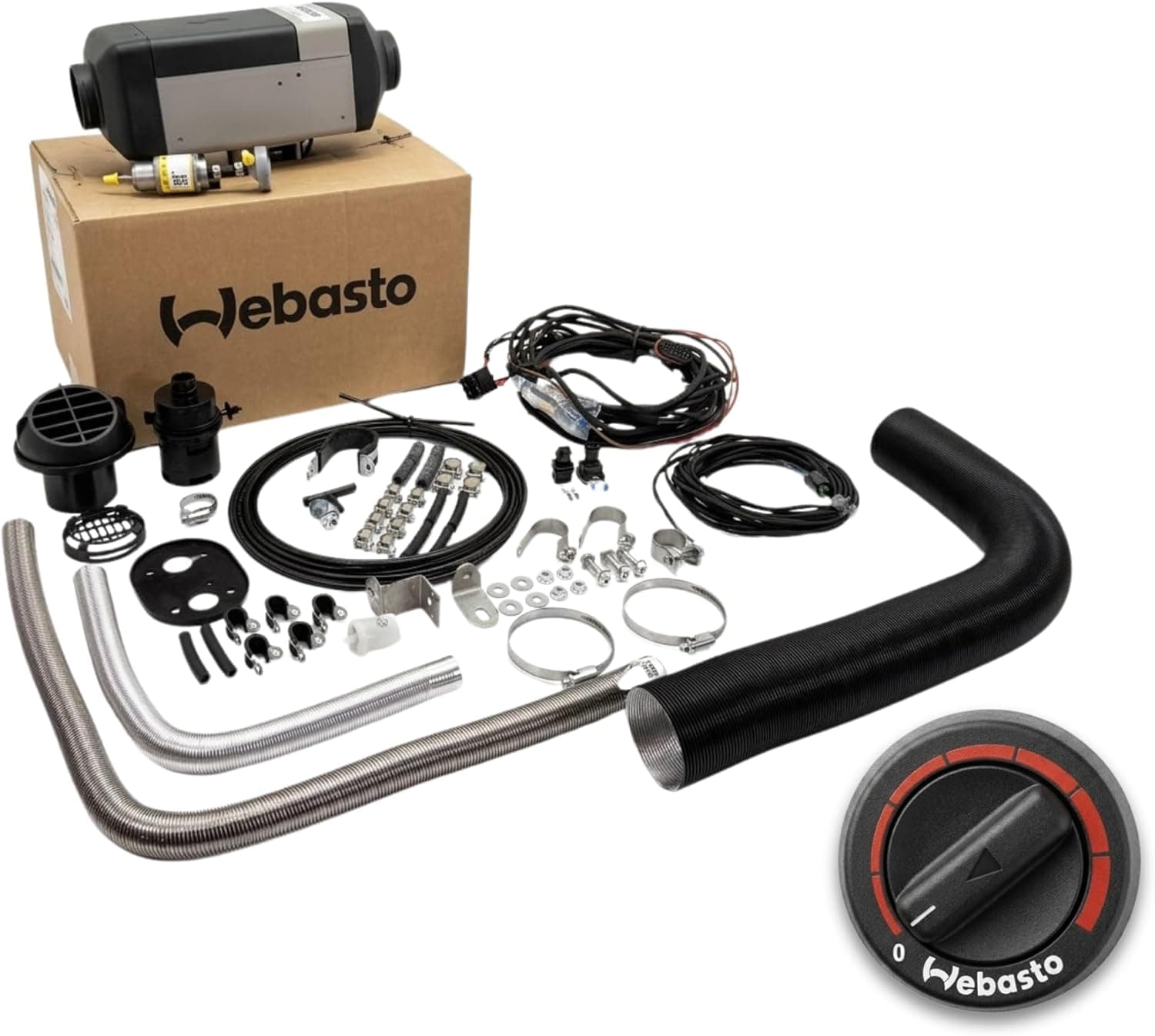
Webasto Air Top 2000 STC Diesel Heater
Webasto's 2 kW air heater, also sold as a marine version: 0.9–2.0 kW. Webasto says it can suit a smaller boat with one main cabin, or a larger one with several cabins through several outlets, depending on where you cruise and how much heat you need. Webasto publishes marine installation instructions and says installers need Webasto training, so check a yard near you has a trained technician before you buy.
View on Amazonpaid link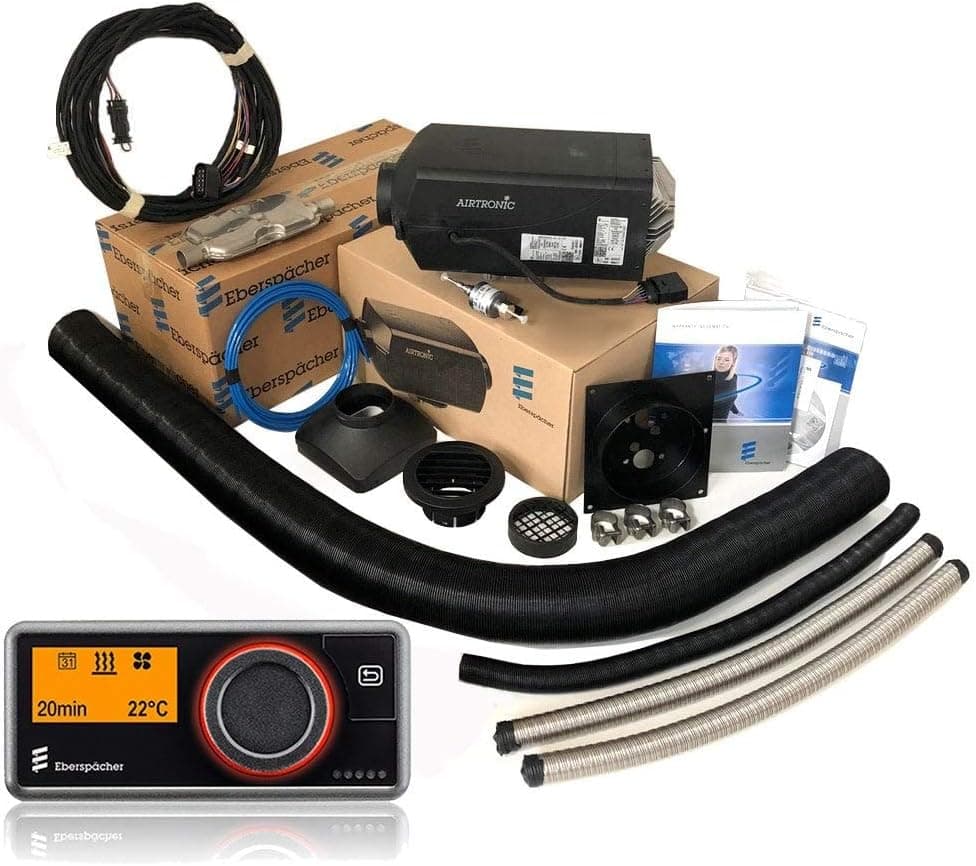 Eberspächer · Cabin & Galley
Eberspächer Espar Airtronic S2 D2 L
On paper it is close to the Webasto: 850–2,200 W of heat, 0.10–0.28 l/h of diesel and 6–31 W running draw, by Eberspächer's figures. Its technical description is written for road vehicles; for a boat, Eberspächer sells marine kits through its service partners and says an authorised partner should fit it. The timer comes with the EasyStart Pro controller, which only some kits include.
View on Amazonpaid link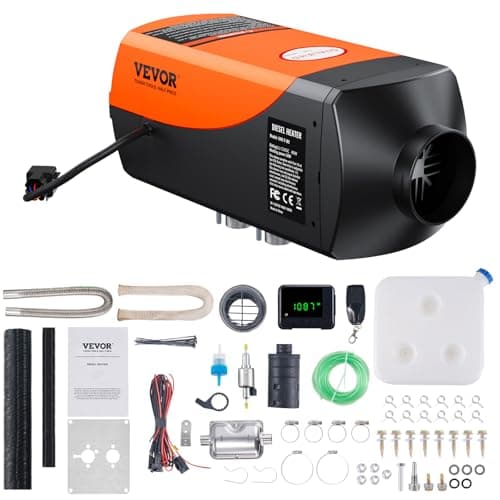 VEVOR · Cabin & Galley
VEVOR 2KW Diesel Air Heater
We run one of these aboard. It is a Chinese heater and we are not going to pretend otherwise — but it is surprisingly good for the money, and the real argument for it is that if it does fail you replace it without it hurting. A Webasto or Eberspächer is the better unit. Know what you are buying: VEVOR's manual covers road vehicles only and has no boat section, and we found no VEVOR marine installation instructions. Webasto's and Eberspächer's marine manuals forbid putting a heater or its exhaust in the accommodation, and the Coast Guard advises fitting CO alarms inside the boat.
View on Amazonpaid link
What this guide leaves out
Step-by-step installation: fit a heater to its maker's marine manual, and the makers say by a trained or authorised installer. Water-based (hydronic) heaters, noise figures (none of the makers publishes one) and battery budgets for a night at anchor. And any 'marine approved' label: the only approvals we found for these heaters are road-vehicle ones.
Sources
- 1.US Coast Guard Boating Safety — Carbon monoxide dangers
- 2.US Coast Guard Boating Safety — Carbon monoxide
- 3.Webasto — Boat air heaters installation instructions (copy hosted by Butler Technik)
- 4.UK MAIB — Safety warning after the loss of 2 lives on the motor cruiser Diversion
- 5.UK MAIB — Report 4/2021, Diversion
- 6.Boat Safety Scheme (UK) — Beware killer exhaust gases
- 7.Eberspächer UK — Marine heater installation guide, 2006 (copy hosted by Hisse et Oh)
- 8.Eberspächer — Airtronic S2 technical description (copy hosted by Modul-System)
- 9.VEVOR — Diesel heater XMZ-D manual (copy hosted by tuitam.pl)
- 10.Webasto North America — Marine heater installation manual, 2013
- 11.Autoterm — AIR heaters installation manual, 2021 (copy hosted by Nakatanenga)
- 12.Autoterm — AIR heaters user's and installation manual, 2026
- 13.Webasto — Marine catalogue 2025–2026, air distribution
- 14.Webasto — Air Top marine installation instructions, fuel supply (ManualsLib copy)
- 15.Webasto — Air Top marine installation instructions, fuel pump (ManualsLib copy)
- 16.Eberspächer — Airtronic 3 technical description (copy hosted by Seatronic)
- 17.Webasto Australia — Heater installation guide (copy hosted by MyGenerator)
- 18.Webasto North America — Marine air heaters datasheet
- 19.Eberspächer — Heaters for boats brochure
- 20.Eberspächer — Marine heater catalogue, 2013 (copy hosted by Plaisance Pratique)
- 21.Autoterm — Marine-grade heaters
- 22.Webasto — Air Top 2000 STC Marine
- 23.Webasto — Marine heaters
- 24.Webasto — Air Top series marine datasheet
- 25.Eberspächer — Airtronic technical description, first generation (copy hosted by Hisse et Oh)
- 26.Webasto — Marine catalogue 2025–2026, controls
- 27.Eberspächer — EasyStart control unit manual (copy hosted by Cub Campers)
- 28.Webasto — Air Top 2000 STC workshop manual (ManualsLib copy)
- 29.US Coast Guard Boating Safety — Protect yourself from carbon monoxide
- 30.US Coast Guard Boating Safety — Carbon monoxide checklist
- 31.US Coast Guard — A boater's guide to the federal requirements for recreational boats
- 32.ABYC — A-24, carbon monoxide detection systems (2020)
- 33.ABYC — CO detectors on boats
- 34.Minnesota DNR — Sophia's Law
- 35.Boat Safety Scheme (UK) — CO alarms now mandatory on boats, 2019
- 36.Boat Safety Scheme (UK) — CO alarms save lives
- 37.VEVOR — 2 kW diesel air heater, 10 L tank (listing)
- 38.VEVOR — 2 kW Bluetooth diesel air heater, XMZ-D2 (listing)
- 39.VEVOR — FAQ
- 40.UK Office for Product Safety and Standards — Product safety report, VEVOR diesel heater