
Photo: Jordan Cormack on Unsplash
Boat fire extinguishers, explained
Recreational boats propelled or controlled by propulsion machinery must carry marine-type fire extinguishers, in a number set by length, if they have a permanently installed fuel tank or spaces where fuel vapors can be trapped. This guide covers which boats need them, how many, how to read a rating, the rules for older boats, when a disposable extinguisher expires, how to check one, where to mount it, fixed engine-room systems and how to use one. Every factual statement links to the regulation, the Coast Guard guidance or the maker's page it came from.
This guide links to products on Amazon. If you buy through those links we may earn a commission, at no extra cost to you. Each one is marked “paid link”. More in our affiliate disclosure.
Published October 19, 2026
Which boats need them
The federal rules are in 33 CFR part 175, subpart E, which applies to recreational vessels propelled or controlled by propulsion machinery. They took effect on April 20, 2022, under a Coast Guard rule published on October 22, 2021, which moved them out of 46 CFR subpart 25.30; that part now excludes recreational vessels. The Coast Guard says the rule did not change which boats must carry extinguishers or how many.[2][12][13][8][14]
A boat must carry them if it has any of the five conditions in Table 2 to 33 CFR 175.320, the places where fuel vapors can be trapped or fuel is permanently installed.[5][14]
Seat compartments
Closed compartments under thwarts and seats where portable fuel tanks may be stored.[5]
Double bottoms
Double bottoms not sealed to the hull, or not completely filled with flotation material.[5]
Living spaces
Closed living spaces.[5]
Closed stowage
Closed stowage compartments in which combustible or flammable materials are stowed.[5]
Permanent fuel tanks
Permanently installed fuel tanks.[5]
An outboard-propelled boat under 26 feet need not carry portable extinguishers if its construction will not permit explosive or flammable gases or vapors to be trapped. The Coast Guard's FAQ puts it plainly: under 26 feet, an outboard engine, fuel in a portable tank, and no areas in the boat where fuel vapors can be trapped.[5][14]
How many
| Boat length | No fixed fire extinguishing system in the machinery space | Fixed fire extinguishing system in the machinery space |
|---|---|---|
| Under 16 ft | 1 | 0 |
| 16 ft, under 26 ft | 1 | 0 |
| 26 ft, under 40 ft | 2 | 1 |
| 40 ft to 65 ft | 3 | 2 |
One 20-B extinguisher may be substituted for two 5-B. A 10-B may not: the Coast Guard's FAQ says a 10-B counts only as one 5-B, even though it contains more extinguishing agent. 33 CFR 175.320(c) lets extinguishers with larger numerical ratings or multiple letter designations be used to meet the table.[5][14]
Reading the label
On a marine-type extinguisher the letter is the class of fire it is suitable for, and the number its relative extinguishing potential as rated by UL 711 (46 CFR 162.028-2). The Coast Guard's guide says the extinguishers required for boats are Class B, marine type and hand portable, Class B being for flaming liquids such as gasoline, oil and grease, and that they are generally available as 5-B, 10-B or 20-B.[10][16]
A multipurpose marking such as 1-A:10-B:C means ratings for A (trash, wood and paper), B (liquids and gases) and C (energized electrical equipment); the guide says to make sure the B rating is the proper size for your boat. In its 2021 rule the Coast Guard noted that there are no listed portable extinguishers with only a B rating, so a 5-B extinguisher also carries an A or C rating, or both.[16][12]
The Coast Guard says the label on the bottle will state 'Marine Type USCG Approved', and that Underwriters Laboratories approves extinguishers on the Coast Guard's behalf. Every approved portable must be supplied with a bracket that holds it securely in its stowage location and provides quick and positive release (46 CFR 162.028-3).[14][11]
Older boats
The Coast Guard's FAQ says boats of model year 2018 and newer must carry 5-B or 20-B extinguishers that are date stamped. Older boats may carry 5-B or 20-B extinguishers that, if portable, are either not date stamped or not more than 12 years old, or B-I or B-II extinguishers in good and serviceable condition; its table for model years 1953 to 2017 counts a B-I with a 5-B and a B-II with a 20-B.[14]
In the regulation, a boat built before August 22, 2016 is deemed built before model year 2017 and follows 33 CFR 175.380; a model year runs from June 1 to July 31 of the following year. Under 175.380, extinguishers already installed with less capacity than Table 1 requires need not be replaced but must be kept in good condition, and any extinguisher installed after August 22, 2016 must meet the current rules. Boats built before model year 1953 have their own section, 175.390.[2][1][6][7]
Disposable or rechargeable
The Coast Guard's FAQ says a disposable (non-rechargeable) extinguisher is intended for one-time use, while a rechargeable one is recharged once used and needs regular maintenance and servicing.[14]
The regulation says only that an extinguisher must not be expired. The Coast Guard's FAQ says a disposable extinguisher with a date of manufacture stamped on the bottle is expired once it is more than 12 years old and must be removed from service, and to look for the wording 'This product must be removed from service within 12 years after date of manufacturing.' The year is generally stamped on the bottom or marked next to the UL label. The Coast Guard's January 2022 handout says to remove it on 31 December of its 12th year.[3][14][15]
The Coast Guard's FAQ says a rechargeable extinguisher does not need to be removed from service after 12 years; it says it must instead be maintained annually by a technician, with its first NFPA certified inspection due one year from its date of manufacture and shown on the bottle's tag. The regulation itself sets a good-and-serviceable standard and no annual-service duty.[14][3]
In its 2021 rule the Coast Guard noted that rechargeable extinguishers are not common in the 5-B size recreational boats need and have to be sought from an industrial distributor, and that disposables are the primary type on recreational boats.[12]
You may keep an expired extinguisher on board, but the Coast Guard says you must also have a newer one that meets all the requirements.[14]
Checking them
Under 33 CFR 175.310, every portable extinguisher must be on board and readily accessible, of an approved type, not expired or appearing to have been used, and in good and serviceable working condition: any pressure gauge or indicator in the operable range or position, the lock pin firmly in place, the discharge nozzle clean and free of obstruction, and no visible signs of significant corrosion or damage. Extinguishers whose nameplates say to protect them from freezing must not be kept where freezing temperatures may be expected.[3]
The 2021 rule removed the NFPA 10 recordkeeping, monthly inspection and annual maintenance requirements for recreational boats; logged inspections are not required, but the owner must keep extinguishers readily accessible and in good and serviceable condition. The Coast Guard's guide advises inspecting them each time you get underway, and weighing them annually if the label states a minimum weight.[12][16]
If the gauge on an unused extinguisher is in the red, the Coast Guard says a disposable one must be discarded and replaced, and a rechargeable one serviced and tagged. Its guide says extinguishers that fail these checks or have been partially emptied must be replaced or, if refillable, taken to a qualified servicing company for recharge.[14][16]
Makers set their own intervals for their own extinguishers. Kidde's MAR5 data sheet, citing NFPA 10, says annual external examinations are required. First Alert's manual for its FE5GR, FE10GR and FE1A10GR says to inspect the gauge once a week, and not to test the extinguisher by squeezing the lever, even briefly, because once used it gradually loses pressure.[17][22]
Where to mount them
The Coast Guard's FAQ says mounting an extinguisher is highly recommended but not required; all portable extinguishers must be readily accessible. Its guide suggests places where one can be reached easily, such as at or near the steering station or in the galley or engine room, but away from locations where a fire may likely start.[14][16]
First Alert's manual says never to locate its extinguishers close to an engine, stove or other heat source, because they are pressurized and could rupture or explode above 150°F (66°C), and, quoting NFPA 302, to mount the cylinder on a boat at least 2 inches (5 cm) above moist or wet surfaces to reduce the danger of corrosion.[22]
Makers tie the approval to the bracket. Kidde says its Mariner 5 and Mariner 10 are USCG approved with the UL-approved strap bracket that comes with them, and Amerex offers USCG approval as an option, with the bracket listed on the UL label.[17][18][20][19][23]
Fixed engine-room systems
A fixed fire extinguishing system must be of a type approved by the Coast Guard under 46 CFR part 162 (33 CFR 175.315). With an approved system protecting the machinery space, Table 1 cuts the number of portables by one, so boats 26 feet and over still carry at least one. Sea-Fire's manual calls its own systems supplementary to the portable extinguishers required on board.[4][5][29]
Fireboy-Xintex sizes a system by the compartment's volume, multiplying the width by the length by the depth at the keel with no deductions for installed equipment, and says never to install a unit in a compartment larger than its volume rating; its MA0100NVC, for example, is rated for 100 cubic feet. Its manual says Coast Guard regulation 162.029 requires an indicator lamp at each helm station, and Sea-Fire says to put the manual-release pull handle at the helm, in full view and easy reach, never in the protected compartment.[27][29]
Both makers address diesel engines. Fireboy-Xintex warns that diesel-powered boats must also install its automatic engine shutdown system or the system may not put out the fire. Sea-Fire, citing the Coast Guard and ABYC standard A-4, says diesel engines, generators and blowers in the protected space must shut down automatically, and that automatic shutdown of gasoline engines is optional but highly recommended.[27][29]
When a system discharges, Fireboy-Xintex says to shut down all engines, powered ventilation and electrical systems at once and not to open the engine compartment; before inspecting, let the agent soak for at least 15 minutes and hot metals and fuels cool, with approved portables in hand. Sea-Fire also says to keep the compartment closed for at least 15 minutes and have a portable ready. Fireboy-Xintex says to check the gauge daily and to weigh the unit on a certified scale every six months; Sea-Fire says to weigh the cylinder at least every six months.[27][29]
Dry chemical, clean agent and aerosols
The UL standards a Coast Guard marine-type portable may be listed to include UL 299 for dry chemical extinguishers and UL 2129 for halocarbon clean agent extinguishers (46 CFR 162.028-1), so a clean-agent portable can be marine type too.[9]
First Alert's manual says to remove dry-chemical powder from electrical equipment after a fire: sweep or vacuum up as much as possible, then wipe the rest with a damp cloth. Fireboy-Xintex says its portable clean-agent extinguishers leave no residue and the agent does not conduct electricity, and that the agent becomes a heavier-than-air gas that tends to settle and stay in an enclosed space such as an engine compartment. Amerex describes its Halotron I agent as nonconductive, non-corrosive and residue-free.[22][28][25]
Element sells an aerosol-type fire suppressor. Its approvals page lists no US Coast Guard or UL marine approval, and its FAQ says it cannot be used to substitute for extinguishers in regulated environments that require UL certification, though it can supplement them.[30][31]
Using one
Follow the label on your own extinguisher, because makers differ. First Alert says to stand back 6 feet (2 m) with the fire not between you and your exit, and to discharge the contents completely and make sure the fire is out, because flashbacks are common. Amerex says to hold it upright and pull the pin, start back 8 to 10 feet and aim at the base of the fire, then squeeze the lever and sweep from side to side.[22][26]
The extinguishers we list
| Kidde Mariner 5 | Kidde Mariner 10 | First Alert MARINE1 | Amerex B500T | |
|---|---|---|---|---|
| UL rating | 5-B:C | 10-B:C | 1-A:10-B:C | 2A:10B:C |
| Type | Single-use | Single-use | Rechargeable by a certified professional | Amerex strongly recommends maintenance by a trained professional |
| Bracket | Strap bracket 322057, included | Strap bracket 322057, included | Mount, bracket and strap included | 818 vehicle bracket, included |
| Coast Guard wording | USCG approved with its UL-approved strap bracket | USCG approved with its UL-approved strap bracket | None on First Alert's page | USCG approval an option, with the bracket listed on the UL label |
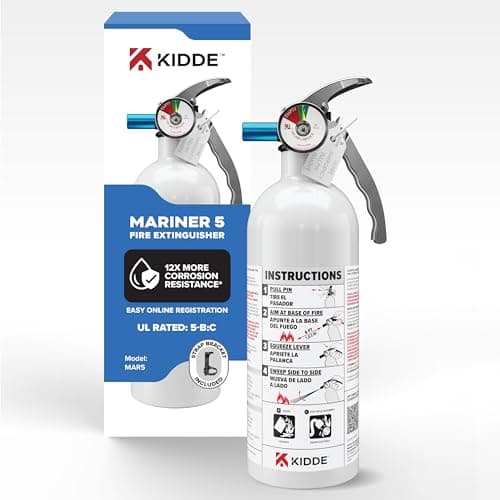
The Mariner 5 is Kidde's single-use 5-B:C, with 2.00 lb of agent on its data sheet. The Mariner 10 is rated 10-B:C, which still counts as one 5-B. First Alert says its MARINE1 (model FE1A10GR) can be recharged by a certified professional after use, though its page makes no Coast Guard statement and showed it backordered on 19 October 2026. Amerex lists the B500T at 5 lb, rated 2A:10B:C, with an 818 vehicle bracket, which is on Amerex's list of USCG brackets, and strongly recommends that maintenance be done by a trained professional such as an authorized Amerex distributor.[17][20][14][21][23][24]
 Kidde · Safety Equipment
Kidde Mariner 5 Fire Extinguisher, 5-B:C
Kidde's single-use marine extinguisher (MAR5), UL rated 5-B:C, with 2.00 lb of agent on its data sheet. Kidde says it is USCG approved with the UL-approved strap bracket that comes with it (322057). The Coast Guard says a disposable extinguisher must be removed from service 12 years after the date of manufacture stamped on it, and that the year is generally on the bottom or next to the UL label.
View on Amazonpaid link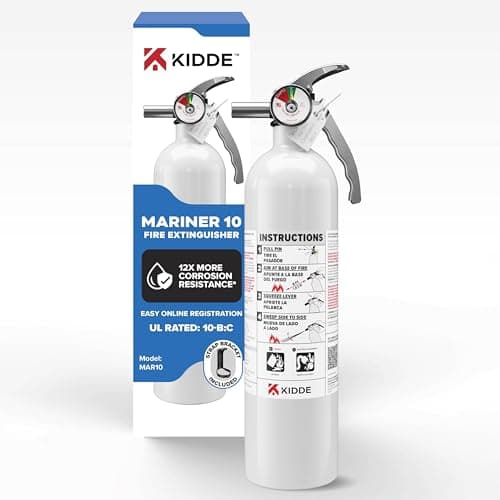 Kidde · Safety Equipment
Kidde Mariner 10 Fire Extinguisher, 10-B:C
Kidde's single-use marine extinguisher (MAR10), UL rated 10-B:C, which Kidde says is USCG approved with its UL-approved strap bracket (322057), included. A 10-B holds more agent than a 5-B but, the Coast Guard says, still counts as only one 5-B; one 20-B may be substituted for two. Disposable, so the Coast Guard's 12-year limit from the date of manufacture applies.
View on Amazonpaid link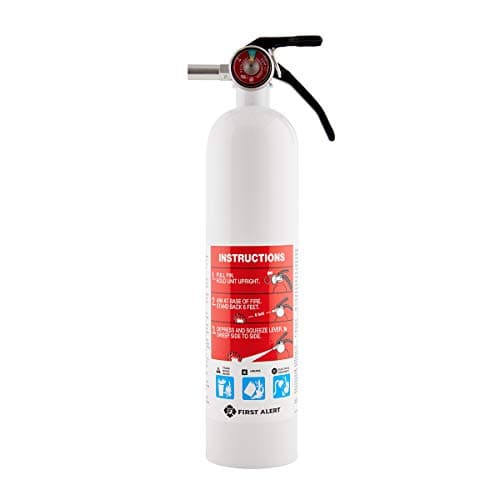 First Alert · Safety Equipment
First Alert MARINE1 Rechargeable Marine Fire Extinguisher, 1-A:10-B:C
First Alert's rechargeable marine extinguisher (model FE1A10GR), rated 1-A:10-B:C, with a mount, bracket and strap. First Alert says it can be recharged by a certified professional after use, and its manual says a certified dealer should service it once a year. First Alert's own page makes no Coast Guard statement, so check the label for 'Marine Type USCG Approved'. A rechargeable is not removed at 12 years; the Coast Guard's FAQ says it must be maintained annually by a technician, though the regulation sets no annual-service duty.
View on Amazonpaid link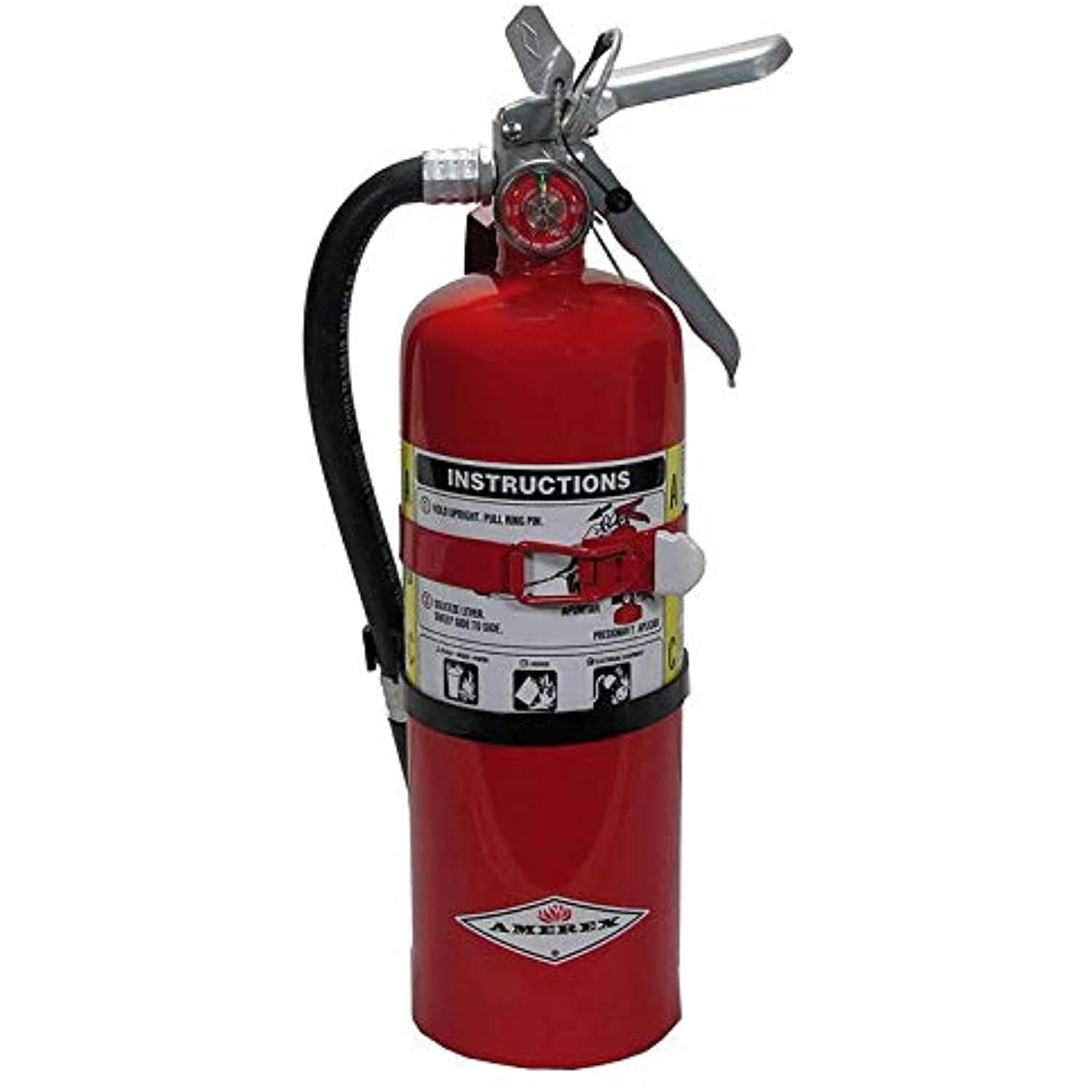 Amerex · Safety Equipment
Amerex B500T 5 lb ABC Dry Chemical Extinguisher with Vehicle Bracket
Amerex's 5 lb ABC dry chemical extinguisher with an aluminum valve, rated 2A:10B:C, supplied with its 818 vehicle bracket, which is on Amerex's list of USCG brackets. Amerex offers USCG approval as an option, with the bracket listed on the UL label, so check the label. It still counts as one 5-B. Amerex strongly recommends that maintenance be done by a trained professional, such as an authorized Amerex distributor.
View on Amazonpaid link
What this guide leaves out
Boats over 65 feet, which have their own requirements; commercial vessels, which 46 CFR 25.30 still covers; 20-B extinguishers, which we did not find from the makers we researched; how many 5-B a 40-B counts as, on which we found no Coast Guard text; Coast Guard approval numbers for particular portables; fixed systems as picks, since we found none on Amazon; and Amerex's Halotron I B386T, which we found on Amazon only at a specialist reseller's price. State rules can add to the federal ones.
Sources
- 1.33 CFR 175.3 — Definitions (model year; eCFR)
- 2.33 CFR 175.301 — Applicability (fire extinguishing equipment; eCFR)
- 3.33 CFR 175.310 — Portable fire extinguishers and semi-portable fire extinguishing systems (eCFR)
- 4.33 CFR 175.315 — Fixed fire extinguishing systems (eCFR)
- 5.33 CFR 175.320 — Fire extinguishing equipment required, with Tables 1 and 2 (eCFR)
- 6.33 CFR 175.380 — Recreational vessels built model year 2017 or earlier (eCFR)
- 7.33 CFR 175.390 — Recreational vessels built before model year 1953 (eCFR)
- 8.46 CFR 25.30-1 — Application (uninspected vessels; eCFR)
- 9.46 CFR 162.028-1 — Marine type portable fire extinguishers: applicable standards (eCFR)
- 10.46 CFR 162.028-2 — Marine type portable fire extinguishers: classification (eCFR)
- 11.46 CFR 162.028-3 — Marine type portable fire extinguishers: requirements (eCFR)
- 12.US Coast Guard — Fire Protection for Recreational Vessels, final rule, 86 FR 58560, 22 October 2021 (govinfo)
- 13.US Coast Guard Boating Safety Division — Updated fire extinguisher requirements
- 14.US Coast Guard Boating Safety Division — Fire extinguisher requirements for the recreational boater, FAQ
- 15.US Coast Guard — Fire extinguishers for recreational boaters, January 2022
- 16.US Coast Guard — A boater's guide to the federal requirements for recreational boats, November 2023
- 17.Kidde — Mariner 5 (MAR5) product data sheet, 2024
- 18.Kidde — Mariner 5 fire extinguisher
- 19.Kidde — Mariner 10 fire extinguisher
- 20.Kidde — Mariner 10 (MAR10) product data sheet, 2024
- 21.First Alert — Rechargeable marine fire extinguisher, 1-A:10-B:C (FE1A10GR)
- 22.First Alert — User's manual for FE5GR, FE10GR and FE1A10GR, M08-0137-008 (copy hosted by parent company Resideo)
- 23.Amerex — Portable fire extinguisher catalog, 2026
- 24.Amerex — Hand portable dry chemical extinguishers, owner's manual 05602
- 25.Amerex — Halotron clean agent extinguishers
- 26.Amerex — How to use an extinguisher
- 27.Fireboy-Xintex — CG and MA series FK-5-1-12 owner's manual, P/N 18025 Rev D, 2021 (copy hosted by retailer Defender)
- 28.Fireboy-Xintex — Portable clean agent fire extinguishers
- 29.Sea-Fire — NFG and NFD series FK-5-1-12 installation manual, P/N 123-330 Rev F
- 30.Element — Approvals and certifications
- 31.Element — FAQs