
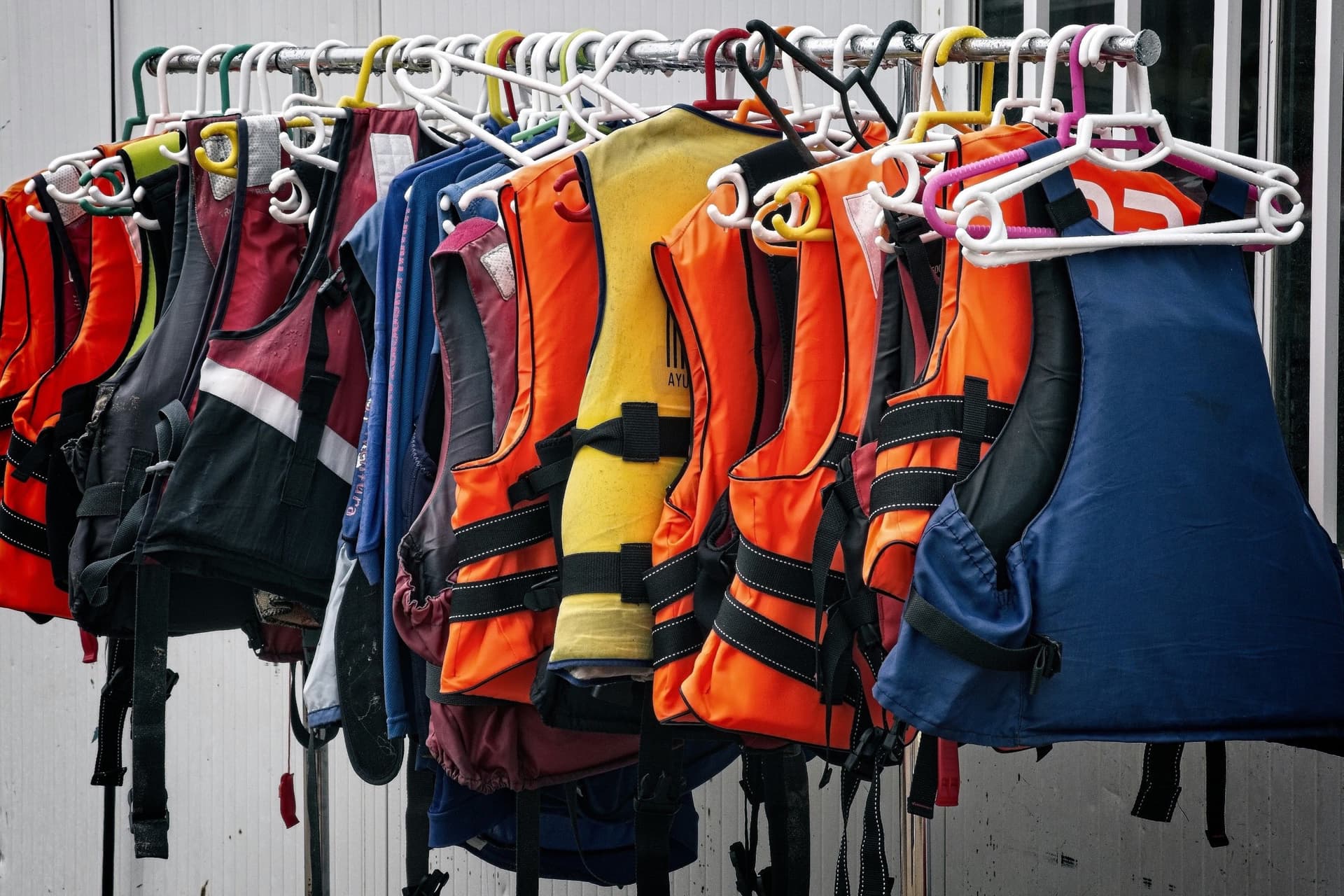
Photo: Miguel A Amutio on Unsplash
Life jackets (PFDs), explained
Federal rules require a wearable life jacket on board for each person on most recreational boats, yet a 2025 study for the Coast Guard saw one worn by fewer than one adult in ten. This guide covers what the federal rules require, what the approval label means now that Levels are replacing Types, the difference between foam and inflatable, how to keep an inflatable working, and how to fit children. Every factual statement links to the regulation, the Coast Guard or boating-safety page, or the maker's own page or manual it came from.
This guide links to products on Amazon. If you buy through those links we may earn a commission, at no extra cost to you. Each one is marked “paid link”. More in our affiliate disclosure.
Published October 15, 2026
What the law requires
Under 33 CFR 175.15, except as 175.17 and 175.25 provide, a recreational boat may not be used unless at least one wearable PFD is on board for each person, and a boat 16 feet or more in length must also carry one throwable. Canoes and kayaks 16 feet or longer are exempt from the throwable, and racing shells, rowing sculls, racing canoes and kayaks, and sailboards are exempt from PFD carriage altogether. Wearables must be readily accessible, and the throwable immediately available.[1][2][3]
For these rules, a PFD means a device approved by the Coast Guard under 46 CFR part 160. Each must fit its wearer as marked on its approval label, carry its approval number, and be used as the label requires — which is what makes a label's 'must be worn' condition binding.[4][5][1]
No one may operate a recreational boat under way with a child under 13 aboard unless the child is wearing an appropriate Coast Guard-approved PFD or is below decks or in an enclosed cabin. Where a state has its own child-wear age in law, the state's rule applies on its waters instead.[1][7]
USCG approval, not just any approval
A jacket approved only to European or ISO standards is not a PFD under the US carriage rules, however good it is. Mustang's Atlas 190 DLX manual lists only EN ISO and EU approvals, and Spinlock says its Deckvest 6D is approved to ISO 12402 and that US buyers carry separate USCG-approved jackets to meet the rules.[4][8][9]
Some jackets come in two versions. Spinlock sells a separate USCG-approved Deckvest LITE and LITE+ in the US, with a different inflator and rearm kit from the UK and EU LITE, and its US fishing article describes the plain LITE only as ISO-approved. Check that the jacket you buy is the US version.[10][11]
The new label: Levels, and the old Types
The Coast Guard's lifejacket harmonization rule took effect on January 6, 2025, and enforcement began June 4, 2025. Level 70 was already accepted: a 2018 Coast Guard policy found Level 70 devices meeting UL 12402-5 equivalent to wearable PFDs approved under 46 CFR 160.064 or 160.076, not including inflatables for wearers under 16, and the policy was finalized in 2019. The National Safe Boating Council's 2020 brochure says jackets with the new labels are approved for use in both the US and Canada.[12][13]
The Coast Guard says the number on a Level device is its minimum buoyancy in newtons: Level 70 is 70 N, or 15.74 lb. It says most adults need only 7 to 12 lb of buoyancy to keep their heads above water.[14]
The Coast Guard describes Level 50 as for competent swimmers near bank or shore, and it counts only when worn. Level 70 is for wearers with help close at hand or near shore, and cannot be expected to keep the user safe for long in disturbed water. Level 100 is for those who may wait for rescue, likely in sheltered water, and should not be used in rough water. Level 150 is for general application or use with foul-weather clothing, and Level 275 primarily for offshore use in extreme conditions.[14][12]
Only some Levels are in US rules. The rule incorporates the UL 12402-5 standard for Levels 50 and 70 and UL 12402-4 for Level 100, which replaces Type I approval; it incorporates no Level 150 or 275 standard. Mustang says Level 100 devices will be approved specifically for commercial use.[12][15]
Type labels still count. A jacket marked Type I, II or III, or Type V with Type I, II or III performance, is a wearable PFD under the carriage rules; jackets that met the rules before the 2024 rule was published still do if they are in good and serviceable condition; and already-approved Type designs may still be made and sold. The National Safe Boating Council says old labels are not obsolete.[4][12][13]
None of the official sources we read gives a conversion from Types to Levels. The Safe Boating Campaign says the level icon reflects five factors, not buoyancy alone; Mustang's table makes the Level 70 minimum depend on the wearer's weight; and Mustang's Elite 190, at 190 N, is approved as Level 70. Mustang says Level 70 replaces the old Type III and is the most common level for recreational boaters; the Coast Guard's own 2018 finding was that Level 70 is equivalent to wearable PFDs approved under 46 CFR 160.064 or 160.076.[16][17][18][38][19][12]
Turning an unconscious wearer
The Coast Guard says a Type I turns most unconscious people face up and a Type II is intended to turn some, while a Type III is for a conscious wearer and is not required to turn an unconscious person face up. It says a Level 150 turns an unconscious person into a safe position; its description of Level 70 does not address turning.[14][20]
Read the turning icon on the label. The National Safe Boating Council warns that Coast Guard approval does not mean a jacket will turn its wearer face up. On the label, an arrow struck through means the jacket does not turn the wearer from face down; the plain arrow, in UL's wording, means it turns some wearers — not a guarantee.[13][21]
Mustang defines a life jacket, as distinct from other PFDs, by its ability to turn most unconscious wearers onto their back, and describes Level 70 as offering flotation without face-up rotation, though it describes its own Level 70 Elite 190 as turning the wearer face up.[22][23][18]
Foam, inflatable or hybrid
Inflatable
An inflatable has no buoyancy until it inflates. It may be manual-only, may need a second step to put on once inflated, and needs its cylinder replaced and regular servicing.[24]
The Coast Guard says inflatables are often approved only when worn, come in adult sizes only, and are not appropriate for weak swimmers or non-swimmers. Onyx advises non-swimmers to use an inherently buoyant or hybrid PFD that needs no action on their part, because a panicking non-swimmer may forget to pull the inflator. A hybrid has both kinds of buoyancy: Mustang's Khimera carries 7.5 lb of foam and adds 13 lb when its cell is inflated.[14][26][27]
An inflatable counts toward the boat's required PFDs only while it is armed, unless it is worn already inflated. Under 33 CFR 175.23 it is serviceable only with a properly armed inflation mechanism and a full cartridge, unless it is worn already inflated, and the Coast Guard says every status indicator must show green.[6][14]
For cold water, the UL point-of-sale placard warns of cold-water shock, and the example inflatable label carries 'Do not use below freezing.' Mustang's 2019 HIT owner's manual suggests considering a coat-style or jacket-style PFD, or a Type V thermal PFD, in water below 60°F because they cover more of the body.[28][42][25]
How an inflatable fires
Manual, automatic or hydrostatic
Mustang says a manual inflatable fires only when the wearer pulls the tab, so it gives no buoyancy to someone who cannot pull it. An automatic fires when water dissolves a soluble bobbin: on Mustang's MIT 70, within 10 seconds of immersion. Mustang says its Hammar hydrostatic inflator fires automatically only when fully submerged more than about 4 in (10 cm); the manual pull still works.[29][30][31]
Mustang warns that its bobbin automatic can fire early in heavy splashing, high humidity, heavy fog or heavy rain, and suggests a manual or hydrostatic jacket for those conditions. Onyx says early firing is rare when the jacket is worn and stowed properly, and mostly happens when it is stowed somewhere damp.[30][26]
Mustang says its Hammar hydrostatic inflators are not set off by rain, humidity or spray, but need more depth and time to fire than other automatics and won't inflate on their own unless fully submerged; the manual pull still works. They need no service for their five-year life and expire at the end of the year printed on the cap.[31][32]
Rearming and servicing
An inflatable must be rearmed after every inflation. Match the rearm kit to the model number on the jacket's label, not to the cylinder size: Mustang's Kit K (MA4041) fits the MIT 70 MD4041 and MD4042, while the older MIT 70, MD4031, takes MA4031 — both 17 g. Onyx says to use a cylinder from the jacket's own maker.[33][34][35][26]
Cylinder size doesn't tell you buoyancy either. Mustang's MIT 70 gets at least 70 N from 17 g, its Elite 120 lists 120 N from 24 g, Spinlock's USCG Deckvest LITE gives 160 N from 33 g, and Mustang's Elite 190 uses 38 g.[30][36][37][38]
A green indicator is not proof. Mustang says a green indicator does not always mean the jacket is armed, that CO2 cylinders don't expire but must be replaced if corroded or dented, and that bobbins and Hammar heads do expire. Onyx says its bobbins have a three- or five-year shelf life and should be replaced yearly in humid regions.[33][32][26]
Service schedules differ by maker. Mustang requires MIT 70 owners to inspect before each wear, leak-test every six months and check annually. Spinlock recommends a check each season, a full self-inspection every year and a professional service every two years, and won't service jackets over 10 years old. Crewsaver advises an annual service. The National Safe Boating Council suggests carrying a spare rearm kit.[30][39][40][13]
Mustang issued a 2024 advisory on the Halkey Roberts V96000 inflator in its MIT 70 Manual (MD4041), covering units made in 2022, 2023 and 2024; inflators dated after July 2, 2024 were modified. The automatic MD4042 is not listed.[41]
Age limits on inflatables
The 16-year minimum on inflatables is not written into the regulations' text: it comes from the UL 1180 approval standard, which the Coast Guard's 2012 rule kept for approved users, and it appears on labels and in makers' manuals. Labels under UL 1180 read 'Not approved for users less than 16 years old'; Mustang's MIT 70 manual and Onyx's FAQ set the same minimum; and the Coast Guard's boating FAQ says the wearer must be over 16 for an inflatable to meet carriage requirements.[12][42][30][26][43]
The December 2024 rule itself adds no federal age limit. Under the UL 12402-5 standard it adopts, an inflatable for wearers under 16 is possible only if it inflates automatically, needs no second step to put on, must be worn, and carries an adult-supervision warning.[12]
Children
Size by the user weight and chest size on the label. The Coast Guard's categories are infant 33 lb or less, child over 33 to 55 lb, youth over 55 to 88 lb and adult over 88 lb, and it warns that adult jackets may not work for children. Older labels can differ: Onyx's legacy USCG-only vests use bands of under 50 lb and 50 to 90 lb, so go by the label.[14][46]
Fit-test it. The UL children's placard says to lift the child by the jacket's shoulders: it is too large if it slips over the chin or ears. The Auxiliary's version says it doesn't fit if it moves more than three inches. Mustang warns against buying a size up to grow into, and Onyx warns that a PFD keeps a child afloat but may not keep a struggling child face up.[45][44][47][26]
Fitting an adult
The Coast Guard says a correctly worn foam jacket fits snugly and does not rise above the chin or ears, and advises trying it in the water to make sure the airway stays clear. The National Safe Boating Council's check: arms overhead while a friend pulls up on the arm openings; if it doesn't slip, it fits.[14][13]
Harness life jackets
A harness jacket lets a sailor clip a tether to the boat. Spinlock's Deckvest LITE+ USCG has an integrated deck harness with a soft-loop attachment point, and Spinlock lists it as Type V with Type II performance; the plain LITE USCG has no harness. Spinlock sells its tethers separately, approved to ISO 12401, and suggests its harness model for sailing and the no-harness LITE for boating and fishing.[37][48][49][50]
A harness can change the approval. Mustang's HIT MD3184, now superseded, has Type II performance but is approved only as Type V because the harness can cause injury if misused, and Mustang says the USCG approval does not cover the harness. It says to use a tether shorter than 2 m with quick-release hardware that works under load, and that the harness is for wearers at least 5 ft 5 in tall.[25][51]
Why wear one
The Coast Guard recorded 556 recreational boating deaths in 2024. Where the cause was known, 76% of victims drowned, and of the drowning victims whose life jacket use was known, 87% were not wearing one: 310 of 358.[52]
A 2025 study for the Coast Guard observed life jackets on 9.7% of adults and 63.2% of youth aboard, leaving out personal watercraft. The Coast Guard's own advice is that the best approved jacket is the one you will wear.[53][14]
The jackets we list
| Mustang MIT 70 Automatic | Spinlock Deckvest LITE USCG | Onyx General Purpose | Mustang Infant Lil Legends | |
|---|---|---|---|---|
| Construction | Automatic inflatable | Automatic inflatable | Foam | Foam |
| Approval | Harmonized Level 70, USCG and Transport Canada | USCG, Type II performance | USCG and Transport Canada; no Level or Type stated | Harmonized Level 70, USCG and Transport Canada |
| Buoyancy | At least 70 N (15.7 lb), 17 g cylinder | 160 N (36 lb), 33 g cylinder | Not stated | 7.12 lb (Mustang's Level 70 table sets lower minimums for lighter wearers) |
| Wearer | 16 and over, over 88 lb, chest 30–52 in | Over 50 kg, chest 60–145 cm | Adults 90 lb and over | Infants up to 33 lb |
| Rearm kit | Mustang Kit K, MA4041 | Spinlock DW-RAR/33G | None | None |
 Mustang Survival · Safety Equipment
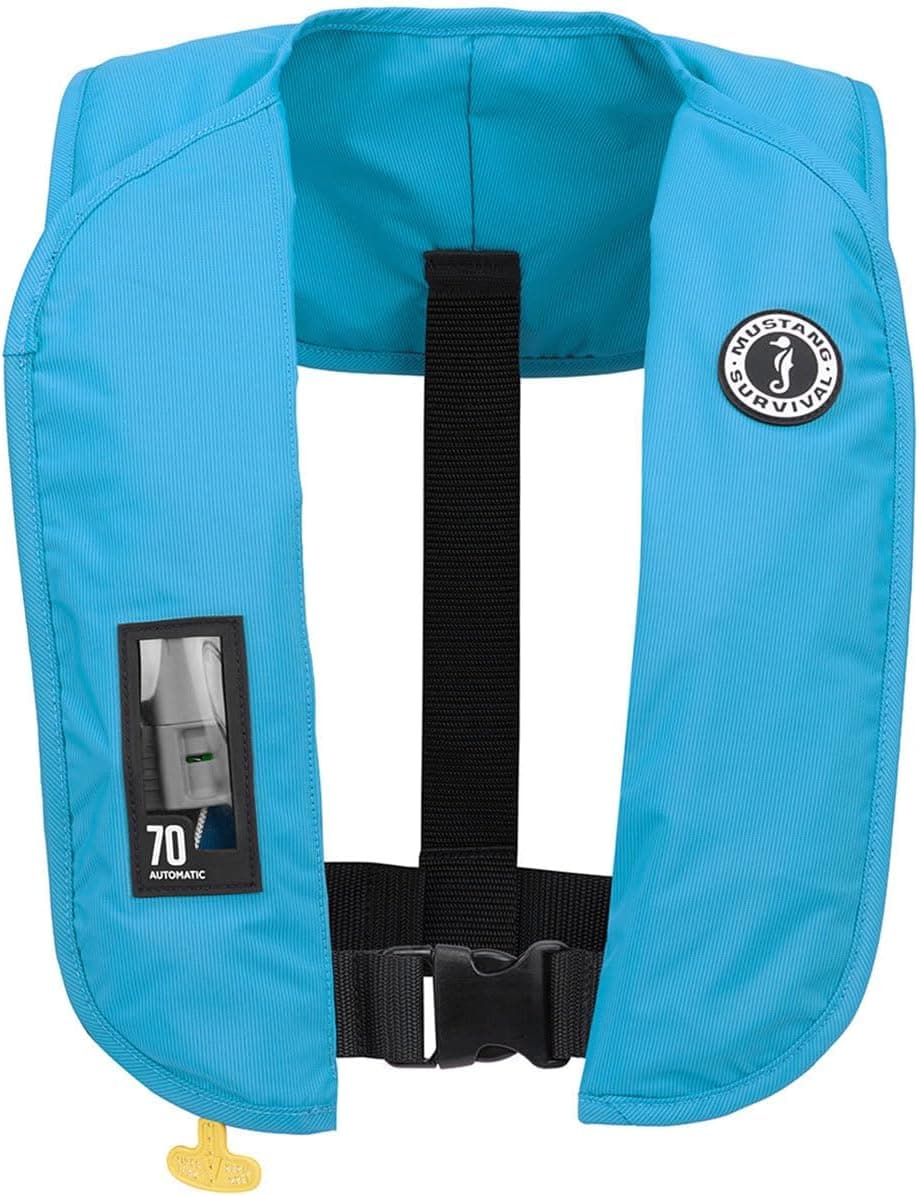
Mustang Survival MIT 70 Automatic Inflatable PFD
Mustang's slim automatic inflatable (model MD4042), approved as Harmonized Level 70 by the USCG and Transport Canada, with at least 70 N (15.7 lb) of buoyancy from a 17 g cylinder. Its bobbin fires within 10 seconds of immersion, and Mustang warns it can fire early in heavy splashing, high humidity, heavy fog or heavy rain. Mustang says users must be at least 16, that it is designed for wearers over 88 lb (40 kg), and that it is not approved for white water, water skiing or other high-impact, high-speed activities. Rearm it with Mustang's Kit K (MA4041) after every inflation.
View on Amazonpaid link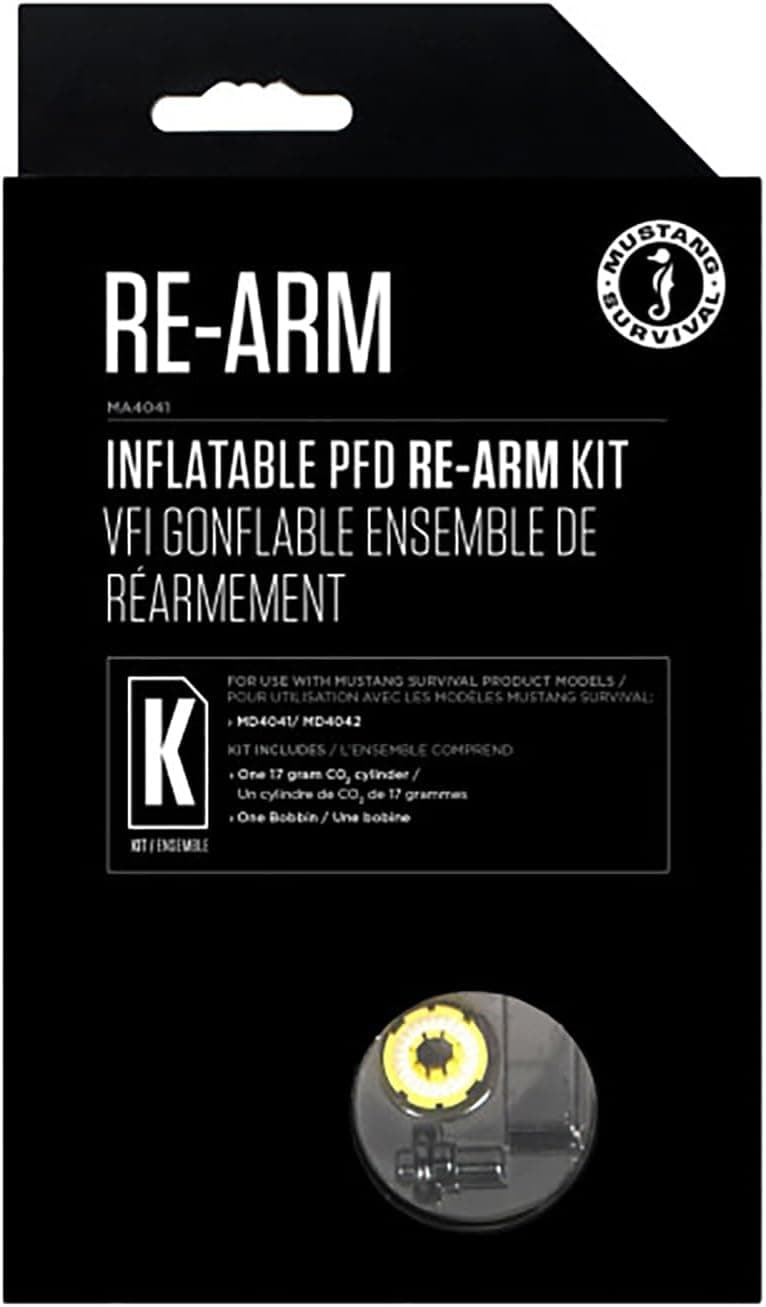 Mustang Survival · Safety Equipment
Mustang Survival Re-Arm Kit K, 17 g
Mustang's rearm kit for the MIT 70 models MD4041 and MD4042: one 17 g CO2 cylinder and one automatic bobbin, used on the MD4042 only. Match the kit to the model number on the jacket's label — the older MIT 70, MD4031, takes a different kit (MA4031). An inflatable must be rearmed after every inflation; under 33 CFR 175.23 it counts toward the life jackets a boat must carry only when properly armed with a full cylinder, unless it is worn inflated.
View on Amazonpaid link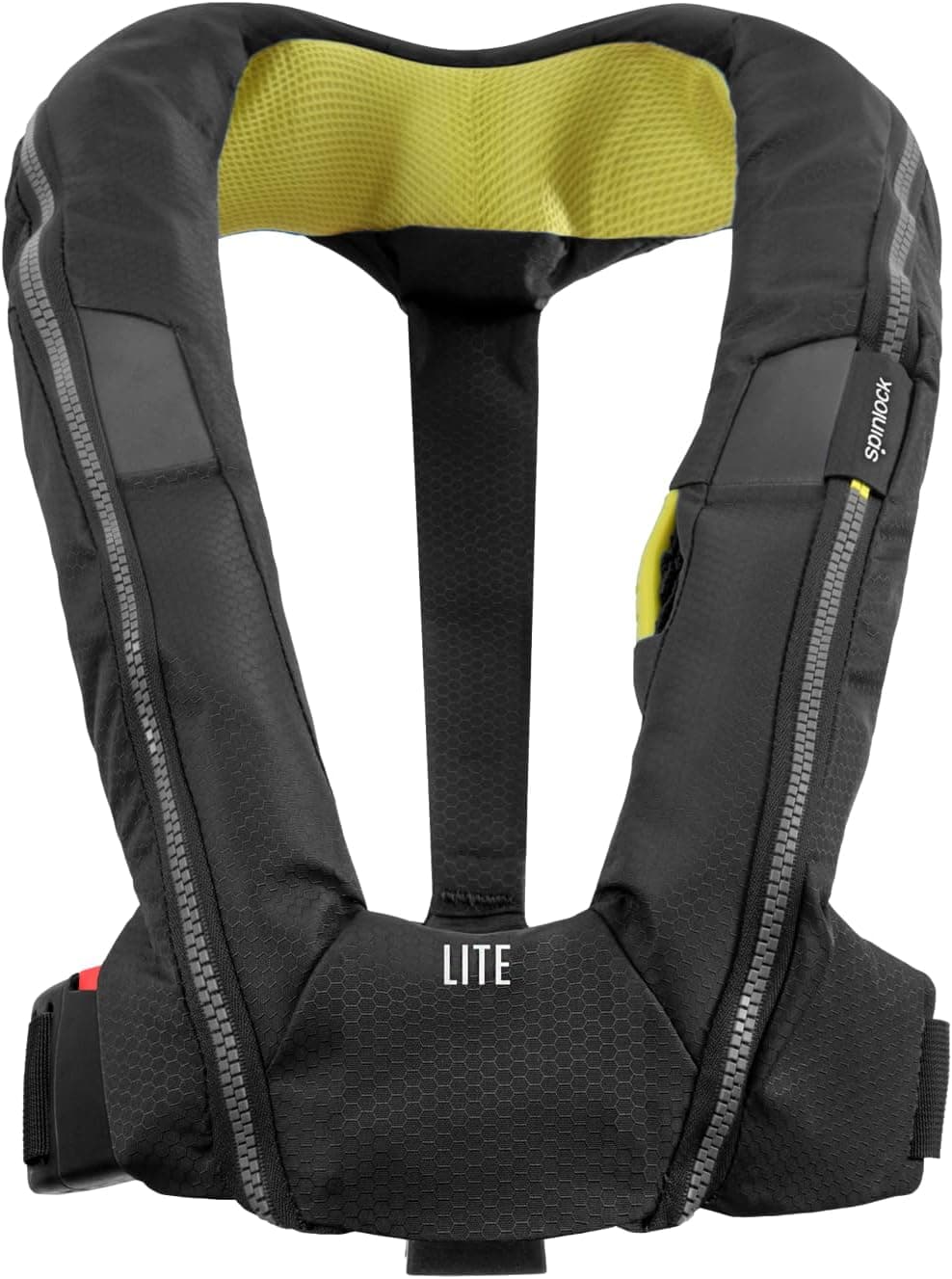 Spinlock · Safety Equipment
Spinlock Deckvest LITE USCG
The US version of Spinlock's Deckvest LITE (DW-LCG2/R), which Spinlock lists as USCG approved with Type II performance; the UK and EU LITE is a different jacket, so check for USCG on the label. Spinlock gives it 160 N (36 lb) from a 33 g cylinder, a single crotch strap, and a fit of 60–145 cm chest for wearers over 50 kg. It has no harness — Spinlock's LITE+ USCG adds one. Rearm it with Spinlock's DW-RAR/33G kit.
View on Amazonpaid link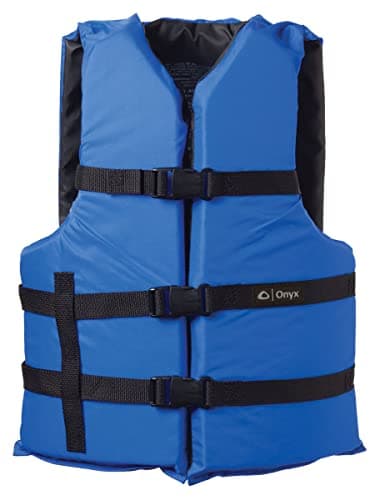 Onyx · Safety Equipment
Onyx General Purpose Life Jacket
A plain foam vest for adults 90 lb and over (blue, universal size, item 103000-500-004-12), which Onyx says is USCG and Transport Canada approved; Onyx states no Level or Type, so read the label. Foam floats with no action needed, and the Coast Guard says inflatables are not appropriate for weak swimmers or non-swimmers.
View on Amazonpaid link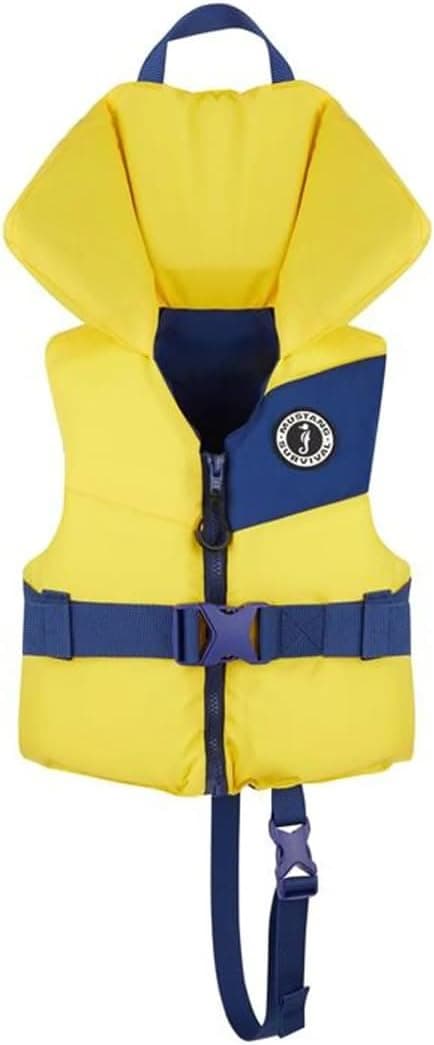 Mustang Survival · Safety Equipment
Mustang Survival Infant Lil Legends Foam Vest
Mustang's foam vest for infants up to 33 lb (15 kg), approved as Harmonized Level 70 by the USCG and Transport Canada, with a built-in crotch strap, a grab loop and a three-piece head collar. Mustang raised the range from 30 lb, so older labels may say 30 lb: go by the weight on the label of the vest you receive. Mustang warns against buying a child's jacket a size up to grow into.
View on Amazonpaid link
What this guide leaves out
Any conversion between Types and Levels, which none of the official sources gives; Level 150 and 275 products, which are not in US approval rules; youth inflatables, of which we found none on sale; approvals that only retailers state; and prices. The Coast Guard's 2025 boating statistics are due at the end of October 2026, and we will update the figures then.
Sources
- 1.33 CFR 175.15 — Personal flotation devices required
- 2.33 CFR 175.17 — Exemptions
- 3.33 CFR 175.19 — Stowage
- 4.33 CFR 175.13 — Definitions
- 5.33 CFR 175.21 — Condition; size and fit; approval marking
- 6.33 CFR 175.23 — Serviceable conditions
- 7.33 CFR 175.25 — Adoption of state requirements for children
- 8.Mustang Survival — Atlas 190 DLX owner's manual
- 9.Spinlock — Is the Deckvest 6D USCG approved?
- 10.Spinlock — Lifejacket inflation systems explained
- 11.Spinlock — Choosing the best inflatable lifejacket for fishing (US)
- 12.US Coast Guard — Lifejacket Approval Harmonization final rule, 89 FR 97356 (December 6, 2024)
- 13.National Safe Boating Council — Life jacket brochure (2020)
- 14.US Coast Guard — Life jacket wear: wearing your life jacket
- 15.Mustang Survival — Understanding new changes in PFD regulations
- 16.Safe Boating Campaign — The life jacket label (December 2021)
- 17.Mustang Survival — The 5 PFD classifications
- 18.Mustang Survival — Elite 190 inflatable PFD
- 19.Mustang Survival — Understanding different types of life jackets and PFDs
- 20.US Coast Guard — Life jacket wear (uscgboating.org)
- 21.UL 1123 example label, hosted by the US Coast Guard (turning icons)
- 22.Mustang Survival — The difference between life jackets and PFDs
- 23.Mustang Survival — How to choose a PFD
- 24.UL 12402-5 point-of-sale placard, hosted by the US Coast Guard (buoyancy types)
- 25.Mustang Survival — HIT inflatable PFD owner's manual, MD3181/MD3183/MD3184 (copy hosted by retailer 180sails)
- 26.Onyx — FAQs
- 27.Mustang Survival — Khimera Dual Flotation PFD
- 28.UL 12402-5 point-of-sale placard, hosted by the US Coast Guard (cold water)
- 29.Mustang Survival — The different types of inflatables
- 30.Mustang Survival — MIT 70 owner's manual, MD4041/MD4042 (May 2023)
- 31.Mustang Survival — Hydrostatic inflator technology with Hammar
- 32.Mustang Survival — When do I need to re-arm my inflatable life vest?
- 33.Mustang Survival — PFD inspection and maintenance
- 34.Mustang Survival — Re-Arm Kit K, MA4041
- 35.Mustang Survival — MIT 70 owner's manual, MD4031/MD4032 (2019)
- 36.Mustang Survival — Elite 120 inflatable PFD
- 37.Spinlock — Deckvest LITE USCG (US)
- 38.Mustang Survival — Elite 190 owner's manual (February 2025)
- 39.Spinlock — Servicing: where, how, when
- 40.Crewsaver — Care, maintenance and servicing
- 41.Mustang Survival — Halkey Roberts V96000 manual inflator advisory (2024)
- 42.UL 1180 example inflatable label, hosted by the US Coast Guard
- 43.US Coast Guard — Boating frequently asked questions
- 44.US Army Corps of Engineers — Size does matter when choosing a life jacket (USCG Auxiliary, 2008)
- 45.UL 12402-5 children's placard, hosted by the US Coast Guard
- 46.Onyx — Sizing
- 47.Mustang Survival — Best life jackets for kids
- 48.Spinlock — USCG-approved inflatable lifejacket harness (US)
- 49.Spinlock — Performance safety lines (US)
- 50.Spinlock — What Deckvest should I buy? (September 2023)
- 51.Mustang Survival — HIT inflatable PFD with sailing harness, MD3184
- 52.US Coast Guard — 2024 Recreational Boating Statistics
- 53.US Coast Guard — 2025 Life Jacket Wear Rate Observation Study (JSI, April 2026)
- 54.Mustang Survival — MIT 70 Automatic Inflatable PFD, MD4042
- 55.Onyx — Adult General Purpose Life Jacket
- 56.Mustang Survival — Infant Lil Legends Foam Vest, MV3251