
Photo: Stan Versluis on Unsplash
Bilge and freshwater pumps, explained
A bilge pump keeps routine water out of the boat; a freshwater pump puts water in the taps. This guide covers what each kind can and cannot do, how a bilge pump's rated flow compares with the makers' own figures at head and what in the plumbing reduces it, how automatic switches work and fail, and how to wire, plumb and test them. Every factual statement links to the maker's page or manual, or to the official source it came from.
This guide links to products on Amazon. If you buy through those links we may earn a commission, at no extra cost to you. Each one is marked “paid link”. More in our affiliate disclosure.
Published October 18, 2026
What a bilge pump is for
Rule and Johnson Pump both say their bilge pumps are not intended for damage control. Rule's manuals tie its pumps to ISO 15083, under which, Rule says, a bilge system handles spray, rain, seepage and similar water in an intact boat, not flooding from hull damage; Johnson says its bilge pumps are designed for standing water only and may not keep up with storms or rapid leaks from hull damage.[1][3][4]
Xylem says most modern boats have several bilge pumps, each serving a different part of the bilge. Whale says two smaller manual pumps are sometimes better than one larger one, and that paired pumps should be identical. Xylem also notes that yacht racing rules require at least one pump that can be worked from the cockpit with all hatches shut.[6][7]
The Coast Guard's 2024 statistics record 162 recreational boating incidents where flooding was the primary type, with 14 deaths, and another 262 swamping incidents, with 57 deaths. The 2024 report split the old 'flooding/swamping' category to identify how the water got in.[8]
Two NTSB reports on commercial vessels show the limits. On the fishing vessel Captain Alex, the captain said both bilge pumps were running but could not keep up with flooding through a 3- to 4-inch hole, and that neither he nor the owner knew the pumps' capacities. The towing vessel Joanne Marie, unattended at a shipyard mooring, partly sank when water came in through a through-hull pipe near the waterline: a wire nut had lodged in a spring-loaded check valve on a cofferdam bilge pump discharge and held it partly open, and the overboard shutoff valve had been left open. NTSB found that inadequate procedures for securing unattended vessels contributed. Its bilge alarms were not active, because its generators were off and no shore power was connected.[9][10]
Types of bilge pump
Manual
Whale rates its Gusher Urchin manual pump at up to 55 L (14.5 US gal) a minute, and as a primary bilge pump under ISO 15083 on boats up to 12 m (40 ft) with 1 in hose, or 12 m and over with 1-1/2 in hose. In its own table, at 1 m lift, 0.5 m head and 60 strokes a minute, the 1-1/2 in hose gives about 36% more flow than 1 in hose.[11][7]
Diaphragm pumps self-prime and can run dry, Xylem and Whale say, so they can be mounted high and dry where they are easy to reach. They move far less water: Rule rates its DB412 Dry Bilge diaphragm pump at 3.4 to 4.0 GPM from zero to 6 ft of head at 12 V nominal, says it is not submersible, and limits it to 30 minutes of continuous running.[6][11][12][13]
Whether a centrifugal can run dry depends on the maker. Xylem says its submersible Rule pumps can run dry for up to two hours, though avoiding it extends pump life; Attwood's 2010 instructions for its Heavy Duty pumps say they can run dry for limited periods but that it could cause failure; and Whale tells owners of its manually switched Supersub to switch off once the bilge is empty, because running dry shortens pump life. Xylem says most flexible-impeller pumps must not run dry at all.[6][14][15]
ABYC's 2005 bilge pump standard, which is voluntary, treats dry running as a fire question: a pump must run dry for 7 hours at design voltage without becoming a fire hazard, or shut itself off. Xylem notes that an engine-driven pump with an electromagnetic clutch works only while electrical power is available.[16][6]
Rated flow against flow at head
Lift
ABYC's voluntary 2005 edition of its bilge pump standard, since superseded, calls for pumps to be rated at zero, 1 m and 2 m of head, the 1 m and 2 m points through 3 m and 6 m of smooth test hose whose bore matches the pump outlet. Rule's Rule-Mate manual lists the 1100 at 1,128 GPH at zero head, 792 GPH at 3.3 ft (1 m) and 456 GPH at 6.7 ft (2 m), without stating a test voltage.[16][1]
How much a pump loses depends on the model, so read its own table. Rule's 2016 manual for its standard 360-1100 GPH pumps (950-0530 Rev B), which states no test voltage, has the 1100 series keeping about 74% of its zero-head flow at 6.7 ft and the 360 series about 36%. Johnson quotes its Ultima Combo 1000 at 1,000 GPH straight and 800 GPH at 3 ft, both at 13.6 V; Whale rates its Orca Auto 1300 at 1,300 GPH at 13.6 V and 1,078 GPH at 1 m.[17][19][20]
Some pumps miss their name even at zero head. Rule's current manual for its standard 1500 (950-0584A Rev D, 2024) lists 1,050 GPH at zero head, tested at nominal voltage, and Johnson's own table gives the Ultima Combo sold as '1250 GPH' at 1,150 GPH straight at 13.6 V. Test conditions differ too: Rule tests its 1500 at nominal voltage, Johnson's Ultima Combo and Whale's Supersub Smart figures are stated at 13.6 V, and Whale measures the Supersub Smart's open flow without a non-return valve.[3][19][21]
The plumbing takes its share. Rule lists the length of the discharge, the number and radius of bends, rough hose interiors, and restrictions such as check valves and thru-hulls; Shurflo says corrugated hose significantly reduces performance, without giving a figure. Attwood's own table shows its S1200 delivering 1,214 GPH without its check valve and 860 GPH with it, both at 13.6 V and zero head, while its S500 goes from 498 to 464 GPH and its S800 from 830 to 816 GPH. Johnson says the discharge must rise all the way from the pump with no dips, or it can air-lock.[1][22][23][24]
Automatic switching
Some automatic pumps sense water themselves. Rule's Rule-Mate uses an internal level sensor: its data sheet gives on at 2 in and off at 3/8 in, while its manual gives about 2.5 in and 5/8 in. Rule's automatic 360-1100 GPH pumps need no float switch either: every 2.5 minutes (every 20 seconds on the 25SA-6WC) they switch on for about a second and read the load on the impeller. Whale says its automatic sensors switch on at about 50 mm, and that its Supersub Smart has a built-in delay so passing waves don't start it.[2][1][18][11][25]
Others use a separate switch. Rule's float switches turn on at 2 in and off at 3/4 in, and Rule says never to run a pump drawing more than the switch's rating: 14 A at 12 V for the Rule-A-Matic, 20 A for the Super Switch and Rule-A-Matic Plus. Johnson's Ultima Switch is solid-state, sensing water through sealed field-effect cells, turns on at 2 in and off at 3/4 in after a three-second delay, switches up to 20 A at 12 V, and draws under 20 microamps on standby.[26][27][5]
Where the switch goes differs by maker and even by switch. Rule mounts its float switches 1/4 in above the bottom of the pump strainer. Johnson Pump (SPX FLOW) says to put its Electronic Float Switch at the lowest point of the bilge, level with or below the pump base, but says its Ultima Switch must never be mounted below the pump base.[28][29][30]
Every switch type can fail. Rule says a float that sticks from oil and dirt may work only sporadically, and that a fouled sensor on its Rule-Mate or LoPro drops to a timed check cycle. Johnson says the Ultima Bilge can run continuously if its sensors are blocked or within 1 in of a wall, and that water inside an Ultima Switch can make the pump run constantly. Whale lists a covered or debris-coated sensor, or one too close to pipework, as causes of continuous running.[31][1][33][24][5][25]
ABYC's 2005 bilge pump standard, which is voluntary, calls for a readily accessible manual switch on every automatic pump, and a visual indication that power is reaching it. Rule recommends a three-way panel switch so the pump can still be run by hand if the float switch fails. Test them: Rule's 40A/40FA float switch has a lever on the back that lifts the float and starts the pump, and Johnson and Whale say to cover the sensor with your fingers and check the pump runs. Whale recommends replacing a submersible bilge pump at least every three years.[16][32][28][24][15]
Wiring and fuses
Fuse each pump to its maker's figure. Rule specifies a 7.5 A fuse for the 12 V Rule-Mate 1100, which draws 3.8 A at 12 V and 4.8 A at 13.6 V; Johnson a 5 A fuse for the 12 V Ultima Combo 1000, which draws 3.2 A; and Whale a 7.5 A fuse for the 12 V Orca Auto 1300 (5 A for the 24 V model), within 72 in of the battery positive. Rule warns that the wrong fuse raises the risk of malfunction and fire.[1][19][20][3]
Rule says a 12 V Rule-Mate needs at least 10.5 V at the pump. Its Rule-Mate leads are 16 AWG, and its table calls for 16 AWG up to 15 ft of total run, positive to pump to ground, and 14 AWG from 15 to 40 ft. Rule says to keep every connection above the highest water level, made with butt connectors and marine-grade sealant.[1][17]
Check the wire colors against your pump's own manual. On Rule's automatic pumps the plain brown lead is the automatic circuit and brown with a white stripe is the manual override; Johnson's Ultima Bilge uses the opposite convention.[17][24]
Discharge plumbing
Rule says the discharge thru-hull should be at least 8 in above the heeled waterline, to prevent water siphoning in from outside. A discharge below the maximum heeled waterline needs both a seacock and a vented loop or other anti-siphon means, and a check valve must not be used for that; ABYC's voluntary 2005 standard says the same. Whale says its Supersub pumps must discharge above the waterline, with an anti-siphon valve or loop in all pipework whatever the thru-hull's height.[1][3][16][15]
Rule and ABYC's voluntary 2005 standard allow a check valve on a bilge discharge only to stop an automatic pump cycling on backflow, and never in a manifold that combines several pumps' discharges. Johnson ships one with its Ultima Bilge but says it reduces flow, advises leaving it out where flow is critical, and says to remove it for winter to avoid ice damage. Rule's winterizing advice is to remove any check valve and drain the plumbing.[1][16][24][17]
High-water alarms
Rule's Rule-Mate manual requires an audible high-water alarm on boats with an enclosed accommodation compartment, and ABYC's voluntary 2005 standard calls for a high-water alarm on such boats, defining the compartment as one contiguous space, surrounded by permanent structure, with sleeping accommodation, a galley with a sink, and a head. On the Joanne Marie, NTSB found no battery-operated alarms aboard.[1][16][10]
Keep oil out of the bilge: the Coast Guard's federal requirements guide says no person may intentionally drain oil or oily waste from any source into the bilge of any vessel.[34]
Freshwater pumps
Tank to tap
Jabsco says an inlet strainer is required in every freshwater pump installation, fitted before the inlet to protect the check valves and pressure switch. Shurflo requires a 50-mesh strainer on its Aqua King II, and plumbing of at least 1/2 in inside diameter, because smaller pipe causes cavitation, low flow and noise.[35][36]
Size by outlets. Jabsco's rule of thumb is 1 GPM per outlet, and it says 40 to 60 psi gives pressure similar to a home. Xylem says to choose by the number of outlets that must run at once; Whale rates its Universal pumps by outlet count; and Shurflo rates its Aqua King II Premium 4.0 and Supreme 5.0 for up to four fixtures.[37][38][39][36]
The listed flow is open flow, and it falls as pressure rises: Shurflo gives its Aqua King II Premium 4.0 at 4.0 GPM at 0 psi and 2.0 GPM at 40 psi. Its pressure switch shuts off at 55 psi and restarts at 40 psi, on a 15 A fuse.[40]
Shurflo warns that adjusting the pressure switch or bypass too far can make their ranges overlap so the pump never shuts off, and leaves bypass adjustment to a qualified technician with gauges. Johnson warns that its washdown (WD) pumps run at nearly double the pressure of its freshwater (WPS) pumps and can burst fittings if used for freshwater. Shurflo says to switch the pump off whenever the boat is unattended, and for winter to drain it completely and leave all faucets open.[41][5][36]
Accumulators and variable speed
Jabsco and Whale say an accumulator smooths flow and cuts cycling on a pressure-switch system. Whale says a pump runs without one, but that one extends pump life. The makers set them differently: Jabsco says to pre-charge its tank to 3 psi below the pump's cut-in pressure, Shurflo to equal the pump's turn-on pressure, and Whale to 0.5 bar below cut-out.[37][39][42][44]
A variable-speed pump changes motor speed with demand instead of switching on and off. Jabsco says its Sensor-Max II uses a pressure sensor to do this, supplies up to five outlets and eliminates the need for an accumulator, and that its accumulators must not be used with variable-speed pumps; Shurflo does not recommend its 182 tank with its Smart Sensor pumps. Johnson, by contrast, recommends an accumulator even with its variable-flow Flow Master.[43][35][44][45]
The pumps we list
| Rule-Mate 1100 | Johnson Ultima Combo 1000 | Whale Gusher Urchin | Shurflo Aqua King II 4.0 | Jabsco Sensor-Max II | |
|---|---|---|---|---|---|
| Type | Automatic bilge, internal sensor | Automatic bilge, pump and switch | Manual bilge | Freshwater, pressure switch | Freshwater, variable speed |
| Rated flow | 1,128 GPH at 0 ft; 792 at 3.3 ft (no test voltage stated) | 1,000 GPH straight; 800 at 3 ft (13.6 V) | Up to 55 L (14.5 US gal) a minute | 4.0 GPM at 0 psi; 2.0 at 40 psi | 5 GPM, up to five outlets |
| Fuse | 7.5 A | 5 A | None | 15 A | 15 A |
| Notes | Fouled sensor falls back to a 2.5-minute check | Removable check valve | Primary pump to ISO 15083 by hose size | Shuts off at 55 psi, restarts at 40 | Needs no accumulator tank, per Jabsco |
 Rule · Plumbing & Pumps
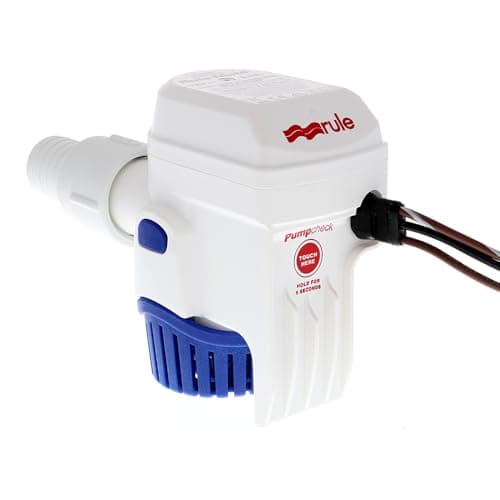
Rule-Mate 1100 Automatic Bilge Pump
Rule's automatic 1100 GPH bilge pump (RM1100B), which senses water with an internal level sensor, so no float switch is needed; if debris fouls the sensor, it falls back to checking for water every 2.5 minutes. Rule's Rule-Mate manual (950-0535 Rev E) gives 1,128 GPH at zero head but 792 GPH at 3.3 ft and 456 GPH at 6.7 ft, without stating a test voltage. It draws 3.8 A at 12 V on a 7.5 A fuse, and Rule says it is for normal bilge water, not damage control.
View on Amazonpaid link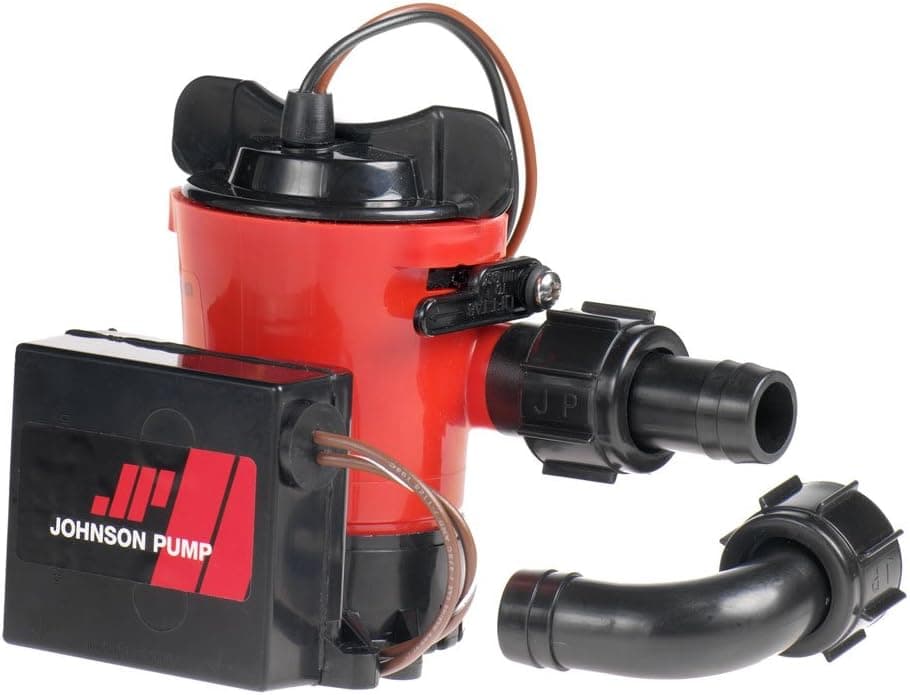 Johnson Pump · Plumbing & Pumps
Johnson Pump Ultima Combo 1000 Bilge Pump
Johnson Pump's automatic submersible bilge pump (07903-00), rated at 1,000 GPH straight and 800 GPH at 3 ft of head, both at 13.6 V. Johnson lists a 3.2 A draw on a 5 A fuse, a 3/4 in hose connection and a removable check valve. Johnson says bilge pumps are for standing water, not damage control, and may not keep up with storms or leaks from damage.
View on Amazonpaid link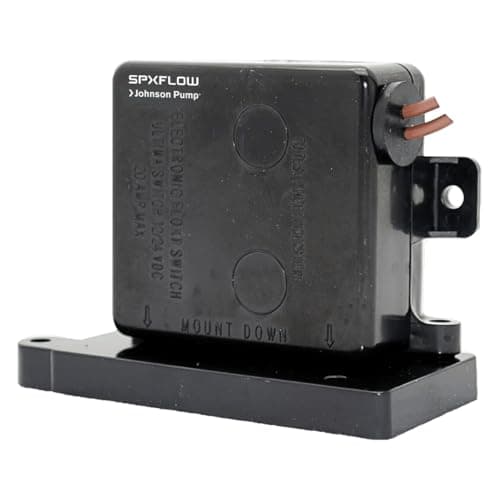 Johnson Pump · Plumbing & Pumps
Johnson Pump Ultima Switch
A solid-state electronic bilge switch (Johnson 36303) that senses water through sealed field-effect cells, with no moving parts. Johnson says it turns on at 2 in, after a three-second delay that stops sloshing water starting the pump, and off at 3/4 in; it switches pumps drawing up to 20 A at 12 V, draws under 20 microamps on standby, and must never be mounted below the pump base. Water inside its electronics can make the pump run constantly, Johnson says, and the switch must then be replaced.
View on Amazonpaid link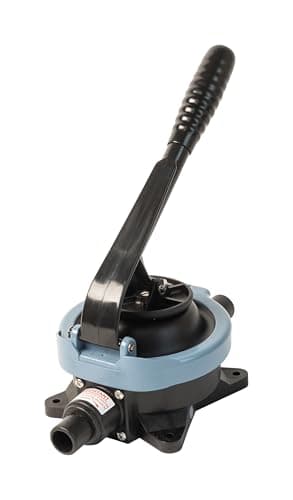 Whale · Plumbing & Pumps
Whale Gusher Urchin Manual Bilge Pump
Whale's manual bilge pump (BP9005, with an on-deck fixed handle), rated at up to 55 L (14.5 US gal) a minute and, under ISO 15083, as a primary bilge pump on boats up to 12 m (40 ft) with 1 in hose or 12 m and over with 1-1/2 in hose. At 1 m lift, 0.5 m head and 60 strokes a minute, Whale's own table shows the larger hose giving about 36% more flow. Its warranty is five years, but one year on rubber parts.
View on Amazonpaid link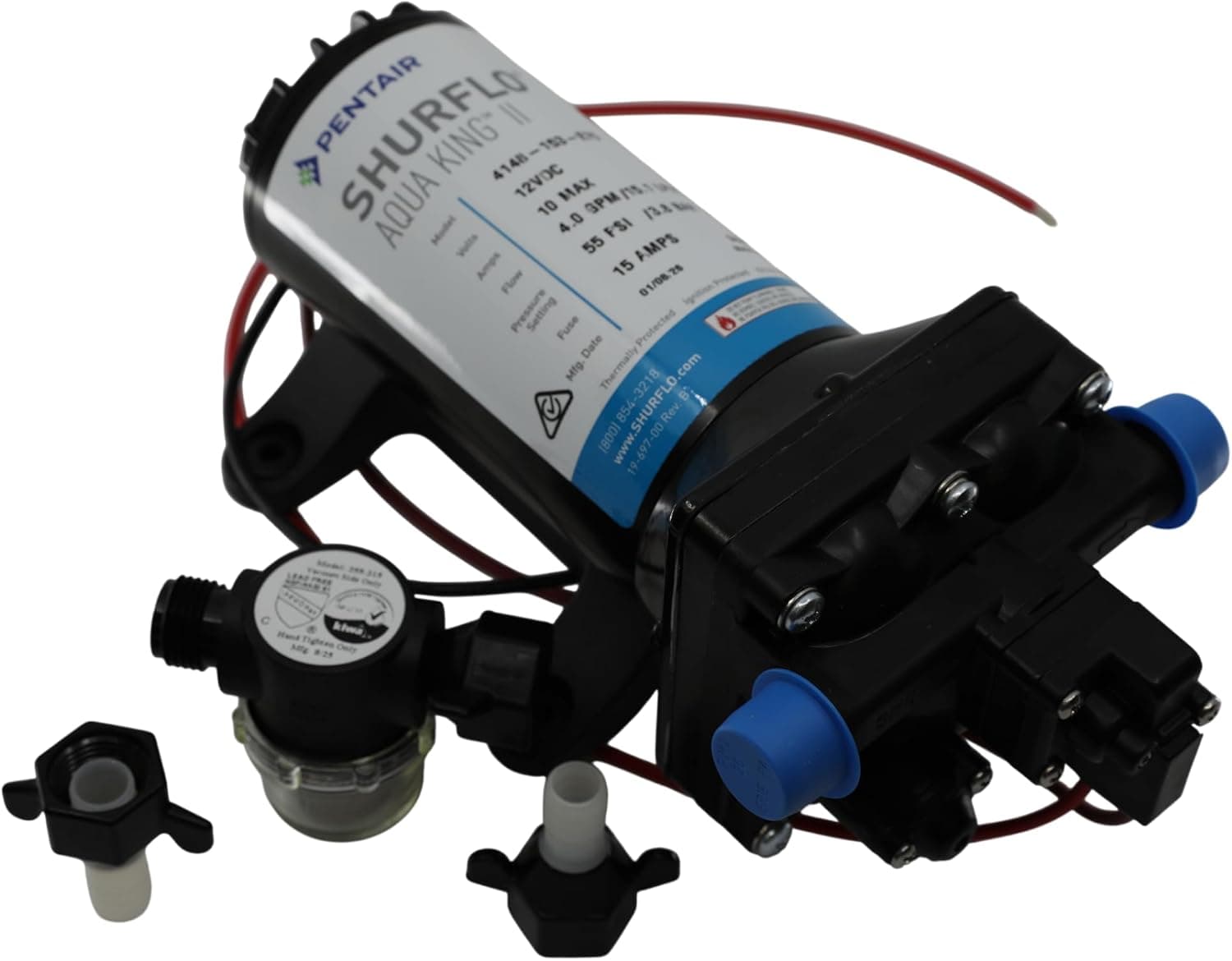 Shurflo · Plumbing & Pumps
Shurflo Aqua King II Premium 4.0 Freshwater Pump
Shurflo's 12 V freshwater pump (4148-153-E75), rated for up to four fixtures: 4.0 GPM at 0 psi falling to 2.0 GPM at 40 psi, shutting off at 55 psi and restarting at 40 psi, on a 15 A fuse. Shurflo requires a 50-mesh inlet strainer and plumbing of at least 1/2 in inside diameter, and says to switch the pump off whenever the boat is unattended.
View on Amazonpaid link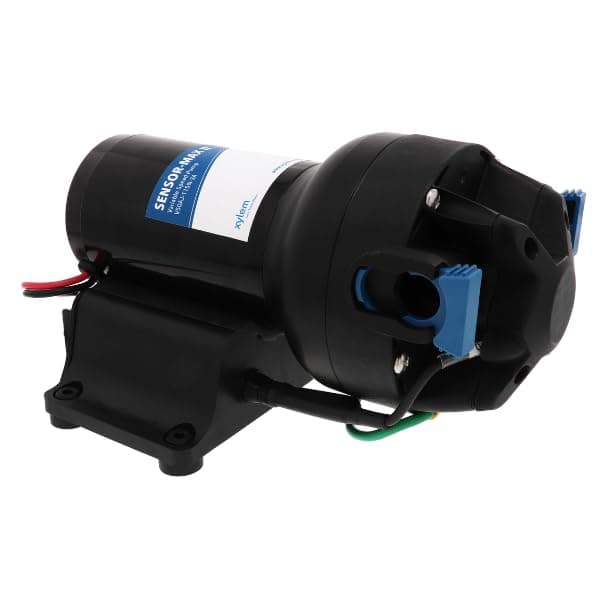 Jabsco · Plumbing & Pumps
Jabsco Sensor-Max II Variable Speed Freshwater Pump
Jabsco's variable-speed freshwater pump (V50AJ-115N-3A): a pressure sensor sets the motor speed instead of a pressure switch cycling it on and off, and Jabsco rates it at 5 GPM for up to five outlets. It draws up to 12 A at 40 psi and needs a 15 A fuse, not included. Jabsco says it eliminates the need for an accumulator, and that its accumulators must not be used with variable-speed pumps.
View on Amazonpaid link
What this guide leaves out
Battery runtime estimates, which would be our arithmetic rather than a maker's; any single percentage for flow lost to head or hose, which no maker gives; recreational-boat sinking reports, since both NTSB cases above are commercial vessels; and any current ABYC edition or Coast Guard requirement to carry a bilge pump, neither of which we could read or find.
Sources
- 1.Rule (Xylem) — Rule-Mate 500-1100 instruction manual, 950-0535 Rev E, 2023 (copy hosted by retailer Toplicht)
- 2.Rule (Xylem) — Rule-Mate data sheet, 950-0008 Rev C, 2022 (copy hosted by retailer Toplicht)
- 3.Rule (Xylem) — Standard bilge pump 1500-4000 manual, 950-0584A Rev D, 2024
- 4.Johnson Pump — Electromagnetic bilge switch manual, 52229 R01
- 5.Johnson Pump — Website FAQs
- 6.Xylem — Bilge pumping for recreational boats
- 7.Whale — Gusher Urchin installation guide
- 8.US Coast Guard — 2024 Recreational Boating Statistics
- 9.US National Transportation Safety Board — Marine investigation report MIR-23-29, Captain Alex
- 10.US National Transportation Safety Board — Marine investigation report MIR-24-07, Joanne Marie
- 11.Whale — Bilge pumps
- 12.Rule (Xylem) — Dry Bilge pump user guide
- 13.Rule (Xylem) — DB412 Dry Bilge pump manual (copy hosted by retailer 180sails)
- 14.Attwood — Heavy Duty bilge pump instructions, 2010 (copy hosted by retailer 180sails)
- 15.Whale — Supersub installation guide (copy hosted by distributor Seatronic)
- 16.ABYC H-22, Electric bilge pump systems, 2005 edition (voluntary; published by law.resource.org)
- 17.Rule (Xylem) — 360-1100 GPH bilge pump manual, 950-0530 Rev B, 2016 (copy hosted by Blowsion)
- 18.Rule (Xylem) — 360-1100 GPH standard bilge pump manual, 950-0547 Rev C, 2022
- 19.Johnson Pump — Ultima Combo automatic submersible bilge pump
- 20.Whale — Orca Auto 1300 manual
- 21.Whale — Supersub Smart data (copy hosted by retailer Toplicht)
- 22.Shurflo (Pentair) — EMEA marine catalogue
- 23.Attwood — Sahara Mk2 sell sheet, 2021 (copy hosted by retailer Fisheries Supply)
- 24.Johnson Pump — Ultima Bilge installation instructions, IB-123
- 25.Whale — Supersub and Supersub Smart manual
- 26.Rule (Xylem) — Rule-A-Matic float switch data sheet
- 27.Johnson Pump — Bilge pump switches
- 28.Rule (Xylem) — Float switch installation instructions (copy hosted by retailer Toplicht)
- 29.SPX FLOW — Electronic automatic bilge pump switch instructions (copy hosted by retailer Defender)
- 30.Johnson Pump — Ultima Switch instructions, IB-116, 2018
- 31.Rule (Xylem) — Combo pack bilge pump and switch data sheet, 2012
- 32.Rule (Xylem) — Combo pack data sheet (xylem.com copy)
- 33.Rule (Xylem) — LoPro bilge pump installation (copy hosted by retailer Defender)
- 34.US Coast Guard — Federal requirements for recreational boats, November 2023 (copy hosted by Illinois DNR)
- 35.Jabsco (Xylem) — 52530-series data sheet, accessories and strainers
- 36.Shurflo (Pentair) — Aqua King fresh water pumps manual, 911-1026
- 37.Jabsco (Xylem) — ParMax HD4 data sheet, Q401J-115S-3A
- 38.Xylem — Freshwater delivery systems for boats
- 39.Whale — Freshwater
- 40.Shurflo (Pentair) — Aqua King II Premium 4.0 data sheet
- 41.Shurflo (Pentair) — Aqua King installation manual (copy hosted by retailer Toplicht)
- 42.Jabsco (Xylem) — 30573 accumulator tank data sheet
- 43.Jabsco (Xylem) — Sensor-Max II data sheet, V50AJ-115N-3A
- 44.Shurflo (Pentair) — Series 182 accumulator tank manual
- 45.Johnson Pump — Aqua Jet variable flow pump