

Photo: Annie Spratt on Unsplash
Impellers, strainers and fuel filters, explained
A raw-water pump's rubber impeller, the strainer in front of it and the fuel filter between tank and engine are small parts with large consequences, and their makers disagree about most one-number rules for them. This guide covers finding the right impeller, how often each maker says to replace it, why makers warn against running it dry, changing one, raw-water strainers, fuel filters and water separators, and the federal fuel-system rules. Where makers give different intervals or methods, the guide gives each one's. Every factual statement links to the source it came from.
This guide links to products on Amazon. If you buy through those links we may earn a commission, at no extra cost to you. Each one is marked “paid link”. More in our affiliate disclosure.
Published October 26, 2026
Finding the impeller your pump takes
Jabsco says the impeller part number is on the data sheet supplied with each Jabsco pump; without it, use the full pump model number in its spares tables, or measure the old impeller's blade count, shaft diameter, outside diameter, material, drive type and depth and look them up in its Impeller Selection Table.[14][13]
| Material | Blades | Diameter x depth | Shaft | |
|---|---|---|---|---|
| Jabsco 1210-0001 | Neoprene | 12 | 2-1/4 x 1-1/4 in | 5/8 in, brass insert |
| Jabsco 17937-0001 | Neoprene | 10 | 2-9/16 x 2 in | 5/8 in, brass insert |
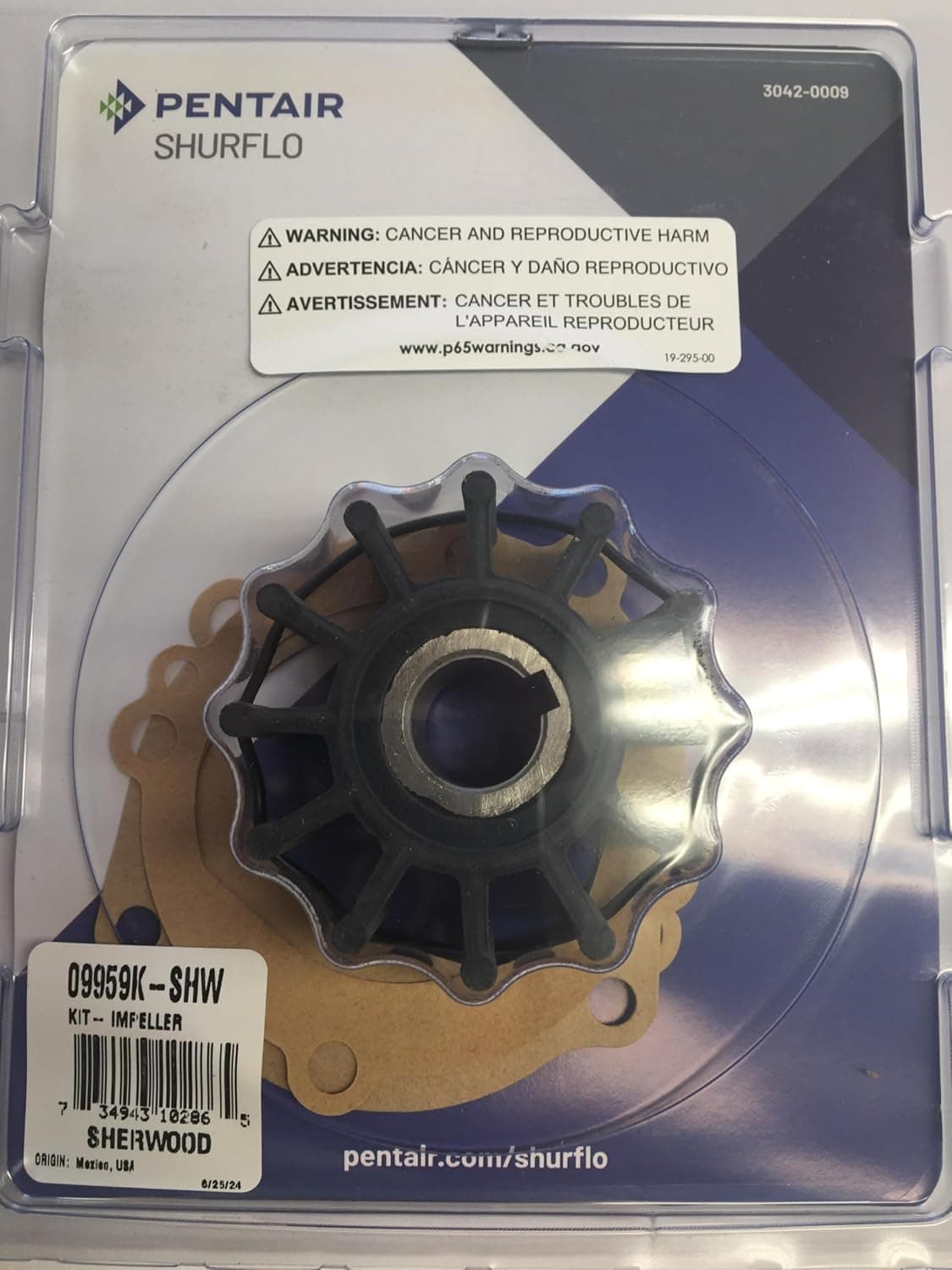
| Sherwood kit 09959K | Neoprene | 12 | 2 7/16 x 1 1/4 in | 5/8 in, 3/16 in keyway |
| Sherwood kit 09000K | Neoprene | 12 | 2 7/16 x 7/8 in | 5/8 in, 3/16 in keyway |
Makers publish cross-references, as their own claims. Jabsco's table lists Johnson 09-1027B, Volvo 860203, Westerbeke & Universal 302571 and Yanmar 129470-42530, among others, against its 1210-0001, and Johnson Pump lists its F5 kit 09-1027B-1 as replacing the 1210-0001. Pentair lists the Sherwood G9903 pump as active with impeller kit 09959K; identify a Sherwood pump by its Sherwood model, not by an engine part number. Check any substitute against the pump housing.[16][25][21][24]
Neoprene or nitrile
Jabsco's 2009 catalogue recommends neoprene impellers for engine cooling and for fresh or salt water transfer, and nitrile for bilge pumping and heavily contaminated water, such as water with oil or diesel; it says neoprene suits only small amounts of oil or diesel.[13]
How often to replace it
| Replace or inspect | |
|---|---|
| Jabsco (2009 catalogue) | Replace at least once a year, or sooner depending on engine duty |
| Johnson Pump (2019 guide) | Replace every year |
| Sherwood (G Series 9959 guide, 2005) | Every year for light-duty pleasure boating; every 6 months for severe pleasure duty (high RPM, silt or sand) and heavy-duty commercial or fishing use; every 3 months for severe commercial or fishing duty |
| Mercury (15/20 EFI manual, 2019; 150 FourStroke manual) | Replace every 300 hours or three years, more often if overheating occurs or water pressure is low |
| Yamaha | Inspect the impeller and pump every year as a general rule, and check the outboard's owner's manual |
Jabsco's 2009 catalogue says a correctly installed impeller may last several years, but advises a preventive schedule rather than waiting for failure. Johnson Pump calls the flexible impeller a wear part that, over time, loses its ability to hold the pressure needed for cooling-water flow. Yamaha's 100-hour service kits for its 115 to 300 hp outboards, designed for use every 100 hours or each year, include a water pump impeller.[13][24][30]
Running it dry
Westerbeke says its raw water pump must never be run dry, because the water lubricates the impeller, and Yamaha says that without water the friction of the rubber on stainless steel quickly overheats and destroys it. Mercury's 15/20 EFI FourStroke manual warns that without sufficient cooling water the engine, the water pump and other components will overheat and suffer damage.[26][29][27]
Jabsco's pump sheets give not more than 30 seconds dry for its 5850-0001, 3890-9011 (data sheet Rev B, 2013) and 18840-series (2001 sheet) pumps, archive documents whose current status we did not check, and its 2009 catalogue's troubleshooting guide says not more than 20 seconds without liquid. That guide lists dry running as a cause of hard, polished or carbon-like cracked impeller end faces and of missing blades.[17][18][19][13]
Changing an impeller
The makers name different lubricants. Jabsco says to always grease new impellers, to ease fitting and protect the impeller on its first prime; Johnson Pump says to use soap or its own lubricant on the shaft, pump body and end cover, and its kit guide says to use its Original Impeller Lube with its MC97 impellers because many rubber compounds are sensitive to petroleum products; Westerbeke's generator procedure says to lightly coat the inside of the pump housing with glycerine.[13][23][24][26]
They differ on tools, and each gives its own direction instruction for its own pump. Jabsco says to pull the impeller with its removal tool or channel-lock pliers on the hub, not screwdrivers, which can damage the pump body face and cause leaks; Westerbeke's generator procedure removes the pump cover and gasket with two screwdrivers or pliers. Johnson Pump says to mount the impeller with a pushing and twisting movement in the rotating direction, and Jabsco says to fit its 18840-series impeller with the blades bent to match the normal rotation of the engine and pump.[13][26][23][19]
Jabsco warns that a thicker or thinner gasket than specified may damage the impeller; its 5850-0001 pump's service kit 90033-0001 contains both the 1210-0001 impeller and gasket 3298-0000. Sherwood's guide lists its 09959K kit as one impeller, one O-ring and one gasket.[17][22]
Westerbeke says to check the base of each blade by bending it vigorously and to replace the impeller if there are any cracks, and that broken-off vanes must be found to prevent a blockage in the cooling circuit, and can often be found in the heat exchanger; Jabsco says that for cracked or missing blades with reduced flow, replace the impeller and check the discharge plumbing for impeller pieces. Jabsco says an impeller can take a permanent set from long-term storage in the pump, and advises removing it for long-term storage; Yamaha says time without use can lead to an impeller taking a set or becoming permanently deformed.[26][13][29]
Jabsco says to carry spare impellers aboard and calls the impeller one of the most vital components of the engine cooling system; Westerbeke says a spare impeller and impeller cover gasket should always be aboard.[13][26]
Raw-water strainers
Basket strainer
Perko's Fig. 0493 has a 316 stainless steel basket with .079 in holes and 47% open area, four outside tie rods and a bottom drain plug for removing sediment and draining for winterizing. Groco's ARG series has a C84400 bronze head and a one-piece molded sight glass that eliminates tie rods and gaskets, with baskets in #304 stainless steel (standard), Monel or non-metallic.[34][31]
Each maker states its own measure of open area, so they do not compare: Perko gives its 1-1/4 in 0493007PLB a 13:1 open-area-to-pipe-size ratio, and Groco lists its 1-1/4 in NPT ARG-1250 at an open area ratio of 24, which it does not define. Perko lists the 0493 as Marine UL Listed 858E, and Groco states its ARG series is UL Listed 255-D, both as the maker's own statements.[34][31]
The makers disagree on where to mount one. Groco's installation sheet recommends its ARG strainer vertically and above the waterline, while its info sheet says strainers are usually installed below the waterline and its strainers may go in either location; Vetus's older model 330 sheet says always above the waterline, against a vertical bulkhead, and its 2022 manual says above the waterline or, if that is not possible, only the 330M or 330MU versions; Westerbeke's generator manual says at or below the waterline, so that it is always self-priming.[33][32][37][38][26]
Perko says its strainers give full flow without restricting the pipe size, that reducers may cause engine damage and are not recommended, and to consult the engine manual for pipe size and strainer location. Vetus warns that an improperly sealed lid lets the sea water pump suck in air, which can overheat the engine, and says always to install a sea-cock on the water inlet scoop.[35][37][38]
Groco and Perko give no cleaning interval. Groco says to inspect and clean the basket frequently, and to clean the sight glass with mild soapy water, not chemical cleaners; Perko says periodic inspection and removal of foreign matter is essential, with the interval depending on use and local conditions; Westerbeke says to look at the strainer at each periodic engine check, where the water in the glass should be clear, and its manual also lists cleaning the strainer filter among maintenance due after a set number of operating hours.[33][36][26]
Fuel filters and water separators
Turbine
Racor's 500MA10 is a single 500 Marine Turbine assembly, 98% at 10 micron and 60 gph, with a clear engineering plastic bowl and a stainless steel shield. Parker lists its marine Turbine Series for diesel and biodiesel engines; the sheet does not mention gasoline.[41]
A micron rating means little without its efficiency. Racor rates its 10 and 30 micron elements at their own sizes, but labels its finest '2' micron and rates it at 98% efficiency at 4 microns. Racor's 900MA/1000MA instructions (Rev B, March 2013) say the finer the filtration, the more often the filter must be changed, and their diagram puts a 30-micron filter first on the suction side, or a 2 or 10 micron if it is the only filter. Racor's Marine Spin-on Series datasheet says its gasoline filters are available first fit with a 10-micron element only.[40][43]
Racor's Marine Spin-on Series datasheet adds notes for gasoline: gasoline filters used in an enclosed location should use a metal bowl, its engineered plastic bowls are only available for gasoline outboard applications, clear bowls should be inspected often for damage, deformation and discoloration, and heaters and water probes must not be used in gasoline systems. The same datasheet says its metal-bowl units for inboard-powered boats meet 33 CFR and USCG regulations, a statement of its own that names no section or test.[40][39]
For its 900MA and 1000MA turbines, Racor says to inspect or drain the collection bowl daily or as necessary, before contaminants reach the bottom of the turbine, not to leave the drain open too long, and to install the filter on the suction side of the fuel transfer pump, since pumps emulsify water. Parker's 500MA10 data sheet says Turbine Series marine filter assemblies should be installed on the vacuum side of the fuel transfer pump for optimal performance. Mercury's 15/20 EFI FourStroke manual says to check the filter for water or sediment and, if there is water in the fuel, drain the filter into a suitable container, with a red ring in the filter floating at the water level.[43][41][27]
Change intervals are per model. Racor's 900MA/1000MA instructions (Rev B, March 2013) say to replace the filter every 500 hours, every other oil change, when an optional vacuum gauge reads 7 to 10 inHg, if power loss is noticed, or annually, whichever comes first. Mercury says to check the water-separating filter on its 15/20 EFI FourStroke every 100 hours or yearly, replacing it if required. Westerbeke's generator schedule (2008 manual) changes the engine fuel filter first at 50 hours, then every 250, and the fuel/water separator every 200 hours or each season.[43][27][26]
Mercury's 15/20 EFI FourStroke manual says to stop the engine and disconnect the battery before servicing any part of the fuel system. Racor's 900MA/1000MA instructions (Rev B, March 2013) say external fuel leaks are dangerous, a fire hazard, and must be corrected immediately; to fill the filter with clean fuel after a change and tighten the lid and T-handle by hand only; and to always carry spare filters, because one tankful of badly contaminated fuel can plug a filter.[27][43]
The federal fuel-system rules
33 CFR 183 subpart J applies to boats with gasoline engines other than outboards, used for electrical generation, mechanical power or propulsion; a boat with only diesel or only outboard engines is outside it. It is a rule on boat builders: the boat manufacturer certifies the boat, and the 2021 Boat Builder's Handbook, produced under a Coast Guard grant, says component makers are not themselves required to certify. The rule's 'fuel system' includes strainers and filters.[2][10][3]
On covered boats, a fuel filter or strainer must be supported on the engine or boat structure independent of its fuel line connections, unless it is inside a fuel tank; every fuel system fitting, joint and connection must be reachable without removing permanent boat structure; the system must have no fitting for draining fuel; and a plug used to service a filter or strainer must have a tapered pipe thread or be a screw type with a locking device other than a split lock washer. Under subpart I, a battery must not sit directly above or below a fuel filter.[7][5][6][1]
If tested under 183.590, a fuel filter and strainer as installed must not leak more than five ounces of fuel in 2 1/2 minutes, a limit that counts leaks from the fuel pump and fuel line too. The test exposes the part to free-burning heptane for 2 1/2 minutes, in a fire chamber, where the temperature within one inch must reach at least 648 °C, or as installed on the engine. The 2021 handbook says no CFR requirement makes these tests mandatory, though the Coast Guard may direct specific tests for specific components, and reads the limit as failing only external leakage over five ounces.[4][8][10]
The Coast Guard's Boating Safety Circular 83 says it keeps no files on associated equipment known to comply with the regulations. EPA's evaporative rules (40 CFR 1060.1) apply to the fuel lines, fuel tanks, couplings and fittings, and fuel caps of new engines and equipment fueled with gasoline; fuel filters are not among the parts listed, and the rules do not apply to diesel-fueled engines. ABYC H-24's 2007 edition, which calls itself a guide, notes that filters, separators and strainers meeting ANSI/UL 1105 comply with its filter requirements; a 2025 revision exists, which we did not read.[11][9][12]
The impellers, strainer and filters we list
| Racor 320R-RAC-02 | Racor 500MA10 | |
|---|---|---|
| Fuel | Gasoline | Diesel and biodiesel |
| Rating | 98% at 10 micron, 60 gph | 98% at 10 micron, 60 gph |
| Bowl | Aluminum | Clear engineering plastic, stainless steel shield |
| Elements listed | S3227, S3228TUL (10 micron); S3228SUL (labelled 2 micron, rated 98% at 4 microns) | 2010TM-OR (10 micron); 2010SM-OR (labelled 2 micron, rated 98% at 4 microns); 2010PM-OR (30 micron) |
| Also | 1/4 in-18 NPTF ports; datasheet lists UL certification: Yes | Vacuum installation recommended; 15 psi maximum |
Parker's sheet does not say which of the 320R-RAC-02's three listed elements keeps its UL certification, so ask Racor before choosing a spare. The impellers and strainer are described above.[40]
 Sherwood · Engine Parts
Sherwood 09959K Impeller Kit
Pentair lists the 09959K as the impeller kit for the Sherwood G9903 pump, and the impeller as neoprene, 12 vanes, 2 7/16 in in diameter and 1 1/4 in wide, on a 5/8 in shaft with a 3/16 in keyway. The listing's part number is 09959K-SHW. Sherwood's 2005 G Series 9959 guide lists the kit as one impeller, one O-ring and one gasket, and schedules a new kit every year for light-duty pleasure boating and every 6 months for severe pleasure duty (high RPM, silt or sand), with 6 or 3 months for commercial or fishing use. Identify your pump by its Sherwood model number.
View on Amazonpaid link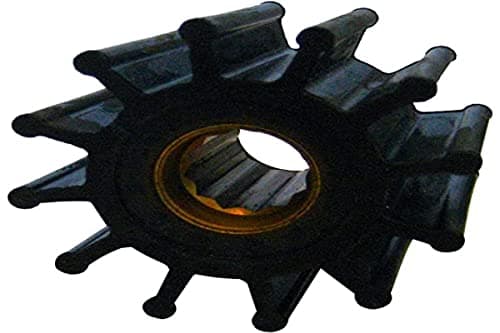 Jabsco · Engine Parts
Jabsco 1210-0001 Neoprene Impeller
Jabsco lists the 1210-0001 as neoprene, 12 blades, 2-1/4 in in diameter and 1-1/4 in deep, on a 5/8 in shaft with a brass insert, and its cross-reference table lists Volvo, Yanmar, Westerbeke & Universal and Johnson numbers against it. The listing's part number is 1210-0001-P. Jabsco says the impeller part number is on the data sheet supplied with the pump, and its 2009 catalogue advises replacing impellers at least once a year, or sooner depending on engine duty.
View on Amazonpaid link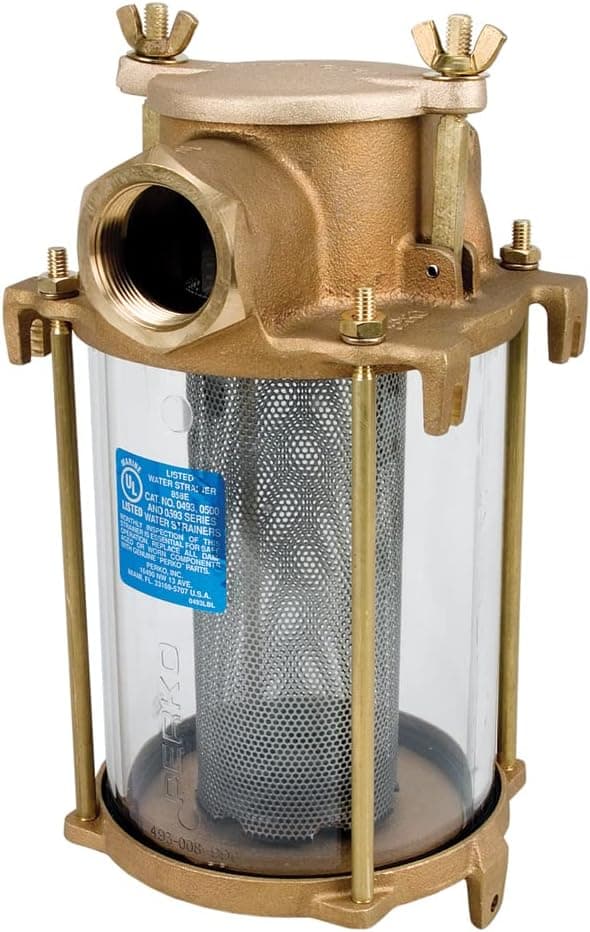 Perko · Plumbing & Pumps
Perko Fig. 0493 Intake Water Strainer, 1-1/4 in
Perko's 1-1/4 in intake strainer, 0493007PLB, is 10 in tall and 5-1/2 in wide, with a 13:1 open-area-to-pipe-size ratio. Perko's page for the Fig. 0493 series gives a 316 stainless basket with .079 in holes and 47% open area, four outside tie rods and a bottom drain plug for sediment and winterizing, and lists 'Marine UL Listed: 858E Strainer' without showing which sizes that covers. Perko says reducers may cause engine damage and to consult the engine manual for pipe size and strainer location.
View on Amazonpaid link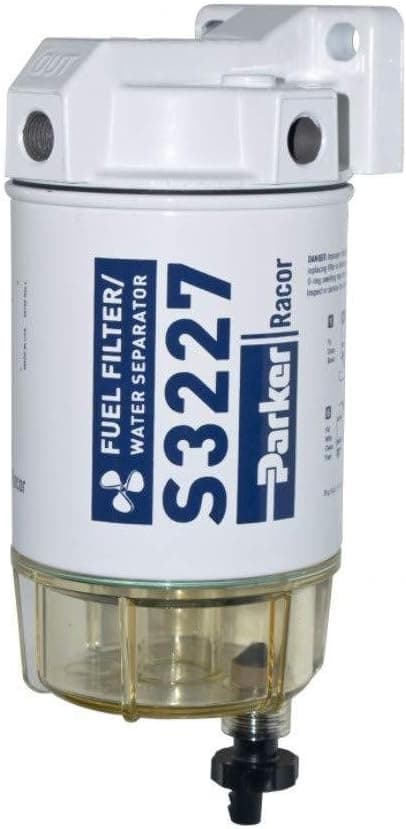 Racor · Engine Parts
Racor 320R-RAC-02 Spin-On Fuel Filter/Water Separator, Aluminum Bowl
Racor's spin-on gasoline filter/water separator with an aluminum bowl: 98% at 10 micron, 60 gph and 1/4 in-18 NPTF ports, with UL certification, which the plastic-bowl 320R-RAC-01 lacks. Racor says gasoline filters in an enclosed location should use a metal bowl, and that heaters and water probes must not be used in gasoline systems. Parker's datasheet lists three compatible elements, S3227 and S3228TUL (10 micron) and S3228SUL (2 micron), without saying which keeps the UL certification, so ask Racor before choosing a spare.
View on Amazonpaid link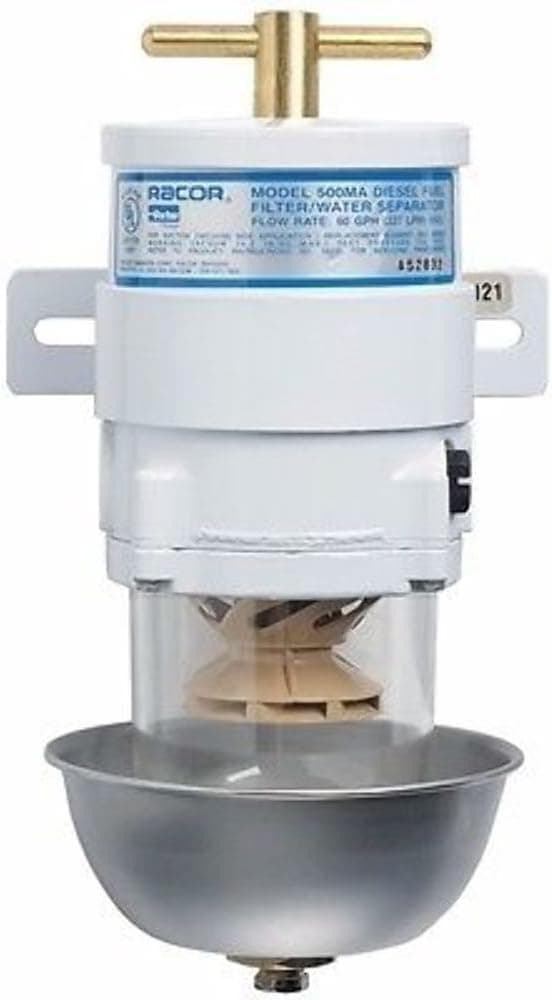 Racor · Engine Parts
Racor 500MA10 Turbine Fuel Filter/Water Separator
Racor's single 500 Marine Turbine assembly for diesel and biodiesel engines: 98% at 10 micron, 60 gph, with a clear engineering plastic bowl in a stainless steel shield. Racor's specification sheet lists 15 psi maximum, recommends vacuum installation, and lists replacement elements 2010SM-OR (2 micron), 2010TM-OR (10 micron) and 2010PM-OR (30 micron); Parker's 500MA10 datasheet rates its "2" micron elements at 98% at 4 microns.
View on Amazonpaid link
What this guide leaves out
Outboard water pump kits by model, whose makers' pages we could not read; engine makers' inboard service schedules beyond those named; impeller temperature ratings, lifespans and pump flow figures; diesel fuel-system rules for private boats, which we found none of; whether a filter-bowl water drain is allowed under subpart J; and any filter's fire-test result. Go by your engine maker's schedule and the pump or filter maker's documents.
Sources
- 1.33 CFR 183.420 — Batteries (eCFR)
- 2.33 CFR 183.501 — Fuel systems: applicability (eCFR)
- 3.33 CFR 183.505 — Fuel systems: definitions (eCFR)
- 4.33 CFR 183.534 — Fuel filters and strainers (eCFR)
- 5.33 CFR 183.554 — Fittings, joints and connections (eCFR)
- 6.33 CFR 183.556 — Plugs and fittings (eCFR)
- 7.33 CFR 183.570 — Fuel filters and strainers: mounting (eCFR)
- 8.33 CFR 183.590 — Fire test (eCFR)
- 9.40 CFR 1060.1 — EPA evaporative emission rules: applicability (eCFR)
- 10.Boat Builder's Handbook, fuel systems (33 CFR 183 subpart J), 2021, produced under a US Coast Guard grant
- 11.US Coast Guard — Boating Safety Circular 83, September 2003
- 12.ABYC H-24, Gasoline fuel systems, 2007 edition (as incorporated by reference)
- 13.Jabsco — Impeller guide and troubleshooting, 2009 catalogue (copy hosted by Defender)
- 14.Jabsco (Xylem) — Replacement impeller guide
- 15.Jabsco (Xylem) — Impeller selection table, r3
- 16.Jabsco (Xylem) — Impeller cross-reference table, r2
- 17.Jabsco (Xylem) — 5850 flexible impeller engine cooling pump manual
- 18.Jabsco (Xylem) — 3890 flexible impeller engine cooling pump data sheet
- 19.Jabsco (Xylem) — 18840 flexible impeller engine cooling pump data sheet
- 20.Pentair — Sherwood rubber impellers
- 21.Pentair — Sherwood G9903 pump
- 22.Sherwood — G Series 9959 technical guide (L-3047, 7/05)
- 23.Johnson Pump (SPX FLOW) — Marine impeller guide, IB-506 R03, 11/2019
- 24.Johnson Pump — Impeller kit guide (copy hosted by Defender)
- 25.Johnson Pump (SPX FLOW) — Original impeller kits
- 26.Westerbeke — 8.0-15.0 EDT generator operator's manual (53060 Rev 3)
- 27.Mercury — 15/20 EFI FourStroke owner's manual (8M0165094)
- 28.Mercury — 150 FourStroke owner's manual (8M0105247)
- 29.Yamaha Outboards — Maintenance matters: additional tasks
- 30.Yamaha Outboards — 100-hour kits with component breakdown
- 31.Groco — ARG series raw water strainers
- 32.Groco — ARG series info sheet (200603)
- 33.Groco — ARG strainer installation instructions (copy hosted by Defender)
- 34.Perko — Intake water strainer (Fig. 0493)
- 35.Perko — Fig. 493 and 500 strainer instructions (03/09)
- 36.Perko — Strainer installation sheet (copy hosted by 180 Sails)
- 37.Vetus — Cooling water strainer 330 installation (copy hosted by Defender)
- 38.Vetus — FTR330 installation manual, 2022
- 39.Racor (Parker) — Marine spin-on series data sheet (hosted by RS)
- 40.Racor (Parker) — 320R-RAC-02 data sheet (hosted by RS)
- 41.Racor (Parker) — 500MA10 data sheet (hosted by RS)
- 42.Racor (Parker) — 500MA/500MAM specifications, RSL0289 Rev E (copy hosted by Defender)
- 43.Racor (Parker) — 900MA/1000MA marine turbine instructions (copy hosted by Glasgow Engineering)