
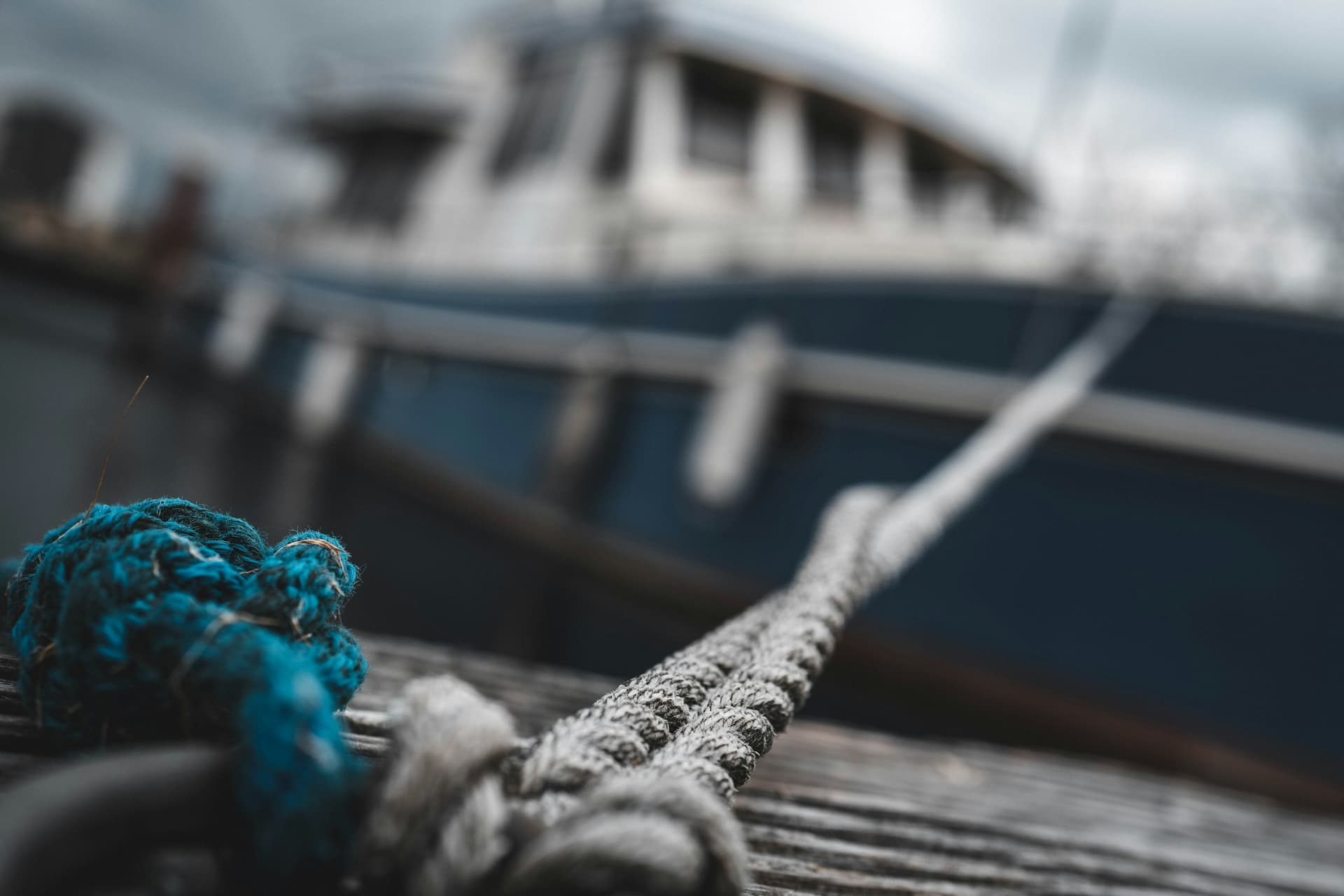
Photo: Bruno Mira on Unsplash
Fenders and dock lines, explained
Fenders keep a hull off the dock, and dock lines keep the boat where you left it. This guide covers fender shapes, how many to carry and what size, hanging and inflating them, nylon and polyester, three-strand and double braid, line sizes and lengths, what a maker's strength figure does and does not tell you, the lines a boat needs and how to make them fast, chafe, snubbers, storms and caring for line. Where the makers disagree, the guide says so and gives each one's figure. Every factual statement links to the source it came from.
This guide links to products on Amazon. If you buy through those links we may earn a commission, at no extra cost to you. Each one is marked “paid link”. More in our affiliate disclosure.
Published October 26, 2026
Cylindrical, round or flat
Cylindrical
Taylor Made calls its inflatable fender the typical cylindrical fender, suited to boating from small recreational vessels to larger yachts. Polyform's F-Series is a twin-eye design for vertical or horizontal use, and Polyform designs it for permanent unprotected moorings, pilings, locks and concrete walls.[16][10]
Flat
Taylor Made says flat fenders distribute impact over a larger surface than round fenders, reduce rolling, fit in tight spaces and store easily.[16]
How many, and what size
Polyform says to use at least three fenders when docking: one aft, one at maximum beam and one forward. Taylor Made's rule of thumb is one fender for every 10 ft of waterline per side, with a minimum of three even for the smallest boats; its page does not say whether the three is per side.[7][16]
For rafting up, Polyform says to position three standard fenders fairly close to maximum beam and two round A Series or LD Series buoys fore and aft, for more protection from boats tossing into each other.[7]
Polyform and Taylor Made each size by boat length, on their own charts. Polyform lists its F-3 under both its 20-25 ft and 25-30 ft rows, and for 30-35 ft boats lists F-4, F-5, G-5, HTM-3 and NF-5 fenders or A-2 and LD-2 buoys. Taylor Made lists its 8-1/2 x 26 in Super Gard and its 8-1/2 x 27 in Storm Gard for 25 to 35 ft boats.[7][17][18]
Taylor Made, Polyform and Dan-Fender each hedge their charts. Taylor Made calls its boat size chart the minimum recommendation and advises asking your marina and docking neighbors about prevailing conditions. Polyform says its guide is a general guide, that boat and mooring conditions must be considered, and that final responsibility rests with the consumer. Dan-Fender says its sizes are guidelines only, and that individual needs might change with boat design and local mooring conditions.[17][7][25]
The Coast Guard's Boat Crew Handbook, written for its own crews rather than as a rule for recreational boaters, tells the coxswain never to fend a boat off a pier or float by hand or foot but always to use a fender, and to keep properly sized fenders at hand. Oregon's State Marine Board likewise says not to use bodies to stop the boat: slow down and use fenders.[1][3]
Hanging fenders
Polyform says to tie fenders to something solid and hang them close to the surface of the water, because a fender tied high can swing in a wide arc and end up on top of the dock. Taylor Made says fender adjusters let you change a fender's height quickly so it sits at the right level to protect the hull, and that its Big B, with a center rope tube that takes a line end to end, is useful hung horizontally against pilings and where the tide changes.[7][16][19]
Polyform's rule of thumb is to use the largest diameter line you can: too small a line can cut through a vinyl eye, and too small a line voids Polyform's warranty. It recommends a single line of at least 3/8 in for its smaller fenders, and its chart gives 3/8 in line, doubled or looped, for its smaller F-Series fenders such as the F-3, and 1/2 in for the F-6, F-7, F-8, F-10 and the A-1, which have a 1 in eye. Taylor Made says its Super Gard's eye takes rope up to 5/8 in.[8][7][17]
Polyform recommends a splice or a bowline for the loop in a fender line, and says two half hitches or a clove hitch are common when tying to the boat or dock, or a looped connection or a cleat hitch at a cleat. It prefers nylon rope for fender lines for its stretch, calling it a little more forgiving and softer, with less friction.[8][7]
A fender cover fits the models its maker names. Polyform's chart gives the EFC-03 for the F-3, the EFC-3 for the HTM-3 and the EFC-A1 for the A-1; Taylor Made lists its 9205N (navy) and 9205R (black) for its Hull-Gard 8-1/2 x 27 in, Super Gard 8-1/2 x 26 in and Big B 8 x 20 in. Taylor Made's covers are polyester knit, washable in cold water with mild detergent.[12][20]
Inflating fenders
Polyform and Taylor Made each give a figure, and Dan-Fender gives no pressure at all. Polyform says to inflate its fenders and buoys to 2.1 lb (0.15 bar), check that a wall still depresses at least 1/4 in under light hand pressure, and, with a compressor, set the gauge at 2 PSI and go no further. Taylor Made lists a recommended 2 PSI on its Super Gard and Storm Gard pages. Dan-Fender says not to over-inflate, and that the fender should stay easy to dent with a finger.[9][17][18][26]
Two makers say over-inflating voids the warranty. Polyform says it reduces performance, may cause premature failure and voids the warranty; Dan-Fender says its listed diameters are maximums and that over-inflation weakens the fender, shortens its life and voids the warranty.[9][26]
Nylon or polyester
The rope makers disagree. Samson calls nylon the right fiber for dock and anchor lines, because its elastic elongation helps smooth out the surge of wakes, waves, wind or heavy seas. New England Ropes says nylon has high breaking strength and high elongation and is still widely used for mooring ropes, but has comparatively lower UV resistance than polyester, which is increasingly replacing it.[36][31]
Marlow takes the other side. It says nylon absorbs shock loads but degrades under UV exposure, with reduced strength over time, while polyester has lower stretch, for which it suggests mooring shock absorbers, and is the most reliable material for mooring lines. A National Hurricane Center forecaster's storm-preparation paper says polyester or Dacron lines stretch much less than nylon but are significantly more chafe-resistant.[39][2]
Nylon changes when wet. Marlow says the fiber shrinks, its strength drops by up to 15 percent and its extension increases, and that the shrinking tightens the strands, making a harder, stiffer rope that may creak. The Coast Guard handbook's fiber table lists nylon's wet strength at 85 to 90 percent of dry and polyester's at 100 percent, and rates resistance to UV in sunlight as Good for nylon and Excellent for polyester.[41][39][1]
How far nylon stretches depends on who measured it and under what load. Marlow gives about 20 percent for its three-strand nylon at half its break load, against 12 percent for polyester at equivalent loads; the Coast Guard handbook's table gives elongation at break of 15 to 28 percent for nylon and 12 to 15 percent for polyester; the NHC paper says five to ten percent, with no load stated.[42][1][2]
Three-strand or double braid
New England Ropes says its double braid dock lines stretch slightly less but are stronger than its three-strand lines. Samson publishes elastic elongation for two of its nylon dock lines, below: its three-strand Pro-Set-3 stretches roughly 1.8 to 1.9 times as much as its double braid HarborMaster at each load.[27][33][34]
| At 10% | At 20% | At 30% | |
|---|---|---|---|
| HarborMaster (nylon double braid) | 3.00% | 5.30% | 6.70% |
| Pro-Set-3 (three-strand nylon) | 5.50% | 10.00% | 12.10% |
A double braid is a cover over a core. New England Ropes says that where the cover moves over winches, cleats and other hardware it can rub the core and cause damage not visible from outside. Samson says the load in a double braid is shared equally between core and cover, so cut strands, significant abrasion or other significant damage mean the rope must be retired.[31][37]
These makers' packaged dock lines come with the eye already spliced. New England Ropes hand splices its packaged three-strand lines with five tucks, a 12 in eye and a whipped bitter end; Polyform's dock line has a 12 in hand-spliced eye; Samson's HarborMaster has a 12 in eye on 3/8 to 5/8 in lines and an 18 in eye on 3/4 in. Samson says an eye's length should be at least three times the diameter of the object it goes over, a cleat among its examples. Marlow says that wherever possible the angle at the throat of a loaded splice should be 30 degrees or less, which it translates to a flat eye length of at least 2.7 times the diameter.[27][13][33][37][40]
What size, and how long
Taylor Made pairs 3/8 in line with boats up to 25 ft and 1/2 in line with boats up to 32 ft, and says to choose the next bigger diameter in a windy area or rough water. Samson says to upgrade one size and double the chafe protection for storm conditions.[21][33]
| Bow and stern lines | Spring lines | |
|---|---|---|
| Taylor Made | Two-thirds the length of the boat | As long as the boat |
| Marlow | At least half the length of the boat, ideally longer | The boat's entire length or longer |
| Samson (custom lines) | Bow 1-1/2 x beam; stern 1-1/2 to 2 x beam | 3/4 x length overall |
Samson's selection guide also pairs boat size with a dock line length: 10 ft lines for 15 to 25 ft boats, 15 ft for 26 to 30 ft, 20 ft for 31 to 35 ft, 25 ft for 36 to 40 ft, 30 ft for 41 to 50 ft and 35 ft for 51 to 60 ft.[36]
Strength figures, and what they leave out
Each maker labels its figure differently, so they do not compare. Samson gives its HarborMaster double braid's strengths as approximate averages of new rope: 4,900 lb at 3/8 in, 8,200 lb at 1/2 in, 13,500 lb at 5/8 in and 22,200 lb at 3/4 in. New England Ropes heads its column 'Tensile' and calls its data typical values without warranty or guarantee: 7,500 lb for its 1/2 in three-strand dock line. Taylor Made prints a tensile strength of 4,450 lb for its 3/8 in double braid and 7,850 lb for its 1/2 in, without saying whether that is an average or a minimum.[33][27][21]
An average and a minimum for the same rope are different numbers. Marlow says its minimum break load is calculated in line with Cordage Institute standard 1500, two standard deviations below the average; Samson's Stable Braid Black, a double braid listed under its mooring ropes, for one, reads 10,400 lb average and 8,800 lb minimum at 1/2 in. New England Ropes says the black version of its packaged dock lines has approximately 5 percent less tensile strength than the white.[40][35][27]
Knots cost strength. Samson says some knots can cost up to 50 percent, varying with construction and fiber, and Marlow up to 60 percent. Splices cost less: Samson says a splice in most cases maintains 100 percent of the specified strength, Marlow that a good splice made by its recommended method should cost no more than 10 percent, and the Coast Guard handbook that a splice is stronger than a knot. New England Ropes says its catalogue breaking loads were measured on free lengths of rope and are decreased by splices or knots.[37][40][41][1][30]
The rope makers' working-load advice is general, not written for dock lines. Samson recommends a minimum 5:1 safety factor in normal conditions, a working load of about 20 percent of the quoted spliced breaking strength, and a higher factor for shock loads, long-term loads and wherever life, limb or valuable property are involved. New England Ropes says the recommended working load is at most 20 percent of the breaking load. Marlow says it does not normally recommend a working load limit, because it often does not know the application.[37][30][40]
The lines a boat needs, and making them fast
Bow and stern lines
The Coast Guard Boat Crew Handbook says the bow line and stern line are used to keep the vessel secured to the dock.[1]
Spring lines
The forward and aft springs keep the vessel from surging forward or aft at the dock, the handbook says.[1]
Breast lines
The handbook defines a breast line as a mooring line run laterally from a vessel to a pier or float, as distinguished from a spring line. It says the four lines above are normally all that is needed, and breast lines may be added in foul weather for extra holding strength.[1]
Two state boating guides add related advice. Pennsylvania's handbook says to have fenders, mooring lines, a boat hook and a heaving line ready when docking, and after docking to secure a line from the dock to the bow. Oregon's State Marine Board advises carrying two or three extra dock lines in case of unusual dockside conditions. New England Ropes' double braid dock line bucket holds two 15 ft and two 25 ft lines, which it describes as a fore and aft line and two spring lines.[4][3][28]
The Coast Guard handbook gives a rule of thumb for matching line to cleat: 1/16 in of line diameter for every inch of cleat length, so 3/8 in line for a 6 in cleat and 1/2 in line for an 8 in cleat. The NHC paper says two lines per cleat is usually the maximum, even on a backed-up cleat, and that lines with properly made eye splices are best on cleats.[1][2]
The cleat hitch is described more than one way. The Coast Guard handbook's method is a complete turn around the cleat, a figure eight over the top and around the horn, then two or more additional figure eights. New York State Parks' operator's guide says a turn under each horn, a figure eight over each horn and a half hitch over one horn.[1][5]
Chafe and snubbers
Davis describes chafe as repeated rubbing against other surfaces that, over time, acts like a knife, weakening and cutting a line's fibers. Polyform says always to use chafing gear where mooring lines run through bow chocks or are likely to touch deck hardware. The Coast Guard handbook says chafing gear, which can be old hose, leather or heavy canvas, protects line where it runs over rails, chocks or other surfaces; the NHC paper suggests ready-made protectors or garden hose and says rags are usually unsuitable.[43][15][1][2]
Davis's black Removable Chafe Guard (397) fits braided or twisted line from 3/8 to 1 in, is 16 in long and comes in pairs; Davis's instruction sheet for the white version (395) says to face the seam away from any bend where the line turns around a cleat or roller. Taylor Made's rubber chafe guards slide through chocks, are 14 in long and come in pairs: #96013 for 1/2 to 5/8 in line, #96014 for 3/4 in.[44][45][22]
Davis says a dock line snubber's primary purpose is to absorb shock and prevent sudden jolts or jerks on the line, and that its Shockles must always be used in parallel with a strong rope or line, never bearing a full load alone. Its DockShockle (2415) is designed for dock lines on smaller, lighter boats up to 40 ft, works with line up to 3/4 in, and has an ideal working slack of 3 to 6 in. Polyform says its Snubber Twist ST-1 is designed for boats up to 13,200 lb and lines up to 3/4 in. Taylor Made sells its rubber snubbers by line size only (#307 for 3/8 in, #308 for 5/8 in, #309 for 3/4 in), with no load or boat size.[46][47][14][23]
Tide, storms and snap-back
Oregon's State Marine Board says to consult tide tables when docking, especially in tidally influenced waters. A University of Florida IFAS Extension storm sheet says to attach lines high on pilings to allow for tidal rise or surge and to make sure they cannot slip off.[3][6]
The NHC forecaster's paper says that most boats are damaged by cleats pulling out and lines parting because there was not enough slack for the extreme low water of a negative storm surge, and that lines angle downward in extreme high water and upward in extreme low water, either way putting considerable stress on cleats.[2]
The paper recommends long, double, crisscrossed spring lines fore and aft; new lines as the primary set, with normal dock lines as backups or doubles; and no aged cordage or lines that might have been weakened by invisible ultraviolet or fungicidal degradation. It also suggests polyester from the cleat through the chock, joined by two eyes and five tucks to a nylon line running to the piling or mooring, for polyester's chafe resistance with nylon's stretch.[2]
The Coast Guard handbook warns not to stand directly behind a line under strain, because if it parts it can snap back and cause injury, and, in its section on double-braided nylon, that if nylon line is doubled and put under excessive strain, the deck fittings might fail and the line snap back like a rubber band, bringing the fitting with it. Samson says rapidly applied shock loads can produce peak loads higher than a rope's minimum break strength, and that the force is amplified more on a shorter rope than on a longer one.[1][37]
Care, inspection and retirement
New England Ropes says to wash rope in fresh water before extended storage, because salt and dirt reduce its life span, and to keep its exposure to sunlight to a minimum, since smaller diameters are affected more severely than larger ones. It warns that abrasive particles inside a rope can cause damage not visible from outside that may significantly reduce its strength.[32]
Samson says glossy or glazed areas, inconsistent texture or stiffness can indicate heat, embedded grit or shock loading and a possible loss of strength. In its section on double-braided nylon, the Coast Guard handbook says all eye splices on working lines, mooring lines among them, should be inspected before each use, paying attention to the tucked-back area for flat spots or a slipped core. Oregon's State Marine Board says to look lines over for chafe or wear.[38][1][3]
The makers we read give no replacement interval for dock lines; they point to inspection. Samson says there are no definitive rules or industry guidelines for when to retire a rope, though it lists common abrasion retirement points: 25 percent or more wear for braided rope, 50 percent cover wear for double braid and 10 percent or more for three-strand. Marlow says that for most uses a rope is unlikely to reach 10 years in service before failing an inspection, that in extreme cases one can be damaged in a single use, and that mooring lines are safety-critical: inspect them regularly and replace them promptly when they show deterioration.[37][40][39]
The fenders, line and gear we list
| Polyform F-3 | Polyform A-1 | |
|---|---|---|
| Design | Twin-eye, for vertical or horizontal use | A-Series buoy |
| Size | 8.2 x 30.0 in | 11.0 x 15.0 in |
| Eye | 0.9 in | 1.0 in |
| Volume and weight | 5.4 gal, 5.3 lb | 3.5 gal, 2.4 lb |
| Polyform's boat size | 20-30 ft | 15-30 ft |
| Cover | EFC-03 | EFC-A1 |
The New England Ropes line we list is its 1/2 in x 25 ft nylon double braid dock line. We print no breaking strength for it, because New England Ropes' own tables and flyer give different figures for its double braid lines. Davis's 397 chafe guard and 2415 DockShockle are described above.[27][29]
 Polyform · Deck Hardware
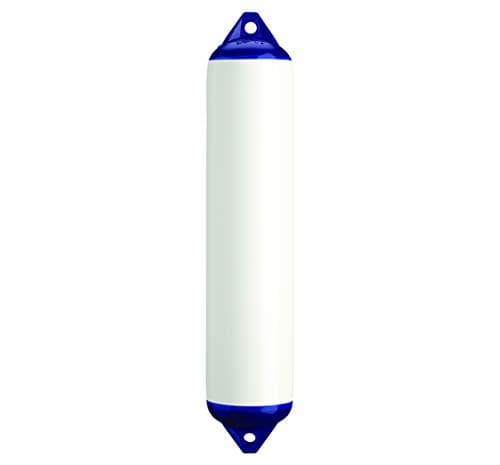
Polyform F-3 Twin-Eye Fender, 8.2 x 30 in, White
A twin-eye fender that Polyform says can hang vertically or horizontally and designs for permanent unprotected moorings, pilings, locks and concrete walls. Polyform gives it as 8.2 x 30.0 in and 5.3 lb, with a 0.9 in eye, for 20 to 30 ft boats. It says to inflate to 2.1 lb (0.15 bar), no more than 2 PSI from a compressor, and to use the largest line the eye takes; its chart gives 3/8 in, doubled or looped. Polyform's cover for it is the EFC-03.
View on Amazonpaid link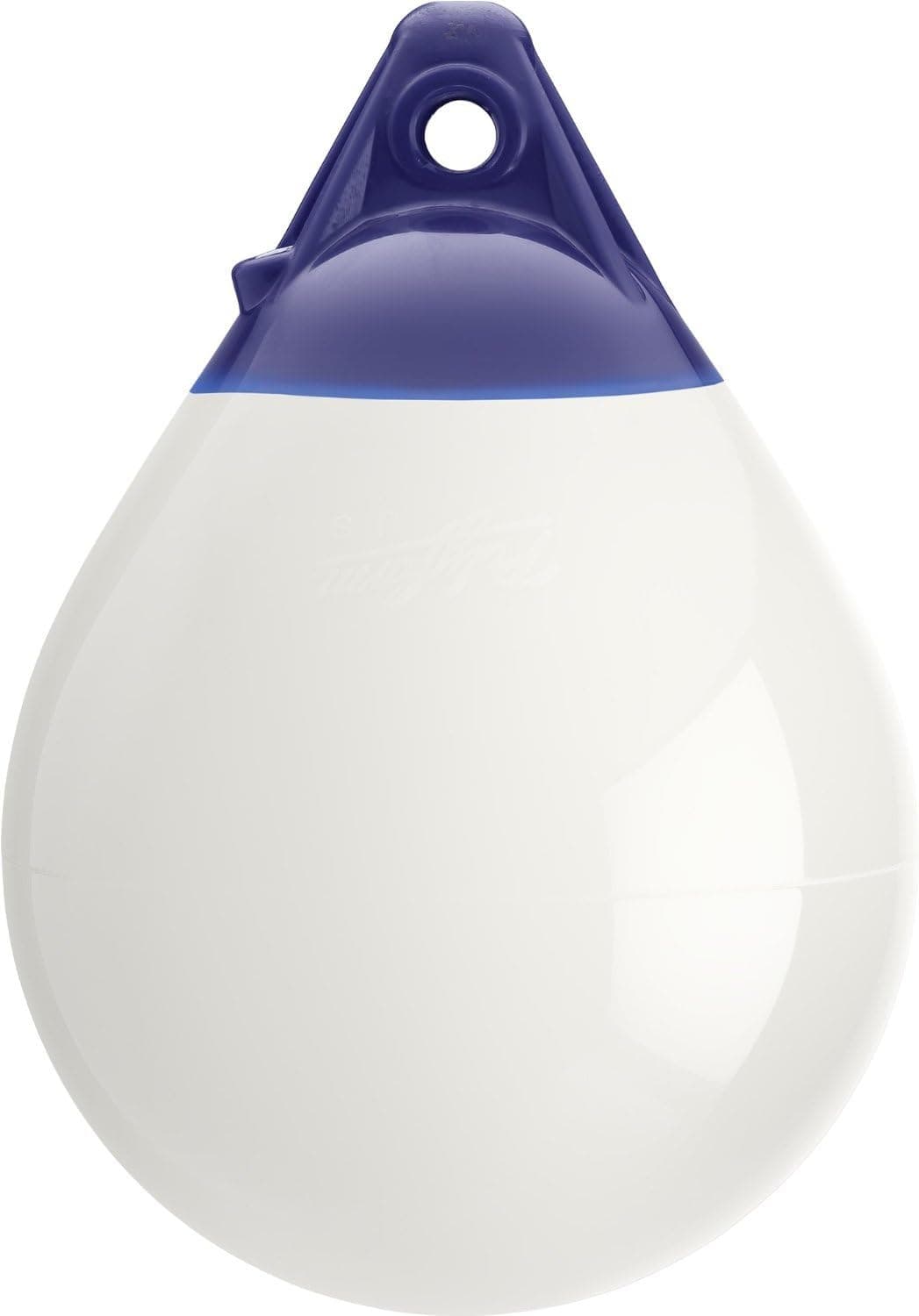 Polyform · Deck Hardware
Polyform A-1 Round Buoy Fender, 11 x 15 in, White
A round Polyform A-Series buoy, which Polyform lists as an excellent choice for a rafting fender. Polyform gives it as 11.0 x 15.0 in and 2.4 lb, with a 1.0 in eye, for 15 to 30 ft boats, and its line chart gives 1/2 in, doubled or looped. For rafting, Polyform suggests two round buoys fore and aft with three standard fenders near maximum beam. Polyform says to inflate to 2.1 lb (0.15 bar), and that over-inflation voids the warranty.
View on Amazonpaid link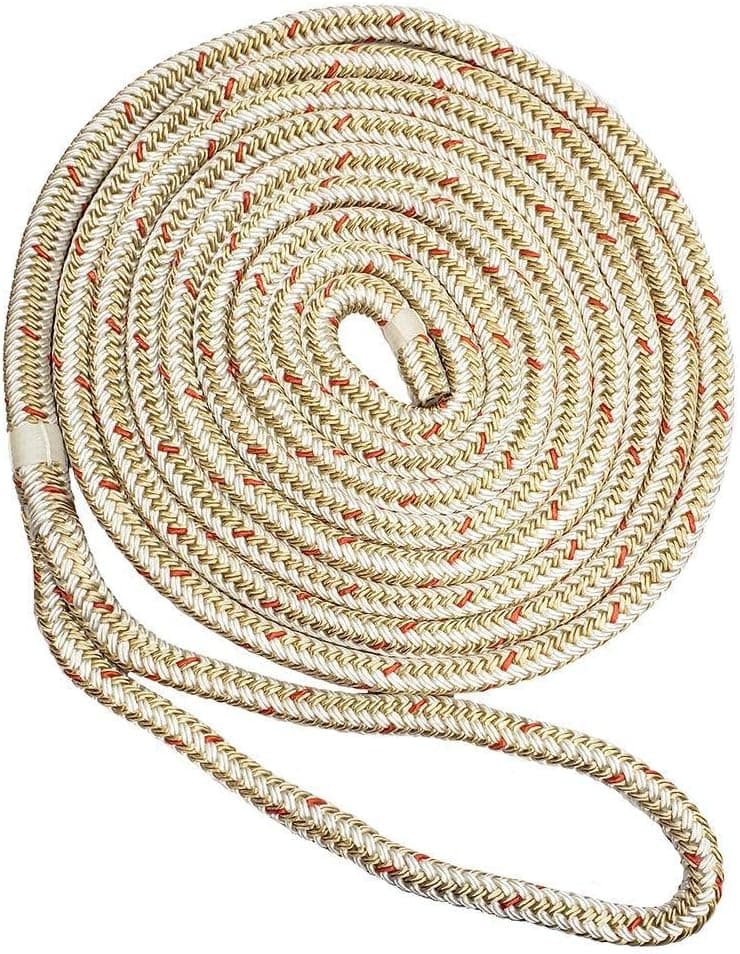 New England Ropes · Lines & Rigging
New England Ropes Nylon Double Braid Dock Line, 1/2 in x 25 ft
A 1/2 in nylon double braid dock line, 25 ft long, white with a gold tracer. New England Ropes says its double braid dock lines stretch slightly less but are stronger than its three-strand lines, and warns that where the cover moves over cleats and other hardware it can rub the core out of sight. Its own tables and flyer give different breaking strengths for its double braid lines, so we print none. Taylor Made pairs its own 1/2 in double braided dock line with boats up to 32 ft, and Samson's dock line chart says to upgrade one size and double the chafe protection for storm conditions.
View on Amazonpaid link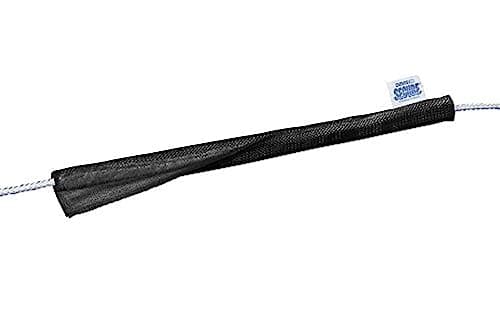 Davis Instruments · Lines & Rigging
Davis Removable Chafe Guard (397), Pair
A pair of 16 in chafe guards, UV-stabilized nylon webbing outside with hook and loop inside, to protect a dock line where it rubs. Davis says they fit braided or twisted line from 3/8 to 1 in, and lists pilings, a dock lip, cleats, a cap rail, crossed lines and an anchor roller among the places chafe happens. Davis describes chafe as repeated rubbing that, over time, acts like a knife on a line's fibers.
View on Amazonpaid link Davis Instruments · Lines & Rigging
Davis DockShockle Dock Line Snubber (2415)
A 12 in snubber that clips onto a dock line to absorb shock loads, which Davis designs for smaller, lighter boats up to 40 ft. Davis gives it 2,500 lb test webbing inside a 3,500 lb test sheath, with two 316 stainless carabiners and two Mini-LineGrabbers for braided or twisted line up to 3/4 in, and an ideal working slack of 3 to 6 in. Davis says to use Shockles in parallel with a strong line and never let one bear the full load alone.
View on Amazonpaid link
What this guide leaves out
Anchors and anchor rode, moorings and mooring pennants; installing cleats and chocks, and their loads, which no source we read rates; a working load for any dock line, since the rope makers' guidance is general; a single stretch figure, or a ranking of lines by stretch; and one-number answers where the makers differ: how many fenders, how hard to inflate them, how long a dock line should be and which fiber is best. Go by the maker's chart for the fender or line you buy.
Sources
- 1.US Coast Guard — Boat Crew Handbook: Seamanship Fundamentals, BCH16114.4 (hosted by the Coast Guard Auxiliary)
- 2.NOAA National Hurricane Center — storm preparation for boats and marinas (a forecaster's paper)
- 3.Oregon State Marine Board — Docking and anchoring
- 4.Pennsylvania Fish & Boat Commission — Pennsylvania boating handbook
- 5.New York State Parks — Public vessel operator's study guide, 2026
- 6.University of Florida IFAS Extension — storm-preparation fact sheet for oyster aquaculture workboats
- 7.Polyform US — Boat fender guide
- 8.Polyform US — Boat fender line guide
- 9.Polyform US — Boat fender and buoy inflation guide
- 10.Polyform US — F-Series boat fender, F-3
- 11.Polyform US — A-Series buoy, A-1
- 12.Polyform US — Elite boat fender covers (EFC)
- 13.Polyform US — 1/2 in dock lines
- 14.Polyform US — Snubber Twist
- 15.Polyform US — Frequently asked questions
- 16.Taylor Made — Boat fender buying guide
- 17.Taylor Made — Super Gard fenders
- 18.Taylor Made — Storm Gard fenders
- 19.Taylor Made — Big B fenders
- 20.Taylor Made — Premium fender covers
- 21.Taylor Made — Dock lines
- 22.Taylor Made — Chafe guards
- 23.Taylor Made — Rubber mooring snubber
- 24.Dan-Fender — Heavy duty balloon fenders
- 25.Dan-Fender — Which fender size fits my boat?
- 26.Dan-Fender — How to inflate
- 27.New England Ropes — Packaged dock lines
- 28.New England Ropes — Nylon double braid dock line bucket
- 29.New England Ropes — Double braid flyer, October 2025
- 30.New England Ropes — Catalogue 2026
- 31.New England Ropes — Product information
- 32.New England Ropes — Line handling and care
- 33.Samson — HarborMaster dock line
- 34.Samson — Pro-Set-3
- 35.Samson — Stable Braid Black
- 36.Samson — Recreational marine line selection guide (2024)
- 37.Samson — Warning statement: safety factors, working loads and retirement
- 38.Samson — Rope care
- 39.Marlow — Securing your vessel: a guide to choosing mooring lines
- 40.Marlow — FAQs
- 41.Marlow — Rope care advice
- 42.Marlow — 3 Strand Nylon
- 43.Davis Instruments — What is dock line chafe?
- 44.Davis Instruments — Removable chafe guard, black (397)
- 45.Davis Instruments — Secure removable chafe guard (395) instruction sheet (copy hosted by Defender)
- 46.Davis Instruments — What are dock line snubbers?
- 47.Davis Instruments — DockShockle (2415) instruction sheet