
Photo: Aaron Mistri on Unsplash
Anchors, chain and rode, explained
An anchor is only one part of the gear: between it and the boat are the rode, any chain, the shackles, and what the rode is made fast to. This guide covers anchor types as their makers describe them, how each maker sizes its anchors, how much rode to let out, nylon line and chain, what chain grades and links mean, matching chain to a windlass, shackles and swivels, setting and weighing anchor, and caring for the gear. Where makers size or rate things differently, the guide gives each maker's own basis rather than one number. Every factual statement links to the source it came from.
This guide links to products on Amazon. If you buy through those links we may earn a commission, at no extra cost to you. Each one is marked “paid link”. More in our affiliate disclosure.
Published October 26, 2026
What the law says
The Coast Guard's guide to the federal requirements for recreational boats says the Coast Guard does not regulate anchors, so no anchor carries Coast Guard approval or certification. The same guide says federal equipment requirements are minimums that do not guarantee the safety of your vessel or its passengers, and that owners may also have to meet laws specific to the state where the boat is registered or operated.[1]
Under Inland Rule 30, a vessel at anchor shows an all-round white light or one ball in the fore part, and an all-round white light at or near the stern at a lower level; a vessel under 50 m may instead show one all-round white light where it can best be seen. A vessel under 7 m need not show the anchor light or shape unless it is in or near a narrow channel, fairway or anchorage, or where other vessels normally navigate.[2]
In or near an area of restricted visibility, Inland Rule 35 has a vessel at anchor ring the bell rapidly for about 5 seconds at intervals of not more than 1 minute. A vessel under 12 m need not give that signal, but must then make some other efficient sound signal at intervals of not more than 2 minutes.[3]
Anchor types, in their makers' words
The four groups below are ours, for finding your way around; the descriptions and the bottoms named are each maker's own claims for its own anchors, not independent test results.
Plough (Lewmar CQR)
Lewmar describes the CQR's classic plough profile as promoting reliable penetration and steady performance across a wide range of seabed types, including sand, mud and clay, and says its articulation helps it reset itself with shifts in wind or tide.[23]
Claw (Lewmar Claw)
Lewmar says its Claw's robust construction ensures dependable performance across multiple seabeds, including sand, mud, rock and coral, and that it fits securely on most bow rollers.[22]
Fluke (Danforth, Fortress)
Danforth says its two large triangular flukes orient toward the seabed at a 32 degree angle for maximum holding in common sea bottoms such as hard sand. Fortress makes its anchors from a hardened aluminum-magnesium alloy and says their 45-degree fluke setting, exclusive to the Fortress series, gives a superior hold in soft mud and silt.[17][15]
Roll-bar, or none (Rocna, Mantus)
Rocna says the roll-bar on its Original makes the anchor arrive at the right angle to penetrate, and that its Vulcan has no roll-bar and a shank designed to fit the bows of a wide range of vessels. Mantus's M1 has a roll bar; Mantus says its M2, without one, fits boats with bow pulpits with slotted anchor housings, and bowsprits, better.[10][11]
Lewmar gives its Delta no type name. It says that whether anchoring in sand, mud or gravel, the Delta delivers immediate penetration and dependable holding, and its Delta page says the anchor carries Lloyd's Register Type Approval, with optional Lloyd's test certification for individual anchors; the same page also words the approval differently, so check with Lewmar before relying on it.[21]
A Coast Guard Auxiliary education article, written in the first person and not a Coast Guard rule, says the best anchor type depends a lot on your boat, the kind of anchoring you do and the make-up of the bottom.[5]
Sizing an anchor: each maker's own basis
| The chart assumes | The maker adds | |
|---|---|---|
| Rocna | Boat length, then displacement; 50 knots of wind, associated surge and poor holding bottoms | A guideline only. For a multihull, use the chart, then select one model size larger. Its sizing should not be compared with other makers' like-for-like |
| Mantus | Boat length and weight, then conditions: a day anchor for winds under 30 knots, cruising under 50, storm over 50 | Most cruisers should size from the cruising column; between two sizes, choose the larger |
| Fortress | Boats of average windage and proportions in 30 knots of wind, average bottom conditions and moderate protection from open seas | For storm conditions, an anchor one or two sizes larger |
| Danforth | Normal wind conditions, average currents and a minimum 5:1 scope | A boat-length range for each model |
| Lewmar (Delta) | Boat length, shown by shading | If in doubt, move up a model; the information is for guidance only |
How much rode: scope
The Coast Guard's boaters' guide gives, as guidance rather than regulation, a general rule of letting out five to seven times as much anchor line as the depth of water plus the distance from the surface to where the anchor line attaches at the bow. Its example: 8 ft of water and 2 ft from the surface to the bow cleat makes 10 ft, to be multiplied by 5 or 7 (50 to 70 ft by our arithmetic). It gives no separate figure for chain.[1]
Fortress and Danforth state their own minimums; Rocna states none. Fortress's selection guide calls for three-strand nylon rope, a minimum of 6 ft of chain for every 25 ft of water depth and a minimum 5:1 scope; its FAQ recommends 6 ft of chain for every 25 ft of depth. Danforth bases its boat-size recommendations on a minimum 5:1 scope. Rocna says its sizing assumes adequate scope and gives no ratio.[16][15][18][9]
The Coast Guard Auxiliary's coxswain standard has the trainee work out the approximate scope from the depth of water, the boat's freeboard at the bow and the room available to swing, and says the boat must be anchored with room to swing. It gives no ratio.[4]
Rode: rope, chain or both
Samson says nylon is still used in dock and anchor lines because its excellent elasticity lets it absorb shock loads. It sells anchor lines in double braid (HarborMaster) and three-strand (PRO-SET) nylon, shipped with a prespliced captive thimble. Its 2024 guide matches a 15 to 25 ft boat to 3/8 in HarborMaster (4,900 lb) or 3/8 in PRO-SET (3,600 lb), and a 26 to 30 ft boat to the same HarborMaster or a larger 1/2 in PRO-SET (6,300 lb), all approximate averages of new rope.[28]
New England Ropes factory eye-splices its packaged three-strand nylon anchor lines with a stainless steel thimble at one end, and prints tensile figures of 4,250 lb at 3/8 in, 7,500 lb at 1/2 in, 11,650 lb at 5/8 in and 17,150 lb at 3/4 in, as typical values without warranty or guarantee. It says its Mega Plait anchor line is designed to handle popular mechanical windlasses without abrading or fraying.[29][30]
Samson's standard working load of 20 percent of rated break strength comes from its advice on sheets, halyards and control lines; it is not a rating for anchor rode.[28]
These three products include different lengths of chain. Danforth's S600 kit has 150 ft of 3/8 in nylon anchor line with a thimble, 4 ft of 1/4 in stainless steel chain and two shackles. Attwood describes its 1/4 in x 4 ft hot-dip galvanized lead chain, with two shackles, as for penetrating anchors, holding down the shank to keep the anchor flat. Seachoice's 50-44564 rode is 300 ft of 1/2 in three-strand nylon on 15 ft of 1/4 in chain, which Seachoice calls high test galvanized chain without giving a grade, pitch or strength.[19][34][33]
New England Ropes sells three-strand nylon rope-to-chain anchor rodes, for example 1/2 in rope on 1/4 in chain (C62H20-16-00200, 200 ft), and says its rope-to-chain splice is designed to minimize chafe between rope and chain and should be checked regularly and remade if there is any evidence of wear.[31][32]
Chain: what the labels mean
ASTM A413, a general carbon steel chain specification rather than an anchor or windlass one, names three classes: Grade 30 (proof coil), Grade 43 (high test) and Grade 70 (transport).[6]
Peerless describes its ACCO BBB, G30 ISO, G43 ISO and G70 ISO chains differently on their product pages. Its BBB is low carbon steel, general purpose chain with a short compact link, ideally suited for anchor chain, and it gives BBB no grade number. Its G30 proof coil ISO chain has an ISO short pitch link and is ideally suited as windlass chain where high tensile strength is not required. Its G43 high test ISO chain is a high tensile strength carbon steel anchor (windlass) chain with a greater strength-to-weight ratio than proof coil. It lists its G70 ISO chain as marine chain, with no statement about windlass fit.[35][36][37][38]
| Wire diameter | Inside length | Working load limit | |
|---|---|---|---|
| BBB (410140502) | 0.328 in | 1.000 in | 1,900 lb (862 kg) |
| G30 proof coil ISO (400140502) | 0.342 in | 1.100 in | 1,900 lb (862 kg) |
| G43 high test ISO (500140502) | 0.329 in | 1.030 in | 3,900 lb (1,770 kg) |
| G70 ISO (520140502) | 0.332 in | 1.111 in | 4,230 lb (1,910 kg) |
Compare working load limits only within one maker's table, and check the design factor even there: Campbell's 2026 catalogue prints 4 to 1 for its Grade 30 proof coil drums and 3 to 1 for its Grade 43 high test drums. An older Campbell catalogue says proof test loads are a manufacturing integrity test and shall not be used as criteria for service or design.[41][43]
Size and grade do not fix the link. Peerless defines pitch as the inside length of a link. Its 1/4 in Grade 30 proof coil comes as an ISO chain with a 1.000 in inside length and as a NACM chain at 1.236 in; Campbell lists its 1/4 in Grade 43 high test (T0180432) at a 1.20 in inside length, against 0.845 in for Peerless's 1/4 in ACCO G43 ISO chain.[40][36][39][42][37]
Peerless embosses its G30 ISO chain G3 and stamps its ACCO G43 chain G4, and recommends its extra thick hot dip galvanized finish for all marine applications on both. Lewmar's windlass manual labels ACCO ISO Grade 43 chain 'G43 (G4)' and uses 'G40' labels in its gypsy table, so match the label in your windlass maker's table rather than assume G4, G40 and G43 are interchangeable.[36][37][25]
Matching chain to a windlass
Maxwell says the right size and right grade of chain must be used for the links to fit the gypsy, that chain not matched to the chainwheel can jump off the gypsy or jam in the chain pipe, and that high test or calibrated short link chain should always be used with its anchor windlasses, and long or regular link chain should not.[44]
Imtra's chart for Lofrans chainwheels says they are designed to fit short link chain only, that NACM spec chain has longer links and will not work in a windlass, and that a mismatched chain may skip or jump from the gypsy pockets. For the Royal, Tigres, Cayman and Kobra windlasses, its 3/8 in BBB gypsy has 7 pockets and its 3/8 in proof coil and high test gypsy 6. Lofrans sells its 10 mm X2 Dark windlass with either an ISO 4565 or a DIN 766 gypsy, so the chain standard must match the model.[50][51]
Lewmar and Quick list each gypsy by the chain it takes, named by standard or maker label. Lewmar lists its V1/2/3 gypsy 002 (part 68000362) for 10 mm DIN 766, Campbell 3/8 in S4 and 5/16 in G40 chain; Quick lists its 8 mm-5/16 in gypsy for 8 mm DIN 766, 8 mm ISO, 5/16 in G4 and 5/16 in BBB chain. Quick says its table applies to rope and chain combined according to the Quick system, and it does not guarantee correct operation with other rodes.[25][47][48]
Maxwell's service manual calls pitch the most important measurement for chainwheel fit, with the width outside the link second, and suggests measuring 11 links and dividing by 11 to average out error. Peerless tells buyers of its ACCO BBB, G30 ISO and G43 ISO chain to check the fit against the windlass maker's specifications, or contact the windlass maker, before buying; Lewmar says to consult its agents or distributors if you have difficulty matching a gypsy to your chain.[46][35][36][37][25]
Shackles and swivels
Crosby's G-209 screw pin anchor shackle is forged, quenched and tempered, with an alloy pin, and hot-dip galvanized, except at 3/8 in and smaller, which Crosby galvanizes mechanically. Crosby lists the 5/16 in at a working load limit of 0.75 (t) with a 6:1 design factor, says the limit is reduced for side loading, shows the limit and Grade 6 permanently on every shackle, and says the G-209 meets or exceeds all requirements of ASME B30.26.[27]
Mantus forges its anchor shackles from 2205 duplex stainless steel and calls out a working load limit of one fifth of the breaking strength. Its swivels have a cast 316L stainless body and a duplex stainless pin, with ultimate breaking strengths of 15,000 lb (S1), 21,700 lb (S2) and 35,000 lb (S3), and Mantus says to size up for uncommon Grade 70 chain.[13][14]
An older Campbell catalogue, writing about welded chain in general, says components such as hooks or shackles should have at least the working load limit of the chain they are used with; if not, the assembly is rated to the capacity of its weakest component.[43]
Setting and weighing anchor
The Coast Guard recommends becoming familiar with anchoring before you ever need to do it, warns not to anchor from the stern because it could swamp the boat, and says not to stop or anchor beneath bridges or in shipping channels, where you can expect to be asked to move and/or be boarded by law enforcement.[1]
The Coast Guard Auxiliary's coxswain qualification guide (January 2007; we could not confirm it is the current edition) lists these steps for a training task it evaluates in calm wind and sea conditions during daylight, and does not address heavy-weather anchoring: plot the anchor position, noting depth and bottom contours and characteristics; approach headed into the wind and/or current; lower the anchor, not throw it, with a round turn on a bitt or cleat; back down while paying out line until proper scope is reached; make fast with a round turn and figure eights; fix the boat's position with three visual or radar bearings; check the depth; make sure the anchor is not dragging, and set an anchor watch.[4]
To weigh anchor, the same standard has the boat moved ahead slowly while the crew takes up slack, to keep the line clear of the propeller, and the anchor retrieved when the line is up and down. If the anchor fails to break free, the standard has the crew make the anchor line fast around the forward bitt or cleat and the boat manoeuvred ahead a few feet; if it is still not freed, it has the engines placed ahead slow and the boat manoeuvred in a wide circle until the anchor frees.[4]
At anchor: hold the rode, not the windlass
Lewmar says classification societies and Lewmar require a vessel at anchor to have its chain or rode held by a chain stopper or equivalent strong point at all times, and that a windlass should never be used as a mooring bollard. Maxwell says never to anchor off the winch and to use accessories such as chain stoppers or snubbers, and in heavy weather a heavy snub or stop from the chain directly to a bollard or firmly fixed deck cleat. Quick's DP1 windlass manual says its windlasses are not designed for storm loads and must not be the only securing device.[25][44][45][49]
Care and inspection
An older Campbell catalogue, writing about welded chain in general, lists reasons to remove chain from service immediately: cracks, excessive nicks or gouges, wear below its minimum allowable thickness chart, stretched, bent, twisted or distorted links, excessive corrosion, evidence of heat damage, or evidence of field welding or weld splatter. Maxwell's service manual says an unusually long pitch for the wire diameter indicates a stretched chain.[43][46]
Maxwell says to routinely wash down the above-deck part of the winch and chain with clean salt or fresh water, remove corrosion build-up and coat them with a suitable protective product. Lewmar's Pro-Sport windlass manual lists checking the rode and splice for wear, and the gypsy as a high wear item, among the checks to make every year, or more often for a frequent user.[45][26]
If the engine fails
In its severe-weather advice, the Coast Guard says that if the engine fails, trail a sea anchor from the bow to keep the boat headed into the waves, and that a bucket can work as a sea anchor in an emergency. The same list ends: 'Anchor the boat, if necessary.'[1]
The anchors, chain and shackle we list
Danforth lists the Standard S600 (part 94012) at 600 lb of holding power, as Danforth states it, and 9 lb, for 17 to 27 ft boats; its boat-size recommendations assume normal wind, average currents and at least 5:1 scope. Danforth's galvanized chain 95135 is 5/16 in x 6 ft with two 5/16 in shackles, at a working load of 1,900 lb. The other picks are described above.[18][20]
 Mantus · Deck Hardware
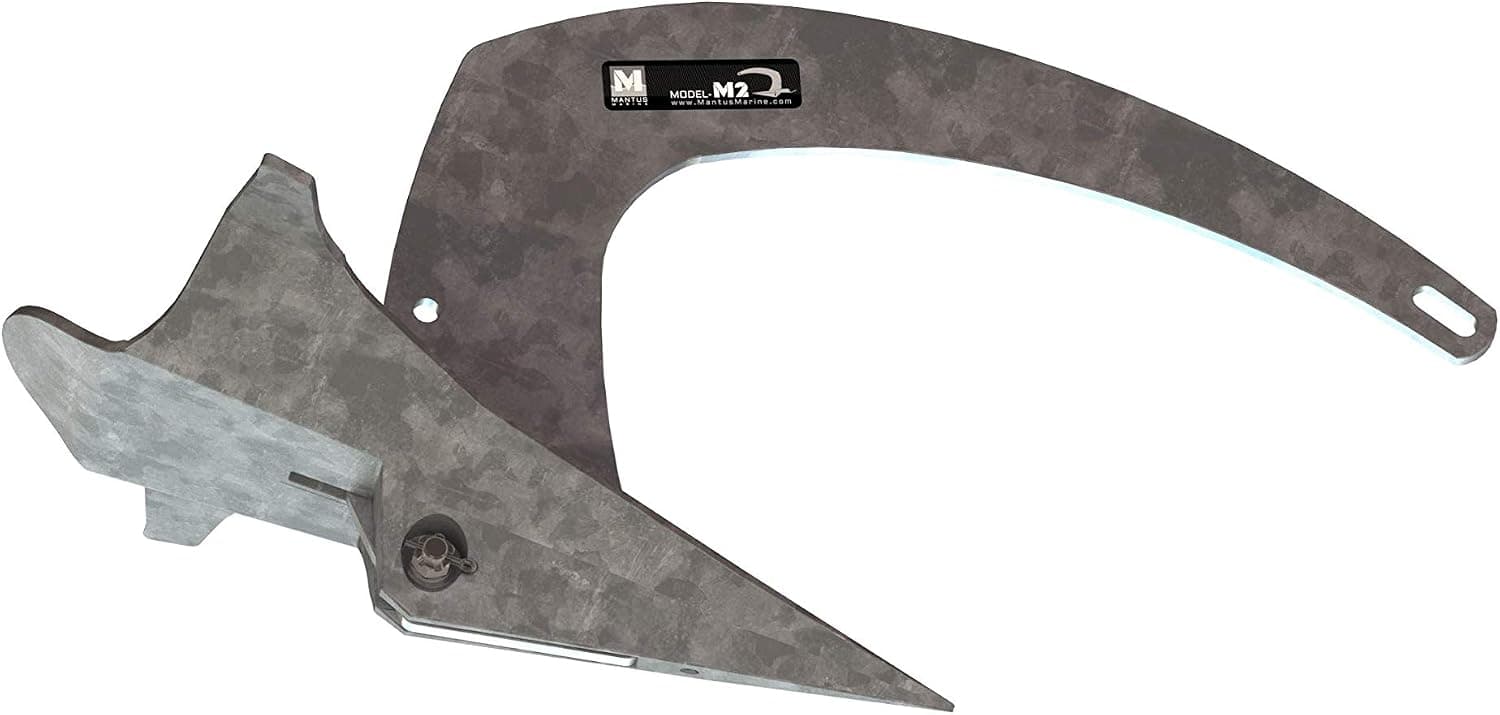
Mantus M2 Anchor, Galvanized, 8 lb
Mantus's anchor without a roll bar, which Mantus says fits boats with bow pulpits with slotted anchor housings, and bowsprits, better than its roll-bar M1. The listing's default is the 8 lb galvanized model. Mantus sizes by boat length and weight, then conditions, in day, cruising and storm columns, and says most cruisers should size from the cruising column and choose the larger anchor between two sizes. Mantus covers the galvanized coating on its anchors for 3 years from purchase.
View on Amazonpaid link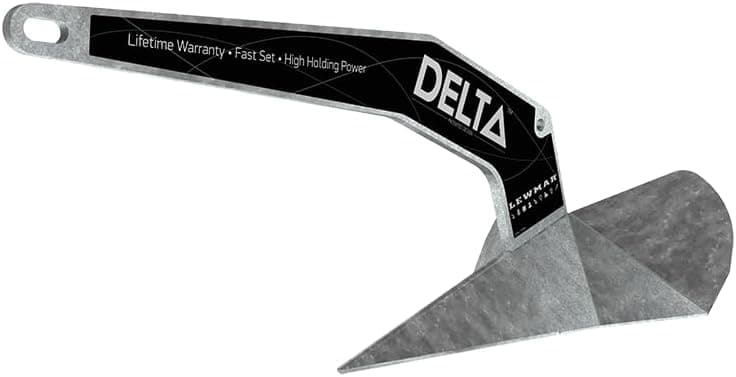 Lewmar · Deck Hardware
Lewmar Delta Anchor, Galvanized, 16 kg (35 lb)
Lewmar's galvanized Delta at 16 kg (35 lb); the listing gives part 0057416. Lewmar says the Delta delivers immediate penetration and dependable holding whether anchoring in sand, mud or gravel, and that it carries Lloyd's Register Type Approval. Lewmar's selection chart shows boat length by shading only, says to move up a model if in doubt, and says the information is for guidance only.
View on Amazonpaid link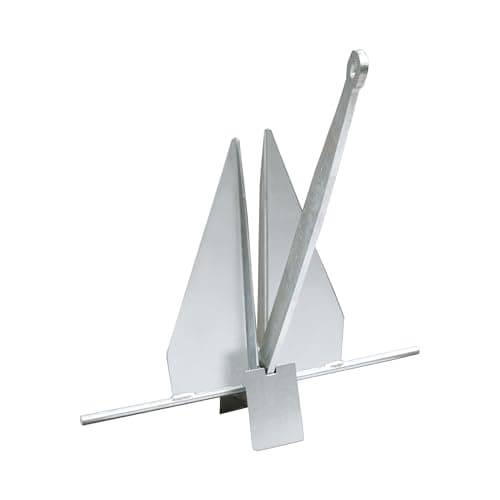 Danforth · Deck Hardware
Danforth Standard S600 Anchor, 9 lb
Danforth's Standard S600 (part 94012), a 9 lb anchor with two large triangular flukes, which Danforth lists for 17 to 27 ft boats, with 600 lb of holding power as Danforth states it; its boat sizes assume normal wind, average currents and at least 5:1 scope. Danforth says its flukes orient toward the seabed at a 32 degree angle for maximum holding in common sea bottoms such as hard sand, and that each anchor is hot dip galvanized.
View on Amazonpaid link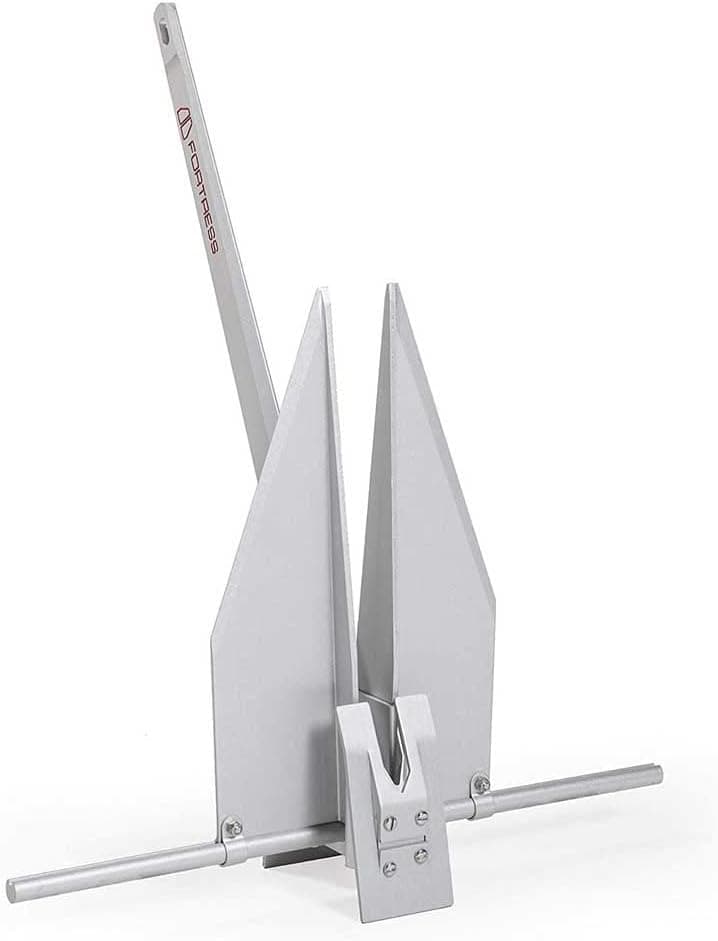 Fortress · Deck Hardware
Fortress FX-16 Anchor
Fortress's FX-16, made, as Fortress says of all its anchors, from a hardened aluminum-magnesium alloy. Fortress says its 45-degree fluke setting gives a superior hold in soft mud and silt, and sizes its anchors for boats of average windage and proportions in 30 knots of wind, average bottom conditions and moderate protection from open seas, one or two sizes larger for storm conditions. For rode it calls for three-strand nylon, at least 6 ft of chain for every 25 ft of depth and at least 5:1 scope.
View on Amazonpaid link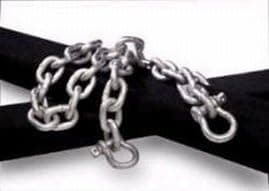 Danforth · Deck Hardware
Danforth Galvanized Anchor Chain with Shackles, 5/16 in x 6 ft (95135)
A 6 ft length of 5/16 in galvanized chain; the item includes two 5/16 in shackles, and Danforth lists the item at a working load of 1,900 lb. Danforth's page names no grade for it, so before running any chain through a windlass, find it in the windlass maker's gypsy table: Maxwell says chain not matched to the chainwheel can jump off the gypsy or jam in the chain pipe.
View on Amazonpaid link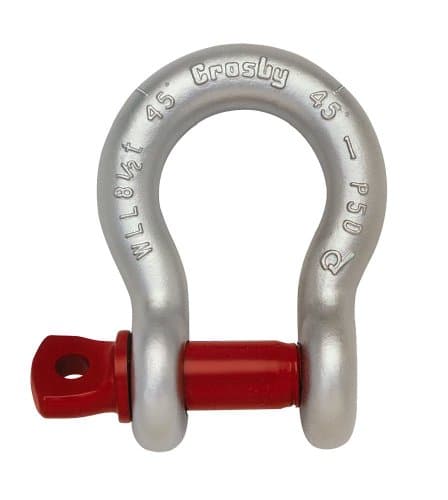 Crosby · Deck Hardware
Crosby G-209 Screw Pin Anchor Shackle, 5/16 in
Crosby's galvanized screw pin anchor shackle at 5/16 in, stock number 1018393: forged, quenched and tempered, with an alloy pin, and mechanically galvanized at this size. Crosby lists a working load limit of 0.75 (t) with a 6:1 design factor, says the limit is reduced for side loading, and shows the limit and Grade 6 permanently on every shackle. Crosby says the G-209 meets or exceeds all requirements of ASME B30.26.
View on Amazonpaid link
What this guide leaves out
Holding-power comparisons between anchor types, which no independent source we read gives; a chain grade or size for your windlass, which only your windlass maker's gypsy table can answer; a general rule for how much chain to put between anchor and rope; anchor chain retirement thresholds; snubbers and bridles at anchor; moorings; and heavy-weather anchoring technique. Go by the maker's chart for the anchor, and the windlass maker's table for the chain.
Sources
- 1.US Coast Guard — A boater's guide to the federal requirements for recreational boats, November 2023
- 2.33 CFR 83.30 — Inland Rule 30, anchored vessels and vessels aground (Cornell LII)
- 3.33 CFR 83.35 — Inland Rule 35, sound signals in restricted visibility (Cornell LII)
- 4.US Coast Guard Auxiliary — Boat crew qualification guide, coxswain (January 2007)
- 5.US Coast Guard Auxiliary Education Department — Anchoring (sample newspaper article)
- 6.ASTM A413/A413M-21 — Standard specification for carbon steel chain (abstract)
- 7.Rocna — Anchor sizing
- 8.Rocna — Fitment guide
- 9.Rocna knowledge base — Rocna sizing recommendations
- 10.Rocna — 2026 anchor range brochure
- 11.Mantus — Mantus anchors
- 12.Mantus — Anchor sizing guide
- 13.Mantus — Anchor shackles
- 14.Mantus — Swivel
- 15.Fortress — FAQs
- 16.Fortress — Anchor selection guide
- 17.Danforth — Danforth anchors
- 18.Danforth — The Standard
- 19.Danforth — Anchor kits
- 20.Danforth — Accessories
- 21.Lewmar — Delta galvanised anchor
- 22.Lewmar — Claw galvanised anchor
- 23.Lewmar — CQR galvanised anchor
- 24.Lewmar — Delta anchor selection chart (copy hosted by Defender)
- 25.Lewmar — V1 to V6 windlass manual
- 26.Lewmar — Pro-Sport windlass manual, 2019 (copy hosted by Defender)
- 27.Crosby — G-209 / S-209 screw pin anchor shackles, 2022 catalog page
- 28.Samson — Recreational marine line selection guide (2024)
- 29.New England Ropes — Packaged anchor lines
- 30.New England Ropes — Catalogue 2025
- 31.New England Ropes — Rope-to-chain anchor rodes
- 32.New England Ropes — 3-strand rope-to-chain splice
- 33.Seachoice — Anchor rode, 1/2 in x 300 ft 3-strand nylon, 1/4 in x 15 ft chain (50-44564)
- 34.Attwood — Catalog, anchor lead chain (page 104)
- 35.Peerless — ACCO BBB chain
- 36.Peerless — ACCO G30 domestic proof coil ISO chain
- 37.Peerless — ACCO G43 domestic high test ISO chain
- 38.Peerless — ACCO G70 ISO chain
- 39.Peerless — Grade 30 proof coil chain, domestic (NACM)
- 40.Peerless — G70 binder chain assembly, import (NACM): pitch defined
- 41.Campbell — Chain and fittings catalog, 2026
- 42.Campbell — Grade 43 high test chain, hot galvanized, 1/4 in drum (T0180432)
- 43.Campbell — Chain catalog (c. 2003)
- 44.Maxwell — FAQ
- 45.Maxwell — Winch safety and maintenance
- 46.Maxwell — Service agent reference manual, V5
- 47.Quick — Prince DP3 vertical windlass
- 48.Quick — AL3 series windlass manual, REV 000A
- 49.Quick — DP1 windlass manual, REV001B
- 50.Imtra (Lofrans' US distributor) — Lofrans chainwheel chart (copy hosted by Defender)
- 51.Lofrans — X2 vertical windlass, dark version